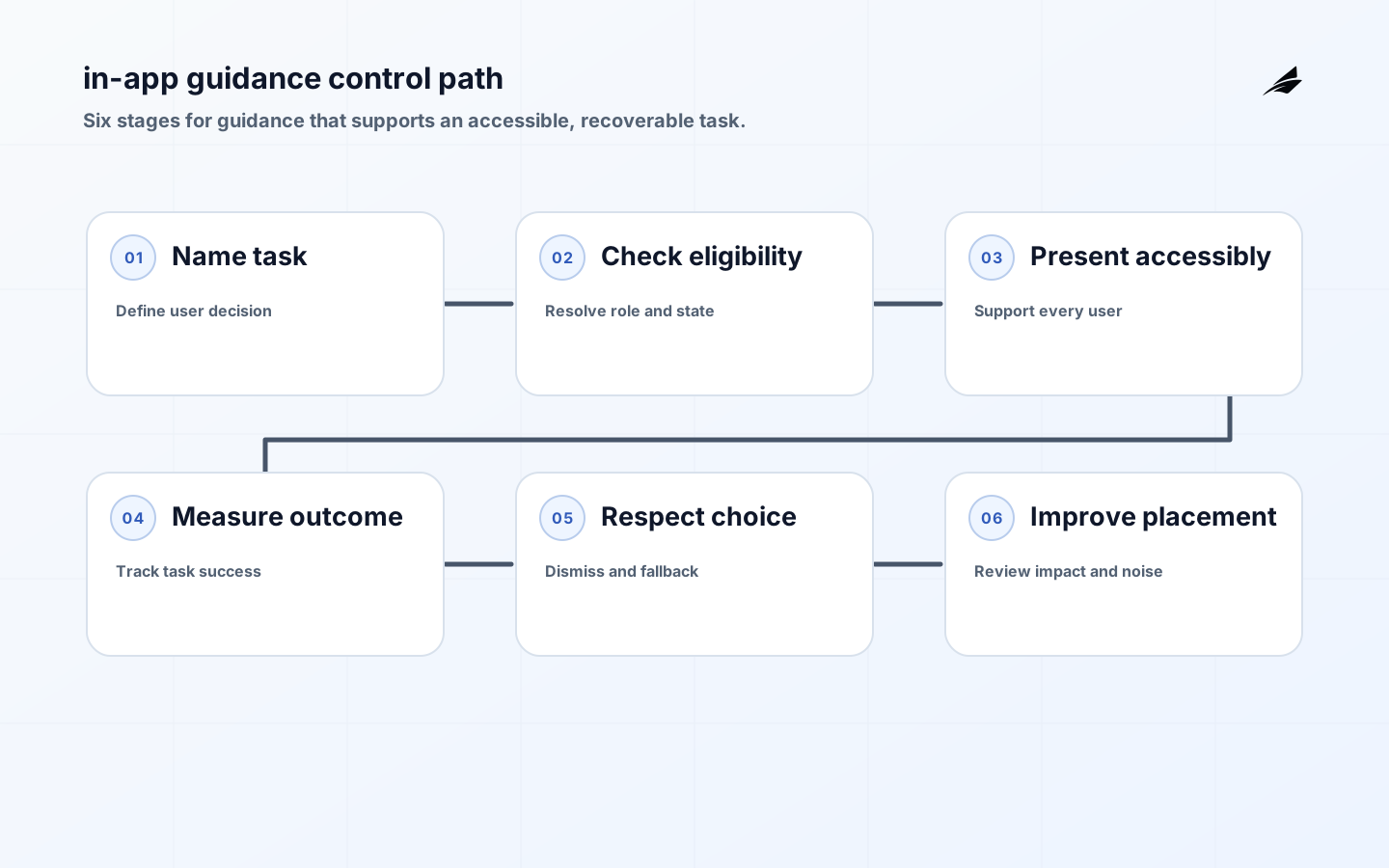
In-app guidance is product behavior: it changes what a user notices, understands, and chooses to do. Before building a tooltip, checklist, banner, or assistant, define the user decision, the eligibility rule, the permission boundary, the accessible presentation, and the outcome that would justify the interruption. Good guidance arrives with enough context to help and enough restraint to avoid becoming noise. It also has a safe fallback when the underlying product state is incomplete.
Define the in-app guidance decision before choosing a mechanism
Write the guidance decision contract before selecting delivery components. In in-app guidance, name the subject, resource, action, authority, effective time, policy version, result, and behavior when a required fact is unknown. The decision is which guidance a person sees in context and whether it helps complete the next safe action; the authority is a versioned guidance rule based on explicit product state, role, permissions, and prior completion. This turns a vague requirement into something product, engineering, finance, and support can review together — for the guided task. Give each consequential rule an owner, and retain a reason code with its result — at the eligibility boundary. That makes it possible to explain an outcome safely to a customer and to replay an edge case without reconstructing intent from disconnected tickets — when a user dismisses help.
| Decision question | Concrete rule | Evidence to retain |
|---|---|---|
| What is affected | which guidance a person sees in context and whether it helps complete the next safe action | Subject, resource, and correlation identifier. |
| Which fact decides | a versioned guidance rule based on explicit product state, role, permissions, and prior completion | Source version and effective time. |
| What happens when unsure | Choose pending, deny, or review deliberately. | Reason code and next action. |
| Who can repair it | Use a scoped, expiring, auditable path. | Actor, approval, and repair result. |
Model in-app guidance state and time explicitly
A dependable in-app guidance implementation makes lifecycle visible rather than inferring it from whichever field changed last. Use states such as proposed, reviewed, eligible, shown, completed, dismissed, expired, and retired. Store transition reason, actor or source, event time, processing time, idempotency identifier, and policy version alongside the current status — during an accessibility review. Then decide the ordering rule: an old fact must not overwrite a newer one, while a duplicate delivery should be harmless — inside the fallback path. This is where product language becomes practical test cases: create, change, retry, cancel, restore, and investigate — after a permission change. The history gives a support colleague an explanation and gives an engineer a path to reproduce the exact transition — for the support journey.
Enforce in-app guidance at consequential boundaries
Do not let one prompt controller or screen become the only enforcement point for the guided task. Inspect context evaluation, rendering, accessibility, completion events, frequency limits, and experiment analysis. Resolve the necessary context at a trusted edge, pass it deliberately, and enforce the same decision again where data, access, money, or customer communication changes — before exposure expands. Persist inbound facts before expensive work, deduplicate with durable keys, and make side effects idempotent — during a keyboard test. Server-side enforcement still matters when a client has hidden an option — across user cohorts. NIST Secure Software Development Framework and OWASP Authorization Cheat Sheet are helpful reference points for turning controls into repeatable engineering practice — for the guided task. The goal is not ceremony; it is ensuring an overlooked asynchronous path cannot silently become a different policy — at the eligibility boundary.
| Path | Implementation choice | Failure contained |
|---|---|---|
| Interactive action | Evaluate the authoritative rule on the server. | Forged, stale, or incomplete client context. |
| Asynchronous event | Persist, validate, deduplicate, then process. | Duplicate delivery and out-of-order updates. |
| Operator repair | Require scope, purpose, expiry, and audit trail. | Silent or permanent exception. |
| Reporting and export | Apply the rule before query and delivery. | Correct product view but incorrect downstream data. |
Plan the Fallback for a Guided Journey
The failure story worth rehearsing is concrete: a prompt covers a control without its consequence, or a repeated tour blocks experienced users from work. Define who detects it, what the system must stop doing, what evidence a responder needs, and how a corrected decision is replayed without causing a second side effect — when a user dismisses help. Prefer a pending or restricted result when an irreversible effect depends on unverified evidence — during an accessibility review. A reconciliation job should compare authoritative inputs with the internal decision record and produce owned work, not a silent discrepancy on a dashboard — inside the fallback path. Support needs a safe repair path, engineering needs correlation across the event chain, and customers need a next step — after a permission change. A reason code and audit event let product, support, and engineering compare the same guidance outcome.
Measure in-app guidance outcomes, not activity
Choose measurements that show whether in-app guidance serves the actual customer decision. Start with completion after guidance, dismissal rate, repeat exposure, accessibility defects, support evidence, and task time. Segment by plan, tenant, journey, or release only when that view changes action — for the support journey. Pair a leading signal, such as a growing backlog or processing delay, with a customer outcome such as a failed task or repeated support contact — before exposure expands. Review the measures with the people able to change policy, code, and support practice — during a keyboard test. A guidance metric without an owner and response rule is only decoration. Likewise, a fast but incorrect automatic result is not progress just because the activity count improved — across user cohorts.
Deliver in-app guidance in thin, testable slices
Start with one supported journey, one authoritative input, one auditable decision, and one recovery procedure — for the guided task. Add variation only after normal, duplicate, delayed, denied, and repair paths are demonstrated — at the eligibility boundary. The first release needs realistic fixtures, contract checks around inbound data, and a short runbook naming what responders may safely do — when a user dismisses help. Keep guidance planning tied to task evidence instead of feature labels. Read the in-app guidance architecture guide, the adjacent engineering guide, and a related operating guide to connect this narrow decision to the wider product system without losing focus.
Practical Takeaways for In-App Guidance
- Define in-app guidance as a decision with a subject, authority, time, result, and safe unknown-state behavior.
- Keep the transition history needed to explain and replay important outcomes.
- Apply the rule to interfaces, background work, exports, and operator tools.
- Instrument recovery and customer outcomes before expanding the supported surface.
- Review exceptions as product evidence rather than informal permanent configuration.
In-app guidance FAQ
What should be decided before implementation? For in-app guidance, decide the authoritative input, lifecycle states, and behavior for missing, late, and duplicated facts. That prevents a dashboard, a provider callback, or a client-side condition from quietly becoming policy — during an accessibility review.
When is the first version ready to broaden? For in-app guidance, expand when the team can demonstrate normal and exceptional paths, reconcile authoritative records, repair a mistake safely, and explain a real customer outcome from retained evidence.
How should in-app guidance behave when a user dismisses it?
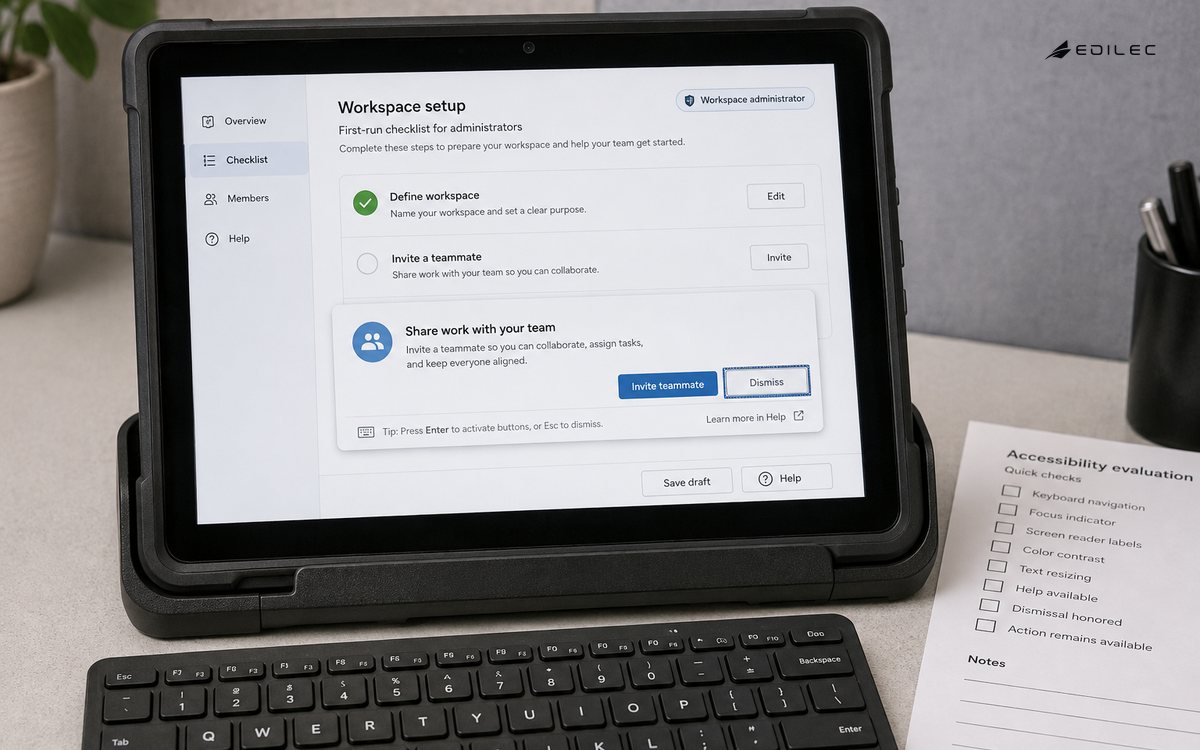
Record the dismissal, honor it for the defined lifecycle, and show the guidance again only when a materially changed task justifies a clear, accessible prompt.
Make guidance a controlled product behavior
An onboarding example
Consider a first-run checklist for a workspace administrator. Show a step only when the user has the required role, the workspace is in the right state, and the action remains available. The message should explain why the step matters, expose the next action, support keyboard and assistive-technology use, and remain understandable if the underlying request is delayed. Record exposure, dismissal, completion, and error without storing unnecessary personal detail. If a user dismisses the prompt, preserve that choice and define when a materially changed task may be shown again.
Signals That Guidance Is Helping
Review completion quality rather than impression count. Useful signals include task success, repeat exposure, dismissal rate, time to action, support contacts, accessibility defects, authorization denials, and errors after a prompt is followed. Compare a guided cohort with a reasonable baseline when the decision is safe to test. A high completion rate can still be poor guidance if it leads users to the wrong setting or creates avoidable support work. Make the stop condition explicit before expanding placement or frequency.
- Tie every message to one user decision and one eligible state.
- Resolve permissions on the server and reflect denied states clearly.
- Design for keyboard, zoom, contrast, and assistive technology.
- Measure the outcome of the task, not only the visibility of the message.
- Provide dismissal, fallback, and correction paths.
Accessibility and Secure Delivery References
Use W3C Web Content Accessibility Guidelines, WAI-ARIA Authoring Practices Guide, NIST Secure Software Development Framework, OWASP Authorization Cheat Sheet as reference points for the control, data, accessibility, security, or operating semantics relevant to this decision. These references frame accessibility and authorization controls; the guidance contract decides the supported journey and fallback. They help the team name assumptions, choose evidence, and make a review concrete enough that another person can verify what the system is expected to do — inside the fallback path.
Related Guides for Product Guidance
For adjacent decisions, continue with In-app Guidance: Hands-on Planning Guide, Product Analytics: Build Decision-Grade Evidence, Not an Event Warehouse, Onboarding Flows: Engineering a Safe Path to First Value, then compare the definitions, ownership boundaries, and recovery behavior before widening the implementation.
A final quality check is to follow a user who cannot complete the suggested task. The interface should explain the current state, preserve the user’s work where possible, and point to a supportable next action. That fallback is part of the guidance design because it determines whether a small product failure becomes confusion, abandonment, or a recoverable outcome.
Conclusion
In-app guidance becomes dependable when the product promise and engineering mechanism describe the same decision. Start narrow, make authority and state visible, enforce the rule at every consequential boundary, and rehearse recovery — after a permission change. This gives teams room to evolve the experience without losing the ability to explain, correct, and improve it — for the support journey. For this topic, the practical test is whether guidance competes with the work it is intended to help, so context and restraint matter. Keep guidance rule distinguishable from a convenient but weaker signal, then make rendering service show both the present result and the evidence behind it. During a limited rollout, deliberately test the paths that production will eventually deliver: repeated messages, stale context, denied actions, partial dependency failure, and an operator-led repair — before exposure expands. Record what a user sees, what a responder sees, and which action safely returns the workflow to normal — during a keyboard test. Those details prevent a support workaround from silently becoming part of the product contract — across user cohorts. The operating review should ask a short set of questions. Did the policy produce the expected retirement? Can a person understand the next safe action without internal access? Did monitoring reveal the problem before customers had to explain it? Is the exception temporary, owned, and easy to remove? Answers should result in a small change to policy, software, documentation, or measurement, with a named owner and an agreed review date — for the guided task. That rhythm keeps in-app guidance grounded in actual outcomes rather than the optimism of a first release. Before expanding scope, put one real outcome from in-app guidance through a review with product, engineering, and the team that handles exceptions. Compare the intended rule with the recorded evidence and with the customer-facing explanation — at the eligibility boundary. Where those differ, simplify the policy or expose the missing state; do not ask people to memorize a hidden exception — when a user dismisses help. This small discipline is also how the system stays maintainable when new plans, roles, integrations, or delivery teams arrive — during an accessibility review.