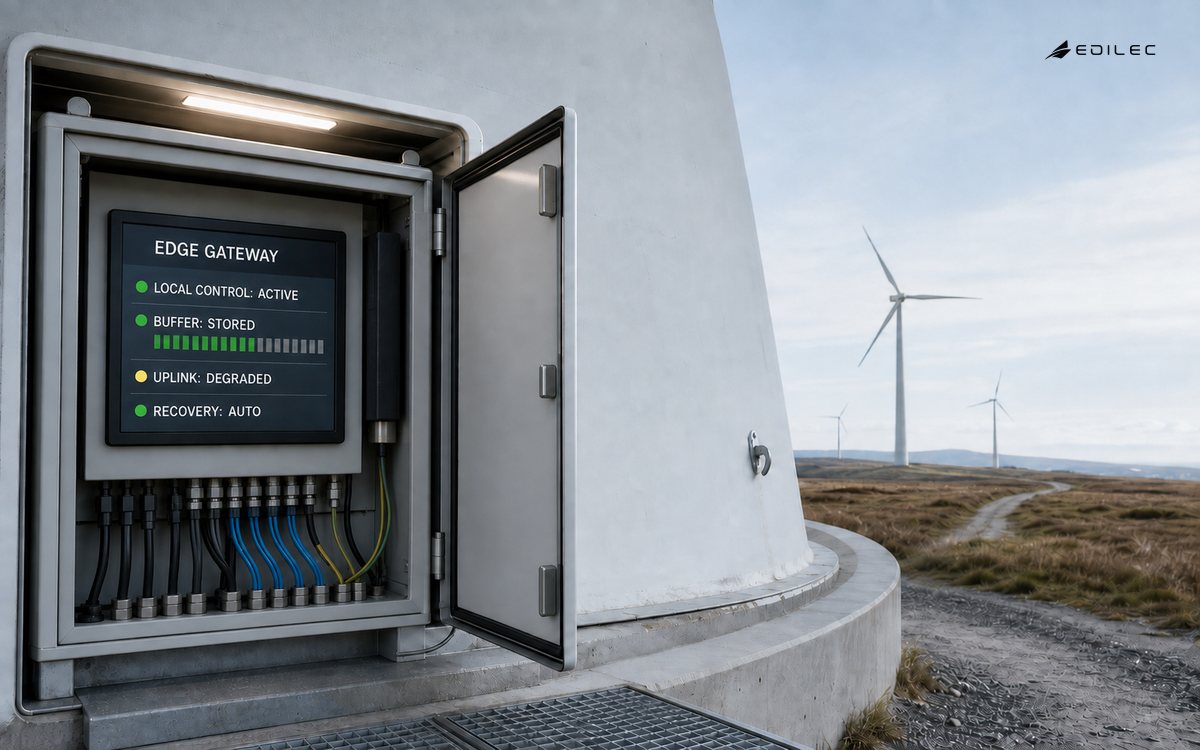
Edge gateways matter to engineering teams integrating local equipment, devices, and cloud services across unreliable networks. In practical terms, it is computing systems positioned near devices that collect local data, translate or aggregate protocols, enforce local policy, and exchange selected information with upstream services. That definition is more useful than a product label because it points to decisions a team can test: what the boundary is, what information is trusted, which failure conditions are acceptable, and who responds when the normal path breaks. The related concerns of protocol translation, offline buffering, gateway security should be designed as part of the operating model, not appended after an initial launch.
What edge gateways means
Edge gateways should be explained in the language of responsibilities and observable behaviour. A gateway is not automatically the source of truth or a place to hide every application function. It exists because local timing, connectivity, protocol diversity, privacy, or safety needs require computation close to devices. Its responsibilities should be bounded so that a failed or compromised gateway cannot silently redefine the whole system. A useful definition therefore includes the information that crosses the boundary, the actors allowed to change it, the evidence retained, and the conditions in which the system refuses to proceed. That gives practitioners a way to challenge vague requirements before they become fragile implementation assumptions.
Architecture decisions to make first
The architecture is not a diagram of components alone. It is the set of contracts that lets engineering teams integrating local equipment, devices, and cloud services across unreliable networks operate the capability repeatedly. Make the following decisions explicit before choosing a platform feature or writing an integration. Each one affects the likely failure mode, the test plan, and the people who will need evidence later.
| Decision | What to define |
|---|---|
| Local responsibility | Specify which data collection, validation, buffering, control, and user functions must continue locally. |
| Protocol boundary | Document device protocols, mappings, error translation, and ownership for every adapter. |
| Offline policy | Define what is buffered, for how long, how it is prioritised, and what happens when storage fills. |
| Remote management | Plan identity, signed updates, configuration versioning, rollback, and observability from day one. |
Implementation path
- Map local devices, network paths, physical constraints, and failure consequences.
- Separate device adapters from business rules and upstream integration clients.
- Use durable queues and identifiers to support replay without corrupting downstream state.
- Apply least privilege between gateway services, device interfaces, and remote management.
- Sign and verify software or configuration updates, with a tested rollback route.
- Test network loss, clock drift, storage pressure, duplicate upload, and partial update scenarios.
Build a thin, inspectable path first. It should include the unpleasant cases as well as the demonstration case: a missing identifier, a delayed message, an expired credential, a rejected record, or an unavailable dependency. Give that path named inputs and outputs, a clear retry or escalation rule, and a way to prove what happened. This is where protocol translation becomes operational rather than aspirational.
Risks and controls
Gateways concentrate trust: they can see device networks and often hold credentials for upstream services. Keep secrets in protected storage, use mutual authentication where supported, and avoid a shared fleet credential. Remote management needs the same discipline as production deployment: identify the target, verify the artifact, record the intended version, and prove the device returned to a healthy state.
| Operating signal | What it shows |
|---|---|
| Offline continuity | Local functions completed or buffered during planned connectivity-loss tests. |
| Backlog age | Age and volume of queued outbound records by gateway. |
| Update success rate | Verified update completion, rollback frequency, and post-update health. |
| Gateway fleet inventory accuracy | Known identity, version, configuration, and location for active gateways. |
Review and measurement
Measurement should tell the team whether edge gateways is still meeting its contract, not merely whether infrastructure is running. Review the signals in the table with the owner who can change the workflow. Look at trends, samples of failures, and the gap between detected and resolved issues. When a metric changes, follow the evidence back to the contract, implementation version, and real user or device behaviour before declaring a fix.
- Set a service objective for the consequence that matters, not only a technical average.
- Sample successful and failed cases to verify that offline buffering is understandable.
- Make a named owner responsible for triaging exceptions and publishing the resolution.
- Review access, configuration, and retention choices whenever the process or fleet changes.
- Use controlled tests to rehearse recovery before an incident requires improvisation.
Operational scenario
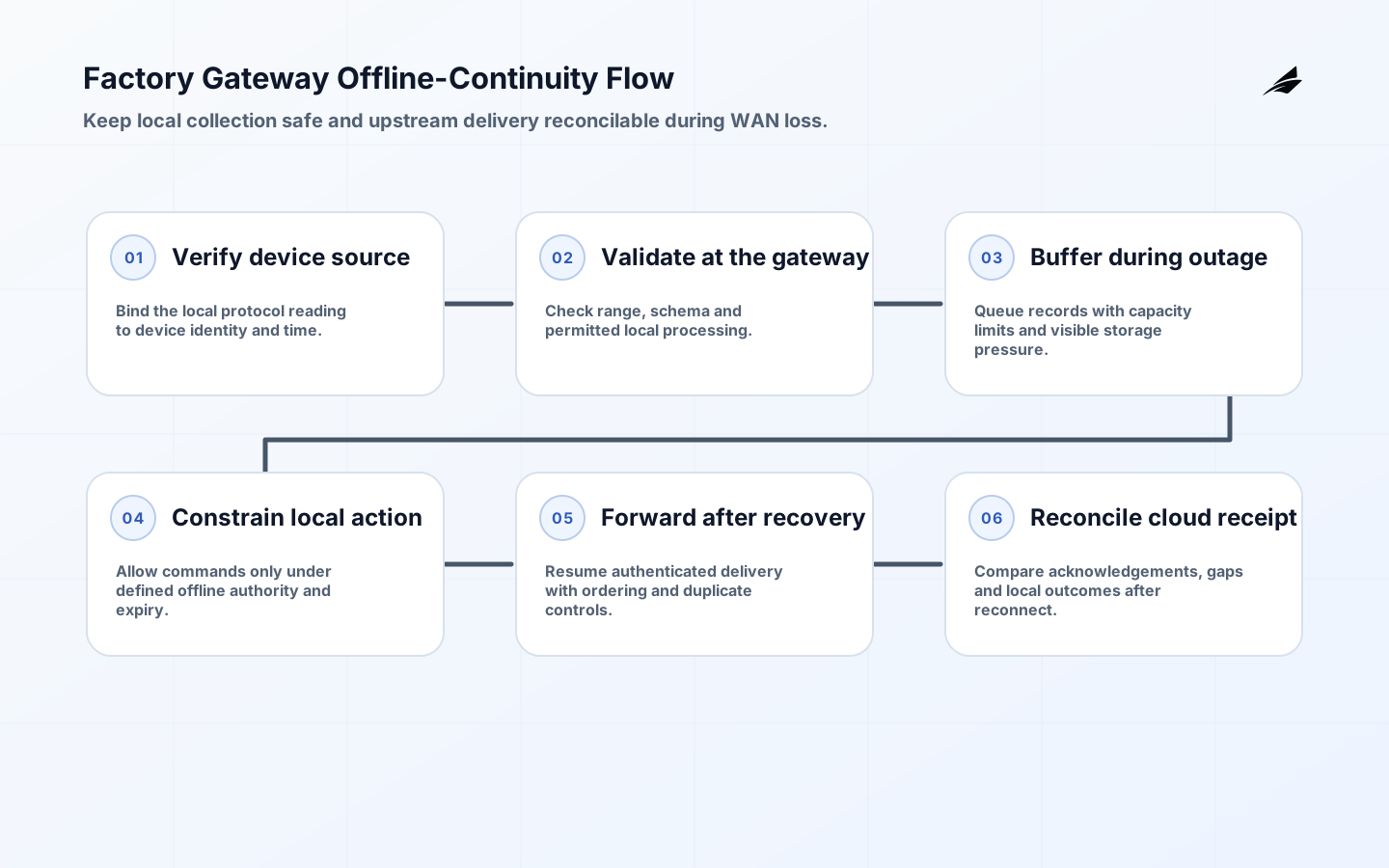
A factory gateway reads a local industrial protocol, buffers readings during a WAN outage, and forwards selected data to a cloud service when connectivity returns. It may also host a local operator page. Those jobs have different availability and trust requirements. The gateway should not become an unreviewed miniature cloud platform. Keep adapter logic, queueing, local display, and remote management boundaries visible, then test them under the actual site constraints that motivated edge computing.
Evidence and testing
Build a site acceptance test that covers power restart, network loss, upstream certificate expiry, queue saturation, local-device disconnect, configuration rollback, and a failed software update. Record expected local behaviour and recovery evidence for every case. Track device identity, hardware variant, software version, configuration version, and last health report in a fleet inventory. This is the evidence required to answer whether a site is safely operating, rather than merely whether an endpoint was recently reachable.
Design review questions
In a design review, identify every trust relationship the gateway holds: device protocol credentials, operator access, remote management, update signing, and cloud service access. Ensure a compromise in one does not automatically unlock the others. Ask how a technician verifies an update at a remote site, how a device is replaced without reusing credentials, and what data remains local when the site is decommissioned. These lifecycle questions prevent a robust prototype from becoming an unmanaged field dependency.
Practical operations
Before field deployment, create a gateway commissioning checklist that a technician can perform without privileged improvisation. It should verify physical identity, network attachment, approved configuration, time source, device-adapter health, remote-management enrolment, and the first successful upstream exchange. Capture these outcomes in a central inventory. A repeatable commissioning record makes later support safer because a team can compare current state with a known starting point instead of guessing which local settings were changed during installation.
Limits and tradeoffs
Edge deployments trade central simplicity for local resilience and control. Every local function adds a patching, observability, and recovery responsibility at many sites. Keep the gateway focused on the work that needs proximity, and move fleet-wide policy or long-term analysis upstream when connectivity permits. When a local decision can affect safety, money, or a physical process, define the allowable state, expiry, and human override explicitly. A resilient edge system is one that degrades predictably, not one that attempts to do everything alone.
- Name the accountable owner before adding another integration or policy.
- Keep a representative failure test beside the normal acceptance test.
- Record the version of the contract, configuration, or rule in use.
- Use evidence from real operations to improve the next release.
- Make temporary exceptions visible, approved, and time-bounded.
- Review the boundary whenever the business process or fleet changes.
Adoption and change management
Site commissioning, degraded connectivity, hardware replacement, and remote incident response are the moments when gateway responsibilities must be clear. Prepare for them with a small change record that names the proposed change, contract or policy version, expected operational effect, affected owners, test evidence, rollout window, and reversal decision. Give users and support teams a plain-language explanation of the behaviour that will change, especially where a new denial, warning, or data-quality status can be mistaken for a defect. Monitor the first production cases closely and compare them with the pre-change baseline. When an exception appears, decide whether it is a valid new requirement, a training issue, a data defect, or a control that must remain firm. This practice keeps edge gateways connected to the people who operate it. It also prevents a series of urgent local fixes from becoming an undocumented alternate system. Retire obsolete rules and integrations deliberately, preserve the evidence needed for a later review, and update runbooks so the next team member inherits a working explanation rather than a collection of historical assumptions.
Key takeaways
- Edge gateway design is a contract between technical components, people, and operations.
- Define boundaries and ownership before optimising a tool or interface.
- Treat offline buffering as a first-class output, with evidence for failure and recovery.
- Make exceptional conditions testable and visible to an accountable owner.
- Revisit the contract as customers, devices, data, or regulations change.
Frequently asked questions
When is an edge gateway necessary?
Use one when local protocol integration, low-latency control, offline continuity, data reduction, or site-specific policy cannot be met reliably by direct device-to-cloud communication. Do not add a gateway merely to duplicate cloud services without a clear local responsibility.
Can a gateway send commands while offline?
It can, if the command is permitted by a defined local policy and required state is available. This needs careful safety analysis, local authorisation, expiry rules, and a reconciliation plan once connectivity returns.
Conclusion
An edge gateway should make a connected system more resilient, not more mysterious. Give it explicit local duties, secure lifecycle management, and failure tests that cover the physical network conditions it will actually face. Reconfirm those responsibilities whenever a site, protocol adapter, or remote-management route changes. Keep site commissioning and fleet records current so later changes do not turn into untraceable local exceptions.