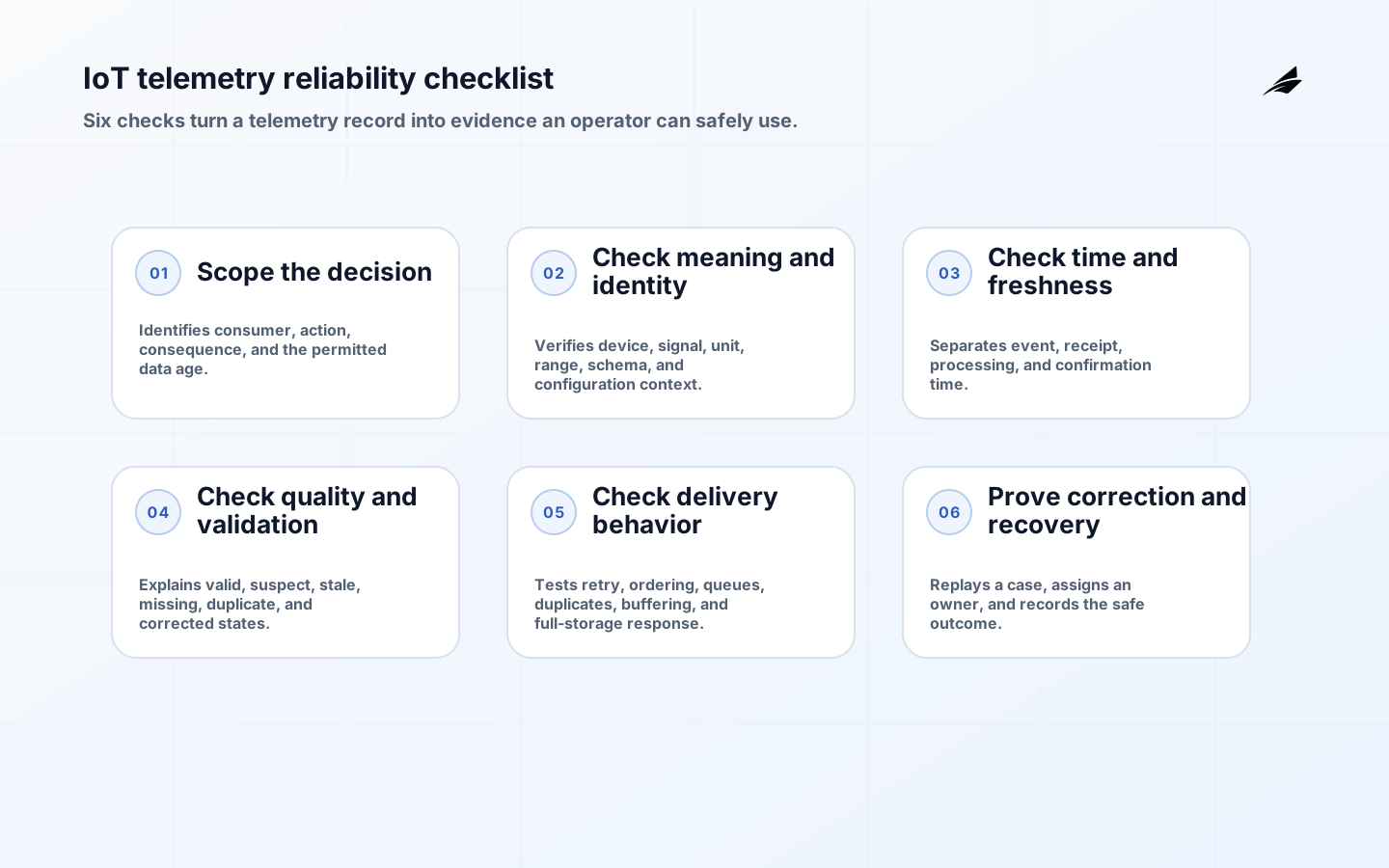
Reliable digital operations need telemetry that remains interpretable through late packets, missing devices, schema changes, and pressured human decisions. The practical test is simple: can an operator tell whether a signal is current, trustworthy, and relevant to the action in front of them? This checklist turns the question into decisions about scope, identity, time, quality, access, retention, and recovery. NIST's IoT capability catalog and OpenTelemetry's documentation offer technical reference points; the checklist connects them to operating work.
Scope the decision and service
Write the decision first: detect, classify, forecast, dispatch, verify, or control. Name consumer, action, acceptable delay, and impact of error. List device, gateway, network, broker, processing, dashboard, and human handoff. Exclude signals that do not change a decision or give them lower priority. A narrow scope lets the team test reliability rather than count integrations.
Include normal, maintenance, connectivity loss, replacement, and correction. State what the operator sees and what the system stops doing when evidence is missing. This is where a checklist exposes decisions an architecture diagram leaves implied.
Check identity, units, and meaning
Every signal needs stable device and signal identity, unit, range, precision, and description of physical or business quantity. Record location and configuration as effective-dated context. Do not rely on a dashboard label to explain whether a value is ambient temperature, product temperature, or a derived estimate.
Ask whether a field means the same across models and sites. If not, version the contract or separate signals. Validate representative payload with firmware, platform, data, and operations. The IoT telemetry guide provides shared language.
| Checklist area | Pass condition | Evidence |
|---|---|---|
| Decision | Consumer and action are explicit | Outcome and owner |
| Meaning | Identity, unit, context, quality are clear | Contract and fixtures |
| Time | Event, receipt, freshness, late policy defined | Timestamp tests and UI behavior |
| Access | Read, export, command, change bounded | Role map and audit |
Check time and freshness
Define event time, receipt time, timezone, clock confidence, cadence, late-data policy, and current-state cut-off. A value received now may describe an hour-old event. Keep both times and expose age. Freshness should reflect decision: a trend may tolerate delay while protective action may not.
Test clock skew, timezone changes where relevant, offline bursts, and out-of-order events. Decide whether late data updates current view, history, or neither. Preserve policy so a future analyst knows why an old value was accepted or excluded.
Check quality and validation
Use explicit quality states and reasons. Range, rate-of-change, cadence, cross-sensor, battery, signal, and maintenance checks can inform quality, but none should hide original observation. Keep rule versions and effective times. A quality flag should change what a person may safely do.
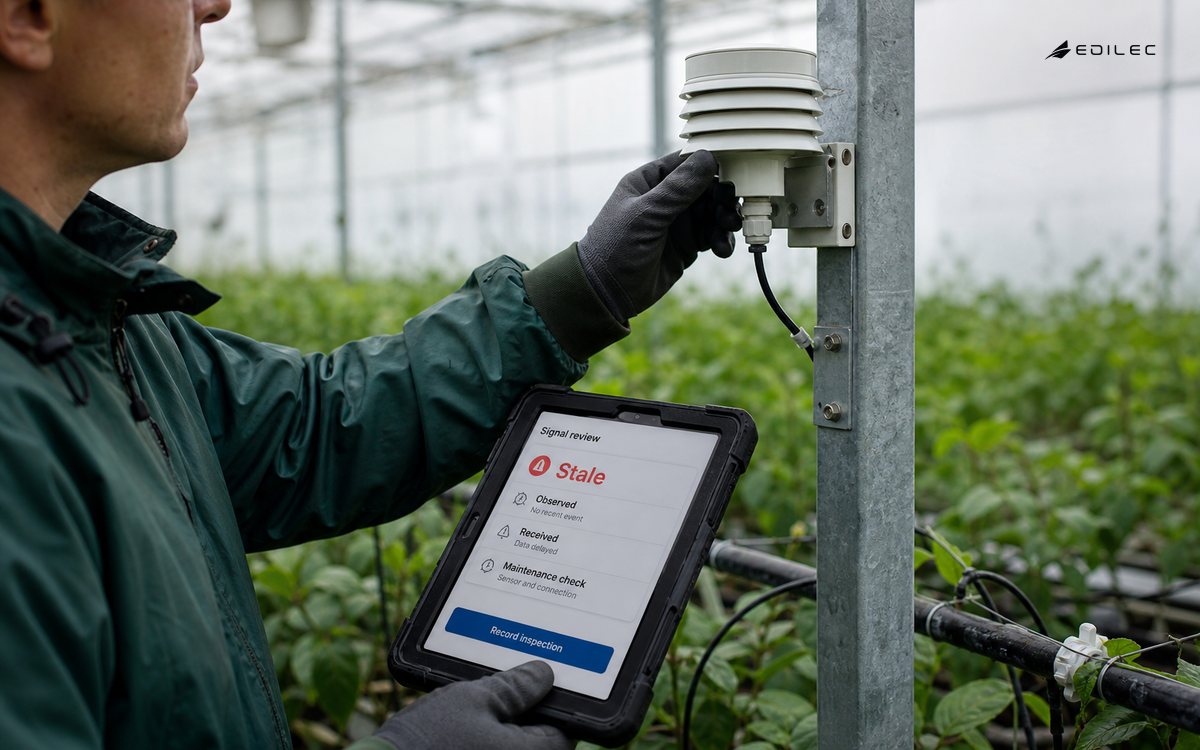
Create fixtures for impossible values, missing fields, duplicates, unit changes, corrupted payloads, and sensor under calibration. Make quarantine owned and observable. If bad data enters a customer record, define correction and communication rather than relying on someone to notice a changed chart.
Check delivery and buffering
Define authentication, message size, retry, backoff, duplicate identity, ordering, queue capacity, and full-storage behavior. The MQTT 5.0 standard can guide protocol choices, while business rule decides late or duplicate effect. Do not make at-least-once transport look exactly-once business behavior without idempotency.
Test intermittent coverage, gateway reboot, broker outage, full storage, duplicate replay, and reconnection. Show queue age and loss explicitly. If device can continue safe local action, document it; if it must stop, make it visible to field team.
| Test case | Expected behavior | Record |
|---|---|---|
| Missing device | Stale or unknown state visible | Last confirmed time and owner |
| Duplicate packet | One business result; source preserved | Event ID and dedupe rule |
| Schema change | Reject or version at boundary | Compatibility result |
| Correction | Original, reason, impact traceable | Before/after and approval |
Check access and boundaries
Telemetry exposes location, production behavior, customer activity, and security posture. Define who may view raw, curated, identity, site mapping, and export. Separate site or tenant access and log material changes. NIST's OT guidance is relevant when telemetry supports physical or safety-sensitive operations.
Restrict command and configuration rights separately from read access. Use service identity at each boundary and verify authorization where action occurs. Record why a user accessed or changed a sensitive record when required. Keep retention aligned with purpose rather than collecting everything.
Check observability and ownership
Instrument ingestion and transformation with traces, metrics, and logs, then add device, signal, time, quality, and contract version. OpenTelemetry's collector concepts help separate receipt, processing, and export, but operations still needs an owner for stale signals, rejected messages, and replay.
Create a small review dashboard: critical freshness, missing-device rate, invalid, duplicate, queue age, correction volume, and unresolved exceptions. Put owner and response beside each. If nobody can act on a measure, remove or downgrade it. Review trends with field and support teams.
Check correction and recovery
Define how to pause publication, preserve source, correct a reading, replay a bounded interval, notify users, and verify downstream results. Correction identifies original, new result, reason, rule or calibration context. Replay should be idempotent and observable.
Run recovery with bad firmware, missing gateway interval, changed unit, and late burst. Confirm the team can explain known, uncertain, and corrected. Link to sensor data pipelines and production telemetry when the checklist becomes a service standard.
A telemetry checklist scenario
Turn each checklist item into a release question. For example: can an operator identify a stale reading without opening raw logs; can a duplicate event produce only one work item; can a schema change be rejected safely; can support explain a correction? Give the question a test owner and expected evidence. This keeps the checklist executable and prevents a green status from meaning only that a document exists.
Use a critical-signal inventory rather than treating every telemetry field equally. Mark which signals drive safety, customer communication, maintenance, billing, or trend analysis. Give those signals stricter freshness, quality, access, and recovery rules. Lower-risk signals can use cheaper retention and less frequent review. Risk-based scope keeps a growing system maintainable.
Review the checklist at every boundary where meaning can change. A device can change units, a gateway can add a correction, a broker can duplicate delivery, and a dashboard can hide quality. The owner of each boundary should be able to show the contract and a negative test. This is how reliability survives organizational handoffs.
Make failure evidence available to the people who can improve the system. A platform team may need queue and rejection details; a field team may need device age, signal, and power context; an operations lead may need affected work and customer impact. Use role-appropriate views that share a common event identity and timeline.
Retention and deletion belong on the checklist. State what raw telemetry, normalized data, quality decisions, corrections, and access events must remain available, for how long, and to whom. Revisit the rule when purpose, contract, site, or regulation changes. A retention decision that nobody can explain becomes a risk during the first investigation.
Close a checklist review with a disposition, not just a score. Record pass, fail, accepted risk, deferred work, owner, due date, and scope. Reopen the item when evidence changes. The discipline turns a static checklist into a lightweight control loop for digital operations.
Make each checklist item a release question. Can an operator identify a stale reading without raw logs; can a duplicate event produce one work item; can a schema change be rejected safely; can support explain a correction? Give each question an owner and evidence. This keeps the checklist executable rather than documentary.
Use negative tests as first-class evidence. Submit a wrong unit, expired credential, duplicate event, late packet, malformed payload, unauthorized export, and command to the wrong site. Each test should have a safe result, a human-readable reason, and a record of what the team did next.
Measure checklist effectiveness through incidents and exceptions. If the same item fails repeatedly, improve the control or change the operating scope rather than adding prose. A useful checklist shrinks uncertainty and directs effort to the boundary that needs attention.
Keep an accepted-risk record for gaps that cannot be fixed immediately. State affected devices or signals, compensating control, owner, expiry, and trigger for reassessment. This is more honest than marking the checklist complete while relying on an undocumented assumption.
At expansion review, compare the checklist against the new device class, site, or consumer. Reuse stable tests but add cases for new units, time behavior, storage, or access. The checklist should grow with real risk, not with every implementation detail.
Close the loop with a short operational summary: what passed, what changed, what remains uncertain, and who decides next. That summary gives leaders a clear basis for funding, sequencing, or limiting further telemetry work.
A checklist is strongest when its evidence is easy to retrieve. Link each pass or accepted risk to a contract version, test run, dashboard behavior, or recovery record. When a boundary changes, reviewers can see what remains valid and what needs to be rerun instead of assuming that an old approval still applies.
Use NISTIR 8259A to check whether device capabilities support the telemetry assumptions in this checklist, especially identification, data protection, software update, and cybersecurity state awareness.
Key telemetry checklist takeaways
- Begin with the operational decision and acceptable delay.
- Make meaning, identity, time, quality, and access testable.
- Design buffering, duplicates, and schema changes before rollout.
- Keep corrections and replays bounded, attributable, visible.
- Review metrics with the people who act on them.
Frequently asked telemetry checklist questions
How should a team use this checklist?
Use it at discovery, design review, pilot acceptance, and major change. Each item should have owner, evidence, and disposition; a checklist is useful only when it changes a release or operating decision.
What does reliable telemetry mean?
It means a signal is sufficiently authentic, timely, interpretable, and recoverable for its intended decision. It does not mean every packet arrives or every value is perfect.
Conclusion: reliable telemetry in practice
A reliable IoT telemetry checklist keeps decision, evidence, ownership, and recovery connected. Use it to make uncertainty visible, test real failures, and scale only signals that support dependable digital operations.