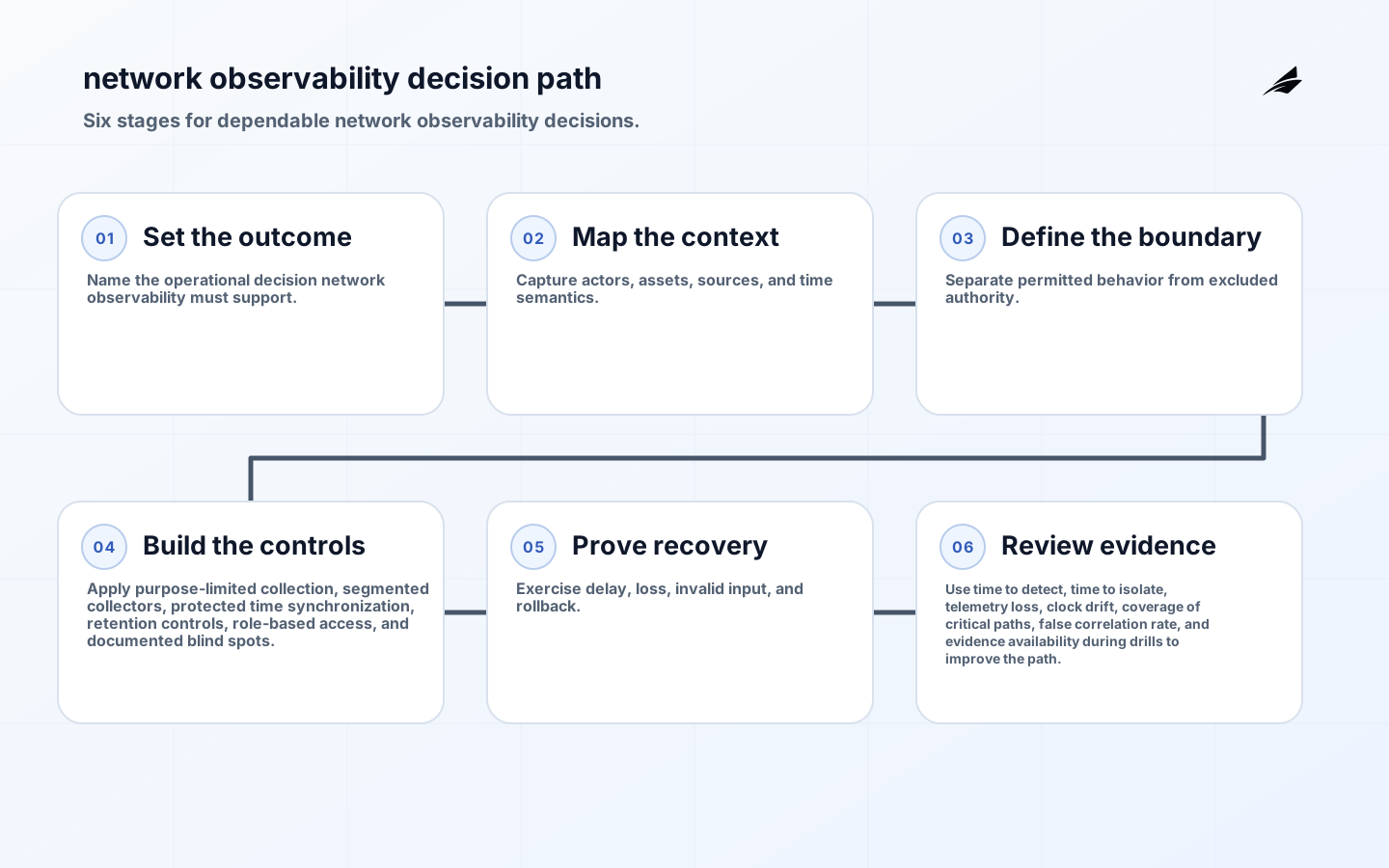
Network observability is a design decision before it is a product category. An operations leader should begin with the operating outcome: a responder can explain whether a service failure originates in reachability, policy, capacity, name resolution, or the application itself. That framing keeps the discussion tied to network flow evidence, device health, application dependencies, and incident decisions, rather than to a shopping list of tools. The decision becomes concrete when a team can describe a normal action, the authority that permits it, the evidence it creates, and what must happen when the normal path is unavailable. For example, a plant report is late, and the team can separate an overloaded historian interface from a blocked route instead of restarting several systems in the dark. The first build should make that path dependable and visible; it should not hide unresolved ownership behind a promising demonstration.
Define the network observability decision
Set the boundary in plain language. For network observability, record asset identity, path or zone, flow direction, protocol, timestamp basis, sampling limits, retention, access policy, and the decision each signal supports. Separate observations from commands, convenience from required behavior, and a temporary workaround from a supported capability. A useful design review asks who owns the decision, which system is authoritative, what changes state, and how a person will recognize an exception. The operational-technology guidance in NIST SP 800-82 Rev. 3 is a useful reminder that availability, safety, and reliability can constrain an otherwise sensible IT pattern. A boundary is credible only when it names the action that is allowed, the action that is deliberately excluded, and the route for requesting a change.
| Decision area | Question to settle before build | Evidence to retain |
|---|---|---|
| Outcome | What must network observability make possible under ordinary conditions? | A named user decision and acceptance example |
| Authority | Which record, policy, or person is decisive for network flow evidence, device health, application dependencies, and incident decisions? | Owner, source of truth, and approval path |
| Failure | What is the safe state when a dependency or connection fails? | Test case, fallback behavior, and recovery owner |
| Change | Who can alter the rules, mappings, or access? | Reviewed change record and rollback point |
Model the network observability operating context
For network observability, a model that only shows components is incomplete. A model that only shows components is incomplete. Map the actor, asset or service, input, decision rule, output, and evidence for each important exchange. Include time semantics: distinguish when something was measured, received, processed, and confirmed. Include quality semantics too, because an unavailable, estimated, stale, or rejected value should not look identical to a current one. The NIST Cybersecurity Framework 2.0 provides a practical organizing lens for governance, identification, protection, detection, response, and recovery. It is not a substitute for local engineering judgment, but it helps expose gaps between an attractive architecture drawing and a runbook people can actually use.
Use realistic cases while modeling. Ask how network observability behaves during a planned maintenance window, a partial outage, a credential change, a delayed upstream record, and an operator handoff. A capable system preserves context across those moments. It does not force the next person to infer intent from an ambiguous status or a timestamp without a source. The design should also state which data is sensitive, which decisions need human confirmation, and how long evidence must remain available. These choices determine operational cost as surely as CPU, bandwidth, or licensing.
Set network observability controls and trust boundaries
Controls should reduce a specific failure mode, not decorate an architecture. For this topic, use purpose-limited collection, segmented collectors, protected time synchronization, retention controls, role-based access, and documented blind spots. The essential question is whether access and automation remain proportionate to the consequence of an error. NIST SP 800-207 emphasizes that trust should not be granted merely because a request appears on a familiar network; identity, policy, and context still matter. Apply that principle without assuming every system can support the same mechanism. Older equipment may require a mediated boundary, compensating monitoring, and a carefully limited maintenance path rather than an unsupported security agent.
- Give network observability a named technical owner and an operations owner.
- Document the normal path, the degraded path, and the recovery path.
- Keep privileged actions separate from routine observation where possible.
- Record exceptions with an expiry, approver, and evidence of removal.
- Test that unavailable or low-quality inputs produce an understandable state.
- Review changes against the consequence to people, equipment, and service.
Design network observability for degraded operation
The important question is not whether a failure can occur; it is what the system will do next. A monitoring deployment mirrors sensitive traffic indiscriminately, creates a new data exposure, and still lacks the context needed for an incident. Design the degraded state deliberately: preserve the last known fact with its age, stop actions that need fresh authority, queue only work that can later be reconciled, and tell the user what is pending. Do not equate retrying with recovery. Retries need stable identifiers, bounded timing, and a way to detect that an action already succeeded. A recovery procedure should identify the evidence to compare, the owner who can decide a disputed outcome, and the conditions that permit normal processing to resume.
Build and release network observability in bounded steps
A network observability release needs topic-specific proof, not a generic readiness claim. Start with one controlled path and its uncomfortable cases. Build a representative test environment, then validate identity, data quality, authorization, behavior during loss of a dependency, and recovery. Release first to a bounded cohort or a noncritical workflow when the consequence allows it. Instrument the handoffs before volume arrives, including rejected input, delay, policy denial, and manual bypass. The NIST IoT device cybersecurity capability baseline is helpful here because it treats configuration, data protection, logical access, software update, and cybersecurity state awareness as operating capabilities rather than a one-time procurement checklist. Keep the release decision reversible until real evidence shows the path is understood.

| Release checkpoint | What to prove | Decision if it fails |
|---|---|---|
| Inventory | The participating assets and owners are known | Pause expansion and repair the inventory |
| Normal flow | A representative network observability transaction completes with traceable evidence | Correct the contract or mapping before rollout |
| Degraded flow | Loss, delay, or invalid input produces the intended safe state | Fix recovery behavior and repeat the exercise |
| Operations | The support team can identify, contain, and reconcile an exception | Keep the change in a limited cohort |
Measure network observability operational fitness
Choose measures that reveal whether the promised outcome still holds. Track time to detect, time to isolate, telemetry loss, clock drift, coverage of critical paths, false correlation rate, and evidence availability during drills. Pair the number with a review question: what decision will change if this worsens? A dashboard with twenty unowned counters creates attention without accountability. A smaller set connected to a threshold, owner, and response habit can improve the system. Review both leading signals, such as an overdue credential rotation or rising backlog, and lagging signals, such as a failed recovery exercise. Sample successful cases as well as incidents, because silent drift often appears in ordinary work before it becomes a visible outage.
Key takeaways for network observability
- Network observability should begin with an operational outcome and a named decision owner.
- Make identity, time, quality, authority, and recovery visible in the design.
- Treat degraded operation as a first-class user and support experience.
- Release in a bounded scope, then expand only with observed evidence.
- Use measurements to trigger review and improvement, not to create passive reporting.
Network observability frequently asked questions
Is network observability mainly a technology selection? No. Technology matters, but the durable choice is the operating contract around it: what is trusted, who can act, what happens under failure, and how change is reviewed. A tool that fits those constraints is usually easier to operate than a feature-rich product adopted without them. How much should the first implementation cover? Cover one valuable path end to end, including a realistic exception and recovery exercise. The first release needs enough scope to prove ownership, evidence, and support, but not so much that the team cannot learn from a contained failure. Add adjacent paths only after the initial behavior is reliable. When should the design be revisited? Revisit it after a material incident, a new device or integration class, a change in data sensitivity, or evidence that manual workarounds are becoming routine. Those are signs that the original boundary no longer matches the work.
Conclusion: make network observability operable
Good network observability design makes the next action clearer when the system is under pressure. It connects network flow evidence, device health, application dependencies, and incident decisions to an accountable outcome, makes its limits explicit, and retains enough evidence to investigate and improve. Begin with the example that matters most to the people doing the work, specify the normal and degraded paths, and prove that the team can recover before broadening the scope. That is how an early technical decision becomes a dependable operating capability rather than a fragile layer of complexity.