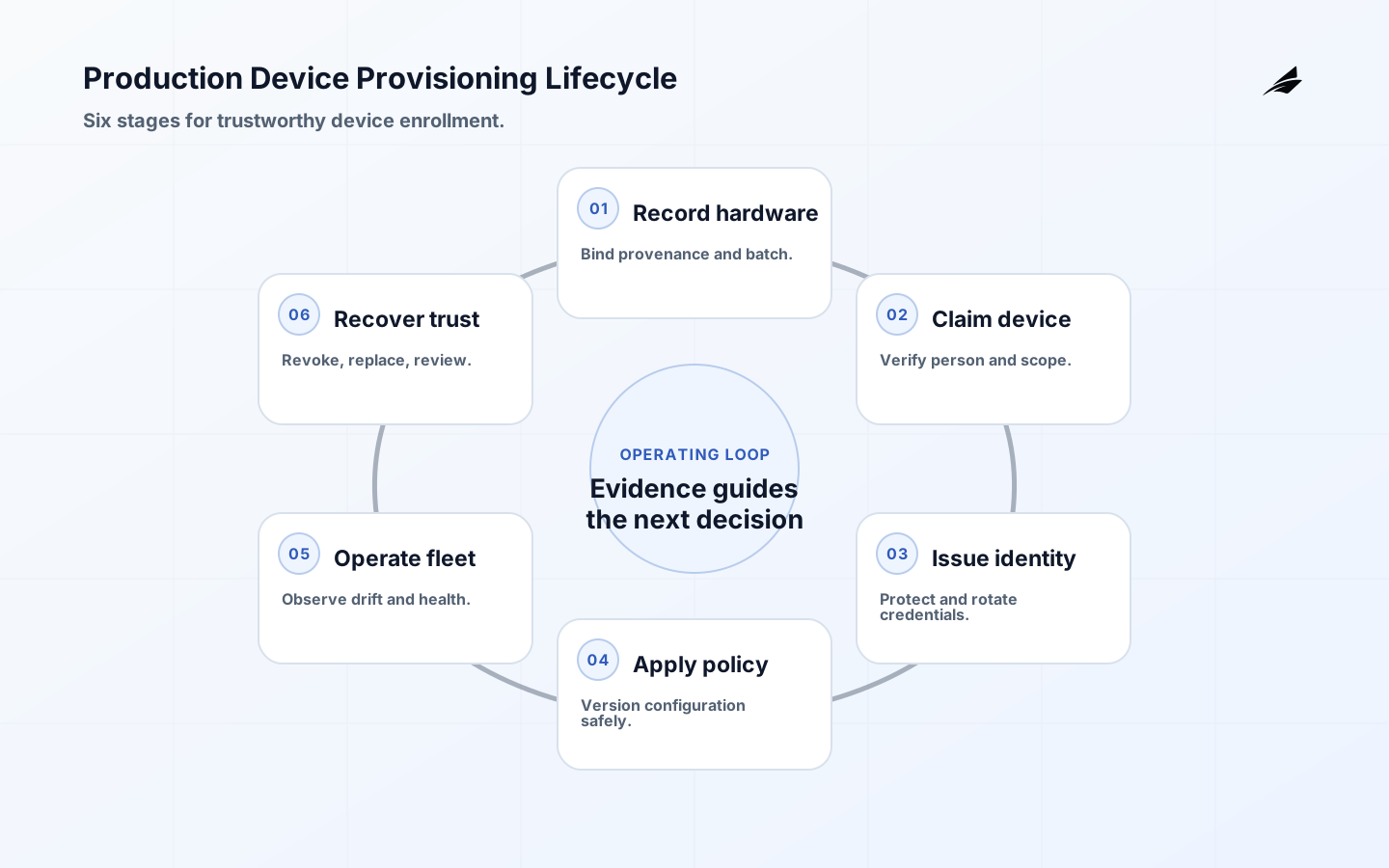
Device provisioning in production changes character. In a lab, a technician can copy a credential, rename a device, or rerun setup until a test passes. In production, every device needs a trustworthy identity, owner, location or tenant, approved configuration, replacement path, revocation path, and evidence that the expected state was reached. The system must survive partial enrollment, duplicate requests, lost hardware, network interruption, expired certificates, and human mistakes under time pressure. NIST IR 8259 Rev. 1 describes foundational manufacturer activities because customers need products they can secure and operate; provisioning is where that promise becomes concrete.
Define enrollment states
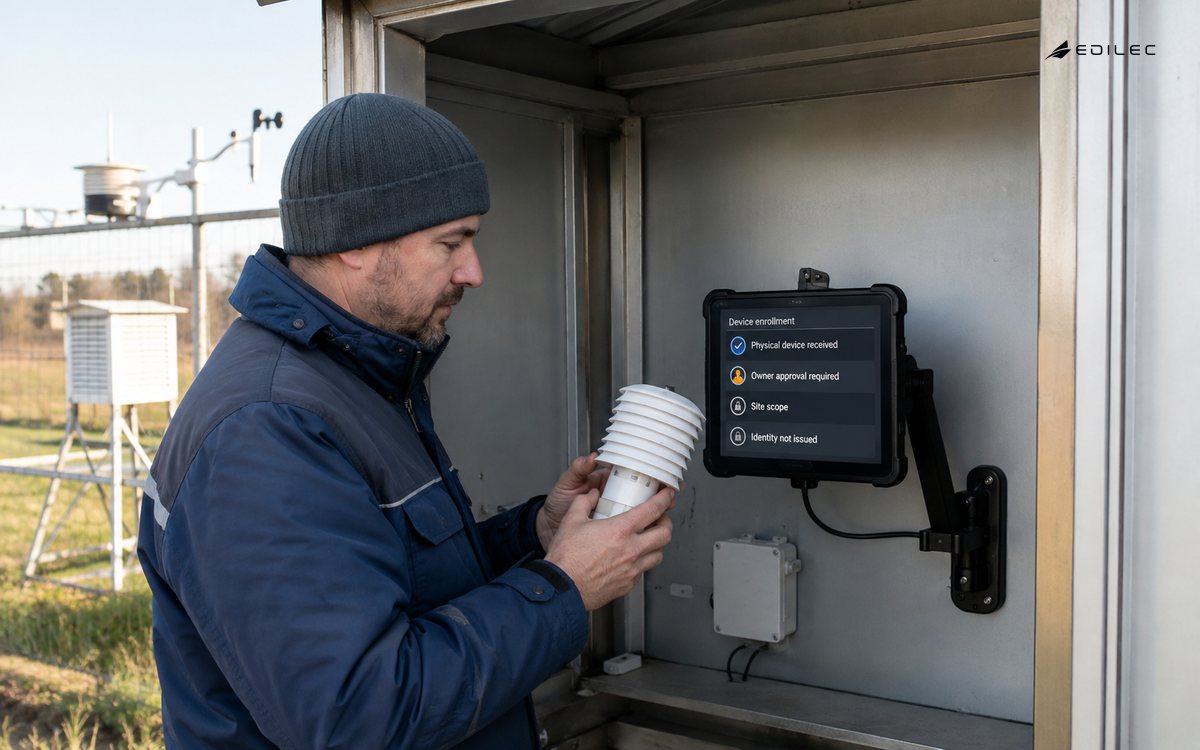
Use explicit states such as manufactured, claimed, pending approval, enrolled, active, quarantined, suspended, retired, and revoked. Define who may cause each transition, checks that pass, and evidence retained. A certificate does not prove that the device has the right tenant, site, firmware, policy, or owner. Separate physical possession from logical authority: a technician scans a serial, an owner approves scope, and a service issues identity. The interface should show complete, waiting, and prohibited next actions.
| State | Entry condition | Exit evidence |
|---|---|---|
| Manufactured | Hardware identity recorded | Serial and batch record |
| Pending approval | Claim submitted | Approver and scope |
| Enrolled | Identity and policy pass | Credential and configuration |
| Quarantined | Mismatch or risk detected | Reason and release decision |
Make identity and credentials replaceable
Choose what identifies the device, how it is protected, and how it survives service. A serial is inventory context, not a secret. A certificate or hardware-backed key may support authentication, but the product still needs issuance, rotation, revocation, expiry, and recovery. Avoid a fleet-wide secret in an image or a technician’s shared password. Test a lost device: how quickly can access be revoked, what data remains available, and how does support distinguish theft from failure? TLS 1.3 protects transport, while lifecycle policy decides what the authenticated device may do.
Bind devices to the right context
A device can authenticate correctly and still attach to the wrong customer, site, line, or asset. Verify a claim against an order, installation ticket, location, registry, or approval record. For a multi-tenant product, carry tenant scope through enrollment and verify it again server-side. If equipment moves, model the move rather than editing a label without history. NIST’s capability baseline helps teams ask which configuration and cybersecurity information operators need. Preserve current assignment and assignment history so investigators can reconstruct where a device was trusted.
| Binding | Check | Common mistake |
|---|---|---|
| Device | Hardware identity matches | Typed serial treated as proof |
| Tenant | Scope matches order | Default tenant allowed |
| Site | Installer verifies location | Stale location trusted |
| Policy | Approved version fits class | Latest config applied blindly |
Handle partial work and replay
Provisioning is distributed. An enrollment request may be accepted while certificate delivery, configuration, or first heartbeat remains pending. Use an idempotency key and durable state machine so retries do not create duplicate records or orphan credentials. Record actor, time, result, and correlation for every step. If a device loses connectivity after identity but before policy, it should return to a safe state and resume deliberately. Distinguish requested, accepted, delivered, acknowledged, and verified. Support needs to retry one step without resetting a healthy earlier step.
Treat configuration and updates as lifecycle work
Provisioning does not end at first enrollment. Devices need configuration changes, firmware updates, certificate rotation, policy changes, and retirement. Version configuration, validate compatibility, stage risky changes, and retain a known-good rollback. Do not overwrite the only record of what was active during an incident. State whether an update is mandatory, what happens when it cannot apply, and who approves an exception. For safety-sensitive environments, coordinate with local operators and maintenance windows. NIST OT guidance keeps availability and physical consequence visible.
Observe fleet state, not only enrollment rate
Track pending age, success by device class, duplicate claims, credential expiry, last contact, configuration drift, revoked devices still attempting access, update failure, quarantine age, and replacement time. Display why a device is not active instead of making support search logs. A useful view answers which devices are trusted, where they are expected, what software and policy they run, who owns the exception, and what evidence proves state. Measure operational completion, not only certificates issued.
Plan revocation, replacement, and recovery
The important provisioning flows often begin with bad news: a device is lost, cloned, sold, returned, moved, or found with a mismatch. Make suspension and revocation fast, auditable, and safe to reverse only with approval. Define downstream behavior: stop telemetry, block commands, quarantine, or preserve evidence. A replacement should not inherit trust because it has the same asset label. Require a fresh identity and explicit transfer record. Exercise recovery with technician and support, including an unavailable identity service and partial credentials.
Key takeaways
- Model provisioning as identity and lifecycle service.
- Separate possession, identity, tenant scope, and policy.
- Make retries, replacement, suspension, and revocation explicit.
- Version configuration and retain change evidence.
- Measure trusted fleet state and recovery time.
The NIST IoT manufacturer guidance frames the responsibilities that make a product securable, and the NIST IoT device baseline gives provisioning capabilities concrete shape. The TLS 1.3 specification covers transport protection, while NIST IoT cybersecurity activities helps define customer and device responsibilities. Use the NIST OT security guide when device state can affect physical operations.
Frequently asked questions
Should provisioning be zero-touch?
Automate repeatable checks, but keep approval where physical placement, tenant scope, safety, or financial consequence requires confirmation.
Is a serial number enough?
No. It is inventory context. Production authentication needs protected credentials and rotation and revocation lifecycle.
What is the production-readiness test?
Enroll, replace, suspend, revoke, update, and recover representative devices while support can explain every state and active policy.
Conclusion
Production provisioning is the process of establishing a trustworthy relationship between a physical device, its intended context, and the services that may use it. The factory or lab can optimize for speed; the fleet must optimize for identity, evidence, recovery, and safe change. Treat enrollment as a lifecycle with explicit states rather than a single successful claim. A device may be manufactured, staged, claimed, configured, active, suspended, replaced, or retired, and each transition needs an owner and an allowed next step. Start with provenance. Record the hardware identity, batch, firmware, manufacturing evidence, intended customer or site, and bootstrap authority. A serial number can help a person recognize a unit, but it is not by itself proof that the unit is genuine or authorized for a particular account. Bind the physical handoff to an approved actor and context. If a device arrives at the wrong site, is duplicated in inventory, or is claimed by an unauthorized account, the system should stop the transition and preserve the reason. Credentials should be scoped and replaceable. Separate bootstrap authority from the long-term device identity, issue only the permissions needed for the next state, and make renewal observable. Test certificate expiry, clock drift, lost keys, factory reset, duplicate enrollment, and a device that continues using an old credential. Rotation must not leave a fleet split between desired and observed trust states. Operators need a clear indication of which identity is active and what action is safe when renewal fails. Context is part of authorization. A device identity without site, asset, tenant, model, firmware, and operational owner can still be attached to the wrong workflow. Keep the source of each context field visible and distinguish asserted information from verified information. When a device changes location or customer, define whether the move is a transfer, a re-enrollment, or a new association. Do not let a support shortcut silently broaden access across the old and new boundaries. Partial work is normal at fleet scale. Enrollment may succeed at the registry while configuration delivery fails, or a device may report active while the service has not applied its policy. Model those intermediate states and make retries idempotent. Keep a record of the request, current state, last observed state, error reason, and next safe action. When connectivity returns, reconcile from authoritative evidence instead of replaying every step blindly. A runbook should tell support whether to resume, quarantine, replace, or escalate. Updates and configuration belong to the same lifecycle. Version desired configuration, validate changes before broad release, stage a cohort, and keep a rollback path that respects the device’s physical role. A fleet metric showing successful downloads is not enough if the new setting changes sampling, network load, or a safety-relevant behavior. Compare intended state with observed state, watch for drift, and make policy exceptions expire. Retain the approval and evidence for changes that affect identity, access, or operation. A useful operating view groups devices by lifecycle state, context, firmware, credential age, last contact, policy version, and recovery status. Measure time to enroll, time to become usable, failed transitions, unresolved exceptions, rotation success, replacement time, and the work that support performs outside the system. Review these measures with fleet operations, security, customer support, and the product owner. A rising active count can hide a growing population that is technically enrolled but operationally unusable. Revocation and retirement complete the trust story. Rehearse a compromised device, a returned unit, a customer cancellation, a lost key, and a gateway outage. Revoke access, preserve the evidence, remove stale associations, and record physical disposition. The final acceptance test should be executable by someone who did not design the enrollment flow. Production provisioning is ready when the fleet can change hands, credentials, configuration, and location without losing track of who is allowed to act or how the team will restore trust. Pair the fleet lifecycle with edge gateway operations, production protocol controls, and SCADA integration scope. Those related decisions show why a device identity cannot be separated from the path that uses it, the messages that carry it, or the physical context in which it operates. Use them to test replacement, revocation, buffering, and local fallback as one lifecycle. A fleet review should finish with a sample device moved through every state by someone outside the enrollment team. The evidence should show who approved each transition, what the device observed, and how trust is restored after a lost key or failed update.
A useful readiness review should include the physical handoff as well as the API flow. Ask the installer to claim the wrong device deliberately, interrupt power after identity issuance, move a device to another site, and request a replacement with the original asset label. The system should preserve the failed attempt, block unsafe trust, and provide a clear next step. Those exercises expose gaps between inventory, identity, installation, and support before the fleet makes them expensive.
Production provisioning is the trust fabric of a connected fleet. Make identity replaceable, context binding explicit, partial work recoverable, and fleet state observable.