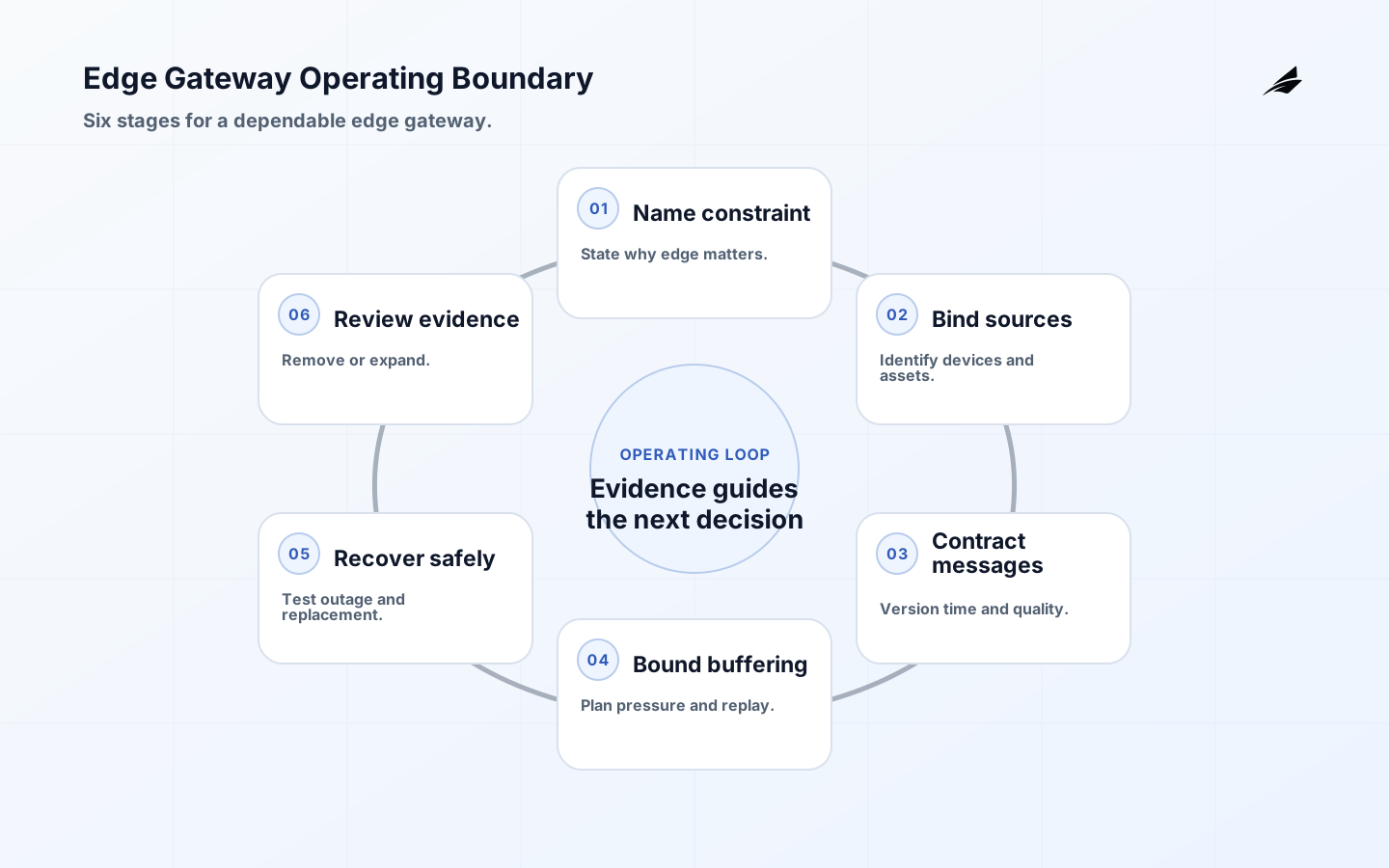
An edge gateway earns its place when it solves a boundary problem that endpoints and cloud services cannot solve well alone. It may translate protocols, buffer during outages, enforce identity, normalize data, reduce bandwidth, or run a bounded rule near equipment. It can also become an expensive box nobody owns. The practical question is whether a local boundary improves a named decision and whether the team can patch, replace, observe, and recover it. NIST IoT guidance treats security capability and customer information as product responsibility, while OT guidance emphasizes performance, reliability, and safety. Those principles make a gateway an operational product, not an incidental appliance.
Start with the constraint
Use a gateway for intermittent connectivity, incompatible protocols, strict latency, data residency, limited bandwidth, or local control needs. Do not add one because a diagram looks cleaner. Write the before-and-after decision: a technician receives trustworthy state during a network interruption, a line continues collecting while cloud is unavailable, or a fleet sends derived summaries instead of raw readings. If the only benefit is a vendor label, the scope is not ready.
| Constraint | Gateway responsibility | Pilot proof |
|---|---|---|
| Intermittent link | Buffer, sequence, reconcile | No silent loss during outage |
| Protocol mismatch | Translate and preserve meaning | Units and quality survive |
| Low latency | Run bounded local logic | Decision timing is measured |
| Sensitive site | Filter and control egress | Allow-list and denial evidence |
Separate gateway responsibilities
Keep the gateway contract small enough to test. Discovery, identity, protocol adaptation, validation, queueing, local calculation, and health have different lifecycles. Adaptation should not change business meaning; buffering should not become an unbounded database; local rules need a version and owner; health must distinguish process failure from source silence. Make a table of what is local, remote, retryable, and required to stop. A clear split makes replacement possible and prevents the gateway from becoming a hidden dependency for every new feature.
Design the data contract and buffer
Every buffered record needs identity, event or sequence time, source, schema version, quality, and retention behavior. Decide whether the gateway stores raw observations, normalized observations, or both. Define a maximum queue and the response when full: backpressure, sampling, summarization, or explicit loss. A retry is not automatically safe; duplicate commands can have physical consequence while duplicate measurements may be harmless with an idempotency key. MQTT semantics describe delivery behavior, but the application owns acknowledgement, expiry, and replay meaning. Record device time, gateway acceptance, and service receipt.
| Field | Why it matters | Failure prevented |
|---|---|---|
| Asset identity | Binds data to object | Cross-asset contamination |
| Observed and received time | Shows lag | Stale data as live |
| Quality and transformation | Explains validity | False confidence |
| Sequence or idempotency | Supports replay | Duplicate work or gaps |
Make identity and updates first-class
A gateway has long-lived identity, local secrets, software supply chain, and replacement needs. Decide enrollment, credential rotation, lost-device revocation, and technician authorization without a permanent shared password. Keep configuration separate from code and record changes to routing, mappings, certificates, and local rules. The NIST device baseline prompts capabilities around identity, configuration, data protection, and updates. Concrete evidence might be a signed release, staged update, rollback, and inventory showing version, site, owner, and last health report.
Observe the gateway as a service
A heartbeat is not enough. Measure source silence, queue age and depth, rejected messages, translation errors, certificate time, storage pressure, resource use, local rule failures, update status, and recovery time. Use structured logs with device, site, component, event, correlation, and severity; the OpenTelemetry Logs Data Model helps create consistent fields. Correlate gateway, broker, and service events where useful, but avoid secrets and unnecessary payloads. Support should be able to tell whether source, gateway, network, or service failed.
Control the security and egress boundary
Limit reachability in both directions. The device network should not inherit cloud privileges, and a cloud credential should not reach every local asset. Use explicit destinations, least privilege, protected storage, secure administration, and a documented break-glass path. Consider physical access, shared vendors, and image restoration. NIST OT guidance keeps availability and safety in view. A boundary that prevents safe recovery is incomplete; design recovery access before the incident.
Exercise failure and recovery
Test power loss, network loss, broker refusal, clock skew, full disk, malformed payload, duplicate delivery, expired certificate, revoked identity, and rollback. Inspect local behavior and remote interpretation. Decide how much data can replay, how operators see the queue, and when a human reconciles state. A recovery claim needs a time target, evidence record, and person who acts. Include a handover to support so recovery is not dependent on the builder’s memory.
Use a staged rollout
Deploy to one representative site or device class, not only the easiest lab. Validate identity, protocol semantics, buffer limits, update flow, support access, and data quality before adding local analytics. Keep a known-good image and configuration record. Expand by evidence. If the gateway reduces loss but creates queue support burden, fix that boundary first. If connectivity is reliable and the protocol is already supported, remove the component. Good architecture includes deletion.
Key takeaways
- Add a gateway for a named constraint, not fashion.
- Separate adaptation, buffering, local logic, identity, and health.
- Make time, quality, sequence, and transformation visible.
- Treat updates, revocation, recovery, and replacement as product behavior.
- Measure recovered outcomes and remove the gateway if evidence changes.
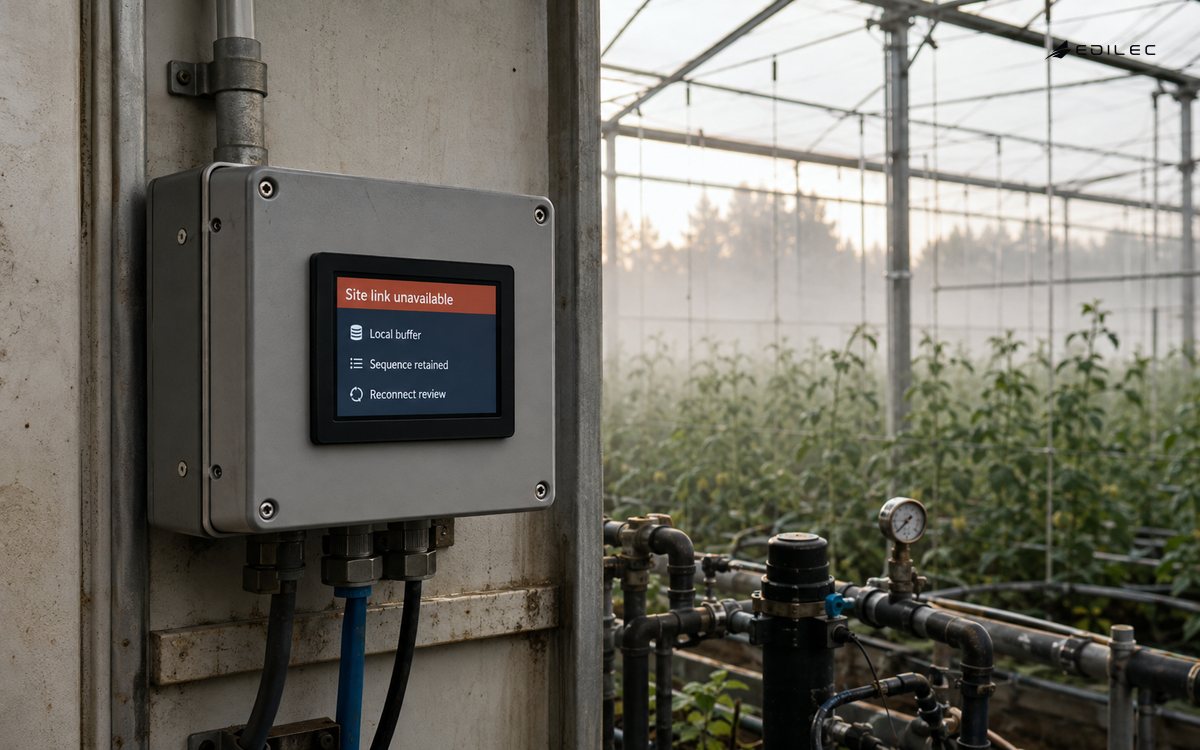
Use the NIST IoT device baseline to check identity, configuration, and data-protection capabilities. The NIST IoT cybersecurity activities helps frame customer and device responsibilities, while the MQTT 5.0 specification clarifies message behavior. Together with the NIST OT security guide, these references make the gateway boundary testable from source to recovery.
Frequently asked questions
Is an edge gateway an IoT platform?
No. A gateway is a local operational boundary; a platform may provide fleet, storage, analytics, and application capabilities beyond it.
How much data should it buffer?
Enough for the declared outage and recovery target, with a bounded limit and explicit behavior when storage fills.
When is it production-ready?
When identity, updates, queue behavior, observability, failure handling, support access, and replacement have been exercised under representative conditions.
Conclusion
An edge gateway is valuable when it gives a connected product a deliberate place to absorb field constraints. It may translate protocols, buffer measurements, enforce an egress boundary, or keep a local workflow useful during a cloud outage. None of those jobs is automatic. The team should state which constraint the gateway resolves, which decisions depend on it, and what the site can still do if the box is offline. That statement keeps an architectural component tied to an operating need. Start with a bounded fleet and a single data path. Inventory the devices, controller or historian, local network, gateway process, outbound destination, and person who owns each handoff. Define the observation contract before choosing a deployment pattern: stable asset identity, source time, received time, units, quality state, sequence, and schema version. A gateway that forwards a value without this context can preserve transport while losing meaning. Make malformed, late, duplicate, and unknown records visible rather than quietly normalizing them. Buffering needs an explicit policy, not just a queue size. Decide which data is worth retaining, how long it may wait, what happens when storage fills, and whether replay should preserve source time or trigger a fresh decision. Bound memory and disk usage, expose pressure before the gateway becomes unhealthy, and give operators a way to see whether the cloud view is current. During an outage, local operation should not depend on a remote acknowledgment unless the process was deliberately designed for that dependency. Treat the gateway as a replaceable service. Give it a scoped identity, protected credentials, a versioned configuration, and a repeatable enrollment path. A replacement device should not inherit access merely because it has the same serial number or network address. Test certificate renewal, key loss, configuration drift, signed updates, rollback, and decommissioning. Keep desired configuration separate from observed state so support can distinguish a failed change from a device that never received it. Observability should explain the path rather than create another dashboard. Correlate device reads, validation decisions, buffer depth, send attempts, acknowledgments, rejected payloads, and configuration changes. Track age at collection and age at delivery separately. A low outbound error rate does not prove that the gateway is receiving useful data, and high throughput does not prove that the correct asset is represented. Give the support owner a small diagnostic sequence that starts with one device and ends with the user-facing result. The security boundary is part of the product contract. Allow only approved destinations and message classes, separate device authority from gateway authority, and make egress changes reviewable. Avoid broad administrative access for routine support. If a site needs a temporary maintenance route, record its purpose, approver, expiry, and removal evidence. A firewall rule is only one control; identity, patching, configuration integrity, and recovery determine whether the gateway remains trustworthy after a change. Pilot the gateway during both a normal shift and a deliberately degraded exercise. Disconnect the uplink, fill the buffer with a controlled backlog, restart the process, replace the gateway identity, and restore delivery. The acceptance review should answer what local users see, which observations are replayed, how duplicates are handled, and who decides when the cloud view is reliable again. Compare support effort and operating outcomes with the pre-gateway workflow, not merely with message counts. A gateway is ready to expand when another team can operate, replace, and troubleshoot it from the documented evidence. If the site depends on private knowledge held by the builder, reduce the scope and improve the runbook. If the component no longer resolves a meaningful field constraint, remove it. The durable design is a small, observable boundary that preserves data meaning, local continuity, and accountable recovery as the fleet changes. The gateway decision should be reviewed alongside SCADA integration scope, connected-system protocol choices, and device provisioning in production. Together, those guides force the team to connect field constraints to the control boundary, the message contract, and the identity lifecycle. Use the links to challenge the same pilot from three angles: what must remain local, what may be replayed, and what evidence proves that a replacement gateway is trusted. A sound gateway review ends with a replacement exercise, a bounded buffer policy, and a named person who can interpret the data path without the original builder. That is the point at which the gateway becomes an operating capability rather than another box in the architecture diagram.
An edge gateway is valuable when it makes a connected system more dependable at the boundary that matters. Keep responsibilities narrow, data honest, identity replaceable, and recovery visible.