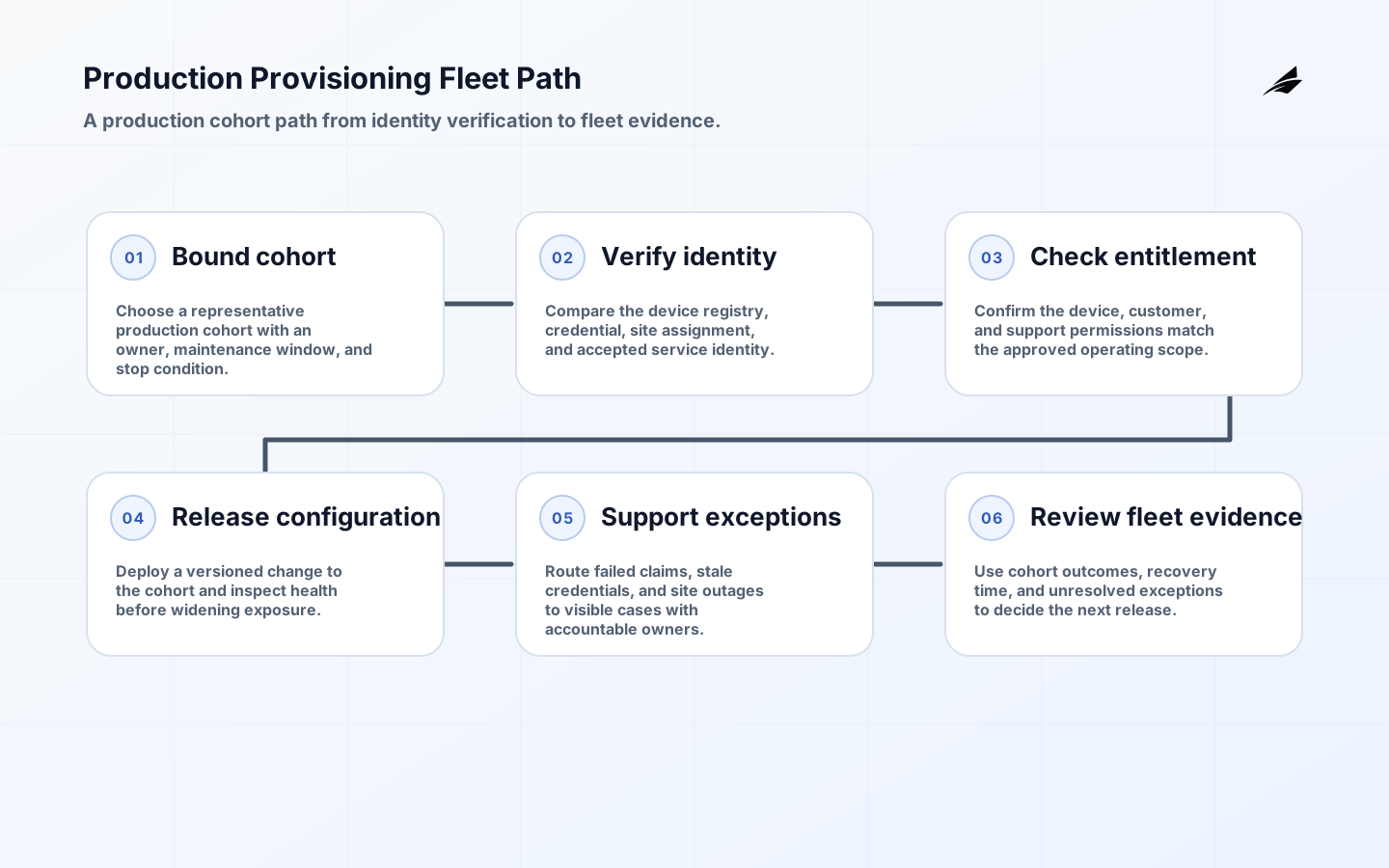
Fleet enrollment changes when connected devices move from a lab into production. This guide focuses on lifecycle states, exception ownership, recovery and the evidence operators need when enrollment is delayed, duplicated or unsafe. For the trust-anchor and bootstrap controls that precede fleet operations, use the device provisioning security review.
Define the device provisioning in production decision and boundary
Define lifecycle states before joining factory, installer, and cloud service: manufactured, claimed, enrolled, configured, active, suspended, transferred, retired, and replaced are common examples release. For each transition name actor, evidence, authorization, and exception rule cohort. Keep immutable hardware identity distinct from customer-facing names rotation.
| Decision area | Question to settle | Evidence to retain |
|---|---|---|
| Outcome | Which decision does device provisioning improve? | Scenario, owner, delay limit, and success measure for fleet. |
| Authority | Who may change or override the path? | Role rule, escalation route, and audit record. |
| Data | Which record is authoritative? | Identity, time rule, quality state, and lineage. |
| Recovery | What happens when a dependency fails? | safe alternative, reconciliation rule, and support owner at release. |
Design a dependable device provisioning in production contract
Use unique identities and a bootstrap method that is restricted, expiring, and auditable fleet. Plan rotation and revocation from the start. Issue configuration only after identity and entitlement checks pass, version settings against model compatibility, and make failed enrollment a safe supportable state window.
| Design choice | Practical rule | Operating signal |
|---|---|---|
| Identity | Use stable IDs instead of display names or shared credentials during maintenance. | Duplicate, unmatched, or unauthorized records. |
| Time and state | Preserve time and explicit quality or status. | Late, stale, unknown, and conflicting items. |
| Change | Version policy, interfaces, and configuration. | Compatibility errors and drift. |
| Evidence | Keep source and reason near consequential decisions for recovery. | Traceability from a view to source data. |
Implement device provisioning in production as a thin, testable path
Test double claims, lost installer tokens, reset, return, expired bootstrap material, partial configuration, and customer transfer recovery. Use idempotent enrollment and correlate factory, installer, and platform records release. Support should see the failed stage without seeing secrets cohort. Pilot with real supply-chain and connectivity conditions rotation.
- Write the device provisioning contract in plain language, including delayed and disputed states.
- Assign operational and technical ownership before release in cohort.
- Use representative devices, sites, and network conditions in a controlled rollout after rotation.
- Capture configuration and approval evidence with stable identifiers for fleet.
- Test recovery from a missing dependency.
- Review the first operating cycle with the people who act on the result at release.
Protect the device provisioning in production operating boundary
Apply device identification, configuration, data protection, logical access, update, and cybersecurity-state awareness across the provisioning path fleet. Secure identity issuance, restrict installer roles, log claims and entitlements, protect credentials, and revoke promptly on retirement window. A universal manufacturing key must not become permanent fleet identity recovery.
Operate device provisioning in production with evidence
Monitor completion by batch, model, firmware, and installer flow; failed claim reasons; state age; credential expiry; duplicate identities; and disable time rotation. Treating provisioning as a one-time screen creates debt when returns and transfers arrive fleet. Preserve failure evidence to correct systemic causes window.
Create a decision record for device provisioning in production
Before expanding device provisioning in production, write the decision record that a shift lead, engineer, and support owner can all read recovery. In the case of a returned field device that must be transferred without retaining its previous customer's access, state the trigger, the person or service allowed to assess it, the evidence needed before action, the latest useful time for that action, and the safe response when evidence is missing release. The record should identify hardware identity, lifecycle state, enrollment evidence, entitlement, certificate state, configuration version, and transfer record cohort. This is more than documentation: it prevents a dashboard label or integration default from quietly becoming policy rotation. Ask each owner to explain what they would do with a late, contradictory, or unavailable input fleet. Where their answers differ, resolve the rule before automating it window. The resulting boundary gives product, operations, and security teams a shared basis for testing change instead of relying on a successful happy-path demonstration recovery.
Work through a realistic device provisioning in production example
Use a returned field device that must be transferred without retaining its previous customer's access as a rehearsal, not as a story that remains in a planning document release. Trace the identifier from the physical asset or source through the service that evaluates it, the interface where a person sees it, the action record, and the later evidence that confirms or disputes the outcome cohort. Decide which facts may be cached, which must be current, and which user may make a temporary override rotation. Make the screen state match the system state: queued is not accepted, stale is not current, and an acknowledgement is not proof that the underlying condition is resolved fleet. This exercise exposes ambiguous names, missing handoffs, and incompatible time assumptions early window. It also provides concrete acceptance tests that a delivery team can repeat at every release recovery.
Release and recover device provisioning in production deliberately
A production release should declare its compatibility assumptions, rollout cohort, rollback condition, and evidence owner release. For device provisioning in production, start with a representative set of sites, devices, or users rather than a convenient set of friendly testers cohort. Verify that the record still preserves hardware identity, lifecycle state, enrollment evidence, entitlement, certificate state, configuration version, and transfer record after normal processing, degraded connectivity, a restart, and a version change rotation. Rehearse the failure case in which a reset or replacement leaves an active credential or ambiguous ownership in the fleet. The recovery path needs a visible queue or case, a named decision-maker, and a rule for retrying, repairing, or rejecting the item window. Do not use deletion to make monitoring look clean; preserve a safe diagnostic record and the reason for the outcome recovery. This practice turns incidents into bounded operational work rather than a hunt through disconnected logs release.
Review device provisioning in production on an operating cadence
Review device provisioning in production with the people who carry its consequences, using completion by batch and model, failed claims, state age, credential expiry, duplicate identities, and revocation time cohort. Compare the signals with real cases rather than looking only at averages rotation. A low fleet-wide error rate can hide one site, firmware version, customer workflow, or technician route that repeatedly fails fleet. Include changes, manual workarounds, unresolved exceptions, and near misses in the review window. Decide whether each finding needs a contract change, better validation, a training update, a capacity adjustment, or no action, and record the decision recovery. This cadence is how a connected capability remains understandable as assets, integrations, and responsibilities change release. It also gives leadership evidence of whether the work is reducing uncertainty and rework, rather than merely producing more data cohort.
Turn the production boundary into release gates
Use lifecycle states, cohort controls, quarantine, rollback, and support evidence so a pilot success does not become a fleet-wide assumption rotation. Start with one bounded workflow, name the person accountable for the outcome, and define what must be true before the next system may act fleet. Keep source identity, observed time, version, quality, and policy context close to the record that drives work window. A successful connection or accepted payload is not proof that the business result is complete recovery.
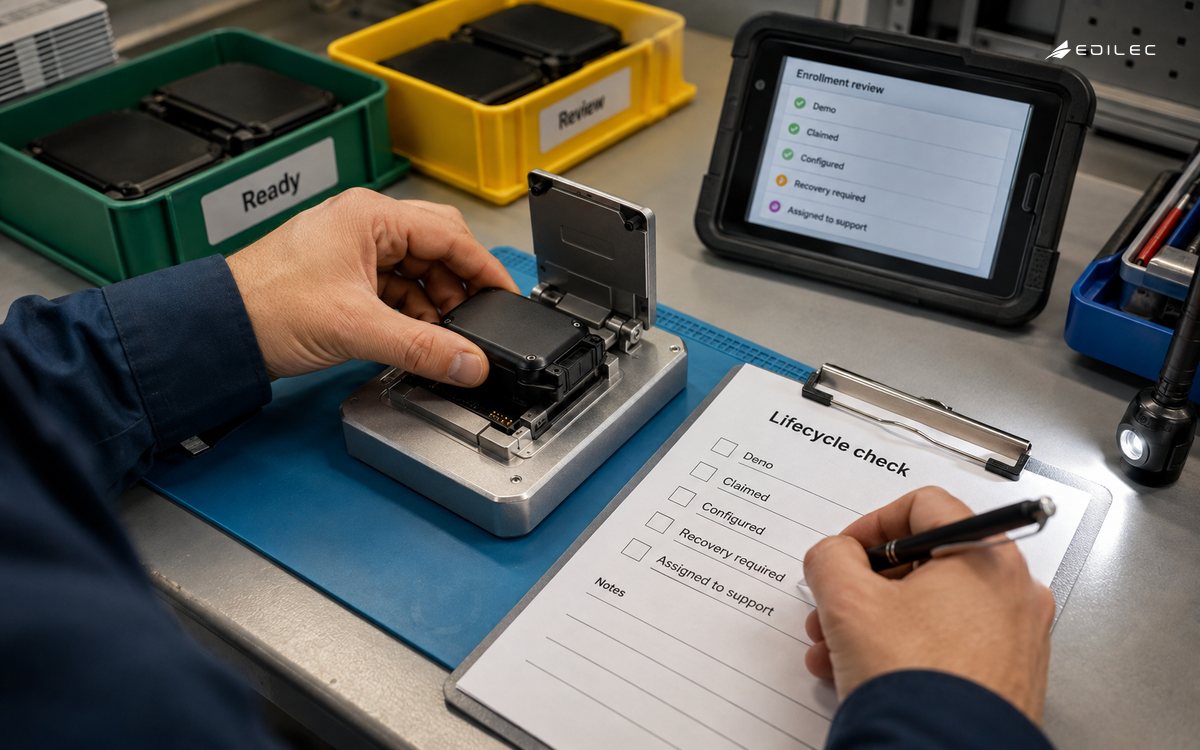
For a production cohort, define the evidence that separates “connected” from “ready for work”: entitlement, configuration version, site binding, clock status, and support ownership release. When one unit fails, isolate its cohort and compare the failure against hardware revision, installer, region, and rollout wave cohort. This makes a fleet incident actionable without treating every device as an identical copy rotation.
| Decision | Rule to settle | Fleet gate evidence |
|---|---|---|
| Scope | Release a representative device cohort only for the sites, models, and maintenance window the team can support. | Cohort roster, stop condition, shift-lead acceptance, and measured completion and recovery results. |
| Control | Keep production claims, transfers, credential changes, and overrides within the approved fleet role and release policy. | Role approval, effective policy version, maintenance window, and auditable change record. |
| Recovery | Quarantine a cohort member when identity, entitlement, connectivity, or ownership evidence is incomplete. | Member state, failure reason, isolation decision, assigned responder, and verified return-to-service record. |
Production Fleet: Source References
Production fleet work benefits from NIST SP 800-193: Platform Firmware Resiliency for resilient platform state, NIST SP 800-40 Rev. 4: Enterprise Patch Management for maintenance planning, CISA Exposure Reduction for exposure reduction, and AWS IoT Jobs Walkthrough for cohort execution after rotation. Use the set to define release, update, pause, and recovery evidence.
Production Fleet: Related Operating Choices
Continue with IoT Telemetry Explained: From Device Signal to Decision, MQTT Brokers: Architecture Guide for Connected Products, Edge Gateways: An Implementation Checklist That Holds Up when a neighboring boundary matters for fleet. The companion articles cover adjacent concerns around device provisioning in production.
Production Fleet: Production Fleet: Decisions to Carry Forward
- Name the device provisioning in production decision, owner, timing, and unacceptable failure before selecting technology.
- Keep identity, authority, time, quality, version, and state visible where they influence work at release.
- Test normal, denied, delayed, duplicate, and recovered cases with the people who operate the result during maintenance.
- Review one real exception and turn the correction into a maintained procedure for recovery.
Production Fleet: Production Fleet: Decisions to Carry Forward — Owner review
- Start device provisioning with a defined decision, not a generic platform objective.
- Preserve identity, time, ownership, and quality where meaning changes in cohort.
- Make exceptions and recovery visible to people who resolve them after rotation.
- Release in cohorts and test adverse conditions for fleet.
- Restrict authority to the smallest useful scope at release.
- Use operating signals to improve the contract, not merely a dashboard during maintenance.
Production Fleet FAQ
Production Fleet: What should teams define first?
Define the operational decision, authoritative record, owner, acceptable delay, and safe alternative before expanding device provisioning.
Production Fleet: How should changes be released?
Provisioning changes must be trialled across factory, installer, and return workflows, not only new-device enrollment window. Confirm that the new flow keeps identities unique, rejects reused claims safely, and revokes old authority when a device is transferred or retired recovery.
Production Fleet: What makes the service trustworthy?
Provisioning trust means support can follow a device from manufacturing through claim, enrollment, configuration, transfer, and retirement without guessing which credential or customer binding is active release. A lifecycle record must make exceptional states as visible as successful onboarding cohort.
Conclusion: Keep production fleet reviewable
Reliable device provisioning in production comes from explicit boundaries and routine evidence rotation. Build one path that retains context, assigns authority, and survives delay, change, and recovery fleet. Once the team can explain that path without guessing, expansion becomes an informed operational choice window.
Authoritative sources for device provisioning in production