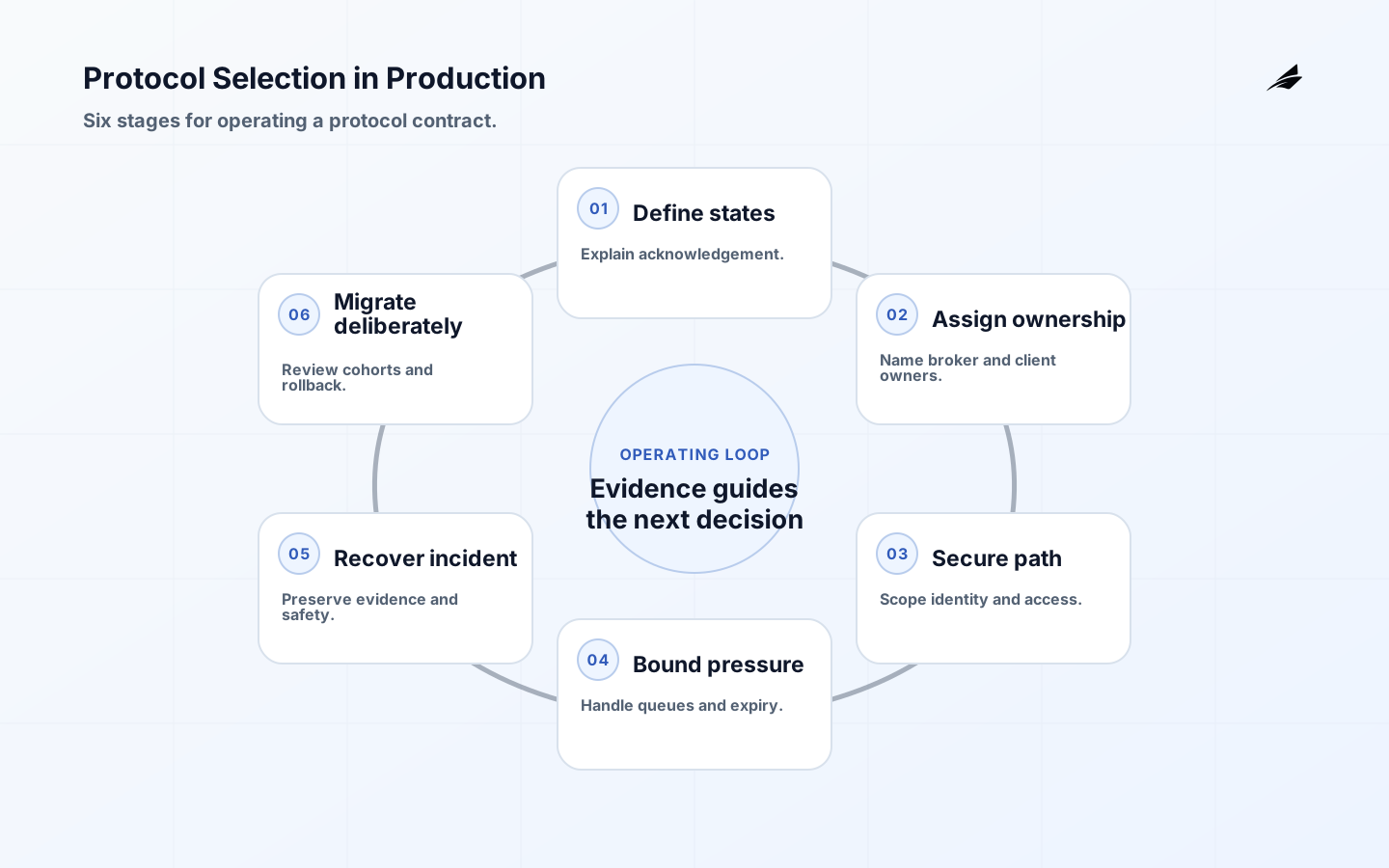
Protocol selection in production becomes a dependency when a message path for real operations. The decision is no longer only payloads and performance; it includes broker ownership, identity, certificates, schemas, queue limits, retries, overload, observability, client upgrades, and migration. A protocol can be standards-compliant and still fail as a product boundary if the team cannot explain what acknowledgement means or what a user sees when a message is late. MQTT, HTTP, CoAP, and local industrial paths must be governed as operating contracts. The MQTT 5.0 specification defines protocol behavior; the product defines safe application behavior around it.
Restate the protocol contract
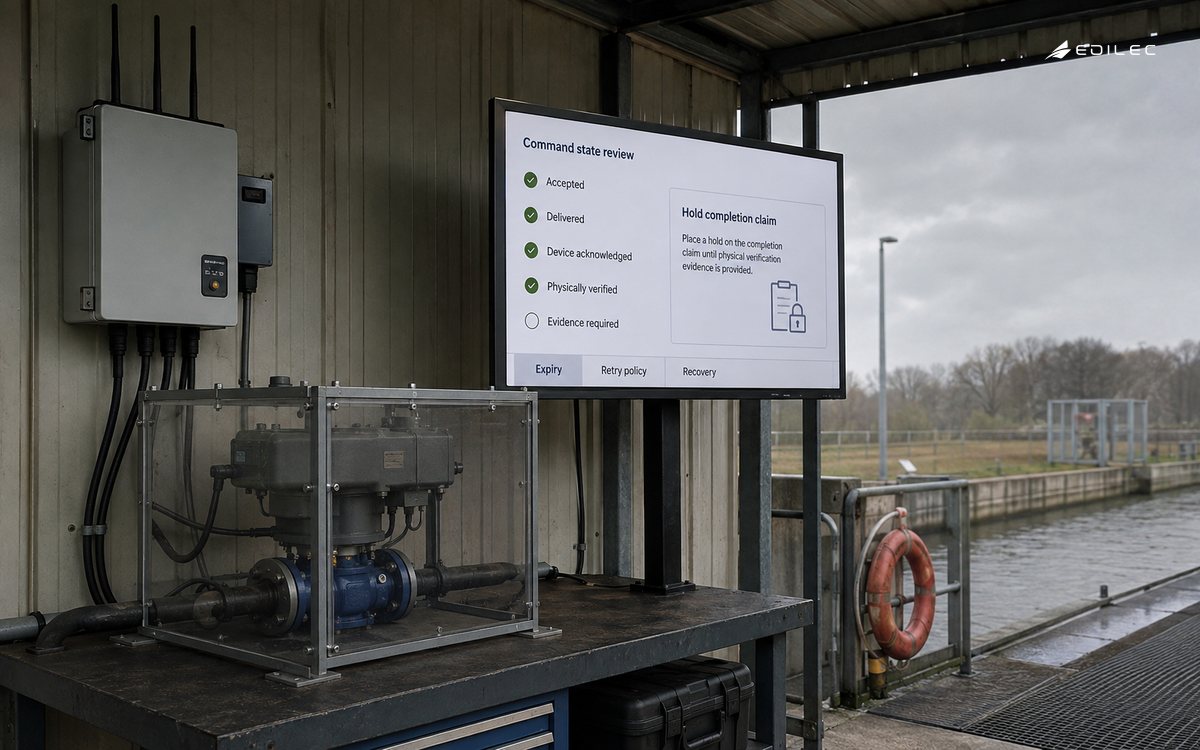
Write the production meaning of connect, publish, subscribe, request, acknowledgement, expiry, retry, and completion. State ordering scope, duplicate expectation, catch-up behavior, and what may be discarded under pressure. For commands, distinguish accepted, delivered, device-acknowledged, and physically verified. For telemetry, distinguish observed, gateway, and service time. Put definitions in tests, dashboards, support guidance, and documentation instead of leaving them in a client library.
| Concern | Contract | Evidence |
|---|---|---|
| Acknowledgement | What state does it confirm? | Message and outcome timeline |
| Expiry | When is old data useless? | Expired count and reason |
| Retry | Which actions are idempotent? | Attempt and dedup record |
| Ordering | What scope stays ordered? | Sequence gap and replay |
Govern brokers, adapters, and clients
Assign owners to broker, proxy, gateway, schema registry, certificate authority, client library, and downstream consumer. Record versions, maintenance windows, capacity assumptions, and rollback. Do not let a broker setting silently become application policy. Retained messages, session expiry, or delivery guarantees can help one class of data and harm another. Put configuration under version control and review changes to delivery, authorization, queueing, or retention. When an adapter changes units or topic names, publish a compatibility note and retain fixtures for old and new behavior.
Secure the production message path
Production credentials need issuance, rotation, expiry, revocation, and ownership. Use TLS where appropriate, but separately authorize identities to publish or subscribe to resources. A telemetry producer should not inherit command authority. Restrict administration, protect configuration, and audit policy changes. NIST IR 8259 asks manufacturers to provide capabilities and information customers can use; that matters when a product exposes protocol configuration without safe defaults. Exercise certificate expiry, device revocation, subscription authorization, and compromised-client containment. The result should be a visible denial and support record.
Operate overload and degraded connectivity
Devices reconnect together after outages, updates create bursts, and slow consumers grow queues. Define connection limits, backpressure, rate limits, expiry, storage bounds, and traffic priority. Separate high-value state from diagnostics. If sampling or dropping occurs, show the condition and reason. Never let unbounded retry turn a temporary outage into another outage. A useful dashboard shows connection churn, queue age, rejected messages, delivery latency, expired data, duplicates, and oldest unresolved gap.
| Pressure | Safer response | Review signal |
|---|---|---|
| Reconnect storm | Jitter and admission control | Connection rate |
| Slow consumer | Bounded queue and backpressure | Queue age |
| Schema mismatch | Reject with reason | Rejected by version |
| Broker outage | Local safe mode and bounded replay | Recovery time |
Make message behavior diagnosable
Use structured events with connection identity, route, schema version, sequence, correlation, status, source, and time. NIST SP 800-92 provides a management lens for collection, protection, review, and retention; incident guidance connects records to response. Correlate gateway, broker, service, and device events where possible. Keep the difference between missing and rejected messages. A dashboard should link an alert to evidence and a runbook should name the next owner.
Plan migration and compatibility
Protocol changes are distributed changes. Use dual-read, dual-publish, translation, or versioned topics only when transition semantics are explicit. Decide authority, overlap duration, duplicate reconciliation, and old-client retirement. Test devices that cannot upgrade, consumers that ignore fields, and incompatible broker settings. Keep a ledger with device class, client version, schema version, cohort, and rollback status. A successful migration proves that users and operators still see a trustworthy state.
Connect incidents to recovery
Prepare for credential compromise, topic misconfiguration, broker failure, queue exhaustion, malformed traffic, and releases that create duplicate actions. Define containment without destroying evidence, a safe operating mode, communication owners, and restoration checks. Recovery should include human review of replay meaning. If messages duplicate, is downstream work idempotent? If a device missed a command, how is physical state verified? The NIST incident handling guide is a useful reference; adapt it to actual consequence.
Key takeaways
- Turn protocol semantics into a contract users can understand.
- Assign ownership for brokers, adapters, schemas, credentials, and clients.
- Bound queues, retries, expiry, and reconnect pressure.
- Use evidence to distinguish loss, rejection, delay, and completion.
- Migrate in cohorts with compatibility tests and rollback.
The MQTT 5.0 specification provides protocol semantics, while the NIST IoT device cybersecurity baseline supports capability and lifecycle questions. The NIST log-management guide and TLS 1.3 specification help structure evidence and transport decisions around the message path. Pair them with the NIST incident handling guide when recovery must preserve a trustworthy business state.
Frequently asked questions
Does delivery guarantee prove action completed?
No. It proves a protocol-level state. The product must verify receipt, execution, and physical outcome when those distinctions matter.
How should old clients be handled?
Track versions, define compatibility, stage cohorts, monitor them, and keep retirement and rollback. Do not assume every device updates immediately.
What should teams monitor first?
Delivery age, queue and consumer lag, rejected and expired messages, reconnects, duplicates, credential failures, and time to restore trusted state.
Conclusion
Putting a protocol into production changes the question from “can messages move?” to “can a team govern meaning, authority, failure, and change over time?” Start by restating the contract in operational language. Identify the producer, consumer, business state, timing expectation, duplicate rule, acknowledgement meaning, and owner for an exception. A broker or adapter can deliver bytes while the product still cannot tell whether the intended work occurred. Separate the responsibilities around the path. Broker or server operators own availability, capacity, policy, and upgrades. Client owners maintain connection behavior, credentials, compatibility, and local retry logic. Event owners define schema, semantics, retention, and deprecation. Product and operations owners decide whether an observation may trigger a human workflow or a physical effect. Put those responsibilities in a service record with escalation routes; otherwise incidents become debates about which team “owns the message.” Production security needs more than encrypted transport. Bind each identity to a narrow set of resources and actions, separate publish from subscribe authority, and make service-to-service credentials distinct from operator access. Log authentication, authorization, configuration, subscription, and policy changes with enough context to investigate. Exercise expired credentials, revoked identities, unauthorized subscriptions, replayed credentials, and an emergency containment procedure. A short-lived break-glass path should be explicit, approved, visible, and automatically closed. Pressure reveals the real operating model. Establish limits for queue depth, message size, connections, retained data, retry rate, and replay speed. Make expiry and backpressure observable before they become an outage. Decide which messages are essential, which can be coalesced, and which should move to a visible exception path. A consumer that is technically healthy can still be too far behind for the business decision it serves. Measure age at processing and time to useful outcome, not throughput alone. Diagnostics should answer a question from the perspective of a person using the system. Given an asset and time range, support should find the original message, its validation result, delivery attempts, consumer action, and final business state. Distinguish not received, rejected, accepted, completed, and unknown. Correlate client, broker, and service evidence, but do not let a trace or dashboard substitute for an accountable owner. Keep representative normal and degraded samples after each material change. Compatibility is a product decision. Version the contract, define additive and breaking changes, publish example payloads, identify active consumers, and set a retirement date. Test old and new clients together and keep rollback evidence for adapters, schemas, access policies, and broker configuration. If a migration changes the meaning of an acknowledgement or timestamp, call that out explicitly; silent semantic drift is harder to repair than a visible connection failure. Incidents should end with a verified business state. If a consumer is down, bound the replay, prioritize consequential work, deduplicate side effects, and reconcile with the system of record. If a broker is unavailable, use the documented local or manual fallback and show users that the remote view is stale. After recovery, preserve what happened, what was retried, what was abandoned, and who confirmed normal operation. This record should improve the next change review rather than disappear into an infrastructure ticket. Keep the production protocol small enough to govern. Review ownership, evidence quality, cost, support load, and customer or plant impact on a regular cadence. Expand when the team can operate the current path without private knowledge; narrow when exceptions are becoming permanent design. A reliable message system is one whose meaning, authority, pressure limits, and recovery remain clear while clients, workloads, and people change. For the surrounding design context, read protocol selection before implementation, edge gateway operations, and device provisioning in production. The relationship matters: a production message path inherits assumptions about the selected semantics, the gateway’s pressure behavior, and the identity lifecycle. Compare the failure matrices rather than only the feature lists. The operations owner should be able to show a normal message, a denied message, a replay, and a compatibility change from evidence. If any case depends on a private conversation with the implementer, the protocol is not yet ready for wider adoption.
Keep a compatibility ledger that names client version, broker capability, schema version, delivery policy, and retirement date. Use it during incident response and planned migration. When a message path changes, compare not only delivery latency but also duplicate actions, stale-state interpretation, operator workload, and support time. The production decision is complete when the team knows how to introduce a new behavior, how to contain it, and how to prove that old devices remain safe.
Production protocol work is governance plus engineering. Define states, secure identity, bound pressure, preserve evidence, and rehearse recovery so the message path remains understandable as devices and teams change.