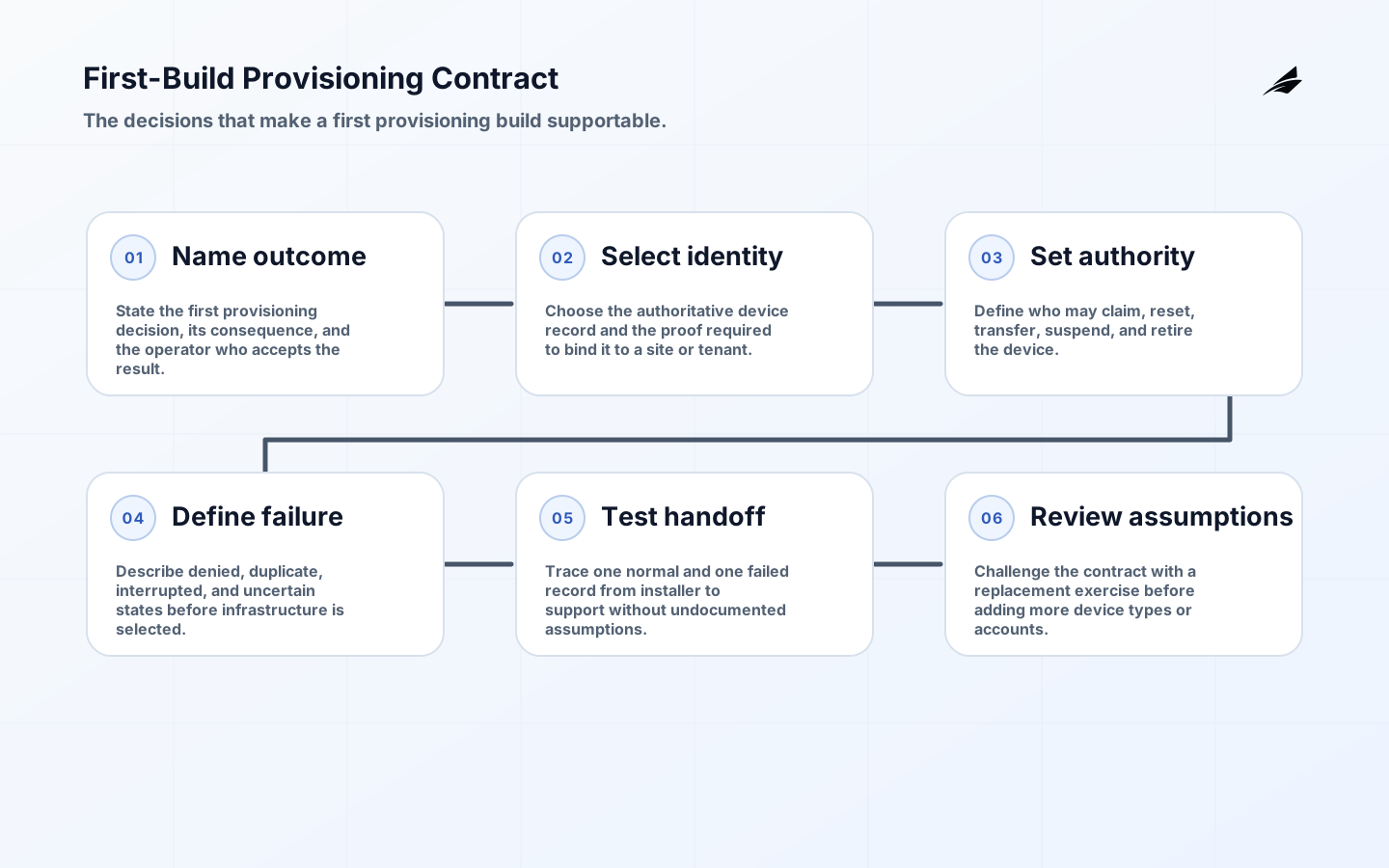
Device Provisioning Decisions That Matter before the First Build is a practical device provisioning guide for teams that need a trustworthy operating path identity. Krishnam Murarka explains device provisioning with practical context for founders: architecture, risks, implementation choices and operating signals claim. The decision is not whether a component can connect or move data; it is whether people can explain identity, authority, state, evidence, and recovery when normal conditions change support.
Choose the smallest credible provisioning contract
Decide identity, claim authority, source of truth, enrollment failure, and lost-device access before selecting infrastructure review. Start with one bounded workflow, name the person accountable for the outcome, and define what must be true before the next system may act contract. Keep source identity, observed time, version, quality, and policy context close to the record that drives work reset. A successful connection or accepted payload is not proof that the business result is complete identity.
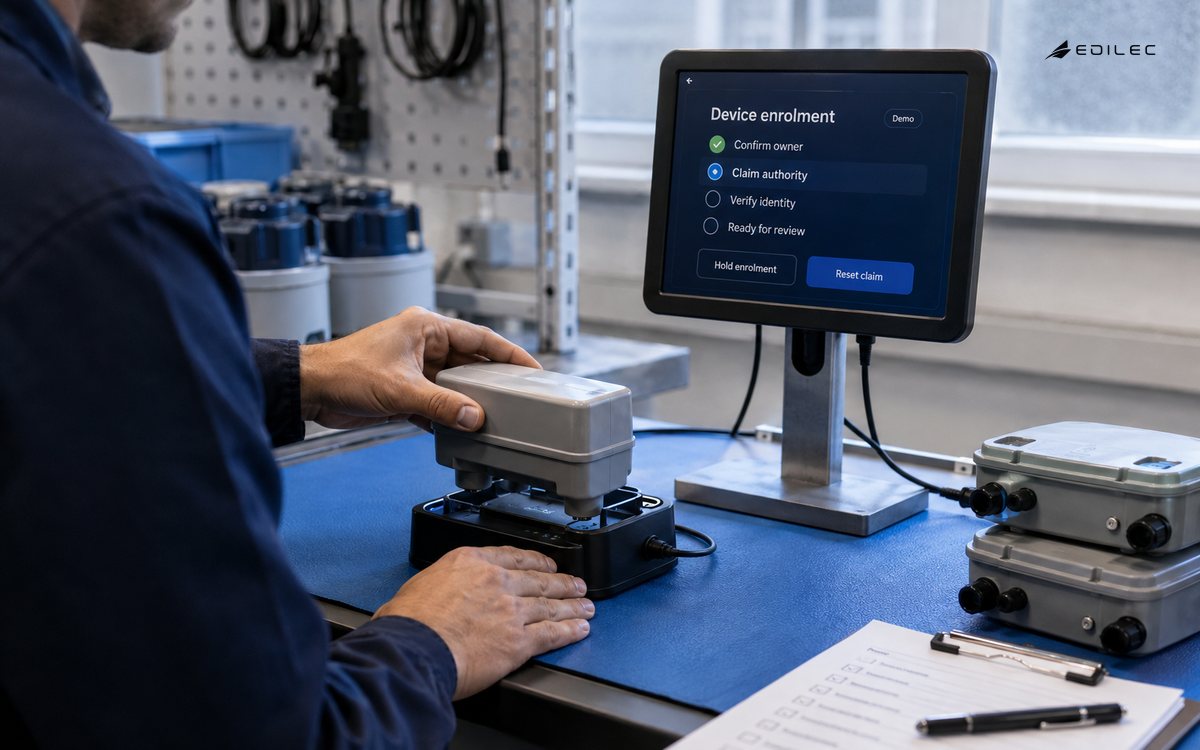
For the first build, write the provisioning decision in terms a customer, installer, and support engineer can all test claim. State who owns the unit before and after claim, what proves a claim is legitimate, how a wrong claim is undone, and which record downstream systems trust support. Those answers keep early product choices reversible without leaving identity and ownership as undocumented assumptions review.
| Decision | Rule to settle | Pre-build proof |
|---|---|---|
| Scope | Choose the first claim and replacement scenario, including the user, device class, tenant boundary, and explicit exclusions. | Scenario owner, claim proof, reversal exercise, and sign-off that the identity contract is testable. |
| Control | Define who may claim, reassign, suspend, and retire a device, and which record each action must update. | Role matrix, approval path, versioned policy, and support trace from action to registry. |
| Recovery | Design the denied, duplicate, offline, and disputed-ownership paths before selecting the provisioning service. | Failure examples, manual-review route, retry boundary, and evidence that a mistaken claim can be undone. |
First-Build Provisioning: Source References
Before the first build, use NISTIR 8259A: IoT Device Cybersecurity Baseline for device capabilities, RFC 8995: Secure Key Infrastructure Bootstrapping for secure enrollment, NIST SP 800-53 Rev. 5 Controls for control selection, and NIST SP 800-213A Requirement Catalog for requirement traceability after reset. Read each against the identity, claim, reset, and replacement cases in scope contract.
First-Build Provisioning: Related Operating Choices
Continue with Network Segmentation Decisions That Matter before the First Build, Alert Routing Decisions That Matter before the First Build, A Field Guide to Sensor Data Pipelines for Growing Teams when a neighboring boundary matters for identity. The companion articles cover adjacent concerns around device provisioning identity.
First-Build Provisioning: First-Build Provisioning: Decisions to Carry Forward
- Name the device provisioning decision, owner, timing, and unacceptable failure before selecting technology at claim.
- Keep identity, authority, time, quality, version, and state visible where they influence work for support.
- Test normal, denied, delayed, duplicate, and recovered cases with the people who operate the result during review.
- Review one real exception and turn the correction into a maintained procedure in contract.
First-Build Provisioning: First-Build Provisioning: Decisions to Carry Forward — Owner review
- Start device provisioning with one accountable decision, not a broad platform promise.
- Preserve identity, time, source, quality, and ownership wherever facts cross a boundary after reset.
- Test degraded conditions and recovery before expanding the rollout for identity.
- Measure whether people can make and later explain the intended decision at claim.
Define the decision boundary for device provisioning
Define the lifecycle states before implementing an onboarding screen: manufactured, claimed, assigned, active, suspended, recovered, retired, and destroyed or transferred claim. For each transition, name the actor, required proof, allowed configuration, and audit evidence support. NIST IR 8259A highlights device identification, logical access, configuration, data protection, software update, and cybersecurity state awareness, all of which begin with a trustworthy bootstrap rather than after a device is already deployed review.
| Question | Decision to document | Evidence in operation |
|---|---|---|
| Purpose | Which action or review does this capability support for support? | Named owner and an observable outcome. |
| Authority | Which system or person may change the relevant state during review? | Actor, source, time, and policy record. |
| Failure | What is safe when required evidence is missing in contract? | Visible pending, rejected, or manual-review state after reset. |
| Recovery | How is an exception resolved and closed? | Case history and reconciliation result. |
First-Build Provisioning: Build an architecture that preserves meaning
Give each device a unique hardware-rooted or securely injected identity where the hardware and supply chain support it contract. Bind that identity to an inventory record, then issue operational credentials scoped to the device and its assigned tenant or location reset. Keep bootstrap credentials distinct from long-lived service credentials identity. RFC 8995 describes a standards-based approach to bootstrapping remote secure key infrastructures; the broader lesson is that enrollment should authenticate both sides and create revocable, attributable credentials claim.
First-Build Provisioning: Apply controls that fit the operating risk
Provisioning needs strong defenses against misclaiming and replay contract. Use short-lived enrollment tokens or verified ownership steps, confirm the intended tenant and device attributes, record approvals for exceptional reassignment, and invalidate credentials when a device is returned or suspected compromised reset. Do not put secrets in QR codes, labels, mobile logs, or support tickets identity. Secure update and configuration channels are part of the lifecycle because an identity that cannot be recovered safely is only temporarily trustworthy claim.
| Control area | Practical implementation | Review signal |
|---|---|---|
| Identity | Use unique, scoped identities for people, devices, and services for identity. | Unexpected access, expired credentials, or orphaned accounts at claim. |
| Change | Version schemas, configuration, and release approvals for support. | Rollback, incompatibility, or unreviewed drift. |
| Resilience | Define degraded behavior, buffering, and manual recovery during review. | Delayed work, queue age, or unresolved exceptions in contract. |
| Evidence | Record material actions and data-quality status after reset. | Ability to reconstruct a consequential decision for identity. |
Release device provisioning in bounded stages
Run a small production-like cohort through normal claim, duplicate claim, lost device, wrong tenant, expired enrollment, interrupted setup, certificate renewal, factory reset, and retirement support. Include operations and customer support in the exercise; they are often the people asked to resolve identity conflicts review. Instrument every state transition and reconcile the device registry with the service credentials actually accepted by production systems contract.
First-Build Provisioning: Measure the operating path, not just availability
Track successful first enrollment, failed claim by reason, duplicate identity detection, enrollment-token expiry, time to resolve ownership exceptions, certificates approaching expiry, unassigned active devices, retirement completion, and support actions that bypass the standard process reset. These measures reveal whether growth is adding managed devices or merely adding unknown endpoints identity.
Set acceptance criteria for device provisioning
An implementation for Device provisioning should have acceptance criteria that an operator, engineer, and accountable owner can all inspect claim. Start with the stated outcome and write normal, degraded, and recovery examples before configuring production services support. A practical acceptance test enrolls a new device, rejects a duplicate or expired claim, interrupts the exchange, rotates its credential, then retires and recovers it under a supervised procedure review. Confirm that service logs and the registry agree about the device state at every step contract. This proves the lifecycle rather than only the happy-path setup screen reset.
Keep the first release deliberately narrow. It is easier to compare a bounded path with its prior process, correct an unclear ownership rule, and teach a support team a real response identity. Expansion should be based on evidence from the representative workflow, including exceptions, rather than on a count of integrated assets or enabled accounts claim. For device provisioning, this means choosing the smallest path that still exposes the relevant ownership, failure, and recovery conditions support.
First-Build Provisioning: Assign ownership across the lifecycle
Manufacturing or supplier teams own initial identity evidence, product teams own enrollment behavior, and customer operations owns assignment and support resolution review. Security teams set credential and revocation requirements, while each transfer between roles needs a recorded, testable handoff contract.
Use a change record for bootstrap method, claim rules, tenant assignment, credential profile, reset behavior, and retirement reset. It should state inventory impact, support instructions, abuse controls, and the reconciliation evidence required after rollout identity.
Treat lost and recovered devices as identity events
A device returned from a customer, found in a warehouse, or recovered after suspected compromise must not simply resume its old relationship claim. Suspend its credentials, verify its hardware identity and software posture, require a new assignment decision, and leave an audit trail support. The same discipline applies to factory reset: reset may remove configuration, but it does not erase the responsibility to account for the endpoint review.
Connect provisioning to procurement and support workflows
Provisioning quality depends on serial capture, shipment status, customer assignment, replacement policy, and support authority contract. Reconcile these records routinely with the device registry and active credentials reset. This makes it possible to spot devices that were shipped but never claimed, claimed twice, or still active after a contract or asset was closed identity.
First-Build Provisioning: Keep decision evidence usable
For device provisioning, decision evidence includes hardware identity, bootstrap and operational credential history, claimant or approving actor, tenant or site assignment, lifecycle transition, and revocation or recovery event claim. This record supports support staff when a customer says a device is missing, transferred, or wrongly attached to an account support. It also limits the temptation to solve a difficult case by silently reusing an old credential or editing an ownership field review.
First-Build Provisioning FAQ
First-Build Provisioning: What should the team decide first?
Can a QR code be used for provisioning? Yes, as a locator or a short-lived bootstrap reference, provided it is not the sole secret and the server verifies device identity and assignment contract. Treat a printed code as observable by anyone who can photograph or copy it reset.
First-Build Provisioning: What makes the implementation durable?
What happens when ownership changes? Use an explicit transfer workflow that suspends current access, verifies the new owner, issues new scoped credentials, and records the event identity. Do not simply edit a customer field while the old credentials remain valid claim.
Conclusion: Keep first-build provisioning reviewable
Reliable device provisioning comes from a defined decision, explicit authority, controlled change, and evidence that survives a difficult day support. Start with a device identity and initial configuration that can be trusted, changed, recovered, and retired at fleet scale, prove the path under normal and adverse conditions, and use the findings to make the next release more dependable review. That produces a capability that operations, security, and engineering can improve together instead of a system that only works while its original builders are nearby contract.
Next review: reconcile a random sample of shipped, active, returned, and retired devices against their credentials and customer assignment reset. Investigate each mismatch to closure. Sampling makes lifecycle drift visible early and gives support teams a concrete way to practice the transfer and recovery controls identity.
First-Build Provisioning: Authoritative sources