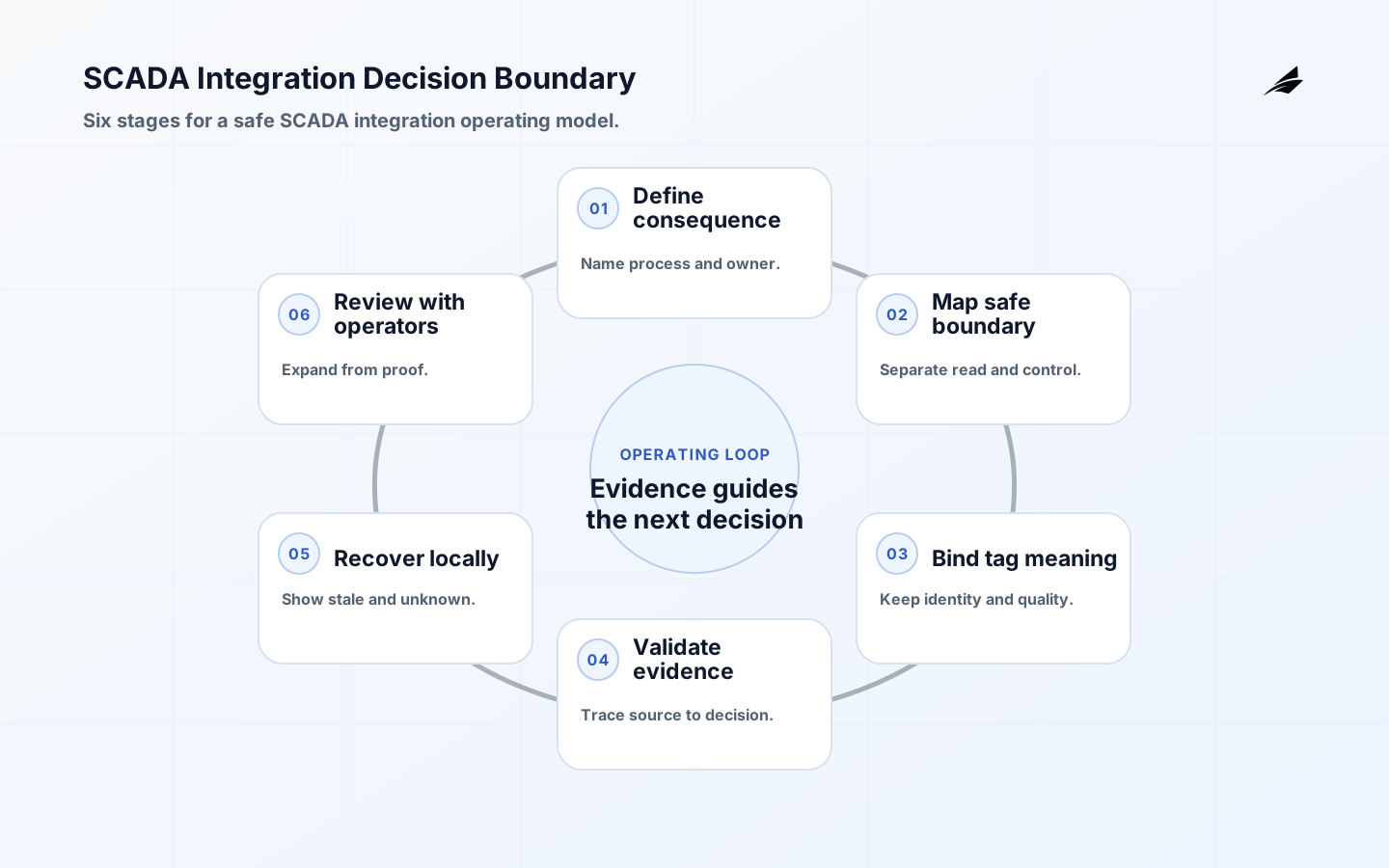
SCADA integration becomes a founder-level decision when software can read from or influence equipment, process states, alarms, or operator workflows. The attractive version is a clean dashboard that joins plant data to a modern product. The real version includes old controllers, undocumented tags, maintenance windows, safety expectations, intermittent links, and people who must trust the result while production is running. Start with a bounded operating decision: what must a person know, what may software do, and what must remain under local control? NIST describes operational technology as systems that monitor or cause changes in the physical environment, so performance, reliability, and safety belong in the product requirements.
Define the operating boundary
Write the boundary before choosing protocols. Name the equipment or process, the data that may leave the site, commands that may never leave local control, people who can approve an exception, and evidence needed after an incident. A factory might allow production counts and motor temperatures into cloud analytics while forbidding remote start, stop, or set-point changes. Another site may allow a maintenance ticket from an alarm but require an operator to perform the physical intervention. These are product decisions, not merely network rules, and they make the conversation with plant engineering concrete.
| Boundary question | Example decision | Evidence to retain |
|---|---|---|
| What leaves OT? | Validated read-only temperature data | Tag allow-list and data-flow record |
| What may automate? | Create a task, never a motion command | Action policy and approval trail |
| Who owns mismatch? | Controls engineer owns tag meaning | Named owners and escalation |
| What if links fail? | Local operation continues; cloud is stale | Last-known time and quality flag |
Model SCADA data with context
A tag name is not a data contract. Preserve asset identity, source system, unit, timestamp, quality state, engineering range, sampling expectation, and transformation history. Keep an observed value separate from a calculated status so an operator can tell a real high temperature from a stale value or changed rule. Carry site, line, cell, equipment hierarchy, maintenance state, and whether a value was measured, derived, backfilled, or manually corrected. This prevents a credible number from being attached to the wrong machine and lets support trace a disputed result to the original observation.
Choose the read path before the platform
Make responsibility visible: controller or historian, local gateway, protocol adapter, validation layer, transport, storage, calculation, interface, and ticketing system. Decide where timestamps are assigned, how units are converted, how duplicates are identified, and which component is authoritative when sources disagree. Keep the plant path resilient when the cloud is unavailable. That may mean local buffering, a last-known indicator, and a rule that cloud recommendations cannot become control commands without an approved path. See edge gateways for connected systems for the adjacent boundary decision.
| Choice | Useful when | Trade-off |
|---|---|---|
| Historian read | Plant context already exists | Freshness may lag controller |
| Local gateway | Protocols need one boundary | Patching becomes operations work |
| Cloud stream | Cross-site analysis needs speed | Connectivity and identity burden |
| Local calculation | Latency or safety matters | Rules must be versioned |
Secure the integration without breaking the plant
Separate control network, site services, gateway, and cloud-facing paths. Use distinct identities, restrict outbound destinations, protect credentials, and log changes to mappings, rules, and permissions. NIST IR 8259 Rev. 1 puts cybersecurity capabilities and customer information in the product conversation, while the IoT capability baseline gives teams concrete categories to ask about. Do not call a gateway secure because it sits behind a firewall. Ask what happens when it is replaced, a certificate expires, a technician needs temporary access, or a site must revoke it immediately.
Test failure and recovery as product behavior
Exercise the uncomfortable path: pull the link, restart the gateway, send a malformed tag, repeat an event, change a unit, revoke an identity, and restore a historian. Observe what the plant operator sees and what the cloud user believes. The interface should show stale or unknown status instead of silently retaining green. Recovery must include reconciliation: which observations were missed, which actions were accepted, and whether an operator must verify the physical condition. OpenTelemetry can correlate gateway logs, service metrics, and traces, but instrumentation does not replace an owner or recovery runbook.
Roll out with operators
Use one site, one asset class, and one decision for the first release. Pick a workflow where benefit is measurable, such as reducing time to identify a cooling fault or removing duplicate entry from a shift report. Let operators define what stale means, which alarms are already handled locally, and what language is safe during a production event. Show the workflow during a normal shift and a degraded shift. Acceptance means the intended user can explain state, confidence, next action, and recovery owner without the integration builder in the room.
Measure value and operational trust
Track approved tags with known quality, freshness by source, time from alarm to acknowledged task, rejected events, manual corrections, gateway recovery time, and times users act outside the system because data is unclear. Do not use tag count, message volume, or dashboard visits as the main success measure. Review measures with operations, controls engineering, security, support, and the business owner. If a measure worsens, decide whether the cause is source quality, a misleading interface, a missing workflow, or a boundary that should be narrowed.
Founder checklist before approving scope
- Name the physical process, user, decision, permitted action, and unacceptable action.
- Document tags with owner, unit, timestamp, quality meaning, and expected freshness.
- Keep local operation safe when gateway, network, cloud, or identity service is unavailable.
- Trace five observations from controller or historian to the user-facing result.
- Exercise stale, duplicate, malformed, revoked, and restored states.
- Give plant operations authority over production impact and product teams responsibility for the digital workflow.
Key takeaways
- Treat SCADA integration as a safety, ownership, and evidence boundary.
- Preserve tag context and quality, not only values.
- Keep local control safe during digital degradation.
- Pilot one decision with operators and exercise recovery.
- Measure trusted work outcomes rather than connection volume.
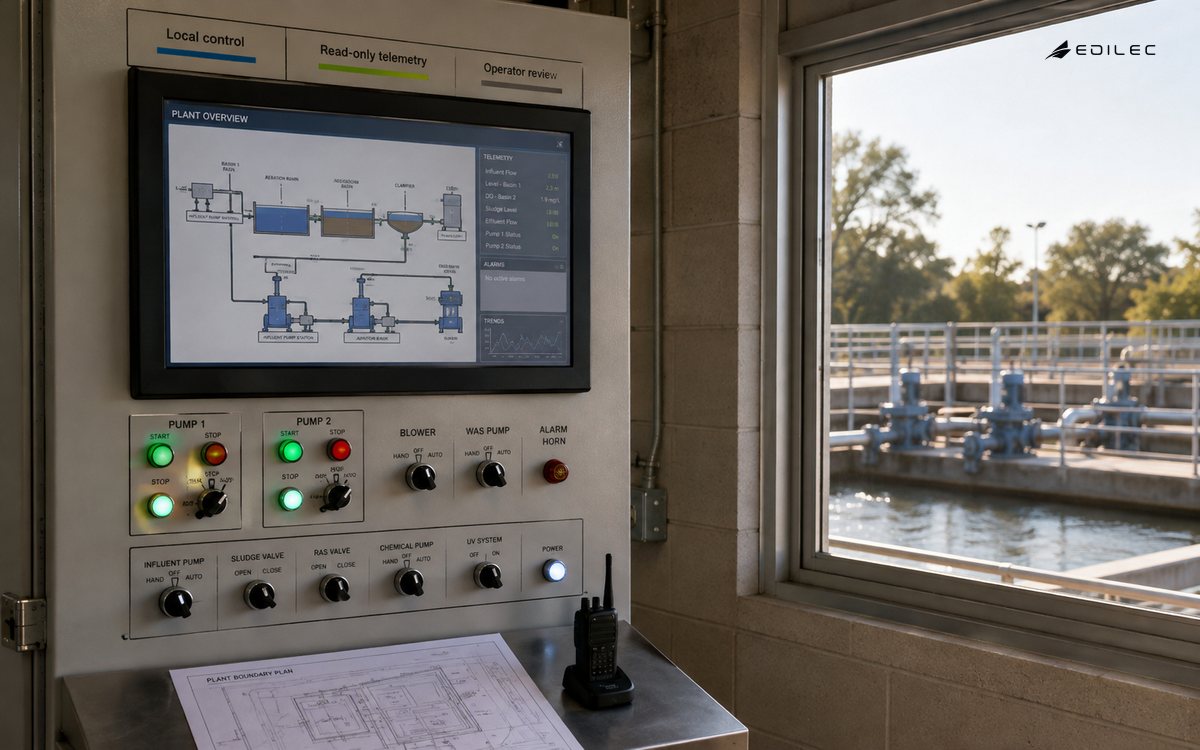
The NIST OT security guide grounds the boundary in safety, reliability, and availability. The NIST IoT manufacturer guidance clarifies product responsibilities, while the OpenTelemetry Logs Data Model supports consistent event context and the OWASP Logging Cheat Sheet keeps diagnostic evidence deliberate. These references turn a founder’s scope decision into evidence that plant and product owners can review.
Frequently asked questions
Should SCADA data go directly to the cloud?
Usually not without a deliberate boundary. A local gateway or historian can validate, buffer, filter, and protect the control environment while sending approved data outward.
Should a first integration include remote control?
Only when physical consequence, authorization, local interlocks, approval, and recovery are understood. Read-only visibility and task creation are safer first capabilities.
What proves readiness to expand?
Operators can interpret freshness and quality, support can trace events, local control stays safe during outages, and workflow improvement survives a degraded-shift test.
Conclusion
For a founder, the most important SCADA integration artifact is not a connector diagram. It is a boundary statement that names the process, the useful observation, the permitted digital response, and the authority that remains local. If a team cannot explain what happens when the network is unavailable, the first release is still a technology demonstration. Put the statement in the product brief and ask a controls engineer and an operator to challenge it before implementation. A credible first slice follows one asset class and one decision. It might help a maintenance lead distinguish a genuine cooling problem from a stale temperature, or help a shift supervisor create a work order from a confirmed alarm. Keep the signal path narrow enough to inspect: controller or historian, gateway, validation, transport, storage, calculation, interface, and human action. At each handoff, preserve source identity, event time, receipt time, unit, quality, and ownership. That information is what allows a support person to tell a late observation from a dangerous interpretation. Remote control deserves a separate approval path. A dashboard that reads a pressure value and a service that writes a set point do not have the same consequence, even when they use the same gateway. Treat commands as a different capability with explicit interlocks, authorization, operator confirmation, audit evidence, and a physical fallback. A safer early release may create a task, recommend an inspection, or show a bounded recommendation while leaving the controller authoritative. This separation gives the team useful learning without quietly turning analytics into an unreviewed control loop. Recovery should be demonstrated at the plant boundary. Disconnect the gateway, delay a historian response, change a tag unit, duplicate a reading, revoke a certificate, and restore the path. The interface should distinguish current, delayed, unknown, and rejected states. The local process should continue in its approved safe mode. After reconnection, reconcile what was missed and what was merely delayed; never make a cloud replay look like a live condition. Record who verifies the physical state before an automated or human workflow resumes. Security evidence should follow the same ownership model. Separate identities for devices, gateways, services, operators, and support staff. Limit destinations and permissions, make temporary access expire, and make mapping changes reviewable. Keep a small evidence sample for ordinary operation and another for a degraded shift. A decision record should include the rejected scope, the fallback, the acceptance test, and the next review date. Those artifacts are more useful than a claim that the integration is secure because it crosses a firewall. Measure whether the integration improves work without weakening local authority. Useful measures include trusted data freshness, time to diagnose a fault, rejected or quarantined observations, recovery duration, manual work created by poor context, and the percentage of actions that operators can explain. Review the measures with plant operations, controls engineering, security, support, and the business owner. If users bypass the interface, learn whether the cause is stale data, unclear authority, or an unsafe workflow before adding another feature. The founder’s final decision is whether to expand, narrow, or retire the boundary. Expand only when the normal and degraded paths are understood by people outside the build team. Narrow when a new data source, command, or site introduces uncertainty that the current evidence cannot contain. Retire a feed when it no longer changes a decision. A trustworthy SCADA integration earns scope through observable behavior, operator confidence, and a recovery routine that works when the plant is busy. For adjacent boundary decisions, compare edge gateways for connected systems, protocol selection for connected systems, and device provisioning in production. The comparison is useful only when each link is read through the same questions: who owns the physical consequence, which context is authoritative, how a degraded state is shown, and who approves recovery. Those questions keep a new integration from becoming an isolated data project. The founder should leave the review with named owners, a bounded first decision, a normal-case evidence sample, and a degraded-case rehearsal date.
Founders should judge SCADA integrations by the safety and quality of decisions they support. Define the boundary, preserve context, keep plant control local when appropriate, and prove recovery with the people who run the process.