What Changes When Firmware Updates Move into Production
Firmware updates move into production when they stop being a technical option and become an operating commitment. The question for CTOs is not whether the technology can be demonstrated; it is whether a deployed device fleet can support changed device software safely while retaining evidence of what ran, where it ran, and how recovery works through ordinary change, failure, and handoff. For firmware updates in production, make artifact provenance explicit before the workflow reaches its next decision point. In firmware updates in production, test cohort eligibility against the user action and record the resulting control evidence. A practical firmware updates in production review connects rollback authority to an owner, an observable state, and a recovery action.
Firmware update campaigns — Define the firmware updates production scope
Firmware updates become a production capability when the organisation can answer four questions for every release: which hardware and bootloader variants are eligible, what security and functional change it makes, how the device validates it, and what happens if installation is interrupted. A release note alone is not a plan. The fleet needs an accurate inventory, an eligibility policy, a maintenance window or operational trigger, and an owner who can pause the campaign.
For firmware updates, the scope statement should include an owner, a measurable outcome, the systems it touches, the constraints it cannot violate, and a condition for stopping or escalating. Use post-update health evidence to keep firmware updates in production decisions traceable when conditions change in the field. The firmware updates in production design is stronger when artifact provenance is checked alongside the affected workflow outcome. For firmware updates in production, make cohort eligibility explicit before the workflow reaches its next decision point. NIST SP 800-193: Platform Firmware Resiliency Guidelines RFC 9019: A Firmware Update Architecture for Internet of Things Devices
| Decision area | Question to settle | Evidence before release |
|---|---|---|
| Outcome | What decision does firmware updates improve? | Named user, action, timing, and success measure |
| Authority | Who may change, approve, or override it? | Role, approval path, and retained decision record |
| Data | What source is authoritative? | Identifier, time basis, quality rule, and owner |
| Failure | What happens when a dependency is unavailable? | Safe state, escalation route, and recovery test |
Firmware update campaigns — Build an inspectable architecture
Choose the update mechanism around the device's failure modes. Signed images, protected keys, version metadata, anti-rollback policy where needed, and a verified boot chain establish trust before application code runs. A dual-bank or recovery partition can make interruption recoverable, but it consumes device resources and still needs tests on real hardware. RFC 9019 and NIST platform-firmware guidance are helpful anchors for reasoning about architecture and protection rather than treating download delivery as the entire problem.
In a firmware updates design, make interfaces readable by people who must support them. In firmware updates in production, test rollback authority against the user action and record the resulting control evidence. A practical firmware updates in production review connects post-update health evidence to an owner, an observable state, and a recovery action. Use artifact provenance to keep firmware updates in production decisions traceable when conditions change in the field. The firmware updates in production design is stronger when cohort eligibility is checked alongside the affected workflow outcome. NIST IR 8259: Foundational Cybersecurity Activities for IoT Product Manufacturers
Firmware update campaigns — Put controls around consequential actions
Separate campaign authorisation from image creation and device installation. Maintain an immutable record of image hash, signer, target criteria, rollout cohort, device result, and operator action. Protect signing keys with an appropriate approval process; a compromised update authority is a fleet-scale risk. Reject a device report that lacks the expected identity, hardware claim, or cryptographic verification result instead of counting it as a successful update.
| Control | Why it matters | Practical test |
|---|---|---|
| Identity and access | Limits who or what may act. | Attempt an unauthorised request and confirm it is denied and recorded. |
| Change management | Makes altered behaviour reviewable. | Trace a production change to an owner, reason, and approval. |
| Integrity check | Prevents silent corruption or substitution. | Send malformed, stale, or unexpected input through the boundary. |
| Recovery path | Prevents improvised high-risk fixes. | Rehearse rollback or isolation with the responsible operational role. |
Firmware update campaigns — Operate with useful signals
Watch eligible-versus-reported inventory, download completion, installation success, rollback rate, boot failures, time in each update state, and performance or error changes after activation. Slice these by hardware revision, geography, network type, and cohort. A single aggregate success rate can conceal a failing variant that will matter during the next maintenance cycle.
For firmware updates, a metric is useful when it changes a decision. For firmware updates in production, make rollback authority explicit before the workflow reaches its next decision point. In firmware updates in production, test post-update health evidence against the user action and record the resulting control evidence. NIST SP 800-61 Rev. 2: Computer Security Incident Handling Guide frames the update runbook as a sequence of analysis, containment, restoration, and learning tied to cohort health.
Firmware update campaigns — Roll out by evidence
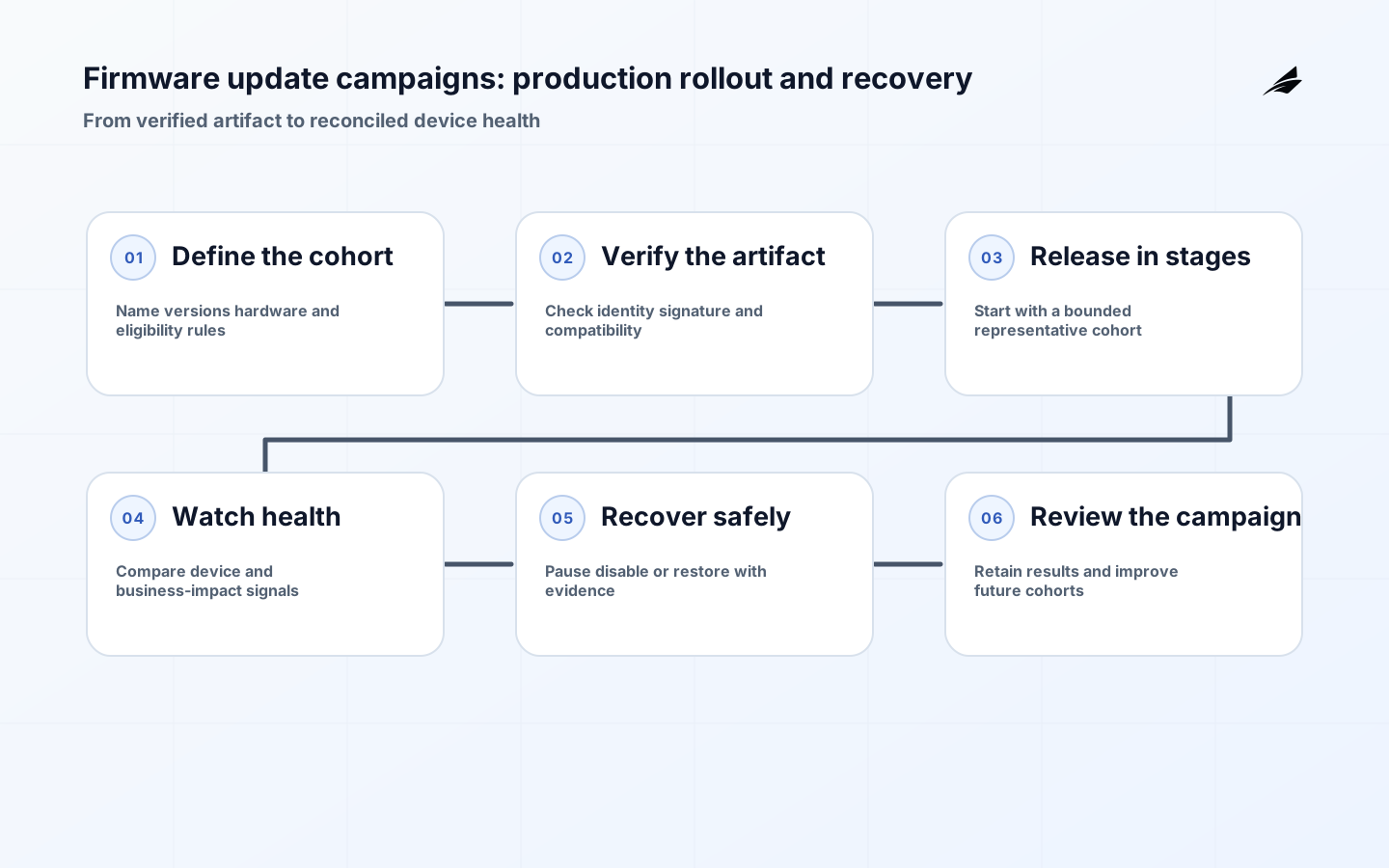
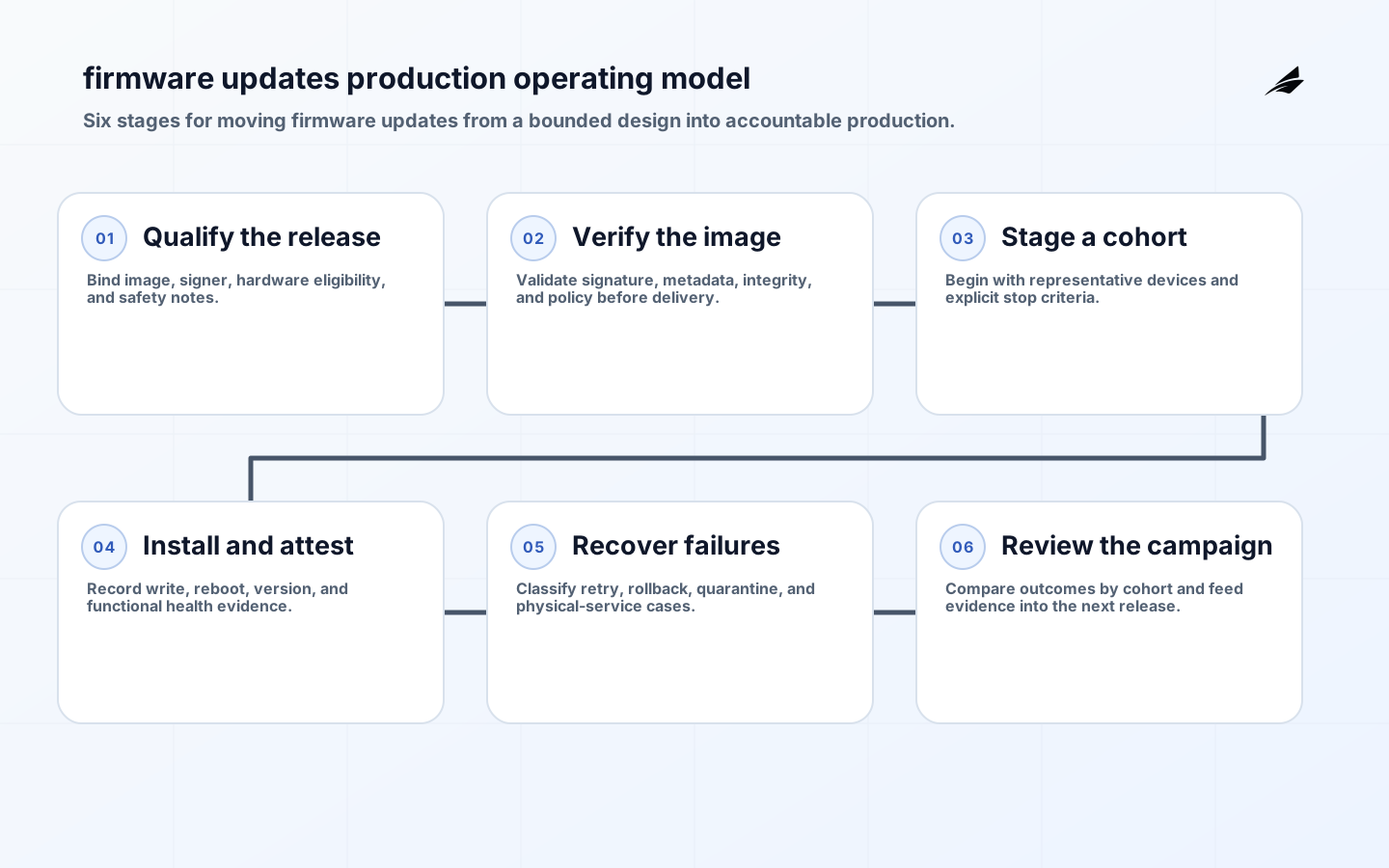
Use rings: laboratory hardware, a small internal cohort, a representative pilot, then controlled expansion. Define entry and stop criteria before the first device receives the image. Keep the prior verified image or a recovery method available, and avoid simultaneous updates to redundant devices that support the same process. The right speed is the one that leaves time to observe the cohort, not the fastest possible download.
For this firmware updates rollout, before broad release, document the acceptance evidence for the bounded path: expected inputs, expected outputs, access constraints, known limitations, support contact, and rollback trigger. A practical firmware updates in production review connects artifact provenance to an owner, an observable state, and a recovery action. Use cohort eligibility to keep firmware updates in production decisions traceable when conditions change in the field.
Firmware update campaigns — Design for failure and recovery
A failed installation needs a state model, not a generic retry. Distinguish download failure, verification failure, interrupted write, first-boot failure, and functional regression after boot. Some cases can retry safely; some need rollback; some require physical service. Preserve the device log, image identity, power and connectivity context, and recovery decision. That evidence is what makes the next release safer.
For firmware updates, make the recovery procedure proportionate to consequence. The firmware updates in production design is stronger when rollback authority is checked alongside the affected workflow outcome. For firmware updates in production, make post-update health evidence explicit before the workflow reaches its next decision point. In firmware updates in production, test artifact provenance against the user action and record the resulting control evidence.
Firmware update campaigns — Run an implementation review
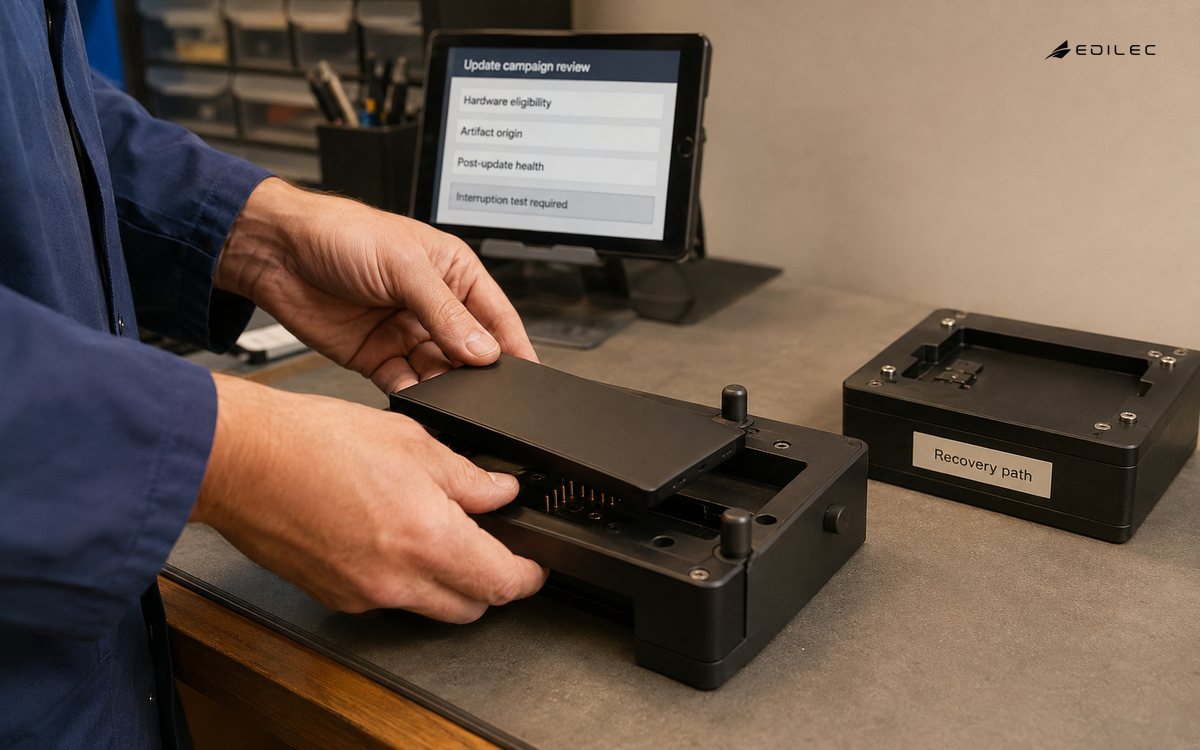
A firmware campaign review should include engineering, security, support, and the operational owner of the affected equipment. Inspect a sample device result from image selection through post-boot health, then inspect an excluded device and a failed device. This checks whether the campaign can explain every outcome, including no action. It also forces a clear decision about devices that cannot recover remotely, spare hardware, and the trigger for pausing a release before a local fault becomes fleet-wide.
For every campaign, retain a cohort ledger that links image hash, target rule, device state, outcome, and operator decision. That ledger provides the evidence needed to halt, investigate, or explain a release long after the download service has moved on.
Key takeaways
- Treat an update as a managed campaign rather than a file transfer.
- Verify image, device eligibility, and installation outcome independently.
- Protect signing authority and retain image provenance.
- Use cohorts and stop criteria before wide rollout.
- Measure results by device and hardware variant, not only fleet totals.
- Design recovery for interruption, failed boot, and functional regression.
Frequently asked questions
Are over-the-air firmware updates always appropriate? No. The device, connectivity, safety consequence, and recovery access determine whether remote update is acceptable.
What is the most important update metric? A traceable outcome per eligible device, including why a device was not updated, is more useful than one percentage.
Can a rollback solve every problem? No. Data migrations, anti-rollback requirements, and hardware faults can limit rollback; those limits must be designed and tested.
Firmware update campaigns — Related reading
For adjacent operating decisions, read What Changes When Device Identity Moves into Production, What Changes When Gateway Security Moves into Production, and Offline Sync Decisions That Matter before the First Build. A practical firmware updates in production review connects cohort eligibility to an owner, an observable state, and a recovery action.
Conclusion
Firmware updates earns its place in connected operations when the team can explain the outcome, boundary, trust model, operating signals, and recovery route in plain language. Use rollback authority to keep firmware updates in production decisions traceable when conditions change in the field. That approach leaves CTOs with something more durable than a feature: a system people can run and improve under pressure.
A production firmware campaign is a controlled change to a device population, not a download job. Record artifact identity, signature verification, hardware eligibility, cohort membership, attempts, boot result, post-update health, and recovery action. Set halt thresholds before exposure and distinguish a device that never received the image from one that installed it but failed its operational check. Recovery may mean a dual-image fallback, a protected recovery image, a supervised field procedure, or forward repair when rollback is unsafe. Reconcile the campaign against inventory and policy version so the team can explain which image ran on which hardware and what remains unsupported.
Related reading: Related guide 1, Related guide 2, Related guide 3.
Treat field support as part of the campaign design. A technician needs the device identity, installed version, failed stage, safe state, and approved next action. Without that context, a recovery call can create a second uncontrolled change. Retain the campaign record until the device population and its exceptions are reconciled.