How Founders Should Think About Device Provisioning
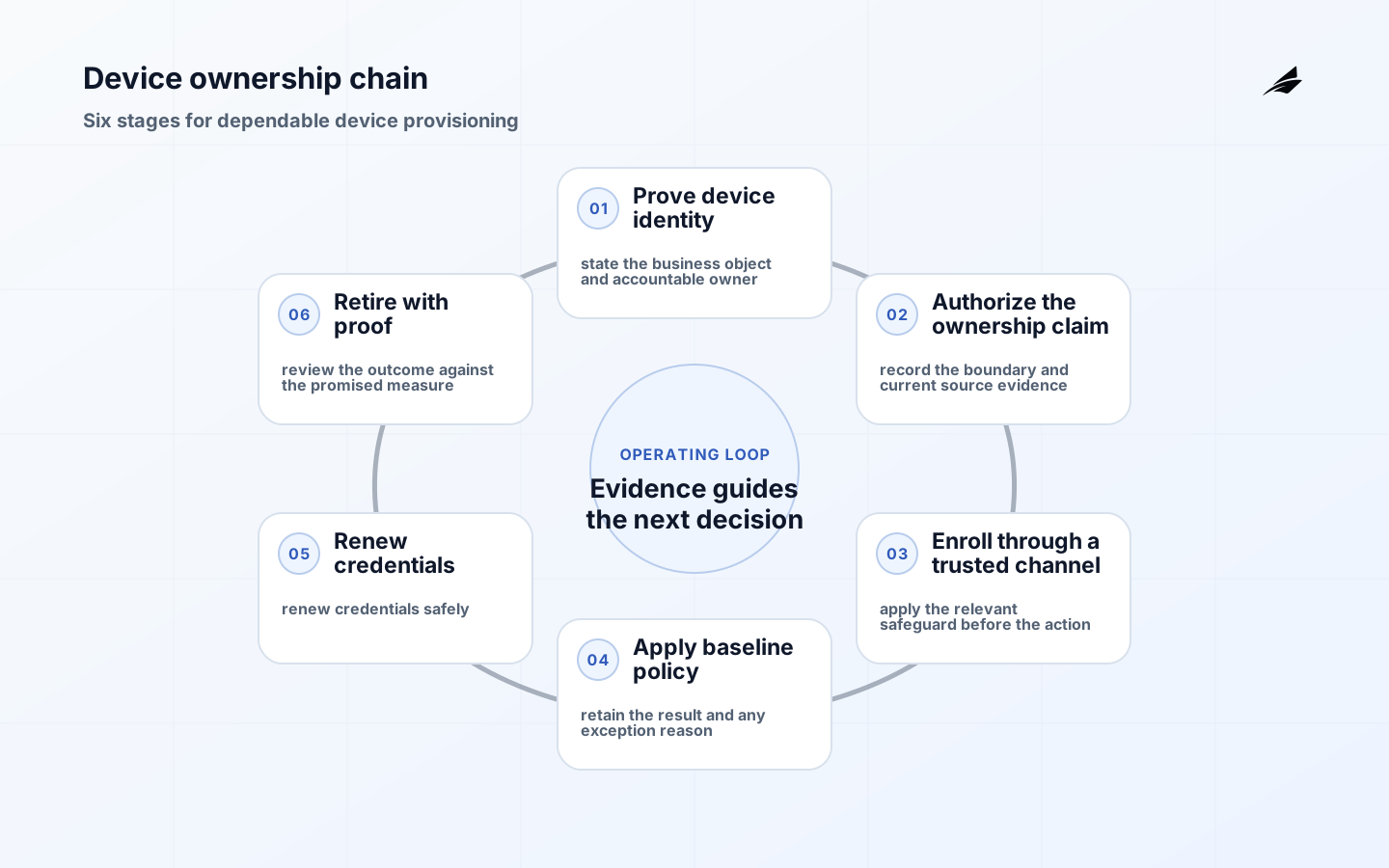
Device provisioning explains how a team can make device provisioning dependable before the work becomes difficult to reverse. Device provisioning uses a decision with a named owner, bounded action, visible state, and inspectable evidence.
Define the device provisioning decision
Device provisioning is ready for a controlled release when the team can state what is authoritative, which context permits action, what must be retained, and how an exception reaches a responsible person. Device provisioning uses a provisional state when evidence is incomplete; Device provisioning never turns an unanswered question into a silent default.
How Founders Should Think About Device Provisioning
- For device provisioning, frame one consequential business object and one accountable owner.
- For device provisioning, capture device identity at the boundary where a request becomes an approved operational action.
- For device provisioning, test the credential lifecycle route with missing, late, duplicate, denied, and corrected inputs.
- For device provisioning, review downstream impact before a change reaches a reader, customer, employee, supplier, or device.
- For device provisioning, approve a bounded correction with a named resolver, deadline, and retained reason.
- For device provisioning, verify the released result against the promised measure and record what remains uncertain.
Controls and evidence for Device provisioning
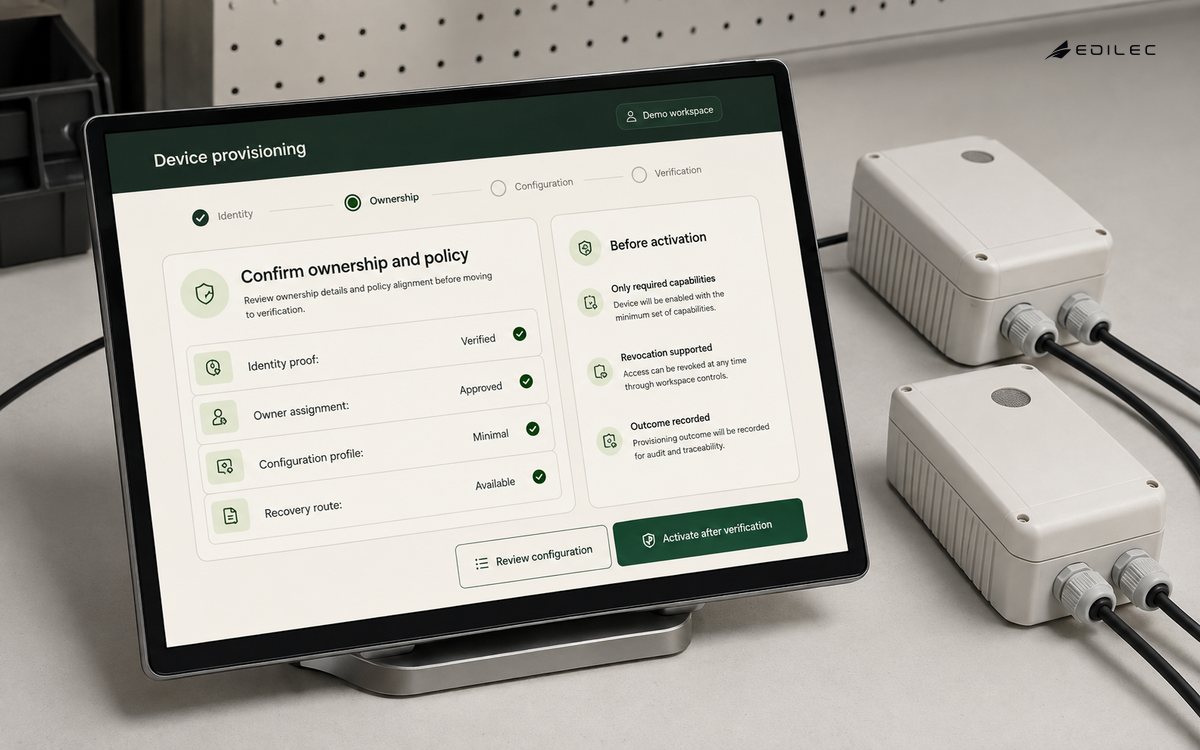
A provisioning control must establish who is allowed to claim a device before it delivers configuration or credentials. Bind the device identity to a verifiable record and an accountable owner, and retain the claim evidence, enrollment method, policy version, effective time, and current lifecycle state. Keep physical possession, manufacturer or fleet records, and authorization to operate distinct when the process depends on different actors. The service should expose a bounded state such as pending claim, enrolled, suspended, or retired rather than treating missing evidence as approval. Audit entries should show the actor and action without disclosing private key material or other secrets. When a claim or enrollment check fails, preserve the prior state, name the resolver, and record the safe next action. This gives operators a trustworthy credential lifecycle to hand over.
| Decision point | Evidence to retain | Owner response |
|---|---|---|
| Normal case | The input, rule, actor, timestamp, and outcome for a newly claimed device. | Confirm the result and publish its status. |
| Exception | The failed check, affected scope, safe options, deadline, and disposition. | Route the case to the device lifecycle owner without overwriting history. |
| Change | The previous behavior, new definition, approval, effective time, and rollback point. | Reconcile the affected records before expanding scope. |
Test Device provisioning before rollout
- For device provisioning, trace one case from intake through the final decision and observable outcome.
- For device provisioning, replay a normal case and an exception case while preserving device identity and the responsible actor.
- For device provisioning, ask an operator outside the build team to explain the credential lifecycle route without private context.
- For device provisioning, measure completion quality, exception age, recovery time, and evidence completeness by owner.
- For device provisioning, check that a correction reaches every affected consumer without rewriting the original event.
- For device provisioning, record the next review date, escalation route, and condition for safely expanding scope.
Test provisioning as a lifecycle, from an unclaimed device to an enrolled device with a usable minimum configuration. Exercise normal enrollment as well as an unknown device, duplicate claim, missing evidence, denied authority, delayed dependency, failed credential renewal, and reversal. Check that each case reaches an explicit state, produces an auditable decision, and leaves no active credential when policy requires suspension or rollback. Replay cases after a retry to confirm the service does not create competing identities or duplicate ownership records. Have an operator outside the build team follow the evidence and explain who may resolve the exception. Include the recovery result in the test record, not just the initial failure. A rollout is ready when the team can demonstrate both successful onboarding and a controlled path back to a safe state.
Implementation notes for Device provisioning
Implement provisioning as explicit state transitions: inventory or claim, enrollment, minimum configuration, active operation, suspension, and retirement. At each transition, identify the authority that may approve it and the evidence that makes the decision repeatable. A device record should connect the identity, responsible owner, credential status, policy version, and effective time; configuration delivery should not silently create a new identity when a retry occurs. Keep the first release narrow enough that support staff can inspect a single case and determine whether the device is merely present, authorized to join, or ready to operate. Define the exception route for an unrecognized claim, incomplete enrollment, or configuration mismatch, including the deadline and resolver. This state model gives founders a concrete product boundary and gives operations a reliable handoff.
The credential lifecycle continues after initial enrollment. Define when credentials are issued, renewed, rotated, suspended, revoked, and recovered, and connect each event to the device identity, policy version, actor, effective time, and result. A failed or overdue renewal should move the device into a defined restricted state rather than leaving operators to infer whether it remains trusted. Recovery must verify the device and the approving authority before restoring access, while retirement must prevent further use of credentials that no longer have an owner. Keep secrets out of audit and support traces; retain evidence about the event and decision instead. RFC 8995 and RFC 7030 provide relevant enrollment patterns, while the NIST IoT guidance supports treating identity, update, and lifecycle responsibilities as product requirements rather than optional support work.
Operating the fleet requires ownership beyond the enrollment transaction. Assign a support owner for each exception and monitor completion quality, exception age, recovery time, and evidence completeness as the accompanying table recommends. When a device is transferred, lost, replaced, or retired, update the authoritative lifecycle state, revoke or restrict its credentials as appropriate, and preserve the reason and effective time. A correction is complete only after dependent services and operators can see the reconciled state; do not erase the original claim or event to make the record look clean. Use a pause or quarantine path for uncertain devices and define who may release it. Expand scope only after normal and exceptional cases have a tested correction route and the team can explain the remaining operational risk.
| Operational question | Evidence to retain | Owner response |
|---|---|---|
| What proves device provisioning is ready? | For device provisioning, a dated device identity decision record connects the input, rule, actor, result, and review. | Confirm the evidence before widening scope. |
| What happens when device provisioning is uncertain? | For device provisioning, the system marks the state, limits the action, names the resolver, and preserves prior context. | Route the exception without erasing history. |
| How is device provisioning corrected? | For device provisioning, the correction names the changed fact, affected readers, approval, effective time, and verification result. | Reconcile consumers and close the case. |
| Which measure protects device provisioning? | For device provisioning, track completion quality, exception age, recovery time, and evidence completeness by owner. | Review the trend with the accountable operator. |
| What should be rehearsed for device provisioning? | For device provisioning, test normal completion, missing data, duplicate input, denied access, delayed dependency, and reversal. | Record the scenario outcome and remaining risk. |
| When may device provisioning expand? | For device provisioning, expand only after representative normal and exceptional cases pass with a usable correction route. | Approve the next bounded use explicitly. |
Carry provisioning evidence into field operations
A device is not fully provisioned merely because it connected once. Retain the manufacturing or enrollment identifier, hardware and firmware version, credential or certificate reference, tenant and site assignment, policy version, activation time, and the result of the first health check. Define how operators distinguish an unclaimed device, a failed enrollment, a revoked identity, a transferred asset, and a device awaiting secure reset. The field workflow should support replacement and recovery without copying long-lived secrets or bypassing ownership checks. This evidence allows support teams to investigate connectivity and authorization while preserving the boundary between device identity, customer tenancy, and the person permitted to administer it.
Key takeaways for Device provisioning
For device provisioning, keep the owner, authoritative state, permitted action, evidence boundary, and recovery route visible. For device provisioning, pause the normal path when proof is missing and show how a corrected result reaches each affected reader.
Device provisioning FAQ
For device provisioning, what should a team settle first? Device provisioning teams should start with the accountable owner, authoritative state, permitted action, evidence boundary, and recovery route. For device provisioning, ask which operator can pause the normal path, what proof they need, and how correction reaches each affected reader.
A dependable device provisioning operating rule
For device provisioning, keep the first release narrow, measurable, and owned. For device provisioning, a result earns its next use only when it can be explained, challenged, corrected, and reviewed by the right person.
For device provisioning, consult these official references for the operating choices in this guide: RFC 8995: Bootstrapping Remote Secure Key Infrastructure; RFC 7030: Enrollment over Secure Transport; NIST SP 800-213: IoT Device Cybersecurity Guidance; NIST IR 8259 Rev. 1: Foundational Cybersecurity Activities for IoT Product Manufacturers. device provisioning related guide 1; device provisioning related guide 2; device provisioning related guide 3