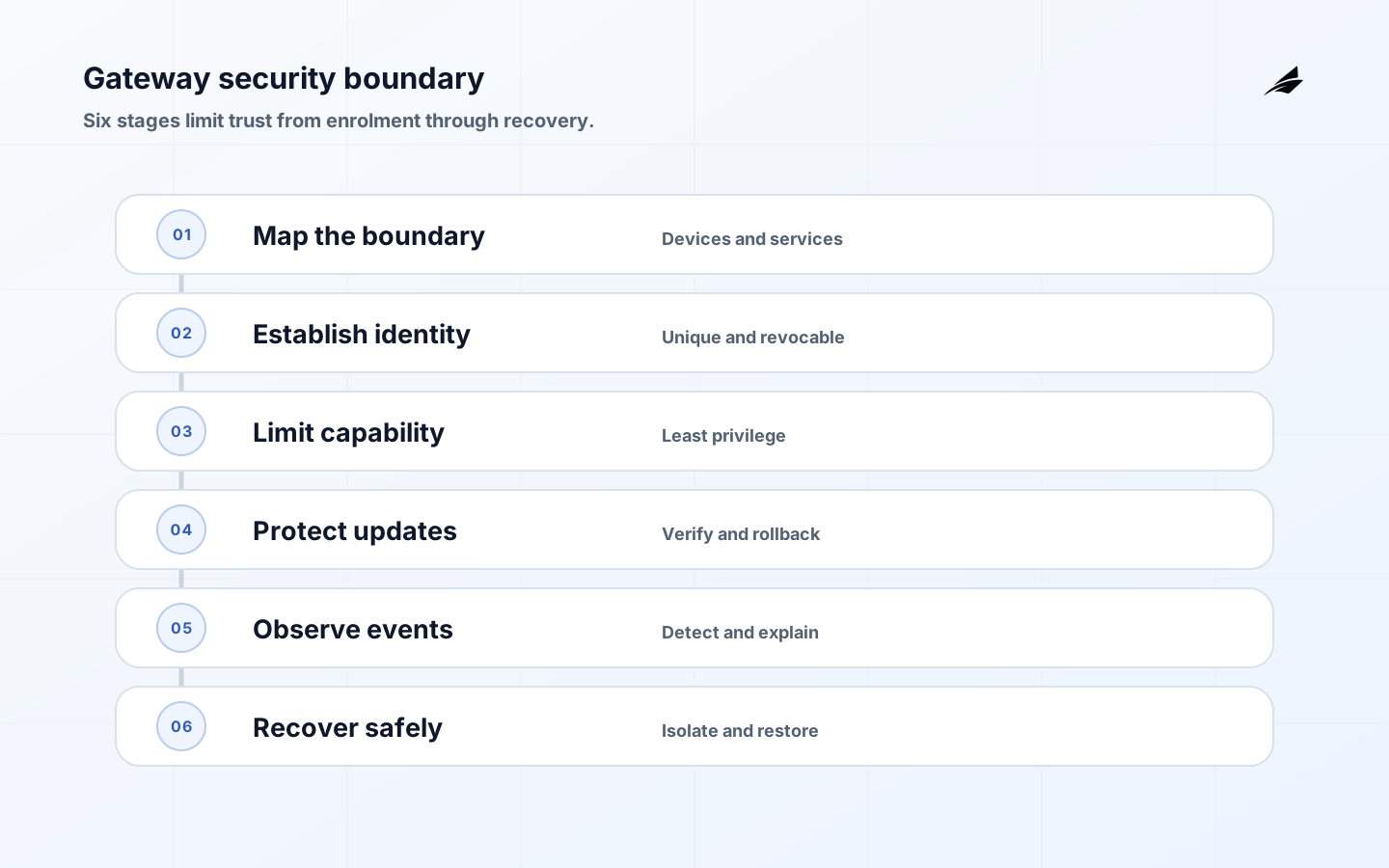
A gateway sits where devices, networks, applications, and physical consequences meet. Product teams should therefore treat gateway security as a user and business promise: only the right device and service may exchange the right data or request the right action, and the team can explain what happened when the path fails. A gateway that merely accepts messages is easy to demo and hard to defend. NIST’s Zero Trust Architecture is a useful foundation because it rejects implicit trust based on network location. That principle becomes concrete in a gateway when identity, authorization, message scope, update authority, and recovery evidence are designed together.
Map the gateway boundary
Draw every connection before selecting a security product. Include sensors, controllers, local operators, gateway processes, broker, cloud API, support tooling, update service, and downstream systems. For each edge, name the identity, direction, allowed action, data sensitivity, and failure behaviour. A gateway may need to translate an old field protocol into MQTT, cache data during a network outage, and expose a narrow management channel. Those are different trust decisions. The team should be able to answer whether a device can publish only telemetry, whether an operator can issue a command, and whether support staff can inspect secrets. Unnamed edges become default permissions.
| Boundary | Default decision | Proof |
|---|---|---|
| Device to gateway | Authenticate and allow named topics or fields | Credential, policy, and denied test |
| Gateway to broker | Use an authenticated service identity | Handshake and certificate rotation record |
| Operator to gateway | Permit only scoped actions | Role, target, and audit event |
| Update service to gateway | Verify signed and compatible release | Version, hash, and rollback result |
Make identity the first control
A device name is not a credential. Give each device or gateway a durable identity, protect the private material, and make replacement and revocation normal operations. Avoid shared credentials across a fleet because one compromise then becomes a fleet-wide incident. Bind authorization to device role, tenant, site, asset, topic, command, and software state where appropriate. MQTT supports authenticated clients and topic-based communication, but the topic taxonomy still needs product ownership. The MQTT specification can inform protocol choices; it cannot define whether a field technician may send a reset command to a production controller. That decision belongs in a policy the team can test.
Segment the gateway and minimize capability
Run only the components the gateway needs. Separate protocol adapters, local storage, command handling, and management functions so a weakness in one path does not automatically grant the others. Restrict outbound destinations, inbound ports, file permissions, and administrative shells. The IoT device cybersecurity baseline helps express the expected protection boundary, but the deployed environment still needs a test that an unneeded path is unreachable, a required path works, and a failed policy produces a visible, supportable symptom.
Security should also be usable at the edge. A technician may need to commission a gateway in a plant with intermittent connectivity, while a central operator needs to revoke it quickly. Design a bootstrap flow with a short-lived enrollment credential, a visible device state, and a local confirmation step. Do not put permanent secrets in a printed install guide. Connect this work to sensor data pipelines for connected systems, industrial dashboards, and gateway security for connected systems because a secure command boundary is only useful if the product communicates state and ownership clearly.
Protect updates and configuration
A gateway that cannot be updated safely becomes a permanent risk. Define who may release firmware, operating-system patches, configuration, certificates, and policy. Verify provenance and compatibility before installation, keep the previous known-good version where feasible, and make rollback observable. Configuration deserves the same care as code: a topic wildcard, open management port, or debug flag can change the security posture without a binary release. NIST key-management guidance reinforces the need to protect certificates and other security material throughout maintenance. Record version, reason, approver, target population, and outcome for every change. Review the release evidence with operations and support so a failed update has a known owner, clear symptom, and safe next action.
| Failure mode | Safe response | Recovery evidence |
|---|---|---|
| Credential suspected | Revoke, isolate, and re-enrol | Identity state and replacement record |
| Update incompatible | Stop rollout and restore known good version | Target count and verified health |
| Broker unreachable | Queue bounded telemetry and deny unsafe commands | Queue age and command outcome |
| Policy change breaks traffic | Roll back policy with review | Diff, approver, and restored path |
Observe the security posture
Collect enough evidence to distinguish a broken device from an attack and a policy mistake from a network outage. Useful events include authentication failures, denied topics, command attempts, certificate changes, update outcomes, local configuration changes, clock anomalies, and repeated restart cycles. Protect logs from tampering, control retention, and avoid collecting payloads that the support team does not need. TLS 1.3 is a reference for protecting telemetry and administrative traffic in transit; pair that transport protection with a response owner and a playbook for isolate, inspect, restore, notify, and learn.
Test the product under pressure
Security testing should exercise the journeys a customer will actually use. Enrol a new gateway, replace a device, lose the broker, rotate a certificate, deploy a policy, roll back an update, and remove an operator. Test both the expected denial and the recovery path. A penetration test can find useful weaknesses, but it cannot decide whether a command should be allowed or whether a customer can recover without an emergency visit. Hold those decisions in acceptance criteria. If the gateway is used near physical equipment, include a safe state for uncertain command delivery and require reconciliation before repeating a command. Reliability and security meet at that boundary.
Also confirm the gateway’s clock, local storage, and update state are visible to operators. These small details determine whether an incident can be reconstructed and whether a retry is safe.
Boundary review before rollout
Run the gateway through enrolment, revocation, certificate rotation, policy denial, update failure, and broker loss before field deployment. Confirm that the denial is recorded, the current state is visible, and support can identify the affected device without retrieving secrets. The sensor data pipelines guide is a useful companion for keeping source health and gateway tests tied to customer recovery.
Deployment checks that protect the boundary
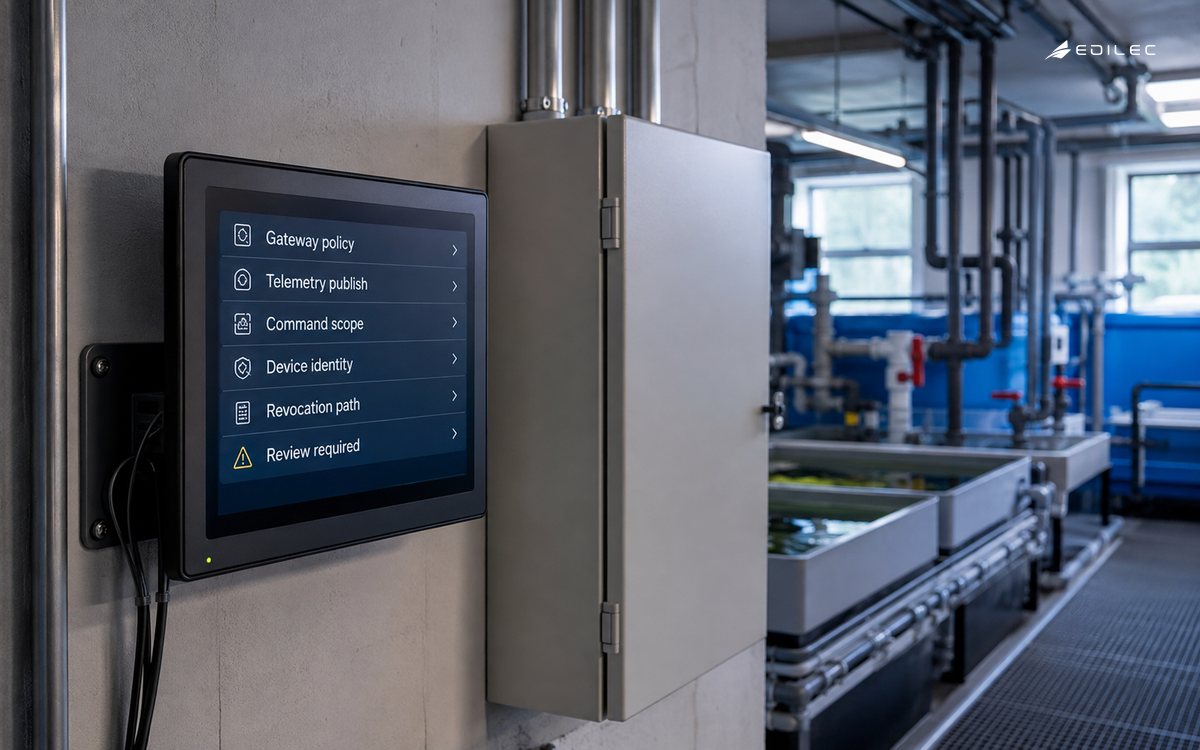
Before a gateway reaches a customer site, test enrolment, revocation, certificate rotation, policy denial, update failure, and loss of the broker. Use a test identity that is not allowed to publish into another site or issue a command, then confirm the denial is recorded and understandable. Test the same cases after a restart and after the gateway’s clock changes. A control that works only during the first session is not a production control.
Make the support contract as specific as the security contract. The support person should be able to find gateway identity, software version, policy version, last contact, last denied action, and current update state without retrieving secrets. The product team should know when to isolate locally, when to revoke centrally, and when a customer needs a technician. The sensor data pipelines guide is a useful related reference for keeping this work tied to the product journey.
- Prove a new gateway cannot impersonate an existing identity.
- Prove a revoked identity cannot reconnect or replay a command.
- Prove an update can pause and recover without hiding the current state.
- Prove the incident record contains enough evidence to scope affected devices.
Audit the gateway boundary after launch
A gateway review should test signal quality where commissioning, update, and revocation work actually happen. Sample records from different sites and confirm that the device, policy, evidence, and next containment step are unambiguous. Check the time from capture to acknowledgement and whether urgent security events bypass the normal cadence safely. Look for failure classes that appear only at well-connected sites and for risks hidden at disconnected installations. This review keeps the boundary from becoming a green status page.
When a gateway policy or update ships, define how the team will prove that the boundary still works. Combine enrolment success, denied-action tests, certificate rotation, update health, support escalations, and device recovery evidence. Review a known-good gateway and a deliberately revoked one so a green rollout does not hide a weak control. Keep the maintenance path usable: technicians should not have to repeat a commissioning journey simply because the security policy changed.
- Sample signals by segment and source, not only by volume.
- Review unowned and stale records with the responsible team.
- Link every release claim to an outcome check.
- Retire fields and states that do not improve a decision.
Key takeaways
- Map every gateway connection and give each one an explicit trust decision.
- Use individual identities, scoped permissions, and routine revocation.
- Reduce components and network reachability, then verify the real enforcement layer.
- Treat configuration and updates as security-sensitive changes.
- Log enough evidence to isolate, recover, and explain an incident.
Frequently asked questions
Can gateways share one credential?
Avoid shared credentials for production devices. Individual identity makes revocation, replacement, incident scope, and audit evidence manageable. If a bootstrap secret is unavoidable, make it short-lived and replace it during enrolment.
Is network isolation enough for gateway security?
No. Network controls reduce reachable paths, while application authorization decides which authenticated actor may perform an action. Use both, and test them in the deployed environment.
What must an update system prove?
It should prove provenance, target scope, compatibility, installation result, current version, and rollback or containment when the release fails. The evidence should be available to support and security owners.
Conclusion
Gateway security becomes a product capability when identity, permission, segmentation, updates, observation, and recovery are visible in the customer journey. Define the boundary before buying controls, make the safe path easy for operators, and test the uncertain path before the gateway reaches the field.