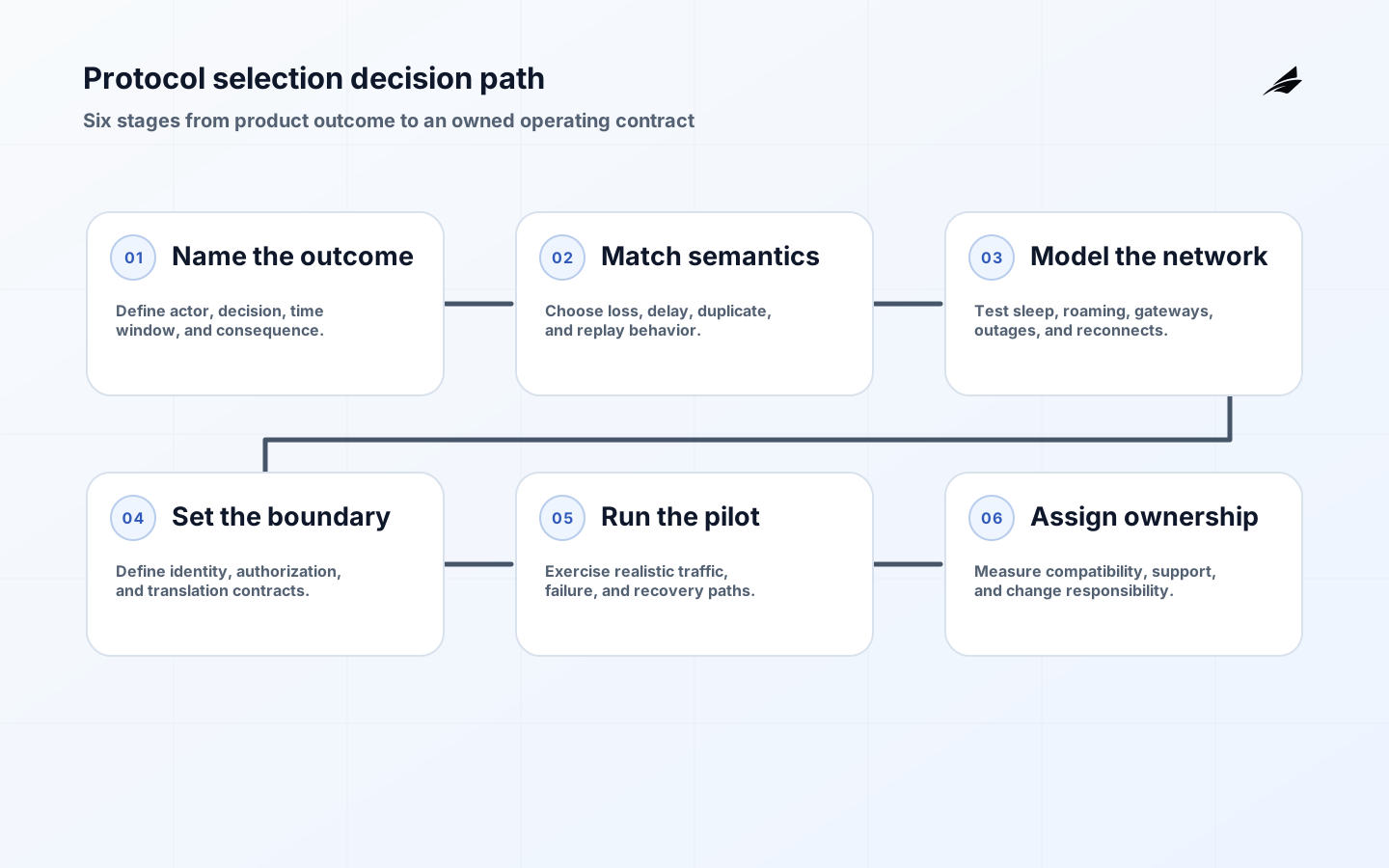
Protocol selection is a product decision with technical consequences, not a vote between familiar acronyms. A cold-chain team may need compact telemetry, intermittent connectivity, and a clear rule for missing readings. A building-control product may need commands, retained state, and careful authorization. The right question is not which protocol is fastest in a benchmark; it is which interaction contract lets the product deliver a useful outcome while making failure observable. Start with the decision a customer or operator will make, then work backward to message shape, delivery semantics, network path, identity, and ownership. The MQTT Version 5.0 specification and IETF CoAP specification are useful anchors because they describe actual protocol behavior rather than marketing categories.
Start with the Product Decision
Write the first use case as a decision record: who needs what information, how fresh it must be, what happens when it is late, and whether a duplicate can cause harm. “Send temperature data” is too vague. “Keep a refrigerated shipment within its approved range and alert a coordinator when the evidence is stale” creates a testable boundary. The boundary also reveals whether the system is telemetry-only, request-response, command-oriented, or a combination. Link this work to IoT telemetry explained from first principles so the product conversation includes timestamps, units, provenance, and quality rather than only transport names. Do not approve a protocol until the team can describe the safe behavior during delay, duplication, reordering, reconnect, and partial rollout.
| Product question | Why it changes the choice | Evidence to capture |
|---|---|---|
| What is the interaction? | Telemetry, command, state, and request-response have different contracts. | A message sequence for the happy and failed paths. |
| How much delay is acceptable? | A periodic reading can tolerate delay that a safety command cannot. | Freshness target and stale-data behavior. |
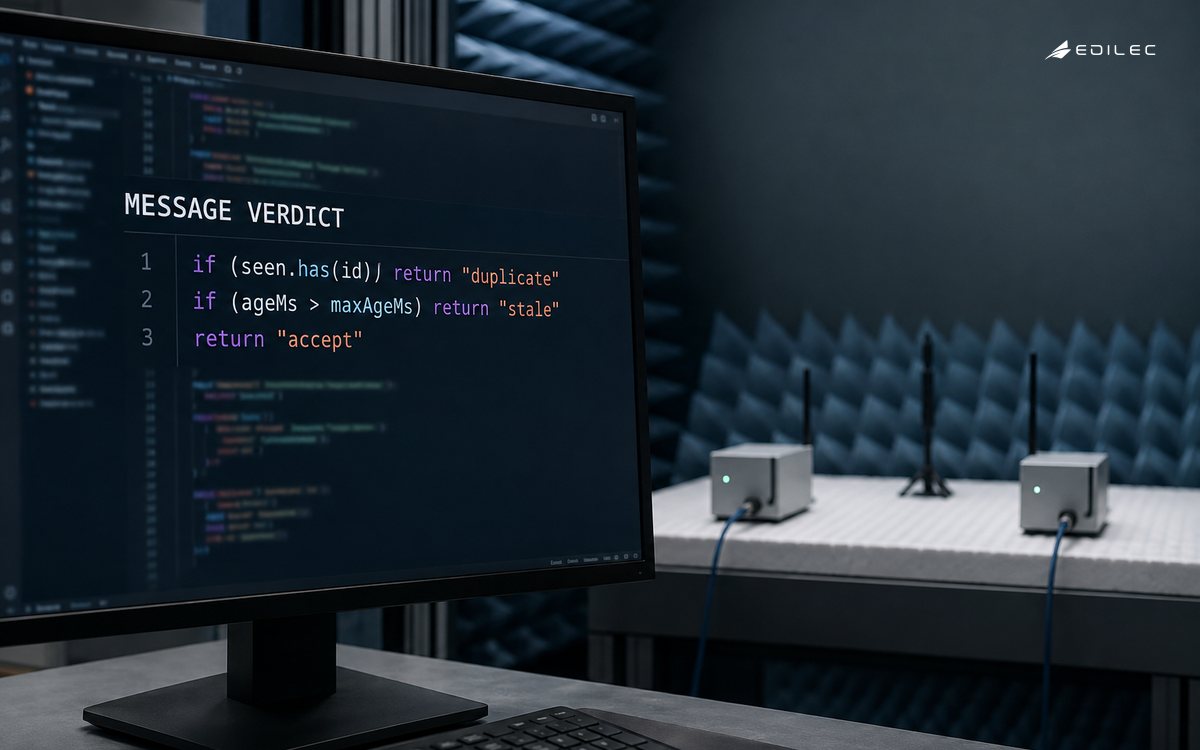
| What happens on duplication? | At-least-once delivery can repeat messages. | Idempotency key or duplicate handling rule. |
| Who owns the boundary? | A protocol cannot define operational accountability by itself. | Named owner for client, broker, gateway, and consumer. |
Match Delivery Semantics to Consequence
Delivery semantics should be chosen from the consequence of loss or repetition. MQTT 5.0 describes three quality-of-service levels: at most once, at least once, and exactly once. That vocabulary is helpful, but it does not remove application design. At-least-once delivery still requires consumers to tolerate duplicates, while exactly-once at the protocol layer does not make an external payment or actuator side effect magically reversible. For a humidity trend, at-most-once may be reasonable if the next sample arrives quickly. For a valve command, use a command identifier, expiry, authorization, acknowledgement, and a safe device state. Put the decision in a contract that engineers, support staff, and product owners can inspect.
Account for the Network You Actually Have
A protocol that looks elegant on a lab network can become expensive when devices sleep, roam, cross NAT boundaries, or operate behind a constrained radio. TCP provides an ordered, reliable byte stream, as documented in the TCP specification, but your product still needs connection management, keepalive policy, reconnect backoff, and bounded queues. CoAP is designed for constrained application environments and commonly pairs with UDP, while HTTP/3 uses QUIC and brings different connection and deployment considerations; the HTTP/3 specification is the right place to verify the wire behavior. Measure battery cost, handshake frequency, payload overhead, and gateway translation work with representative network traces before committing.
Make Security Part of the Protocol Boundary
Security is not a later library choice. Decide how a device authenticates, how a service authorizes a topic or resource, how keys rotate, and what an operator sees when access is rejected. A protocol choice that depends on one shared credential may be cheap to prototype but difficult to contain when a device is lost. Separate device identity from message content, use encrypted transport where the deployment requires it, and test certificate or token expiry before launch. Use device provisioning security review as a companion when identity is still being designed. A sound selection document records the trust boundary, credential lifecycle, broker or endpoint policy, and the smallest set of operations each actor needs.
| Boundary | Decision to make | Failure test |
|---|---|---|
| Device to gateway | Can the device authenticate and reconnect safely? | Expired credential and loss of radio coverage. |
| Gateway to service | Who can publish, subscribe, or call an endpoint? | Unexpected topic, path, or tenant access. |
| Service to application | How is data authorized and interpreted? | Replay, duplicate, and stale payload. |
| Operations | Who can revoke, inspect, and recover? | Lost device, leaked key, or policy mistake. |
Choose an Architecture, Not Just a Protocol
Most durable IoT products use more than one protocol. A sensor may use a low-power link to an edge gateway; the gateway may publish normalized events to MQTT; an application may expose HTTPS for dashboards and administration. That is not inconsistency when each boundary has a clear responsibility. Keep translation explicit: preserve source timestamp, device identifier, calibration state, sequence number, and quality flags as data crosses a boundary. Do not let a gateway silently convert a command into an irreversible action without recording who authorized it. MQTT brokers architecture guide provides useful context for the broker side, while the product team should own the end-to-end contract.
Run a Small, Decisive Evaluation
Use a pilot that can answer a handful of material questions. Connect representative devices, introduce packet loss and reconnect storms, rotate credentials, replay messages, and observe the consumer behavior. Capture battery draw or gateway CPU where relevant, but also capture operator effort: how long does it take to identify a stale stream, revoke a device, or distinguish a protocol error from a sensor fault? A two-week pilot with a narrow acceptance contract is more useful than a broad proof of concept that never tests recovery. Record which assumptions were proven, which remain open, and which are intentionally deferred.
Give the Protocol an Operating Owner
The protocol becomes a product dependency the day customers rely on it. Assign ownership for version policy, compatibility, observability, client libraries, gateway behavior, and incident response. Define how a schema changes, how a deprecated topic is retired, and how consumers discover the contract. Track connection failures, authentication failures, publish latency, queue depth, duplicate rate, stale-data rate, and command acknowledgement. These measures are not a substitute for user outcomes; they are signals that help the owner find where the outcome is at risk. Protocol selection for reliable digital operations can support the checklist, but keep the final decision grounded in this product's boundary.
A useful selection worksheet should fit on one page. Record the primary interaction, acceptable delay, loss consequence, duplicate consequence, network profile, trust boundary, device lifecycle, integration path, and operating owner. Mark each item as known, tested, assumed, or deferred. This prevents a team from treating a decision as complete because a transport connected in a lab. It also gives procurement a precise set of questions: which limits matter, which features are portable, and which operational capabilities would be vendor-specific.
Revisit protocol selection when the product crosses a meaningful boundary: a new tenant, a new actuator, a new radio, a safety-related workflow, or a materially different retention obligation. A protocol can remain appropriate while the surrounding contract changes. Keep compatibility tests for client versions, gateway translation, schema evolution, and authentication renewal. The goal is not to prevent change; it is to make change visible before it reaches a customer decision.
For a concrete example, consider a building sensor that reports occupancy every thirty seconds and a control service that sets an access mode. The sensor flow can tolerate a missed reading and use at-least-once delivery with deduplication. The access command needs an expiry, explicit authorization, acknowledgement, and a defined safe state. They may share a broker, but they should not share an undifferentiated contract. This separation keeps the product understandable as features grow.
Make the selection review auditable by keeping the decision matrix, traffic traces, failure tests, and unresolved assumptions together. This lets a later team understand why a transport was chosen and what would cause the choice to be revisited. It also prevents a gateway or library default from becoming an accidental product promise.
Keep the decision record close to the implementation. It should name the chosen transport, rejected alternatives, expected traffic, security assumptions, continuity behavior, and review trigger. When the product adds a new command or deployment environment, the team can compare the change with the original boundary instead of reopening the whole debate from memory.
Practical Takeaways
- Start from the user or operator decision, not from a preferred protocol.
- Choose delivery semantics from the cost of loss, delay, duplication, and replay.
- Model the real network, including sleep, roaming, gateways, outages, and reconnect storms.
- Treat identity, authorization, rotation, and revocation as part of the protocol boundary.
- Use explicit translation contracts when one product uses more than one transport.
- Assign an owner and measure the signals that reveal when the product contract is drifting.
FAQ: Protocol Selection
Is MQTT always the best IoT choice?
No. MQTT is often a strong fit for publish/subscribe telemetry and commands, especially when a broker can decouple devices from consumers. It is not automatically right for every constrained link, browser interaction, bulk transfer, or hard real-time control loop. Compare the message pattern, network, identity model, and operational ownership against the actual product decision.
Can one product use MQTT, CoAP, and HTTP?
Yes, when the boundaries are deliberate. For example, a constrained device can use CoAP locally, a gateway can publish normalized telemetry through MQTT, and a web application can use HTTPS. Preserve provenance and define which layer owns retries, authorization, and error translation so the combination remains understandable.
Conclusion
Good protocol selection makes a product easier to explain under normal conditions and easier to recover under abnormal ones. Define the decision, map the consequence, test the network and security boundary, then assign an owner for the behavior that customers experience. The result is not merely a transport choice; it is a durable interaction contract that can evolve without hiding risk.