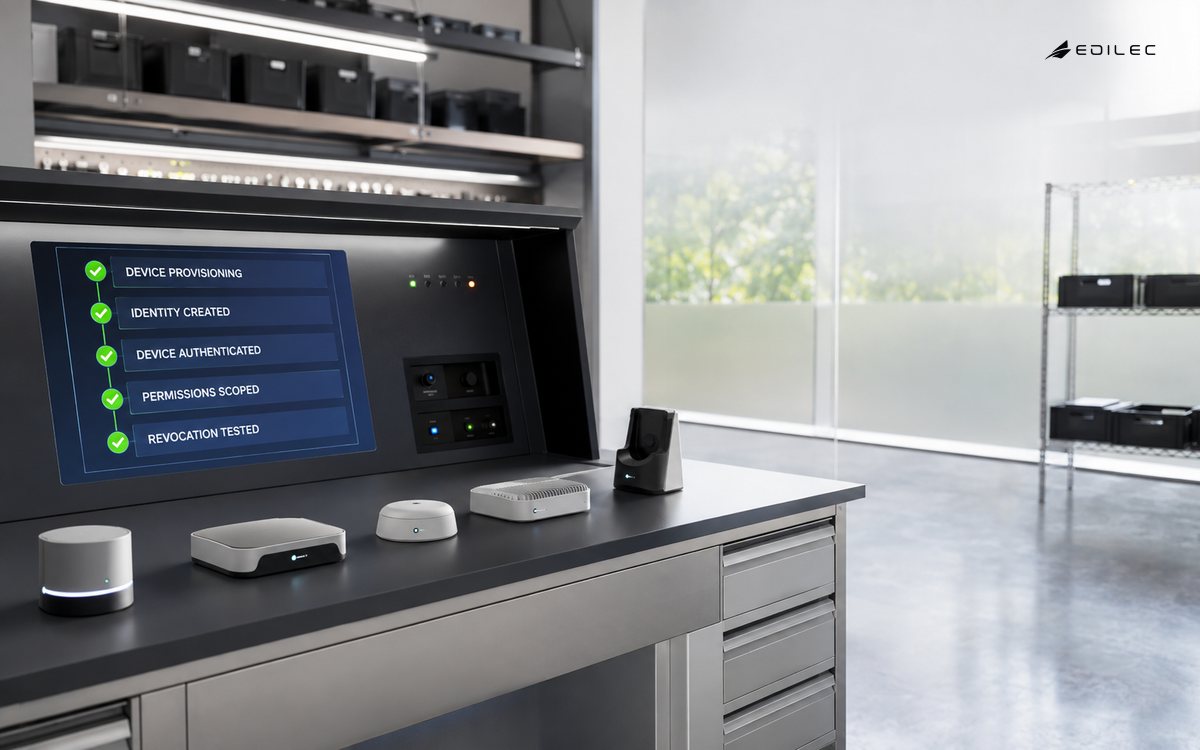
Device provisioning matters to product teams preparing a connected device fleet for production onboarding and support. In practical terms, it is the controlled process that gives a device a verifiable identity, the credentials and configuration it needs, and only the permissions appropriate to its intended service role. That definition is more useful than a product label because it points to decisions a team can test: what the boundary is, what information is trusted, which failure conditions are acceptable, and who responds when the normal path breaks. The related concerns of IoT onboarding, credential rotation, secure bootstrapping should be designed as part of the operating model, not appended after an initial launch.
What device provisioning means
Device provisioning should be explained in the language of responsibilities and observable behaviour. Provisioning is a lifecycle, not a factory checkbox. Manufacturing, first connection, ownership transfer, credential rotation, repair, decommissioning, and compromised-device response all change who should trust the device and what it may access. A useful definition therefore includes the information that crosses the boundary, the actors allowed to change it, the evidence retained, and the conditions in which the system refuses to proceed. That gives practitioners a way to challenge vague requirements before they become fragile implementation assumptions.
Architecture decisions to make first
The architecture is not a diagram of components alone. It is the set of contracts that lets product teams preparing a connected device fleet for production onboarding and support operate the capability repeatedly. Make the following decisions explicit before choosing a platform feature or writing an integration. Each one affects the likely failure mode, the test plan, and the people who will need evidence later.
| Decision | What to define |
|---|---|
| Trust anchor | Choose hardware-backed key material, certificate, secure element, or other root of device identity appropriate to the threat model. |
| Bootstrap channel | Define how an unconfigured device proves eligibility and receives initial configuration without a shared fleet secret. |
| Authorization scope | Grant narrowly scoped publish, subscribe, API, or management permissions for the device role. |
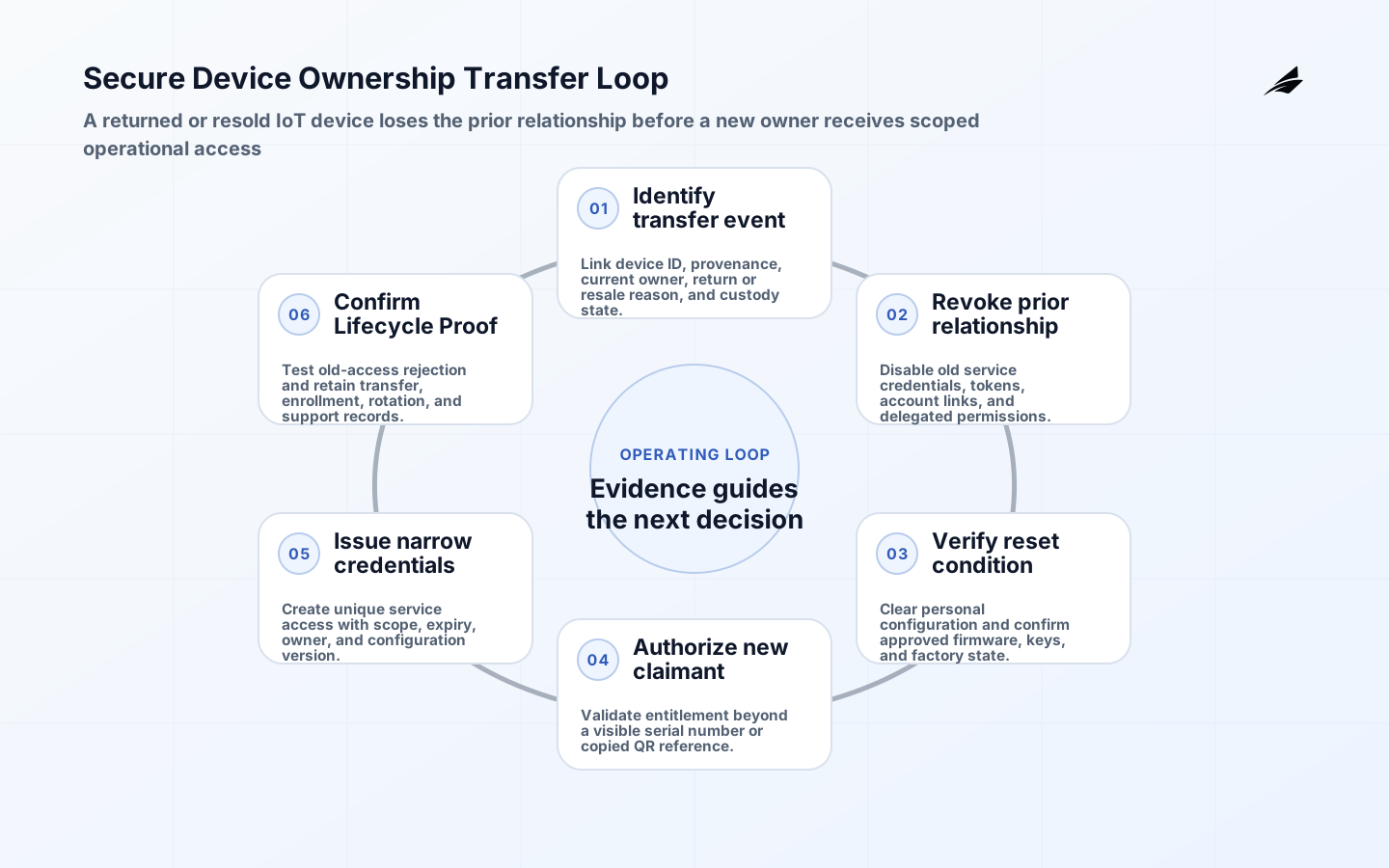
| Recovery lifecycle | Specify rotation, replacement, ownership transfer, revocation, and retirement with accountable operational steps. |
Implementation path
- Create a unique device identity and record its manufacturing or acquisition provenance.
- Protect bootstrap secrets and never reuse one credential across a fleet.
- Authenticate the device through a mutually verified enrollment flow where the platform supports it.
- Issue operational credentials and configuration with limited scope and expiry.
- Record provisioning outcome, owner, software version, configuration version, and service permissions.
- Exercise rotation, revocation, reset, and re-enrollment before shipping at scale.
Build a thin, inspectable path first. It should include the unpleasant cases as well as the demonstration case: a missing identifier, a delayed message, an expired credential, a rejected record, or an unavailable dependency. Give that path named inputs and outputs, a clear retry or escalation rule, and a way to prove what happened. This is where IoT onboarding becomes operational rather than aspirational.
Risks and controls
A shared default password or copied certificate turns one compromised unit into a fleet risk. Prefer unique identities, protected key storage, restricted bootstrap authority, and short-lived enrollment material. Provisioning services must also verify their own identity to the device; otherwise a device can be enrolled into an attacker-controlled endpoint. Capture enough evidence to investigate a device without placing private keys or enrollment secrets in logs.
| Operating signal | What it shows |
|---|---|
| Provisioning success rate | Eligible devices completing enrollment without manual security bypasses. |
| Unique-identity coverage | Active devices with verified unique credentials and known provenance. |
| Credential rotation completion | Devices completing scheduled replacement before expiry or compromise deadlines. |
| Revocation effectiveness | Time from revoked identity to rejected service access across interfaces. |
Review and measurement
Measurement should tell the team whether device provisioning is still meeting its contract, not merely whether infrastructure is running. Review the signals in the table with the owner who can change the workflow. Look at trends, samples of failures, and the gap between detected and resolved issues. When a metric changes, follow the evidence back to the contract, implementation version, and real user or device behaviour before declaring a fix.
- Set a service objective for the consequence that matters, not only a technical average.
- Sample successful and failed cases to verify that credential rotation is understandable.
- Make a named owner responsible for triaging exceptions and publishing the resolution.
- Review access, configuration, and retention choices whenever the process or fleet changes.
- Use controlled tests to rehearse recovery before an incident requires improvisation.
Operational scenario
A device leaves manufacturing with a unique hardware-backed key and an enrolment reference, then connects to a provisioning service that verifies eligibility before issuing service-specific credentials. Later, a field replacement or ownership transfer must remove the old association before the new device is trusted. This path should be rehearsed end to end. The MQTT brokers architecture guide is relevant because the device identity and authorisation policy determine which broker routes are available after enrolment.
Evidence and testing
Keep an enrolment record with a non-secret device identifier, manufacturing provenance, bootstrap method, provisioning event time, software and configuration versions, issued credential reference, owner, and result. Perform test enrolments for valid, duplicate, stolen-reference, expired-bootstrap, and revoked-device conditions. Confirm that failed attempts are safely recorded without logging private keys or reusable secret material. For hardware returns, prove that a reset does not accidentally restore a prior tenant or service identity.
Design review questions
During security review, ask whether an attacker who copies a visible serial number, QR code, or network message could enrol an unauthorised device. Verify that service authentication is mutual where supported, credential scope is narrow, and revoked identities are denied at every entry point. Also review human operations: who authorises manual recovery, how temporary assistance expires, and how a customer receives evidence that a retired device no longer has service access. Provisioning succeeds only when lifecycle control remains intact.
Practical operations
Provisioning should be exercised in the same environments and conditions in which devices will be supported. Include factory reset, poor connectivity, certificate expiry, a replaced hardware unit, an operator-assisted recovery, and an attempted enrolment with revoked material. Each test needs a clear expected state in both device and service inventories. This confirms that the system can distinguish a new eligible device from a duplicate, stolen, or previously retired identity. It also gives support teams a safe playbook instead of a reason to bypass the security model under deadline pressure.
Limits and tradeoffs
Strong onboarding controls introduce operational tradeoffs. Hardware-backed keys and mutual authentication improve resistance to credential theft, but require manufacturing coordination, recovery procedures, and compatible service tooling. Short-lived bootstrap material reduces exposure, but means delayed installation needs a reauthorisation route. Make those costs visible in the product plan. The aim is not maximal ceremony for every fleet; it is a proportionate lifecycle that keeps an individual compromise from becoming broad, persistent access to connected services.
- Name the accountable owner before adding another integration or policy.
- Keep a representative failure test beside the normal acceptance test.
- Record the version of the contract, configuration, or rule in use.
- Use evidence from real operations to improve the next release.
- Make temporary exceptions visible, approved, and time-bounded.
- Review the boundary whenever the business process or fleet changes.
Adoption and change management
Manufacturing handoff, first installation, field replacement, and incident-driven revocation are the moments when device identity lifecycle must remain controlled. Prepare for them with a small change record that names the proposed change, contract or policy version, expected operational effect, affected owners, test evidence, rollout window, and reversal decision. Give users and support teams a plain-language explanation of the behaviour that will change, especially where a new denial, warning, or data-quality status can be mistaken for a defect. Monitor the first production cases closely and compare them with the pre-change baseline. When an exception appears, decide whether it is a valid new requirement, a training issue, a data defect, or a control that must remain firm. This practice keeps device provisioning connected to the people who operate it. It also prevents a series of urgent local fixes from becoming an undocumented alternate system. Retire obsolete rules and integrations deliberately, preserve the evidence needed for a later review, and update runbooks so the next team member inherits a working explanation rather than a collection of historical assumptions.
Key takeaways
- Device provisioning is a contract between technical components, people, and operations.
- Define boundaries and ownership before optimising a tool or interface.
- Treat credential rotation as a first-class output, with evidence for failure and recovery.
- Make exceptional conditions testable and visible to an accountable owner.
- Revisit the contract as customers, devices, data, or regulations change.
Frequently asked questions
Can a QR code provision a device securely?
A QR code can carry an identifier or bootstrap reference, but it is not automatically a trust anchor. Its security depends on how it is protected from copying or substitution, how the device verifies the service, and whether sensitive credential material is exposed. Use it as one part of a verified enrollment design.
What happens when a provisioned device is resold or returned?
Treat ownership transfer as a defined lifecycle event. Revoke or rotate previous credentials, clear configuration and personal data as appropriate, verify the reset state, and require the new owner to complete an authorised enrollment flow.
Conclusion
Secure device provisioning establishes the trust relationship on which every later message and update depends. Plan the identity lifecycle before the fleet is in the field, limit every credential’s authority, and rehearse the recovery actions that turn a security incident into a controlled operation. Teams building the software layer around enrollment, telemetry and fleet operations can also review Edilec’s IoT software service.