Connected-System Offline Sync: Design for Reconnection
Connected systems are not continuously connected systems. A device, mobile worker, or edge service may lose coverage, lose power, restart with stale state, or reconnect through a network with high delay. Offline sync lets useful work continue, but only if the product defines what local work means and how it becomes authoritative later. Treat the problem as a chain of contracts: local storage, operation identity, transport, authorization, conflict policy, and recovery. MQTT and other protocols can carry messages, yet they cannot decide whether a local reading should overwrite a newer approved fact. That decision belongs in the domain model and must be explainable to operators.
Choose the connected-system use case
Begin with an observed connectivity problem and a measurable business consequence. “Users need offline mode” is too broad. “Technicians must record inspections in underground rooms and upload them within two hours” gives the team a boundary. Identify what can be drafted, what can be submitted, what must be verified online, and what a supervisor does when the upload cannot be accepted. The AWS IoT Jobs reference shows why queued work needs status, retry, and completion evidence; adapt those ideas to the business record rather than treating every disconnected action as an interchangeable message.
Use precise sync language
A local write is not a server acknowledgement. Give the product separate states for saved locally, waiting to send, sent, accepted, rejected, conflicted, and quarantined. Include the relevant time and next action. “Synced” should mean the canonical service accepted the operation, not merely that the phone attempted a request. When a user can see the difference, support calls become more actionable and product analytics become less misleading. RFC 9000 is a useful transport reference, but reconnect behavior still needs product states for late, duplicated, or out-of-order work.
| State | Meaning | User or operator action |
|---|---|---|
| Saved locally | The device accepted the data into a protected local store. | Continue work or review local retention. |
| Queued | The operation awaits a connection or dependency. | See age, dependency, and retry status. |
| Accepted | The service validated and committed the canonical result. | Continue using the returned record. |
| Conflict | Current authority differs from the local operation. | Review field differences and choose a valid resolution. |
| Quarantined | The operation cannot safely retry automatically. | Resolve identity, policy, schema, or security issue. |
Model authority and time
Connected systems often carry several times: when a sensor observed a value, when the client recorded it, when the gateway received it, and when the service processed it. Preserve these separately. A server receipt time can order operations for processing, but it should not replace the observation time. Likewise, a client timestamp can explain field context but should not grant authority against a newer server version. Define which timestamps appear to users and which drive reconciliation. If the domain needs event time, processing time, and correction time, put those meanings in the schema and documentation instead of asking analysts to infer them later.
- Which system is authoritative for each field or event type?
- Can a late observation be accepted without changing the current state?
- What does a correction mean, and is it append-only or replacement?
- How are device clocks checked, corrected, or treated as untrusted?
- Which version or sequence prevents an older client from overwriting new state?
- When is a human decision required, and who is accountable for it?
Represent operations, not just snapshots
A snapshot says what the client currently sees; an operation says what the user or device tried to do. For reliable sync, keep a stable operation identifier, entity key, schema version, actor, client time, dependency, payload, attempt count, and outcome. Make operations idempotent so a timeout can be retried without duplicating a side effect. Keep the original payload or a safe digest according to retention and privacy rules. This record lets the team answer whether the user submitted twice, the network retried, the server applied once, or a device replayed an old queue after a long absence.
Build a reconciliation pipeline
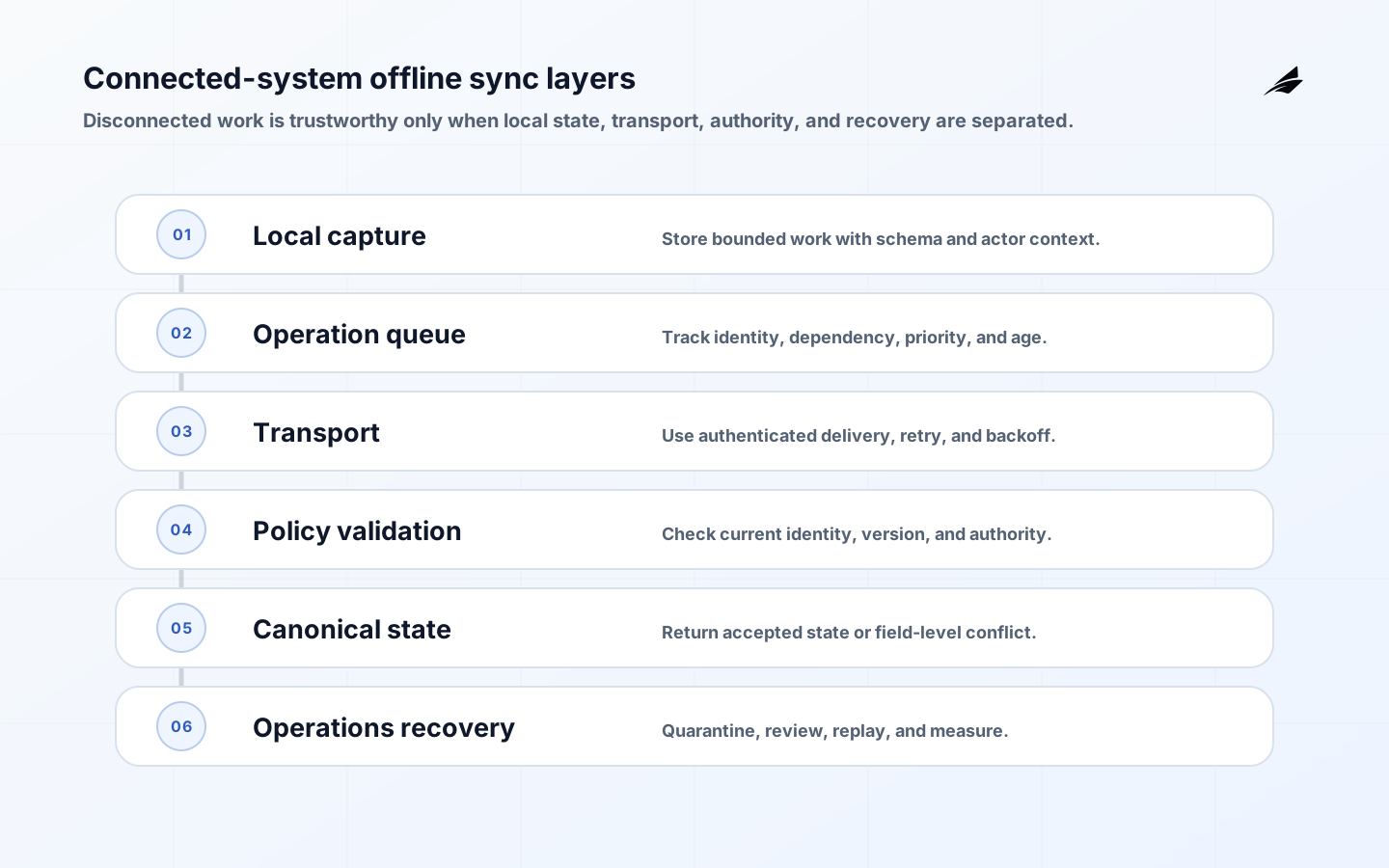
A practical pipeline has five boundaries: capture, queue, transmit, validate, and reconcile. Capture validates local shape and stores a transaction. The queue orders operations and records dependencies. Transmit authenticates the actor, applies bounded retry, and preserves responses. Validate checks tenant, record version, permissions, invariants, and transition rules. Reconcile replaces local state with canonical data or creates a review task. Kubernetes concepts around desired and observed state are a useful analogy: a system is easier to operate when it can state what it intended, what it observed, and what remains out of alignment.

| Boundary | Design rule | Evidence to retain |
|---|---|---|
| Capture | Write the record and operation atomically where possible. | Local transaction, schema version, and actor. |
| Queue | Make dependencies and idempotency visible. | Operation key, age, priority, and blocked reason. |
| Transmit | Separate transport retry from business retry. | Attempt, response class, latency, and token context. |
| Validate | Check current authority before side effects. | Version, policy result, and validation error. |
| Reconcile | Return canonical state or route to a named reviewer. | Final result, conflict fields, and resolution reason. |
Transport recovery must not become business duplication. The MQTT Version 5.0 specification can help teams choose message delivery semantics, but an application still needs idempotency keys, deduplication windows, and a clear interpretation of a repeated command. A reconnect storm may also overload the service. Use backoff, batching, admission limits, and priority for safety-relevant or time-sensitive work. The HTTP Semantics specification reinforces that a retry response is not proof of an accepted business operation. If a client is too old to understand a response, quarantine it rather than repeatedly sending an operation that can never succeed.
Select conflict strategies by meaning
There is no universal best conflict algorithm. Last-write-wins can be reasonable for a low-risk preference but dangerous for a safety inspection. Field-level merge can work for independent attributes while failing for a status transition whose fields must remain consistent. Append-only events preserve history but require a projection that explains the current view. A useful policy classifies values as replaceable, mergeable, append-only, or review-required. Document examples, not only names: two notes can coexist; two different asset owners may require review; a later calibration result may supersede an earlier reading only when its provenance is valid.
Example: edge observations and service state
Consider a cold-chain monitor that records temperature observations at the edge while a central service tracks an alarm state. A late observation should be accepted with its observation time, but it should not automatically clear an active alarm that a supervisor has acknowledged. The edge queue uses a stable event identifier; the service deduplicates it and recalculates the time-window projection. If the device firmware sends an unknown schema, the event is quarantined with a support reason. This design preserves measurement history and keeps the current operational state under the authority of the service that can see alarms, acknowledgements, and policy.
Protect local data and queued authority
Offline storage can hold customer data, credentials, asset details, or evidence for longer than the user expects. Encrypt local data where the threat model requires it, minimize retained fields, expire old queues, and define behavior after logout, device loss, identity revocation, or repeated authentication failure. Do not let a previously authorized queue gain broader authority merely because it was captured earlier. Re-check tenant, scope, record access, and current policy at upload. The security boundary should exist at the service as well as the device; a local label or hidden interface control is not an authorization decision.
Test the reconnect journey
Connected-system teams should test the moments users experience rather than only the happy path. Kill the process during a local write, pause the network after an upload begins, expire the token, change the record on another device, fill local storage, alter the device clock, and migrate from an older schema. Observe whether the user can tell what happened and whether support can recover without database surgery. Pilot with a cohort that experiences actual connectivity gaps. Compare work completion, rework, queue age, conflict rate, and support load with a connected baseline.
Avoid predictable failure modes
A sync feature fails when it makes uncertainty invisible. Common examples are a badge that claims success after send, a retry that duplicates a command, a merge that drops a correction, a queue that never expires, or a support tool that reveals only the final state. Another failure is designing for a single device when the same record is edited by a portal, gateway, and mobile app. Keep a conflict and replay model from the first release. If a manual correction is allowed, record who made it, why, and which local and server versions were compared.
- Queue age and blocked reasons are visible by device, version, and workflow.
- A repeated operation cannot create a repeated financial, safety, or inventory side effect.
- Old clients receive a safe upgrade or quarantine response.
- A revoked identity cannot upload sensitive queued data without a fresh policy check.
- Support can inspect original operation, canonical result, and conflict resolution.
- Data retention and purge behavior are tested on real device failure scenarios.
Measure whether the system remains trustworthy
Track queue age percentiles, accepted-after-reconnect rate, conflict rate by field, rejected operation classes, duplicate side effects prevented, data loss incidents, and time to resolve review-required cases. Add business outcomes such as inspection rework, missed service windows, alarm acknowledgement delay, or manual transcription. Segment by firmware, app version, network type, and location when the data is appropriate and access-controlled. A high accepted-after-reconnect rate can still be bad if the client reports local completion before service acceptance. Pair every telemetry measure with a user-facing state and an owner who can act on it.
Reconnection rules to carry into implementation
- Start with a defined connectivity problem and one bounded workflow.
- Separate observation time, client time, receipt time, and correction time.
- Represent operations with stable identity, dependencies, versions, and outcomes.
- Choose conflict behavior according to field meaning and consequence.
- Re-check identity, tenant, authorization, and state at upload time.
- Measure queue health and business rework together, then improve the recovery path.
Offline sync for connected systems FAQ
Does MQTT solve offline sync?
No. MQTT can provide useful messaging and session semantics, but the application still needs local storage, idempotency, authorization, schema compatibility, conflict policy, and a canonical outcome.
Should late events be rejected?
Not automatically. A late observation may be valuable when its event time and provenance are preserved. It should be rejected or quarantined when it cannot be trusted, violates retention, or would create an unsafe current-state change.
Is a client library enough?
A library can reduce implementation effort, but it cannot choose domain authority or user-visible consequences. Evaluate it against the workflows, failure cases, data retention, security boundary, and support evidence you actually need.
Conclusion: reconcile honestly
A connected-system sync design is credible when late work can be identified, safely retried, reconciled against current authority, or placed in a queue that a named owner can resolve. Preserve event time and operation identity so reconnection does not erase the story. The firmware updates guide, event streaming guide, and edge computing guide extend the surrounding system view. The useful promise is not “offline support”; it is an honest answer to whether this operation is pending, accepted, superseded, or waiting for review.