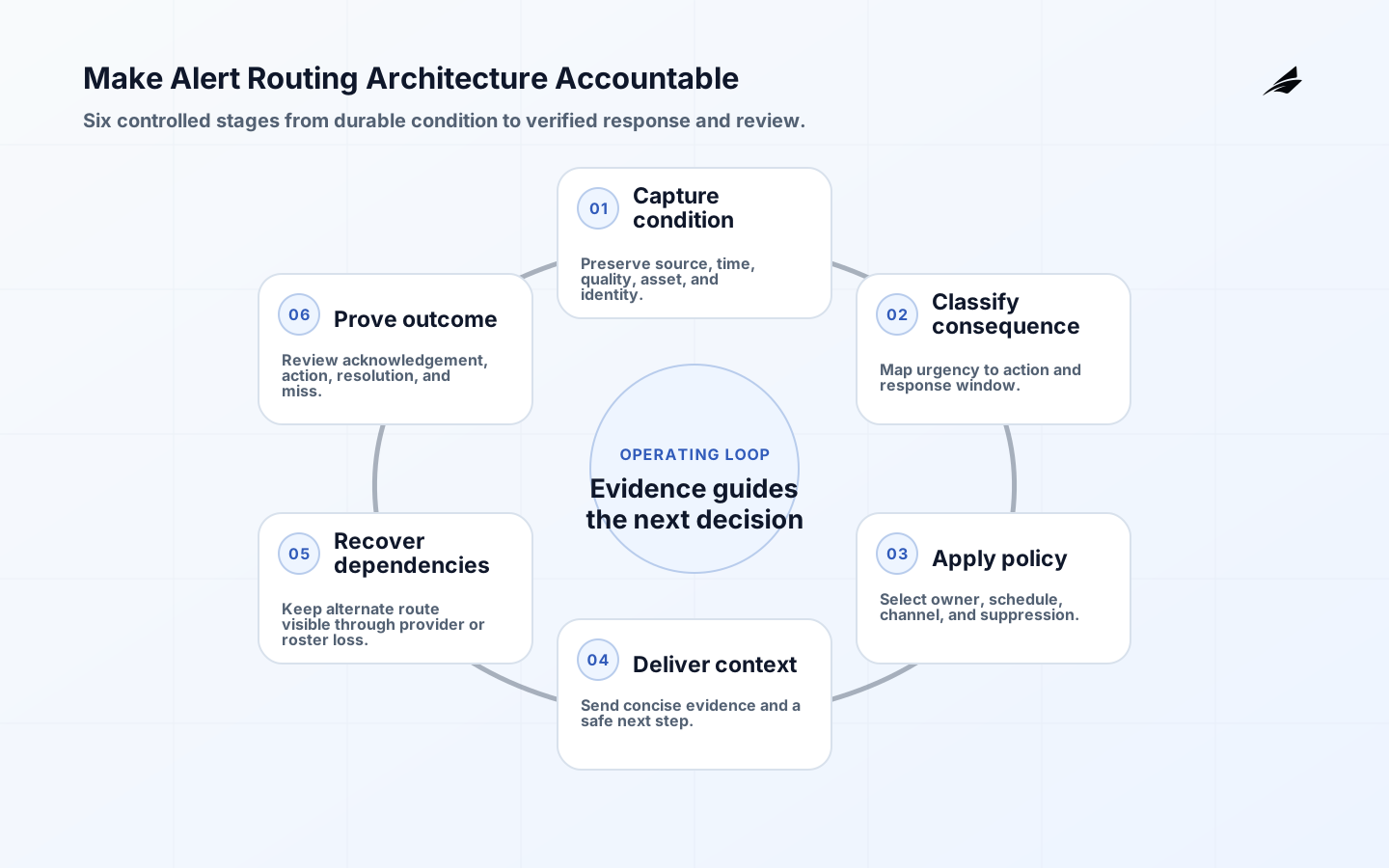
Alert routing architecture is the set of boundaries and decisions that determines how a system turns evidence into accountable action. It includes detection, context, classification, ownership, delivery, escalation, acknowledgement, resolution, and review. Operations leaders should treat it as part of service reliability because a perfect detector still fails if the alert reaches the wrong person, loses its context, or disappears when a notification dependency is unavailable.
Define the alert routing outcome
Start with a decision and a response window. For example, a site operator must know that a critical asset has entered an unsafe mode and must receive a local next step even if the central notification service is down. The plain-language guide to alert routing aligns detection, notification, acknowledgement, and resolution vocabulary. An architectural outcome should name consequence, owner, contingency route, and evidence rather than promising a generic “real-time alert.” Architecture examples include SCADA integration checklist and Industrial dashboard context.
| Architecture layer | Responsibility | Decision evidence |
|---|---|---|
| Signal | Capture condition and quality | Source, time, asset, validity |
| Decision | Classify consequence and urgency | Rule, threshold, context |
| Policy | Choose owner, schedule, and channel | Versioned routing policy |
| Response | Record acknowledgement and action | Actor, time, result |
| Review | Improve the route and condition | Outcome, miss, change |
Separate detection from delivery
The detector should produce a durable condition with source, asset, observed time, quality, history, and a stable identifier. A routing service should decide who receives it, when, by which channel, and under what escalation policy. This separation lets the team change an on-call schedule without changing the physical threshold and lets it preserve an incident when a provider fails. Correlate logs, metrics, traces, and response records; OpenTelemetry documentation provides a useful foundation for connecting distributed signals.
Set authority and control boundaries
Protect routing policies, recipient data, runbooks, and suppression controls with explicit permissions. A person who can view an alert may not be allowed to change escalation or silence a critical condition. NIST SP 800-207 supports the principle of evaluating access explicitly; apply it to administrative changes and machine-generated action. Keep a change history with approver, scope, expiry, and reason. Architecture is safer when policy changes are observable and reversible.
Carry context that changes the action
An alert should carry the asset and site, current mode, source quality, last known contact, recent trend, threshold or rule, affected service, safe action, and relevant runbook. Context should be concise enough for a channel but complete enough for a first decision. Avoid attaching a hundred fields that force an operator to search. The architecture should distinguish observed time, received time, and notification time so a delayed message cannot masquerade as current evidence.
- Give each actionable condition one primary owner and a backup.
- Group repeated symptoms while retaining the underlying evidence.
- Make suppression scoped, approved, visible, and automatically expiring.
- Preserve the condition when a channel fails.
- Record acknowledgement, action, resolution, and any manual override.
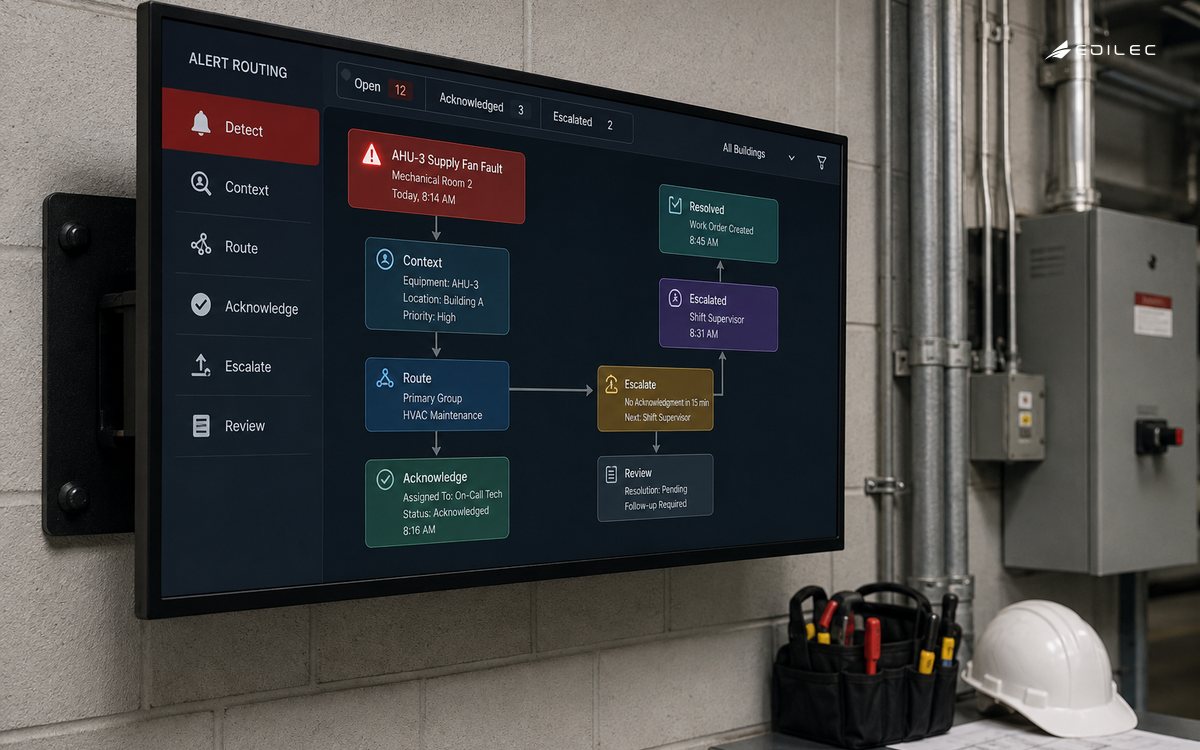
| Control point | Design choice | Test case |
|---|---|---|
| Classification | Severity maps to an action and response window | Same signal in different operating modes |
| Routing | Schedule and ownership are explicit | Roster gap and escalation |
| Channel | Critical path has an independent alternate route | Provider outage |
| Suppression | Maintenance scope and expiry are recorded | Expired suppression |
| Change | Policy requires authority and review | Unauthorized edit |
Roll out by operational consequence
Start with a small set of high-confidence conditions and one staffed response path. Do not begin with every metric. Include an operator in design, test the runbook under time pressure, and observe whether the route changes a decision. NIST SP 800-82 Rev. 3 is relevant where alerting crosses operational technology boundaries because availability and safe local behaviour may matter more than a central notification. Expand only after the first path is understood.
Design recovery and contingency routes
Exercise notification-provider failure, stale rosters, disconnected sites, duplicate conditions, flapping signals, and an alert that resolves before acknowledgement. Decide whether a critical condition is also visible locally, queued for later review, or escalated through a separate channel. Recovery should preserve the condition, attempted deliveries, acknowledgement state, and operator action. NIST SP 800-193 offers resilience thinking that can be adapted to the platform and firmware dependencies supporting an alert path.
Measure architecture health
Track detection-to-notification latency, delivery failure, acknowledgement time, escalation rate, actionable rate, duplicate grouping, stale context, resolution time, and missed conditions. Review by service and consequence; a single average can hide a dangerous tail. NISTIR 8259A helps maintain awareness of device identity and state, which are often essential context for connected-system alerts. Use findings to tune conditions and ownership, not only to optimise channel throughput.
Make ownership part of the design
For each alert class, document who owns the condition, who owns the route, who can change suppression, who confirms resolution, and who reviews misses. These roles can be combined in a small organisation, but they should not be implied. Include policy version and runbook version in the event record. When an incident occurs, the team should be able to distinguish a bad signal, a bad route, a missed acknowledgement, and an unavailable dependency.
Review the architecture as a control loop
An alert route is healthy when the system can move from evidence to action and back to evidence about the outcome. Review one condition through detection, classification, policy, notification, acknowledgement, action, and resolution. Note where the architecture loses time, context, or authority. A dashboard that shows delivery but not acknowledgement is incomplete; a ticket that records closure but not the original evidence is difficult to audit. Keep the path traceable without requiring every operator to understand its implementation.
Design for changes in the operating environment. People change shifts, assets move sites, services enter maintenance, and device identities are revoked. Routing should consume current ownership and lifecycle state, but it should also preserve the owner and policy version used at the time of the alert. That history explains why a message went to a person who is no longer on the roster and helps distinguish a stale policy from a bad detector.
Use a severity model that an operator can apply consistently. Define the consequence, response window, escalation rule, and contingency route for each class. Avoid making every uncertain condition critical; instead, route uncertainty to a review path that can improve the signal. A high-severity label without a safe action creates urgency without control. A lower-severity queue with good context can be more valuable for trends and early intervention.
Architecture reviews should include a live exercise, not only a document walk-through. Disable one notification provider, remove a roster entry, inject a duplicate, expire a suppression, and make a device stale. Ask an operator to state the current condition, the safe next action, and the evidence they would retain. Feed the result into the next policy revision. This is how the design stays useful as the connected environment changes.
Keep the route’s dependencies visible. Alerting may depend on telemetry freshness, identity service, configuration store, schedule service, notification provider, runbook, and local network. For each dependency, define what the system reports when it is unavailable and which contingency route remains valid. NIST SP 800-82 Rev. 3 grounds availability and safe operation when an alert path supports physical processes.
| Architecture review | Question | Evidence |
|---|---|---|
| Ownership drift | Does the current roster match the asset state? | Policy and lifecycle record |
| Uncertainty | Does unclear data become a review path? | Quality and severity test |
| Dependency loss | What remains visible if a service fails? | alternate route exercise |
| Response outcome | Can action and resolution be proven? | Acknowledgement and closure record |
| Change safety | Can policy be reverted or expire? | Version, approver, expiry |
Leaders should ask for one end-to-end proof rather than a collection of platform metrics. Show a condition, its context, the selected owner, the attempted route, the acknowledgement, the action, the resolution, and the retained evidence. Then repeat the proof with a provider outage or stale roster. This small demonstration exposes whether the architecture is genuinely accountable and recoverable, and it gives the team a concrete basis for deciding what to change next.
Make the contingency route visible in the architecture and in the operator view. A route that silently falls back to an unstaffed inbox is not resilient. State whether the local system, manual procedure, secondary channel, or later reconciliation is authoritative during the dependency outage. After recovery, compare the original condition with the messages and actions recorded so the team can close the gap rather than merely clear the queue.
Alert architecture takeaways
- Design alert routing around a response outcome and contingency route.
- Separate detection, routing policy, delivery, acknowledgement, and resolution records.
- Carry concise context that changes the operator’s next decision.
- Protect policy and suppression changes with explicit authority and expiry.
- Measure misses and response quality, then improve the architecture from evidence.
Alert architecture questions
Should alert routing live in the monitoring platform?
It can, if the platform preserves condition evidence, ownership, policy history, contingency route behaviour, and recovery state. A separate routing service may be better when multiple monitoring sources share one accountable response model.
How do leaders know whether alert routing works?
Review a sample of alerts from detection through resolution, including failures and suppressions. Look for clear ownership, timely acknowledgement, useful context, safe contingency route, and a documented outcome rather than relying on delivery percentage alone.
Reference the operating contract
Keep the alert classes, routing policies, response windows, contingency route channels, and review cadence in a versioned operating contract. Link the contract to the service and asset owners so architectural intent remains visible after the original implementation changes.
Conclusion: accountable routing
Alert routing architecture earns trust when it turns conditions into accountable, recoverable action. Separate detection from policy, carry the context that matters, protect changes, test failure, and measure the response. Operations leaders can then judge the system by the decisions it enables rather than the number of notifications it sends.