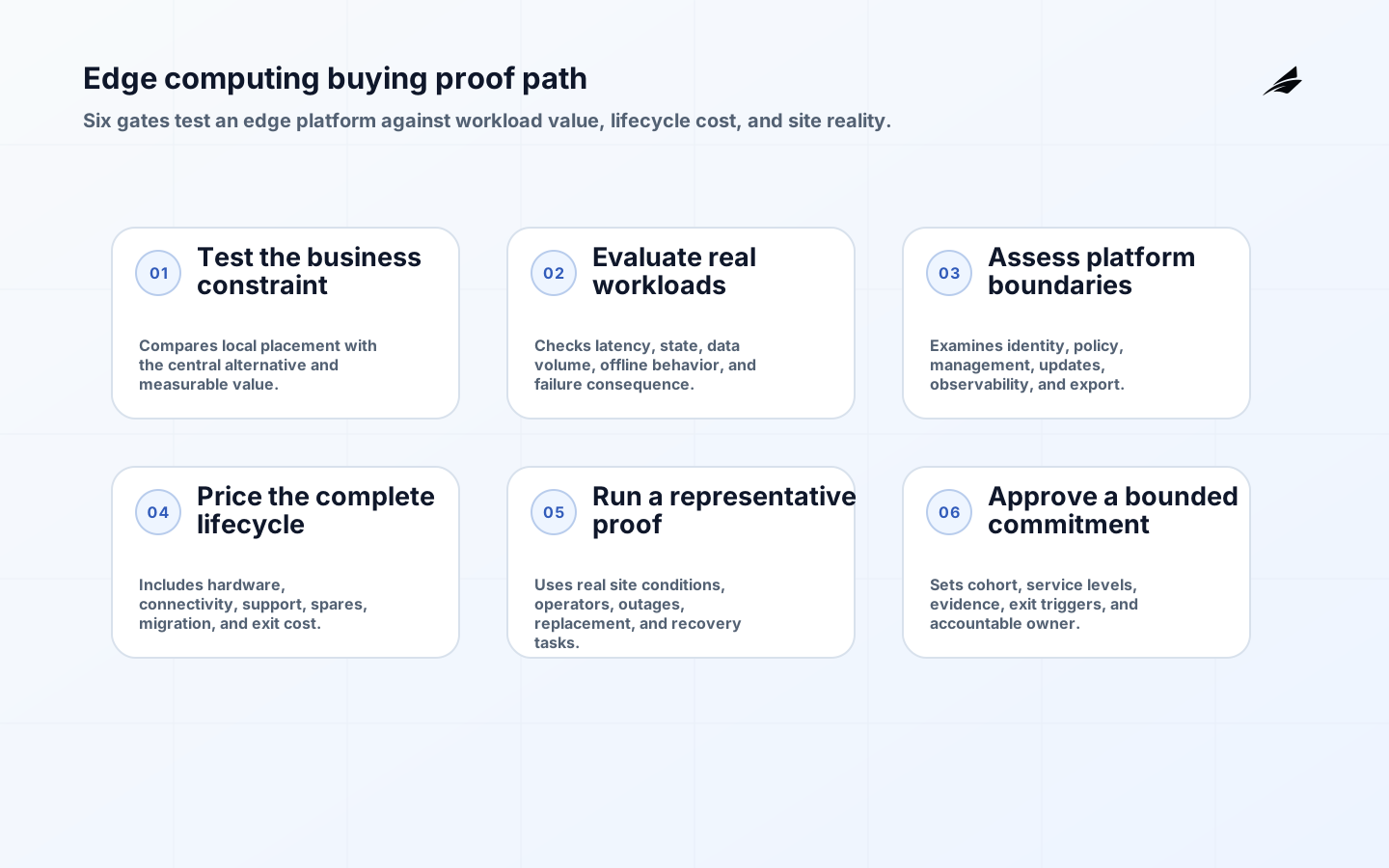
Buying edge computing means adopting a distributed operating model, not simply placing a box near a device. A useful evaluation asks what must run locally, what remains central, how sites are enrolled and updated, what happens through outage, and who supports the platform after the pilot. NIST's fog computing model frames nodes between end devices and central resources, while ETSI's MEC group provides standards context. Use the buyer process to test operating model, not only feature list.
Build the business case around a constraint
Name measurable constraint: local latency, unreliable connectivity, transfer cost, privacy, local integration, resilience, or site autonomy. Estimate current cost and consequence. If case is only “edge is strategic,” purchase will be hard to evaluate and easy to oversize. Decide which outcome justifies hardware and lifecycle work.
Compare edge with simpler central and hybrid designs. Include network upgrades, installation, spares, patching, observability, travel, and retirement. A small node can be inexpensive to buy and expensive across hundreds of sites. Make total operating model visible before procurement.
Evaluate workloads, not marketing labels
For each workload define inputs, outputs, latency, offline duration, state, sensitivity, compute, storage, updates, and failure consequence. A local protocol adapter differs from safety controller, model inference, or site dashboard. Ask supplier to map each claim to a testable behavior.
Keep placement reversible where possible. If workload runs centrally with acceptable delay, do not move locally without material benefit. If it must be local, define central policy, inventory, history, and recovery. The edge computing checklist helps structure evaluation.
| Buyer question | Evidence to request | Decision signal |
|---|---|---|
| Why edge? | Baseline central alternative and constraint | Material latency, outage, cost, or locality benefit |
| Can we operate it? | Runbook, support, monitoring, spares | Named owner and recovery |
| Can we secure it? | Identity, update, secret, threat evidence | Scoped authority and patch path |
| Can we exit? | Export, migration, retirement, deletion | Portable records and bounded lock-in |
Assess the platform boundary
See edge-to-central architecture, not only product diagram. Ask how devices enroll, workloads authenticate, data buffers, commands expire, configuration applies, software updates, and logs collect during central outage. NIST's model highlights distributed nodes and location; make those dependencies explicit in request for proposal.
Check tenant, site, workload, and management authority separation. Require stable identity, least privilege, signed artifacts, protected secrets, and auditable change. Ask what remains usable when management plane is unavailable. An edge product is not operable if only recovery path requires the service it is meant to withstand.
Evaluate security and physical exposure
Edge hardware may sit in an unstaffed cabinet, retail site, factory, or vehicle. Ask about secure boot or integrity, encrypted storage, debug interfaces, credential storage, identity provisioning, local admin, and tamper response. NIST's OT guidance is relevant when software affects physical processes.
Require threat model for stolen hardware, compromised local network, malicious workload, rogue installer, leaked support credential, and blocked updates. Evaluate vulnerability reporting and fixes. Tie security claims to evidence, version, scope, and operating procedure, not generic badge.
Price the full lifecycle
Include procurement, staging, shipping, installation, enrollment, networking, spares, monitoring, updates, certificate rotation, packaging, support, replacement, recovery, and decommissioning. Ask who owns identity when site changes provider. Define removal without leaving credentials or customer data.
Review support windows. A five-year deployment with two-year workload support is unstable unless upgrade and migration are clear. Require inventory export and exit path. A platform that cannot provide portable configuration, data, and evidence creates lock-in at the difficult layer.
| Proof scenario | Pass condition | Evidence |
|---|---|---|
| Central outage | Local workload follows degraded behavior | Offline duration and recovery |
| Bad update | Pause, revert, or recover safely | Install state and cohort |
| Node replacement | Re-enroll and resume service | Identity and validation |
| Support incident | Operator diagnoses least-privilege | Time and action log |
Run a procurement proof with real conditions
Use representative hardware, network constraints, workload versions, and operators. Test local response, central synchronization, offline duration, queue limits, interrupted update, credential expiry, replacement, and support access. Include rare site or device class a demo would exclude.

Write pass/fail before proof: maximum delay, data loss, enrollment time, node recovery, workload update rate without field visit, and support diagnosis time. Record evidence and exceptions. Do not accept “works in principle” for a platform multiplied across sites.
Define operating signals and objectives
Track node availability, workload health, resource pressure, data freshness, queue age, synchronization lag, version distribution, certificate state, failed updates, support incidents, and reconciliation. OpenTelemetry's documentation can guide instrumentation, but the buyer should require domain signals and export access.
Set objectives by workload and site class. A node can be online while critical workload is unhealthy; site synchronized while high-value stream is stale. Require dashboards distinguishing local, central, and link failures. Ask who receives alert and what action is permitted.
Turn vendor answers into commitments
Translate claims into contract or acceptance evidence: supported hardware, update window, vulnerability notice, identity ownership, log access, export, incident communication, recovery assistance, and end-of-life. Avoid vague “high availability” without scope and measure.
Ask what customer can do without vendor and what needs paid service. Clarify support across hardware, OS, platform, workload, network, and installer. Buyer should know who can pause rollout, revoke credential, export evidence, and approve replacement.
Make a bounded recommendation
A CTO recommendation states where edge is necessary, workloads in scope, excluded sites, evidence passed, remaining risks, and what changes decision. Prefer staged commitment with expansion gate. If platform cannot show safe offline behavior, identity, update, observability, and recovery, defer scale even if demo is strong.
Use edge computing for growing teams, edge gateways checklist, and offline sync guide to connect procurement to implementation.
An edge procurement scenario
Require a live demonstration of how administrators recover when the central control plane is unavailable. The team should see what local operators can inspect, what workloads continue, how credentials behave, and how the node reports when service returns. A slide describing offline support is not enough; the proof should record duration, queue behavior, command expiry, and recovery evidence.
Procurement should distinguish platform capabilities from customer responsibilities. A vendor may provide packaging and updates while the customer owns network, device identity, workload policy, and site access. Put the boundary in a responsibility matrix and test it with an incident scenario. Ambiguity becomes most expensive when a site is already degraded.
Require export that preserves meaning, not only files. Configuration, workload versions, device identity, site assignment, logs, event IDs, and retention state should be interpretable outside the platform. Ask how a departing supplier supports migration and whether historical evidence can remain searchable. Portability is part of operational resilience.
Use a risk-weighted site plan for rollout. Include a simple site, an isolated site, a high-value site, an older hardware site, and a site with limited local support. Define what evidence each contributes and how the expansion gate treats unresolved differences. This makes the pilot representative without requiring every site to participate immediately.
Commercial terms should cover vulnerability and end-of-life timing. Ask how customers receive security notices, how long fixes are available, what happens when a component is discontinued, and who pays for field replacement. A platform may be technically strong but commercially unsafe if its support horizon is shorter than the asset lifecycle.
At the executive decision point, state what the organization is willing to operate. If the answer is a managed service, require visibility and exit rights; if it is a self-managed platform, budget for site support and lifecycle engineering. The best edge purchase is the one whose responsibilities match the team's real capacity.
Have the supplier show how site operators continue safely when central administration is unreachable. The team should inspect local workload state, cached policy age, queue limits, credential behavior, and the evidence produced when the link returns. A slide describing offline support is not enough: the proof should show which actions remain permitted, which commands expire, how operators regain control, and how the platform records reconciliation.
Require a clear answer for local administration. Ask how a site technician authenticates, what actions are permitted, how access expires, and how changes are recorded. Local convenience should not create an unreviewed route around central policy. The buyer should see both normal support and emergency access flows.
Evaluate observability export before signing. Confirm that logs include workload, site, device, identity, version, and time context, and that the customer can retain or analyze them independently. If the platform only exposes a vendor dashboard, incident evidence may disappear when the contract or network relationship changes.
Ask for a written recovery target by site class. A node supporting a low-risk cache may differ from one supporting a control loop. Require evidence for spare availability, enrollment, data restoration, validation, and communication. A single fleet-wide promise conceals the differences that matter.
Review expansion economics with actual support ratios. Count installation hours, replacement visits, update exceptions, and local network dependencies during the proof. Use observations to update the business case. A platform is not cheaper because central compute is lower if every site needs specialist intervention.
For the device side of an edge purchase, use NISTIR 8259A to test identification, configuration, data protection, software update, and cybersecurity state awareness as buyer requirements.
Key edge-buying takeaways
- Buy edge to solve a measurable constraint, not add a fashionable layer.
- Evaluate placement, lifecycle, security, and recovery together.
- Require evidence under offline, update, replacement, and support conditions.
- Make domain signals visible beyond node heartbeat.
- Stage commitment with expansion gate and exit path.
Frequently asked edge-buying questions
What should a CTO ask an edge vendor first?
Ask which named business constraint requires edge, what must continue offline, how identity and updates work, who supports failures, and what evidence proves recovery. Those answers reveal the operating model faster than feature list.
Is a managed edge service always best?
Not always. Management can reduce lifecycle burden, but buyer still needs failure behavior, identity ownership, export, support boundaries, and exit path. Choose based on ability to operate the whole service.
Conclusion: edge computing buying in practice
An edge computing purchase is a commitment to distributed responsibility. Approve it when the constraint is material, workload boundary clear, and vendor can prove secure lifecycle operations, observability, offline behavior, and recovery at sites that matter.