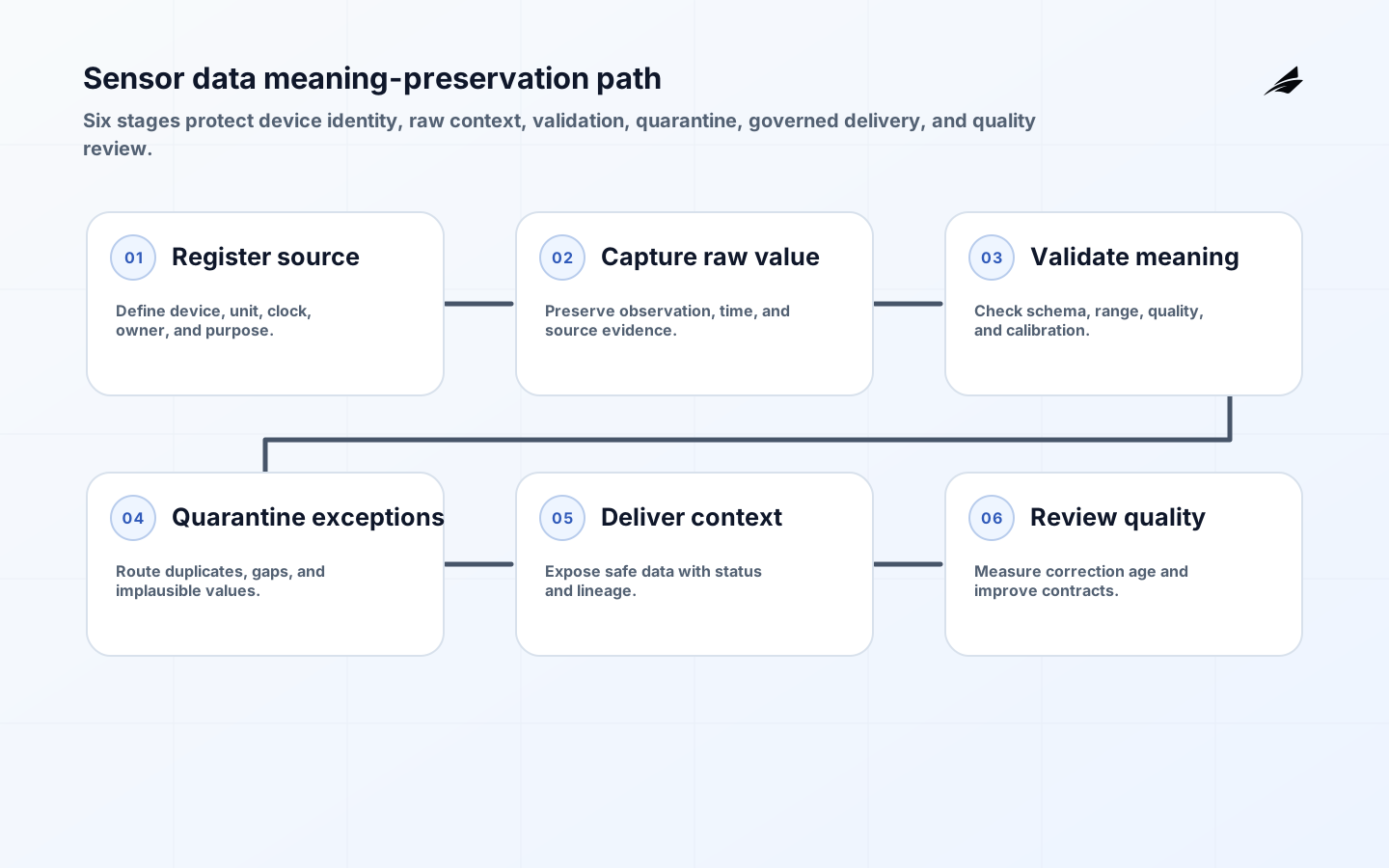
Sensor data pipelines are trustworthy only when a measurement keeps its identity, time, unit, quality, and ownership as it moves from a device into a decision. The recurring mistakes are often quiet: a field is renamed, a clock drifts, a late value looks current, or a bad reading is averaged into a good-looking trend.
Treat the Pipeline as a Chain of Evidence
For every important measurement, document its origin, observed time, transport time, schema, unit, calibration or configuration context, quality state, and owner. These fields are not optional metadata for a future audit; they are the difference between a reliable trend and an attractive fiction. A pipeline should make it possible to trace a point from a report back to the device and transformation that produced it. If that cannot be done, the team cannot assess a surprising result or correct a bad mapping safely.
The first scope should be a thin vertical slice: one device class, one measurement contract, one storage route, and one operational consumer. This exposes the entire chain including permissions and support. The sensor data pipeline practical guide is useful when turning that slice into a production service with clear quality and recovery expectations.
| Pipeline stage | Question to answer | Evidence |
|---|---|---|
| Source | Which physical device and configuration produced it? | Serial, point ID, configuration version. |
| Ingestion | When and how was it received? | Observed and received times, route. |
| Transformation | What changed the raw value? | Rule version and input reference. |
| Consumption | Which decision used it? | Report, alert, or work-order linkage. |
Fix Time and Identity Before Analytics
The most expensive mistakes are often mundane. Devices may report local time with a wrong time zone, gateways may batch several hours of records after reconnection, and services may use arrival time as though it were observation time. Preserve both. Validate clock plausibility and expose lateness to consumers. An average computed by arrival time can misplace an event during an outage, leading an operator to investigate the wrong shift or assume a control did not work.
Identity failures are equally damaging. Keep a stable device identity separate from a human-readable tag and link both to an effective asset and location history. When a sensor is replaced, moved, or reconfigured, publish a lifecycle event rather than editing history into silence. Loose joins based on label text can combine two installations or create a gap that looks like a process failure. Master-data ownership and controlled mapping changes belong in the pipeline plan.
Make Validation Explainable
Validate message shape, required fields, unit, range, sequence, and known quality flags at defined control points. Rejecting an invalid record without retaining a reason turns a repairable data problem into a mystery. Keep a quarantine route with the original reference, validation result, and accountable review owner. At the same time, avoid aggressive rules that discard genuine abnormal conditions. A spike may be a broken sensor, a bad parser, or the very event the operation needs to investigate.
Normalize data with versioned transformations. When converting units, applying calibration factors, aggregating samples, or deriving a status, retain the method and inputs. Do not overwrite raw data with a cleaned value and call the result truth. Different consumers may legitimately need different views: a technician needs the raw diagnostic detail, an operations screen needs a validated recent value, and a monthly report needs a documented aggregation. The pipeline should serve those uses without hiding their differences.
| Common mistake | Practical fix | Monitor |
|---|---|---|
| Arrival time used as event time | Store both times and calculate lateness. | Late-record distribution. |
| Unknown unit or scale | Validate contract at ingestion. | Unit and range validation failures. |
| Silent data cleaning | Version transformations and retain raw reference. | Quarantine count and rule changes. |
| Broken asset join | Manage effective identity mappings. | Unmapped or multiply mapped points. |
Design for Replay and Recovery
A pipeline needs a clear retry and replay model. Give records durable identities, make consumers idempotent where possible, and distinguish a temporary delivery failure from a semantic rejection. Set retention from the time needed to restore a downstream service or investigate an incident. Test replay into a controlled environment so that a recovery procedure does not accidentally recreate alerts, work orders, or external notifications. Recovery is a business process as well as a technical operation.
Capacity controls should protect both the device path and the analytical path. Define message size, rate, backlog, storage, and query limits. Backpressure must have a visible consequence: buffer, sample, aggregate, shed a low-priority stream, or alert an owner. A silently overloaded pipeline can produce partial data that looks complete. Keep health metrics close to outcome metrics so teams can see whether data loss altered a decision or merely affected a noncritical display.
Protect Data and Change Paths
Secure ingestion with device or gateway identity, encrypted transport, scoped credentials, and authorization that limits what each producer can submit. Protect the transformation and schema change path as carefully as the data path: a compromised mapping or threshold can create widespread false conclusions without touching a device. Log changes to contracts, access, routing, and retention. Grant analysts appropriate views without giving them the ability to alter raw evidence or operational rules.
Retention and sharing need a documented owner. Sensor records can reveal site activity, production behavior, and location even if they do not include personal data. Classify the dataset, define who may export it, and ensure suppliers receive only the subset needed for their service. Security that ignores operational need will be bypassed; involve the people who use the pipeline in the access and incident design.
Operate a Quality Feedback Loop
Review data quality with consumers, not only with platform engineers. Ask which records were missing, late, surprising, or impossible to interpret, then trace them to a source or rule. Track quality as an operational service level: completeness for a required window, median and tail lateness, invalid-message rate, mapping coverage, and time to resolve quarantined records. Those measures guide investment better than a generic claim that the pipeline is healthy.
- Register source, time, unit, identity, quality, and owner for every consequential measurement.
- Keep raw values and versioned transformed views distinct.
- Validate at control points and quarantine with an explanation.
- Manage device-to-asset mappings as effective-dated data.
- Test replay, backpressure, and late delivery before production scale.
- Review quality with the operational consumers of the data.
Fix the pipeline at the point where meaning is lost
Most sensor data pipeline failures are semantic before they are computational. A value can arrive on time and still be unusable if its device identity changed, its unit was omitted, its clock drifted, or its quality state was flattened into a normal-looking number. Preserve the raw observation with source identity and observed time, then create normalized records with an explicit schema version, unit, calibration context, and processing status. Keep late, duplicated, impossible, and quarantined observations distinguishable from valid measurements. NISTIR 8259A and SP 800-213A are useful when defining device and supplier requirements because they connect technical capabilities with the information organizations need to secure and operate an IoT product. The pipeline contract should state what a consumer may safely decide from each quality state.
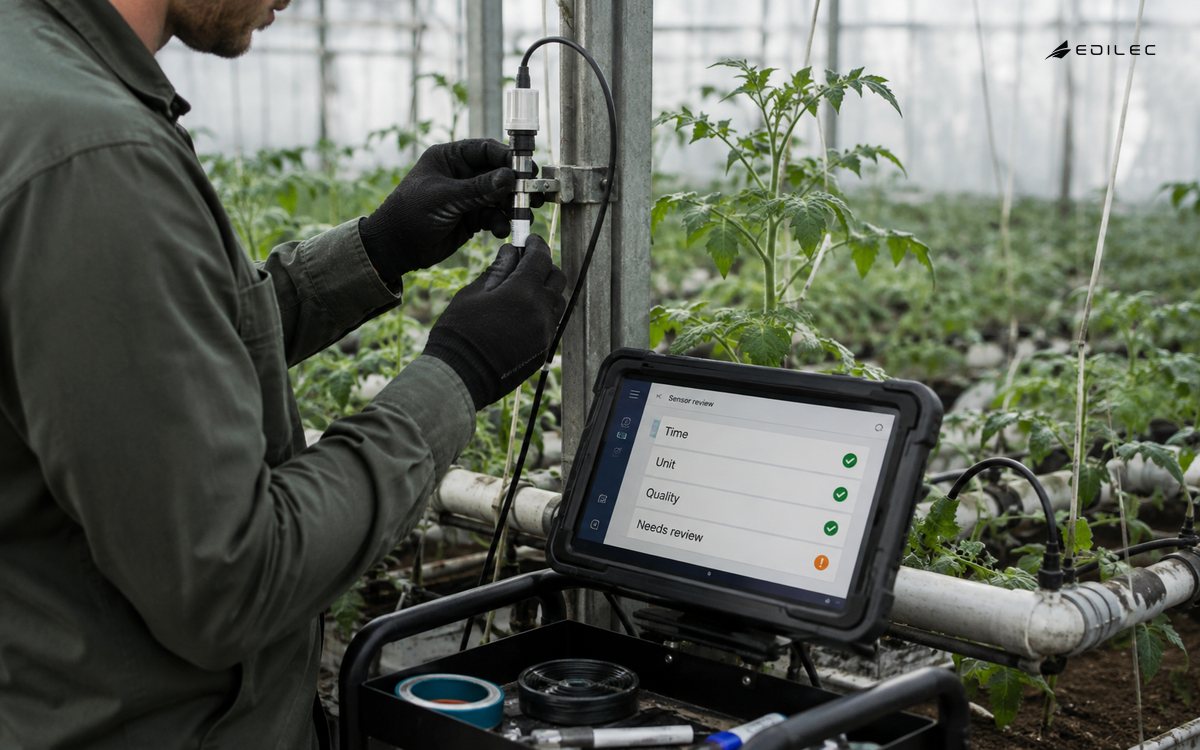
For sensor handoff controls, compare What Changes When Sensor Data Pipelines Move Into Production, Sensor Data Pipelines Decisions That Matter before the First Build, The Plain-language Guide to Sensor Calibration Data; together they frame sensor data handoffs, ownership, and recovery without asking the reader to infer the operating boundary.
- Preserve raw observations before normalization or aggregation.
- Carry unit, calibration, identity, time, schema, and quality context.
- Test replacement, clock drift, duplicates, gaps, firmware changes, and impossible values.
- Route quarantined records to an owner with a bounded correction path.
Sensor data pipeline mistakes and fixes takeaways for operators
- A sensor data pipeline is a chain of evidence, not just a transport route.
- Time, identity, units, and quality must survive every handoff.
- Validation should explain rejected or transformed records rather than erase them.
- Replay and capacity behavior need business-aware controls.
- The best quality metrics come from whether users can make and explain a decision.
Change management is a pipeline control point too. Before a firmware release, schema update, gateway mapping change, or new analytical rule enters production, identify affected consumers and run representative compatibility checks. Publish a change notice that explains the difference in operational terms, not only a technical version number. After release, compare completeness, units, latency, and outcome metrics against the baseline. This catches a subtle failure class: everything still arrives, but a scaled value, renamed field, or changed sampling interval has made existing thresholds wrong.
Sensor-pipeline questions about meaning and repair
What context must a sensor record carry?
Keep device identity, measurement name, unit, observation time, receipt time, quality state, calibration or firmware context, and the source needed for later reconciliation.
What should happen to an implausible measurement?
Preserve the raw value, mark it as rejected or disputed, route it to a review queue, and record whether the repair was a mapping, device, calibration, or contract change.
Conclusion: keep sensor data handoffs explainable
Reliable sensor data pipelines keep measurements interpretable as they move. Start by preserving source context, make every validation and transformation explainable, and test the recovery path with the teams who depend on the outcome. That turns a collection of messages into operational evidence.
Primary references for sensor data pipelines
These primary references ground sensor data pipeline mistakes and fixes: NISTIR 8259A, NIST SP 800-213A, RFC 3339: Date and Time on the Internet, OpenTelemetry Metrics Data Model. Read them with the site's safety, sector, and jurisdiction requirements before implementation for sensor data handoffs.