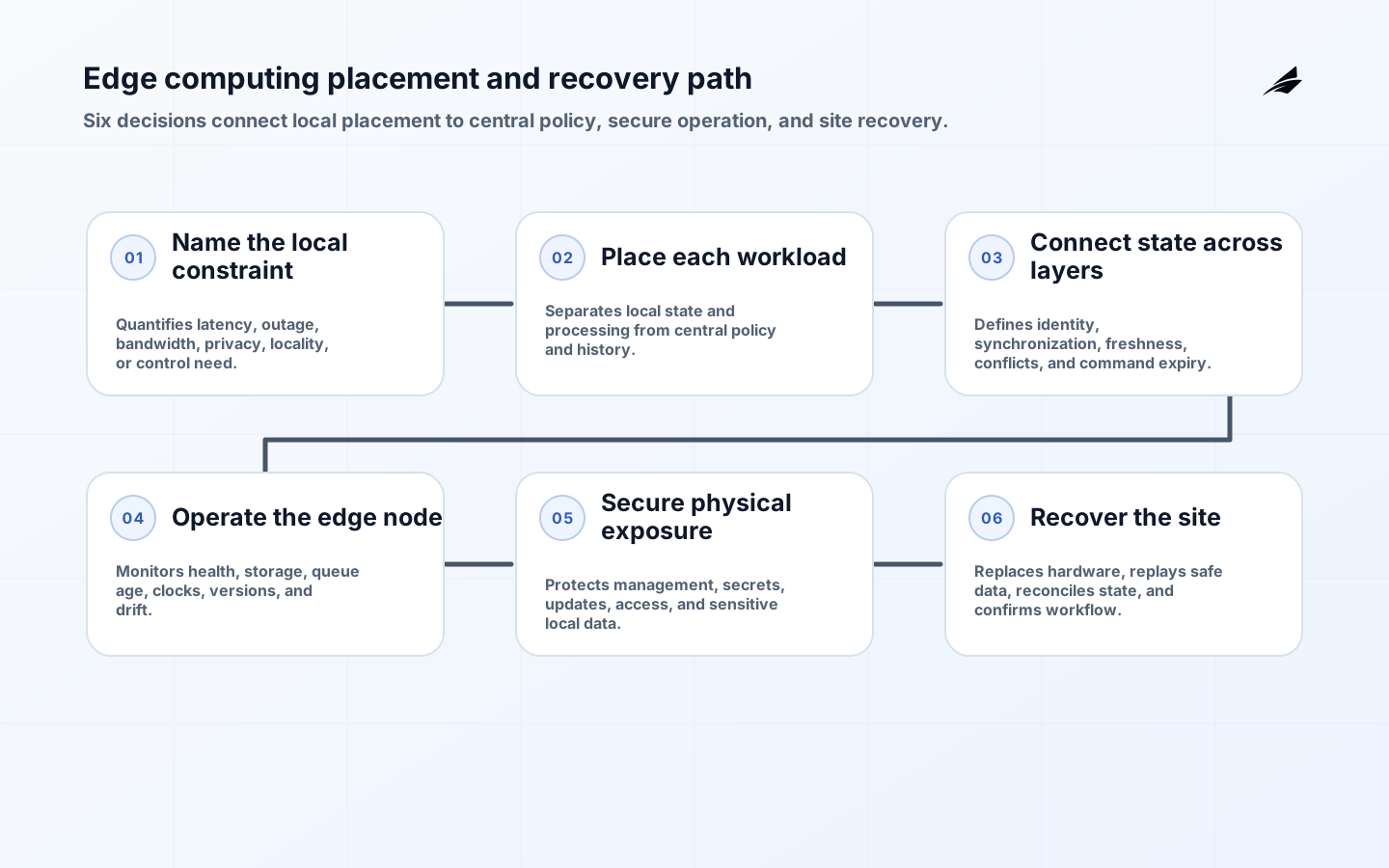
Edge computing places selected processing, storage, control, or connectivity closer to the devices and people that need it. The useful question is not whether edge is fashionable; it is what must continue when latency, bandwidth, privacy, or cloud availability makes central-only design unsuitable. NIST's fog computing model describes distributed compute between end devices and central resources, while ETSI's MEC materials provide standards context. Use those ideas to make a bounded placement decision.
Understand what edge changes
Edge can run filtering, local analytics, protocol translation, caching, control logic, or a complete workflow near the source. It does not remove central services; it changes where decisions and data are made. Start with constraint: response time, disconnection, transfer cost, privacy, resilience, or local integration. If none is material, central may be simpler.
Define the edge boundary plainly. A gateway that forwards messages differs from a site node that stores history and executes control. An on-device model differs again. Name responsibility moved to edge and evidence that returns centrally. This avoids calling every local component an edge platform.
Place work by consequence
Put a function near the device when delay or disconnection makes central execution unsafe or unusable, raw data should be reduced, or local protocol must be bridged. Keep work central when it needs broad history, cross-site correlation, heavy compute, shared policy, or centralized governance. Use hybrid when local continuity and central learning both matter.
For each function document input, output, state, time, authority, update path, and failure behavior. A local classifier may continue with cached model, but must expose model version and confidence. A central dashboard may show local state, but must show last synchronization. The edge gateways checklist helps make placement explicit.
| Placement question | Prefer edge when | Prefer central when |
|---|---|---|
| Latency | Local response has bounded need | Delay acceptable; history matters |
| Connectivity | Work continues through outage | Reliable bandwidth available |
| Data | Local reduction or residency matters | Cross-site analysis needs raw context |
| Operations | Site supports lifecycle | Central control materially simpler |
Design the edge-to-central path
NIST's model emphasizes distributed nodes mediating between end devices and cloud. Translate that into contracts for enrollment, data, commands, software updates, configuration, and health. Protect local management, isolate workloads, constrain storage, and mutually authenticate central links.

Preserve local and central identities, observed and receipt times, quality, and synchronization state. Use store-and-forward where data tolerates delay, and bounded local state machine where actions cannot wait. Decide which commands expire offline and how conflicts reconcile after reconnect. The edge computing checklist is a practical companion.
Make edge operations observable
A fleet of nodes creates a surface: versions, resource pressure, queues, clocks, certificates, models, and links. Monitor node as a service while preserving site and workload context. OpenTelemetry's documentation helps instrument local and central applications, but edge health also needs queue age and synchronization.
A green heartbeat does not prove local workflow health. Track data freshness, rejected messages, disk, CPU or memory pressure, command confirmation, and drift. Make dashboard usable during central outage. If node cannot report, local safety or operating behavior must still be defined.
Secure distributed placement
Edge nodes may be physically accessible and responsible for valuable data or action. Use device identity, least privilege, secure boot or platform integrity where appropriate, encrypted storage and transport, protected management, and signed updates. NIST's OT guide is relevant where edge software interacts with physical processes.
Keep local credentials and caches bounded. Decide what onsite operator can do, what needs central authorization, and how emergency access is reviewed. Treat replacement as identity and data-recovery event. Physical proximity is not permission to change policy or extract sensitive history.
| Edge failure | Safe behavior | Recovery evidence |
|---|---|---|
| Central link lost | Continue bounded work or pause safely | Offline duration and queue |
| Storage full | Apply retention/backpressure | Dropped or retained records |
| Workload unhealthy | Restart, isolate, or known-good version | Health check and version |
| Node replaced | Re-enroll and restore approved state | Identity, data, validation |
Choose an implementation path
Start with one workload whose placement constraint is clear and central alternative understood. Use representative site with weak connectivity or strict latency, then compare local and central outcomes. Measure end-to-end delay, transfer, degraded behavior, recovery time, and operating effort. A proof on a perfect network cannot validate edge value.
Prefer small platform with known lifecycle over bespoke agents. Define packaging, configuration, secrets, updates, rollback, logging, and support before adding workloads. Make placement explicit in deployment metadata so operator can tell what runs locally and why.
Make trade-offs visible
Edge reduces some latency and transfer but adds distributed state, hardware lifecycle, local support, and synchronization. Local processing may improve privacy but complicate deletion, audit, and model consistency. Caching improves continuity but creates staleness. Write trade-off with bound: maximum offline duration, data loss, local storage, or recovery target.
Review benefit as system changes. Network upgrade may remove latency constraint; regulation may make local processing more important. Revisit placement when workloads, sites, sensitivity, or failure consequences change. Do not move work edgeward merely because central feels slow.
Plan offline and replacement recovery
When site disconnects, state what continues, pauses, buffers, and expires. On reconnect, reconcile local events, commands, configuration, and identity. Use sequence or idempotency keys and preserve conflict decisions. For failed node, define spare hardware, enrollment, data restoration, and validation.
Exercise central outage, partial failure, full replacement, bad update, clock error, and full storage. Recovery is verified when site resumes intended workflow and central records explain interval. Link to offline sync planning when the edge boundary depends on intermittent networks.
An edge placement scenario
Edge placement should include an explicit state model. Define what the workload knows while connected, what it may infer offline, which local data is authoritative, and which central decisions are pending. Label cached policy and model age. A site can continue safely only when people understand whether a local result is current, provisional, or blocked.
State synchronization needs conflict rules before the first outage. Decide which system wins for configuration, how duplicate events are identified, whether commands expire, and how a local change is reviewed. Do not assume last-write-wins is safe for physical actions or ownership. Preserve both versions when a human must resolve the conflict.
Design the edge platform for constrained maintenance. An operator may have limited bandwidth, a small service window, or no local engineer. Package diagnostics that can be collected safely, make resource pressure visible, and keep recovery steps short. Remote support should not require opening a permanent administrative tunnel or copying secrets to a site.
Local storage is a policy choice. Set limits by data class, age, and recovery need, then define what happens when storage fills. Drop low-value aggregates before critical event evidence, or pause a workload when loss would make the local decision unsafe. Show the retention state to central operations and the site owner.
Workload updates should preserve the node's ability to recover. Keep a known-good version, verify packages, stage changes, and health-check local behavior before accepting. A central rollout service should understand sites that are offline and avoid marking them complete. Record local and central versions separately until synchronization is confirmed.
Measure edge value after deployment. Compare the local constraint that justified placement with actual latency, transfer, continuity, support effort, and incidents. If the benefit is absent, simplify or move work back centrally. A distributed architecture earns its complexity by improving a named outcome, not by having more components.
An edge workload should declare its local authority. State which decisions it can make without central approval, which cached policies it may use, and what maximum age is acceptable. If a policy expires while disconnected, define whether the workload pauses, uses a safer mode, or continues only a narrow function. This prevents offline autonomy from becoming unbounded authority.
Design data movement with a reason for every direction. Device-to-edge may carry raw measurements, edge-to-central may carry aggregates and exceptions, and central-to-edge may carry policy or commands. Document what is dropped, compressed, delayed, or retained at each boundary. This makes privacy, cost, and recovery decisions reviewable.
Edge support needs a diagnostic package safe to collect during degraded operation. Include version, health, queue age, last synchronization, certificate status, resource pressure, and workload state, but exclude secrets and unnecessary payloads. Test that the package can be gathered with normal support permissions.
Use a replacement rehearsal that includes identity and local state. A new node should not inherit old authority merely because it occupies the same cabinet or network address. Re-enroll it, restore approved configuration, validate workload behavior, and reconcile buffered data. Record what was restored and what was intentionally discarded.
Revisit edge placement after the first operating cycle. Compare actual response time, bandwidth, outage continuity, support effort, and incident pattern with the business case. If central service now meets the constraint, simplify. If local benefit is stronger than expected, expand only after lifecycle evidence supports it.
Central operations should know the age and authority of every local decision. Show whether a result was computed with current policy, cached model, or an expired condition. This helps a user decide whether to act immediately, wait for synchronization, or escalate to the site owner.
Key edge-computing takeaways
- Use edge to solve a named latency, connectivity, data, or locality constraint.
- Assign each moved responsibility local owner and central evidence path.
- Design synchronization, expiry, identity, and updates as first-class concerns.
- Monitor workload outcomes, not only node heartbeat.
- Rehearse outage and replacement recovery before scale.
Frequently asked edge-computing questions
Does edge computing replace cloud computing?
Usually not. Edge and central services divide work according to latency, connectivity, data, and governance. A hybrid design keeps local continuity while central services provide policy, history, and cross-site insight.
When is edge computing a poor fit?
When placement solves no material constraint, the team cannot operate distributed software, or local state and recovery outweigh benefit. A simpler central service may be safer.
Conclusion: edge computing in practice
Edge computing is a placement decision with operating consequences. Put only work needing local context or continuity at edge, then make identity, synchronization, updates, observability, and recovery as visible as workloads.