MQTT brokers matters to CTOs choosing how connected clients exchange device, command, and service messages. In practical terms, it is servers that accept MQTT client connections, authenticate clients, apply topic authorisation, manage sessions, and route published messages to matching subscribers. That definition is more useful than a product label because it points to decisions a team can test: what the boundary is, what information is trusted, which failure conditions are acceptable, and who responds when the normal path breaks. The related concerns of MQTT topic design, quality of service, persistent sessions should be designed as part of the operating model, not appended after an initial launch.
What MQTT brokers means
MQTT brokers should be explained in the language of responsibilities and observable behaviour. An MQTT broker is not merely a pipe between devices. Topic names, retained messages, session state, quality of service, client identity, and authorisation rules define the actual system behaviour. The broker can improve decoupling, but a weak topic contract can still expose data or create unbounded operational load. A useful definition therefore includes the information that crosses the boundary, the actors allowed to change it, the evidence retained, and the conditions in which the system refuses to proceed. That gives practitioners a way to challenge vague requirements before they become fragile implementation assumptions.
Architecture decisions to make first
The architecture is not a diagram of components alone. It is the set of contracts that lets CTOs choosing how connected clients exchange device, command, and service messages operate the capability repeatedly. Make the following decisions explicit before choosing a platform feature or writing an integration. Each one affects the likely failure mode, the test plan, and the people who will need evidence later.

| Decision | What to define |
|---|---|
| Topic taxonomy | Design stable topic segments for tenant, device, direction, and message purpose without leaking sensitive identifiers. |
| Client identity | Use unique device or service identities and validate credentials before a session is accepted. |
| Delivery contract | Choose QoS, retained-message use, expiry, and session persistence per message class. |
| Authorization policy | Grant publish and subscribe rights narrowly rather than relying on topic naming conventions. |
Implementation path
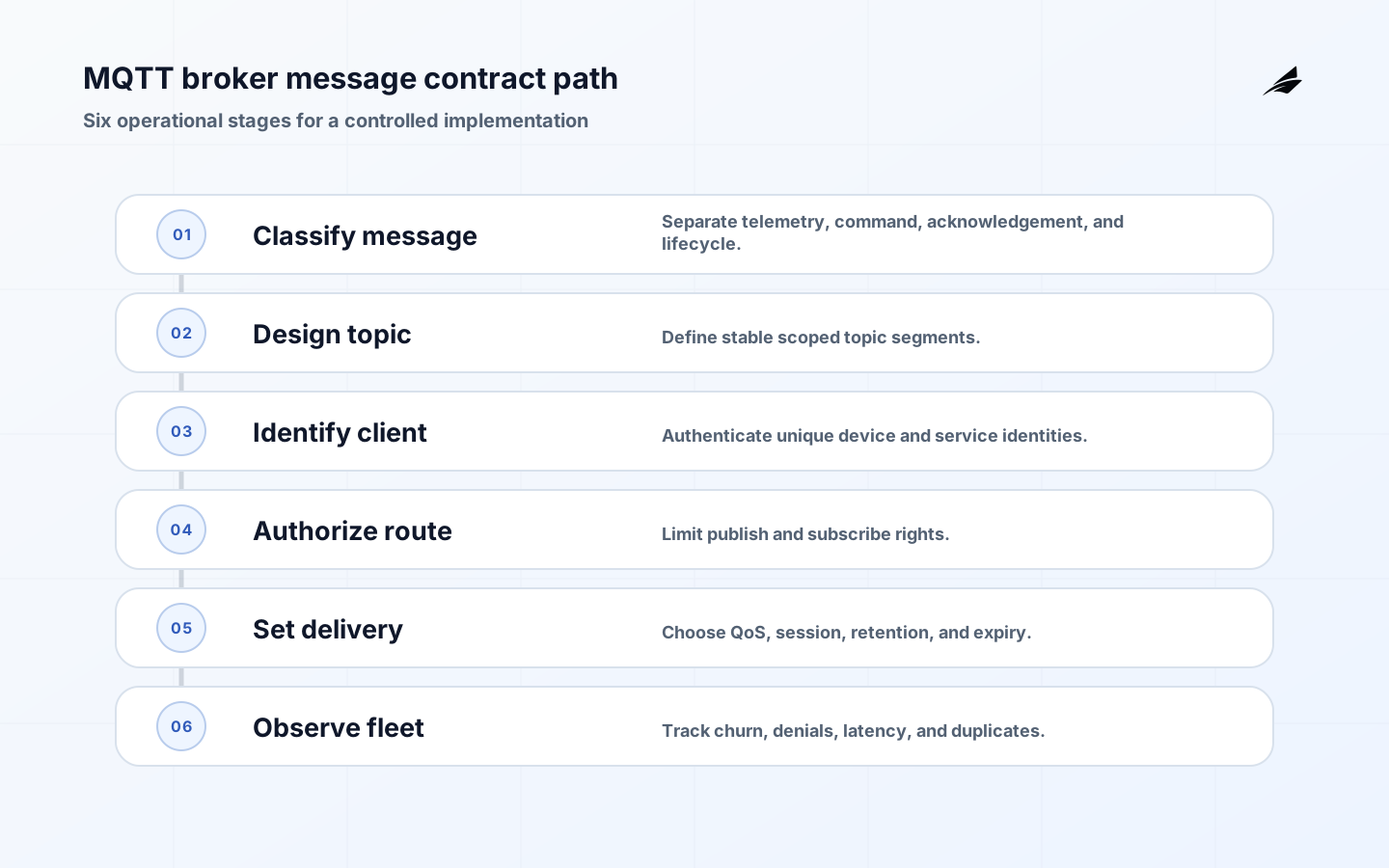
- Classify messages as telemetry, command, acknowledgement, lifecycle, or operational event.
- Define topic patterns and payload schemas together, including version and tenant context.
- Issue unique identities and rotate credentials through a controlled device lifecycle.
- Set QoS and persistence from the consequence of loss, duplication, and delay.
- Authorise publish and subscribe operations independently for each client class.
- Observe connection churn, rejected authorisations, queue depth, and delivery outcomes.
Build a thin, inspectable path first. It should include the unpleasant cases as well as the demonstration case: a missing identifier, a delayed message, an expired credential, a rejected record, or an unavailable dependency. Give that path named inputs and outputs, a clear retry or escalation rule, and a way to prove what happened. This is where MQTT topic design becomes operational rather than aspirational.
Risks and controls
QoS is not an end-to-end business guarantee. QoS 1 can deliver a message more than once, so consumers need idempotent handling; QoS 2 adds protocol coordination but still does not replace an application-level command outcome. Retained messages are convenient for durable state but can surprise new subscribers when old state is replayed. Use explicit expiry, ownership, and payload validation for every retained topic.
| Operating signal | What it shows |
|---|---|
| Connected client stability | Reconnect churn, session expiry, and abnormal disconnect patterns. |
| Authorisation denial rate | Denied publish and subscribe attempts by client type and topic. |
| Message delivery latency | Time from accepted publish to intended consumer handling. |
| Duplicate handling rate | Replays or duplicate QoS deliveries handled safely by consumers. |
Review and measurement
Measurement should tell the team whether MQTT brokers is still meeting its contract, not merely whether infrastructure is running. Review the signals in the table with the owner who can change the workflow. Look at trends, samples of failures, and the gap between detected and resolved issues. When a metric changes, follow the evidence back to the contract, implementation version, and real user or device behaviour before declaring a fix.
- Set a service objective for the consequence that matters, not only a technical average.
- Sample successful and failed cases to verify that quality of service is understandable.
- Make a named owner responsible for triaging exceptions and publishing the resolution.
- Review access, configuration, and retention choices whenever the process or fleet changes.
- Use controlled tests to rehearse recovery before an incident requires improvisation.
Operational scenario
A fleet of energy controllers publishes site-scoped telemetry and receives only commands addressed to its own identity. A service consumer subscribes to broader operational topics but cannot publish device commands. Those distinctions are best expressed in the topic and authorisation contract, not left to convention in application code. The IoT telemetry guide is the companion discipline: every accepted message needs a payload meaning and quality expectation as well as a route.
Evidence and testing
Document representative publish and subscribe permissions for each client type, including an attempted cross-tenant or cross-device access that must fail. Test reconnect with clean and persistent session settings, retained-state delivery, QoS retries, and expired credentials. Capture the broker decision and the consuming service outcome separately, because a successful publish does not prove a business action completed. A command acknowledgement should identify the command, intended device, observed result, and time so retries can be handled safely.
Design review questions
At architecture review, look for topic patterns that encode too much product logic or expose identifiers that do not belong in broad subscriptions. Verify retained messages have a named owner, explicit expiry, and a consumer that understands old state. Consider back pressure and noisy clients: a single misbehaving publisher should not make critical lifecycle messages unavailable. Broker clusters, bridges, and observability are important, but they do not compensate for an ambiguous message contract.
Practical operations
A broker architecture benefits from a written message catalogue beside its topic catalogue. For each message, name the producer, authorised subscribers, payload schema, QoS, retained-state rule, expiry, idempotency key, and expected acknowledgement. This enables useful security review and helps service teams recognise when a subscriber is using a topic outside its intended purpose. Run load and reconnect tests with representative fleets, including clients that reconnect simultaneously after a network event. Observe whether critical messages still reach their handlers and whether stale session state creates unexpected delivery.
Limits and tradeoffs
MQTT deliberately gives architects several delivery options, and each creates tradeoffs. Persistent sessions help clients recover subscriptions but can retain queued work beyond the context in which it mattered. Retained messages simplify state discovery but need expiry and careful ownership. Higher QoS can reduce loss but increases coordination and duplicate-handling work. Choose behaviour per message class, publish it in the contract, and make consumers robust to the semantics they receive rather than assuming a broker can guarantee business completion.
- Name the accountable owner before adding another integration or policy.
- Keep a representative failure test beside the normal acceptance test.
- Record the version of the contract, configuration, or rule in use.
- Use evidence from real operations to improve the next release.
- Make temporary exceptions visible, approved, and time-bounded.
- Review the boundary whenever the business process or fleet changes.
Adoption and change management
Fleet growth, reconnect storms, new downstream consumers, and credential rotation are the moments when a broker contract meets operational reality. Prepare for them with a small change record that names the proposed change, contract or policy version, expected operational effect, affected owners, test evidence, rollout window, and reversal decision. Give users and support teams a plain-language explanation of the behaviour that will change, especially where a new denial, warning, or data-quality status can be mistaken for a defect. Monitor the first production cases closely and compare them with the pre-change baseline. When an exception appears, decide whether it is a valid new requirement, a training issue, a data defect, or a control that must remain firm. This practice keeps MQTT brokers connected to the people who operate it. It also prevents a series of urgent local fixes from becoming an undocumented alternate system. Retire obsolete rules and integrations deliberately, preserve the evidence needed for a later review, and update runbooks so the next team member inherits a working explanation rather than a collection of historical assumptions.
Key takeaways
- MQTT brokers is a contract between technical components, people, and operations.
- Define boundaries and ownership before optimising a tool or interface.
- Treat quality of service as a first-class output, with evidence for failure and recovery.
- Make exceptional conditions testable and visible to an accountable owner.
- Revisit the contract as customers, devices, data, or regulations change.
Frequently asked questions
Does MQTT QoS 2 guarantee that a device performed a command exactly once?
No. QoS 2 provides an exactly-once delivery protocol between MQTT clients and broker for the publish transaction. A device can still disconnect, restart, or act before an acknowledgement is recorded. Commands need identifiers, idempotency rules, and a separate business acknowledgement.
Should every device subscribe to wildcard topics?
Usually not. Wildcards are useful for tightly controlled service consumers, but broad device subscriptions make authorisation, load, and incident analysis harder. Give devices the narrow subscriptions their role requires.
Conclusion
MQTT brokers earn their place when their message contracts are as deliberate as their network setup. Design topic and identity boundaries first, state delivery semantics plainly, and measure the behaviours that reveal a client fleet or consumer is drifting out of control. Review the route and payload contract whenever a client class, topic, or consumer is added.