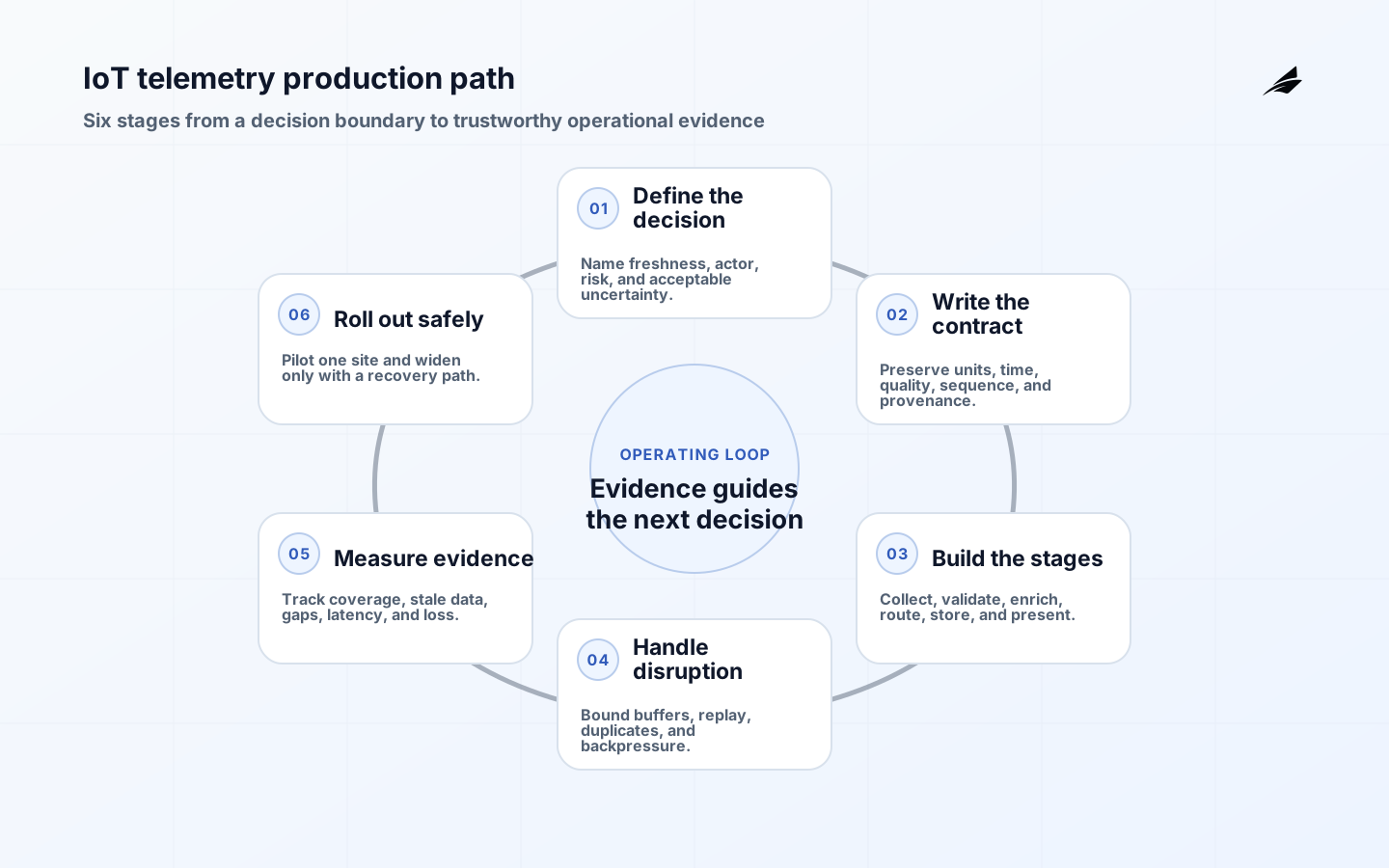
IoT telemetry changes character when it becomes a production dependency. In a prototype, a dashboard that shows recent values can feel complete. In production, a missing reading, a clock that drifted, a duplicate message, or a gateway that buffered data for six hours can change an operational decision. The system therefore needs more than ingestion: it needs freshness rules, provenance, quality flags, storage policy, access control, and a way to explain what happened. OpenTelemetry signals offer a useful vocabulary for thinking about telemetry signals, while MQTT remains a transport contract rather than a guarantee that every reading is meaningful. Design the evidence path around the decision, not around the number of charts.
Define the Telemetry Decision Boundary
Begin with a sentence that names the decision, actor, time window, and acceptable uncertainty. “The operations team decides whether a pump needs inspection using pressure and vibration readings from the last fifteen minutes” is actionable. It immediately raises questions: what if one sensor is silent, what if the timestamp is from the device rather than the gateway, and what if the reading is outside calibration range? Link this to IoT telemetry explained from first principles to keep signal, measurement, metadata, and interpretation separate. Production telemetry should make uncertainty visible instead of converting every absence into a zero.
| Field | Production question | Example rule |
|---|---|---|
| Event time | When did the device observe it? | Preserve device time and ingestion time separately. |
| Quality | Can this value support the decision? | Mark calibration failure, range failure, or estimated value. |
| Freshness | How old can the evidence be? | Show stale after fifteen minutes; never silently fill. |
| Provenance | Which device and path produced it? | Retain device, firmware, gateway, and schema version. |
Specify the Production Evidence Contract
A telemetry contract describes the payload, units, timestamp policy, sequence behavior, schema version, retention, and failure meaning. Define whether a missing field differs from a null field and whether a zero is a real measurement or an error default. Preserve a stable device identifier, but avoid placing secrets or excessive personal data in topics and payloads. If a product publishes through MQTT, make topic authority and subscription scope explicit; the MQTT Version 5.0 specification is the authoritative reference for its delivery and session behavior. Consumers should reject incompatible schemas loudly enough that operators can find the boundary.

Design the Pipeline in Stages
Separate collection, validation, enrichment, routing, storage, and presentation. A gateway may add site context and buffer readings, an ingestion service may validate units and sequence numbers, and a storage layer may partition hot operational data from long-term history. The OpenTelemetry Collector documentation describes a receiver, processor, and exporter model that is a helpful pattern even when your device payloads require a custom adapter. Keep each stage observable and make retry behavior bounded. A poison message should be quarantined with reason and provenance, not retried forever until it hides a larger outage.
Separate Observed State from Desired State
A telemetry value answers what the device reported; desired state answers what an application wants the device to do. Combining them creates unsafe assumptions. AWS IoT’s Device Shadow service illustrates this separation with reported and desired state that can remain available while a device is disconnected. Use the same conceptual boundary even if your implementation is different: record who changed desired state, when it expires, and how the device acknowledges or rejects it. A dashboard should not show a desired temperature as if it were an observed temperature.
| Signal type | What it answers | What to do when absent |
|---|---|---|
| Measurement | What did the device observe? | Mark stale or unknown; do not invent a value. |
| Health | Can the device and path be trusted? | Escalate separately from the business threshold. |
| Command acknowledgement | Did the device apply intent? | Keep pending, retry within policy, or request review. |
| Derived state | What does the system infer? | Show formula, inputs, and calculation time. |
Treat Time as Data
Production telemetry usually has at least three relevant times: observation time, gateway receipt time, and service ingestion time. Keep them distinct. A device with a bad clock can still produce useful data if the pipeline exposes the uncertainty and uses a trusted receipt time for operational freshness. Sequence numbers help detect gaps, while monotonically increasing device counters can reveal resets or replay. Establish how daylight saving changes, time zones, leap behavior, and clock correction are handled before the first incident. A simple time policy prevents teams from arguing over a graph that has silently mixed event time and processing time.
Plan for Disconnects and Backpressure
A production design must state what the device, gateway, broker, and consumer do when the network is unavailable. Bounded local storage is safer than an unbounded queue; define eviction order, replay order, and whether old samples remain useful. MQTT session behavior can help with reconnects, but the application still needs deduplication and an explicit freshness calculation. Test a gateway restart, a broker outage, a storage throttle, and a burst of delayed readings. If the pipeline cannot keep up, preserve the records that support the critical decision first and make the loss visible to the operator.
Measure the Evidence Path
Monitor more than ingestion throughput. Useful signals include device coverage, expected-versus-received rate, stale duration, invalid payload rate, sequence gaps, duplicate rate, buffer depth, end-to-end latency, and the percentage of readings with trustworthy time and quality metadata. OpenTelemetry distinguishes signals such as metrics, logs, and traces; use that distinction to correlate a missing reading with the gateway, broker, parser, or storage path that handled it. A single counter called telemetry received cannot tell an operator whether a quiet site is healthy or simply disconnected. Keep the measures connected to an action and an owner.
Protect Telemetry and Its Context
Telemetry may reveal occupancy, production volume, health, or customer behavior. Apply least privilege to publish and subscribe paths, encrypt transport where appropriate, redact sensitive fields, and restrict who can query historical data. Keep device identity, site identity, and user identity separate when the business case does not require joining them. Rotate credentials and audit changes to schemas, routing, retention, and access policy. Device provisioning security review provides a useful companion, while the production evidence path continues after onboarding.
Roll Out with a Bounded Baseline
Choose one site, one device family, and one operational decision for the first production release. Capture a baseline for expected reporting rate, freshness, invalid messages, and operator response time. Then introduce realistic interruptions and compare the evidence with the acceptance contract. Do not widen the rollout simply because data is arriving; widen it when the team can tell whether data is late, wrong, duplicated, or intentionally suppressed. The related sensor data pipelines guide can help review failure modes before scale. Keep a rollback or routing disablement path for each new transformation.
Before promoting a telemetry pipeline, ask an operator to explain one record from device to decision. They should be able to identify the device and firmware, see observation and receipt times, understand quality, find transformations, and tell whether the value was used in an alert or report. If that walkthrough requires privileged database access or tribal knowledge, the evidence path is not yet production-ready. Turn the walkthrough into a repeatable support procedure.
Also define what the service does when evidence becomes less trustworthy over time. A calibration expiry may turn a measurement into a warning; a gateway outage may turn a stream into an unknown state; a late batch may remain useful for history but not for real-time control. Put those transitions in the contract and user interface. This protects the product from quietly converting degraded evidence into confident-looking decisions.
Keep a small evidence sample for each device family: a normal record, a stale record, a rejected record, and a delayed replay. Review it with operations during every material pipeline change. This creates a practical regression check for time, quality, provenance, and consumer interpretation without requiring the whole fleet to be present.
A production review should include a sample of the operator experience, not only pipeline metrics. Ask whether a user can tell fresh from stale, observed from desired, and unavailable from zero. That small test catches misleading presentation choices that a healthy ingestion rate will never reveal.
Keep source and derived records distinguishable so a later review can tell what the device actually reported from what the platform inferred.
Practical Takeaways
- Define the decision and freshness boundary before choosing dashboards or storage.
- Preserve observation time, ingestion time, provenance, sequence, units, and quality.
- Separate observed state from desired state and show acknowledgements honestly.
- Use bounded buffers, explicit replay, deduplication, and visible loss handling.
- Measure the evidence path from device through consumer, not only total ingestion.
- Roll out one device family and one decision at a time with an exit path.
FAQ: IoT Telemetry in Production
How long should IoT telemetry be retained?
There is no universal period. Retain raw data long enough to investigate the decisions and failures that matter, then use an explicit aggregation or deletion policy. Consider operational value, legal requirements, storage cost, privacy, and whether derived records preserve enough evidence to explain a decision.
Should a missing reading be stored as zero?
No, unless zero is independently observed and the contract says so. A missing reading should carry a status such as stale, unknown, or unavailable. Filling it with zero can turn a connectivity problem into a false operational conclusion.
Conclusion
Production IoT telemetry is a governed evidence system. Its value comes from trustworthy timing, provenance, quality, resilience, and a clear connection to decisions. Build those contracts before adding more devices, and the service will be easier to operate, explain, and improve when the network or hardware behaves differently than the prototype did.