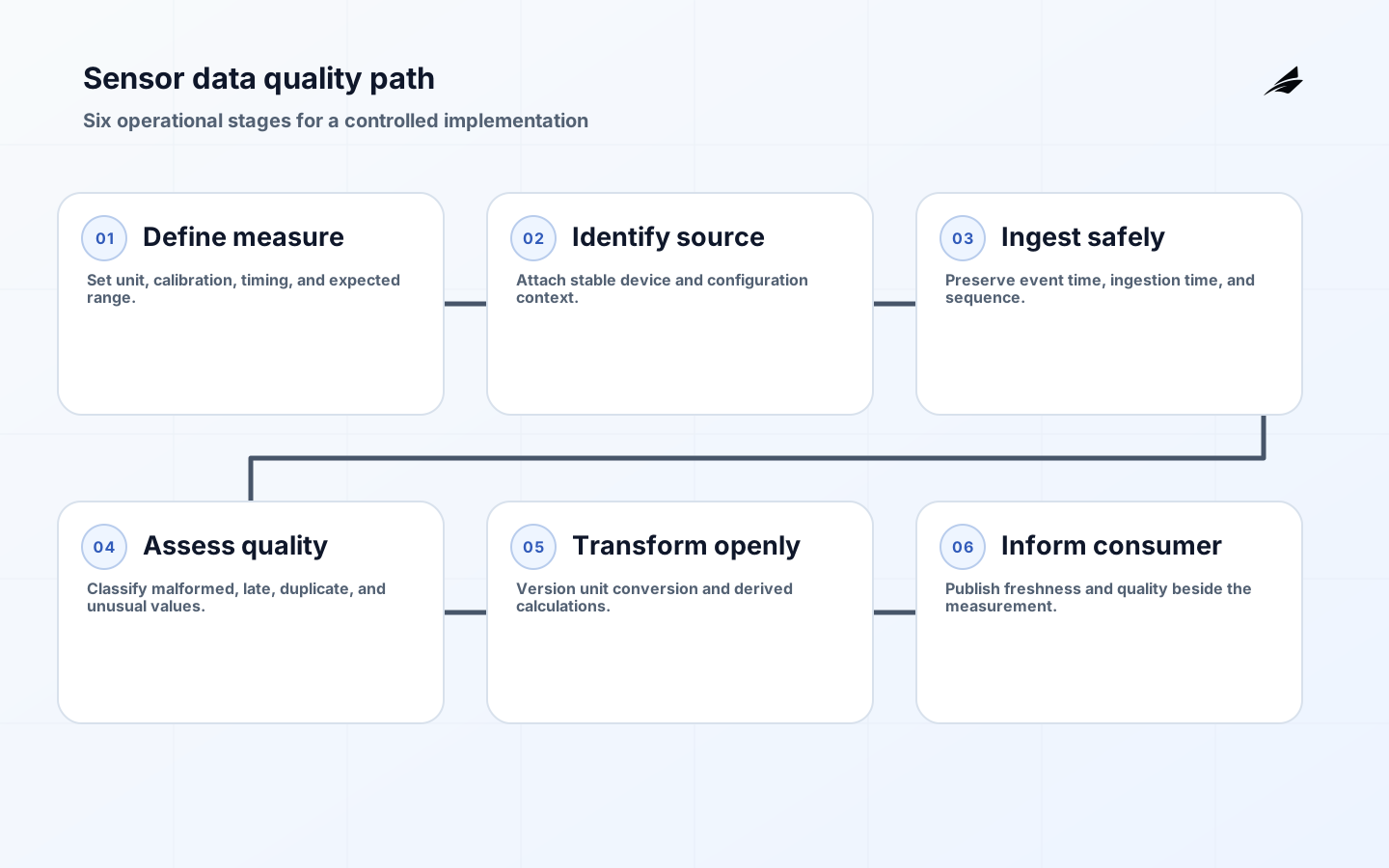
Sensor data pipelines matters to operations leaders whose decisions depend on measurements arriving from a changing device fleet. In practical terms, it is the collection, validation, storage, transformation, and delivery components that turn raw sensor observations into data a person or automated process can use responsibly. That definition is more useful than a product label because it points to decisions a team can test: what the boundary is, what information is trusted, which failure conditions are acceptable, and who responds when the normal path breaks. The related concerns of time-series ingestion, device data schema, telemetry validation should be designed as part of the operating model, not appended after an initial launch.
What sensor data pipelines mean
Sensor data pipelines should be explained in the language of responsibilities and observable behaviour. The pipeline begins before cloud ingestion. Calibration, firmware behaviour, device time, connectivity, and installation context shape what a measurement means. It ends after a consumer can assess freshness and confidence, not merely when a row lands in storage. A useful definition therefore includes the information that crosses the boundary, the actors allowed to change it, the evidence retained, and the conditions in which the system refuses to proceed. That gives practitioners a way to challenge vague requirements before they become fragile implementation assumptions.
Architecture decisions to make first
The architecture is not a diagram of components alone. It is the set of contracts that lets operations leaders whose decisions depend on measurements arriving from a changing device fleet operate the capability repeatedly. Make the following decisions explicit before choosing a platform feature or writing an integration. Each one affects the likely failure mode, the test plan, and the people who will need evidence later.
| Decision | What to define |
|---|---|
| Measurement contract | Define unit, resolution, calibration status, expected range, and event-time semantics for each signal. |
| Identity and context | Attach device, location or asset, configuration, and schema version without relying on mutable display names. |
| Quality policy | Separate malformed, late, duplicate, out-of-range, and suspicious-but-possible values. |
| Consumer view | Publish quality flags and freshness with measurements so dashboards do not imply unwarranted certainty. |
Implementation path
- Document each sensor signal as a measurement contract before scaling ingestion.
- Capture event time, ingestion time, device sequence, and software or schema version.
- Normalise units at an explicit transformation boundary and retain the original value where investigation requires it.
- Deduplicate using stable message or device sequence identifiers instead of timestamp alone.
- Quarantine invalid payloads with reason codes and a route for correction or replay.
- Reconcile aggregate sensor counts against fleet and connectivity expectations every day.
Build a thin, inspectable path first. It should include the unpleasant cases as well as the demonstration case: a missing identifier, a delayed message, an expired credential, a rejected record, or an unavailable dependency. Give that path named inputs and outputs, a clear retry or escalation rule, and a way to prove what happened. This is where time-series ingestion becomes operational rather than aspirational.
Risks and controls
The common mistake is silently “cleaning” sensor data until it looks believable. A spike may represent a fault, a real physical event, a unit change, or a bad installation. Preserve raw evidence within an appropriate retention policy, make transformations versioned, and expose the quality decision. Filtering and imputation are legitimate only when the downstream user can understand the rule and uncertainty.
| Operating signal | What it shows |
|---|---|
| Expected-signal coverage | Received observations compared with active-device and sampling expectations. |
| Late-arrival distribution | Delay between observed time and accepted ingestion. |
| Quality-flag rate | Malformed, duplicate, out-of-range, and quarantine categories over time. |
| Schema migration success | Producers and consumers correctly handling approved schema versions. |
Review and measurement
Measurement should tell the team whether sensor data pipelines are still meeting their contract, not merely whether infrastructure is running. Review the signals in the table with the owner who can change the workflow. Look at trends, samples of failures, and the gap between detected and resolved issues. When a metric changes, follow the evidence back to the contract, implementation version, and real user or device behaviour before declaring a fix.
- Set a service objective for the consequence that matters, not only a technical average.
- Sample successful and failed cases to verify that device data schema is understandable.
- Make a named owner responsible for triaging exceptions and publishing the resolution.
- Review access, configuration, and retention choices whenever the process or fleet changes.
- Use controlled tests to rehearse recovery before an incident requires improvisation.
Operational scenario
A water-monitoring fleet reports flow and pressure from devices installed at different times and calibrated by different teams. One firmware version sends litres per minute while another supplies millilitres per second. Both can be converted, but only if the pipeline identifies the source version and transformation rule. A monthly operations total that ignores this difference can look precise while being wrong. The data pipeline meaning guide provides the broader contract and lineage discipline for this situation.
Evidence and testing
Create a measurement registry that links each signal to unit, calibration policy, device model, valid range, sampling cadence, schema versions, and consuming reports or automations. Include test fixtures for unit conversion, delayed upload, duplicate sequence, and replacement-device mapping. Keep quality reason codes in the delivered dataset so analysts can exclude or investigate records with intent instead of applying undocumented spreadsheet filters. A reconciliation report should explain missing signals by fleet state, not only show a lower total.
Design review questions
At review, walk one observation from sensor to decision. Can the team show the raw payload, source device, time basis, validation result, transformation version, stored record, and dashboard interpretation? If any step depends on tribal knowledge, document it or automate it. Discuss retention separately for raw and derived data, because the investigation value of raw evidence may differ from the cost and privacy profile of long-term storage. The goal is traceable quality, not a false claim of perfect data.
Practical operations
Build data-quality operations into the daily service rhythm. A dashboard should show active devices, expected observations, late arrivals, quarantined records, and unexplained changes in range or unit. Pair automated checks with periodic review of field context: a missing sensor may be undergoing maintenance, a sudden change may follow installation, and a valid extreme measurement may signal a real event. The goal is a feedback loop between operational teams and data owners, so quality rules improve from evidence rather than becoming permanent blind filters.
Limits and tradeoffs
Sensor pipelines balance preservation and usability. Raw messages can be valuable for diagnosis but expensive or inappropriate to retain indefinitely; derived tables are convenient but can conceal their assumptions. Keep a documented retention and transformation policy for both. Prefer reversible, versioned derivations and record the quality rule that changed a value’s status. When a new device model or firmware enters the fleet, treat it as a compatibility event and test the full consumer path before its data is compared with older measurements.
- Name the accountable owner before adding another integration or policy.
- Keep a representative failure test beside the normal acceptance test.
- Record the version of the contract, configuration, or rule in use.
- Use evidence from real operations to improve the next release.
- Make temporary exceptions visible, approved, and time-bounded.
- Review the boundary whenever the business process or fleet changes.
Adoption and change management
New sensor models, calibration changes, seasonal conditions, and backfilled records are the moments when quality assumptions need explicit review. Prepare for them with a small change record that names the proposed change, contract or policy version, expected operational effect, affected owners, test evidence, rollout window, and reversal decision. Give users and support teams a plain-language explanation of the behaviour that will change, especially where a new denial, warning, or data-quality status can be mistaken for a defect. Monitor the first production cases closely and compare them with the pre-change baseline. When an exception appears, decide whether it is a valid new requirement, a training issue, a data defect, or a control that must remain firm. This practice keeps sensor data pipelines connected to the people who operate it. It also prevents a series of urgent local fixes from becoming an undocumented alternate system. Retire obsolete rules and integrations deliberately, preserve the evidence needed for a later review, and update runbooks so the next team member inherits a working explanation rather than a collection of historical assumptions.
Key takeaways
- Sensor data pipelines are a contract between technical components, people, and operations.
- Define boundaries and ownership before optimising a tool or interface.
- Treat device data schema as a first-class output, with evidence for failure and recovery.
- Make exceptional conditions testable and visible to an accountable owner.
- Revisit the contract as customers, devices, data, or regulations change.
Frequently asked questions
Why is a timestamp not enough to order sensor data?
A timestamp can be wrong because device clocks drift, messages are buffered, or two events share the same resolution. Keep device sequence or message identifiers when the producer supports them, and distinguish event time from ingestion time before deciding how to order or deduplicate records.
Should outliers be deleted?
Not automatically. Mark and investigate them according to the measurement contract. An outlier can be a faulty sensor, but it can also be the earliest evidence of a meaningful physical change. Downstream consumers need the value, quality status, and rule used to assess it.
Conclusion
Sensor data becomes operational evidence only when its physical meaning survives the pipeline. Define measurements before storage, preserve timing and quality context, and make every transformation explainable to the people who will act on the result.