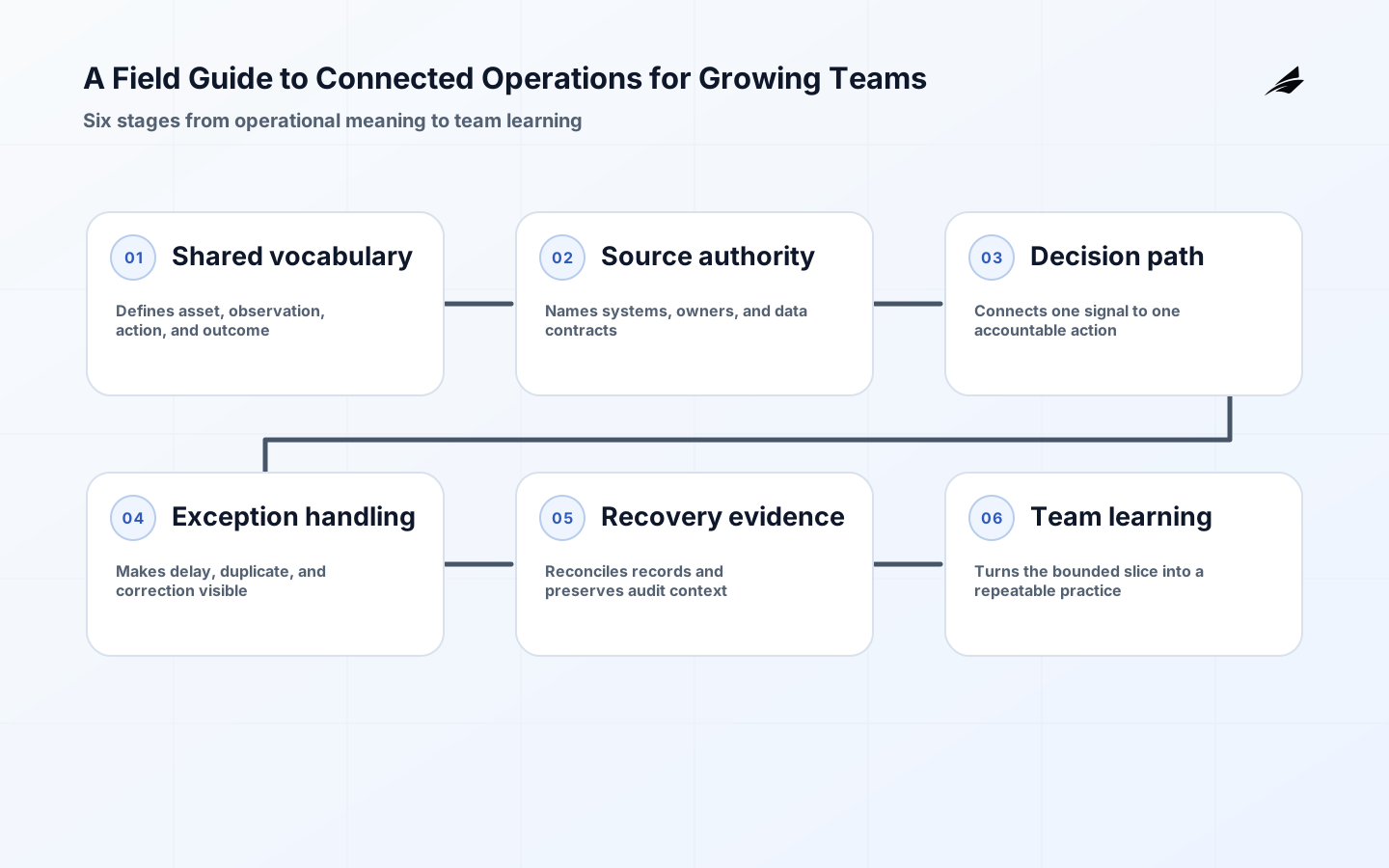
Connected operations describes the practical use of field, application, and business signals to make operations more visible and responsive. It does not mean collecting every possible data point into one dashboard. The value appears when a signal is tied to an accountable decision: inspect an asset, reroute work, stop a process, notify a customer, or verify recovery. Growing teams should choose a few operational outcomes where delay or ambiguity is expensive, then build the information flow and controls needed to act responsibly.
Define the connected operations decision
Begin with a measurable operating outcome such as reducing time to acknowledge a critical condition or confirming that a repair restored a required service level. Name the person who acts, the evidence they need, the time window, the acceptable recovery route, and how completion will be verified. This prevents a connected operations program from becoming a collection of attractive charts. NIST SP 800-160 Volume 2 is helpful for resilience thinking: anticipate disruption, continue essential functions, and learn from adversity.
| Control area | What to specify | Evidence to review |
|---|---|---|
| Purpose | State the operational decision, user, completion evidence, and cost of a wrong result during shared-operations review. In connected operations, make the boundary explicit rather than relying on a default setting during shared-operations review. | A named owner, an example record, and a repeatable test that shows the purpose rule works in production conditions during shared-operations review. |
| Authority | Name the system, role, or device that may create or correct this record during shared-operations review. In connected operations, make the boundary explicit rather than relying on a default setting during shared-operations review in the second pass. | A named owner, an example record, and a repeatable test that shows the authority rule works in production conditions during shared-operations review. |
| Time | Keep observation time, processing time, and review deadline distinct and visible during shared-operations review. In connected operations, make the boundary explicit rather than relying on a default setting during shared-operations review in the third pass. | A named owner, an example record, and a repeatable test that shows the time rule works in production conditions during shared-operations review. |
| Change | Version the contract or rule and publish a migration and rollback decision during shared-operations review. In connected operations, make the boundary explicit rather than relying on a default setting during shared-operations review in the fourth pass. | A named owner, an example record, and a repeatable test that shows the change rule works in production conditions during shared-operations review. |
Design the record and boundary
Connect systems through explicit ownership boundaries. Asset records, telemetry, work orders, customer commitments, and access decisions may originate in different systems; a shared display should show freshness and source rather than pretending they are one database. Use stable identities to associate evidence across them, and preserve event time separately from processing time. Industrial dashboards can then present the current operational picture without becoming the hidden system of record.
Make controls testable
Automated recommendations and actions require clear limits. State which conditions trigger a response, who can override it, what confidence or quality flags are required, and how an unsafe or incomplete action is stopped. Apply least privilege to integrations and operational roles, especially where a portal can change equipment state or customer commitments. The NIST Cybersecurity Framework 2.0 provides a useful way to connect governance, protection, detection, response, and recovery with operational ownership.
| Control area | What to specify | Evidence to review |
|---|---|---|
| Failure | Describe the safe response to loss, delay, duplication, malformed input, and access denial during shared-operations review. In connected operations, make the boundary explicit rather than relying on a default setting during shared-operations review in the fifth pass. | A named owner, an example record, and a repeatable test that shows the failure rule works in production conditions during shared-operations review. |
| Evidence | Retain identity, correlation, configuration, result, and accountable owner for investigation during shared-operations review. In connected operations, make the boundary explicit rather than relying on a default setting during shared-operations review in the sixth pass. | A named owner, an example record, and a repeatable test that shows the evidence rule works in production conditions during shared-operations review. |
| Release | Test representative field conditions, permissions, degraded connectivity, and recovery before scale during shared-operations review. In connected operations, make the boundary explicit rather than relying on a default setting during shared-operations review in the seventh pass. | A named owner, an example record, and a repeatable test that shows the release rule works in production conditions during shared-operations review. |
| Review | Measure decision impact, exception burden, and unresolved work; assign the next improvement during shared-operations review. In connected operations, make the boundary explicit rather than relying on a default setting during shared-operations review in the eighth pass. | A named owner, an example record, and a repeatable test that shows the review rule works in production conditions during shared-operations review. |
Operate from evidence
Review the whole control loop: signal received, condition interpreted, action assigned, work performed, result verified, and rule improved. Measure missed detections, false positives, response time, manual bypasses, stale data, and unresolved exceptions. A high volume of alerts may indicate that thresholds are wrong or that no one owns the response. Include operators in regular review, because their workarounds often expose missing context that a systems diagram cannot show.
Roll out and review deliberately
Use a limited rollout that includes representative assets, roles, connectivity, and exception cases for connected team operations. For connected operations, publish the success measure, a containment trigger, and the person allowed to pause the change. Review observed behavior with the people who perform the work, then update the operating record, test fixtures, and recovery guidance for connected team operations. A feature is not mature because it is deployed; it is mature when a new operator can understand the boundary and a support owner can resolve a failure without guessing for connected team operations.
A deeper connected operations review should connect signal quality, response ownership, and verified restoration. Take one material condition from the first reading through the final verification. Identify when the signal becomes credible, who interprets it, what work is assigned, and how completion is distinguished from mere acknowledgement. Include a case where data is late or contradictory. That scenario reveals whether the operating loop has an honest recovery route or simply keeps showing an attractive but stale status. Keep the review concrete by naming the records, people, assets, and time windows involved for connected team operations. It is tempting to call an architecture sound because its normal path is tidy, but operational confidence comes from explaining an incomplete path: a message that arrived after a decision, a device that was replaced, a technician who worked offline, or a credential that should no longer work for connected team operations. For connected operations, record the observed result, the expected result, the owner who decides the difference, and the smallest corrective action. That creates a reusable acceptance test for the next release and prevents a local workaround from quietly becoming a permanent rule for connected team operations. Review this evidence with engineering and the people who carry the operational consequence for connected team operations. When their accounts disagree, preserve both facts and resolve the authority rather than smoothing the difference in a dashboard or export for connected team operations. The goal is not perfect data. It is a system that tells people when its evidence is incomplete, states which record remains authoritative, and gives them a safe accountable way to respond for connected team operations.
Make connected work legible to a growing team
A growing team needs a shared language for connected operations before it needs more integrations. Define the operational object, its source of truth, its lifecycle, and the human decision attached to each state. A connected asset record may include identity, location, condition, last observation, ownership, and open work. If different teams use the same word for different states, automation will amplify the disagreement. Start with a small glossary and examples from real cases.
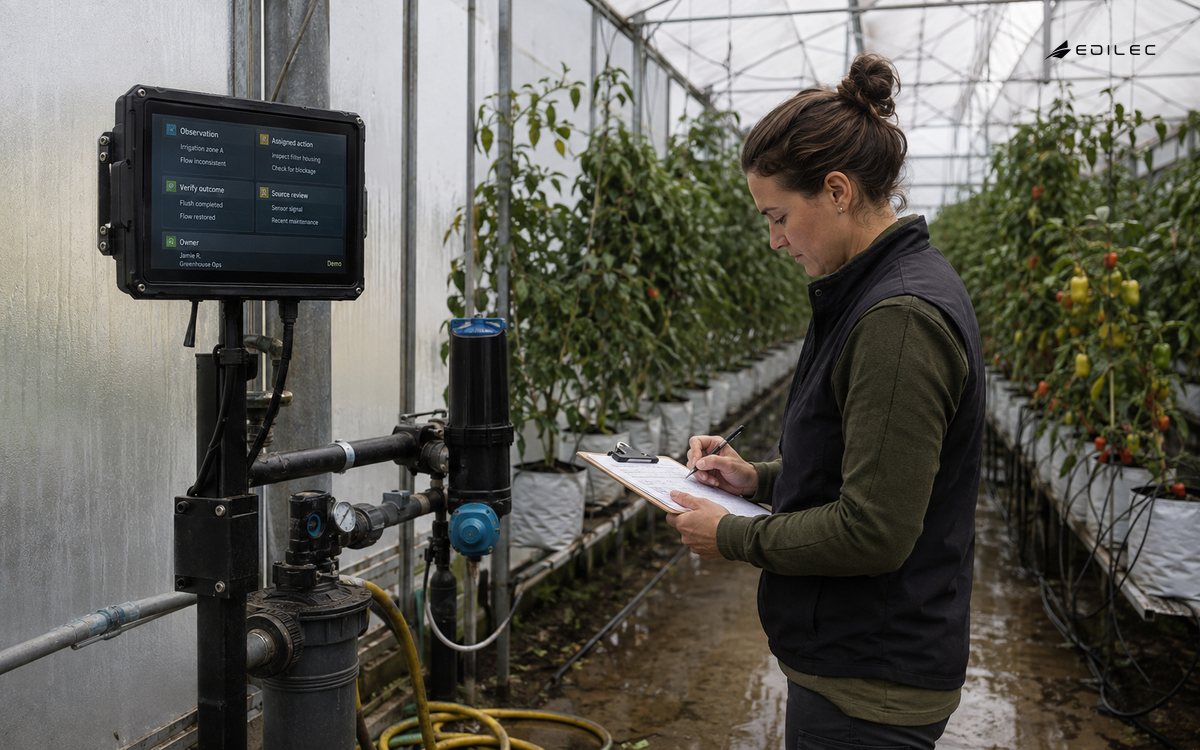
Use a bounded service slice to prove the language: ingest one meaningful signal, display its quality and age, route one decision, and record the result. Ask a new on-call engineer to explain what happened during a delayed message, duplicate event, or manual correction. If the answer requires tribal knowledge, the system is not yet ready to scale. Keep the data contract and recovery procedure close to the workflow so they evolve together.
| Shared concept | Decision to standardize | Evidence |
|---|---|---|
| Asset identity | Which record identifies the thing? | Stable key and ownership |
| Observation | What do value, quality and age mean? | Sample payload and test |
| Action | Who may initiate or approve it? | Policy and role mapping |
| Outcome | When is work actually complete? | Accepted state and audit trail |
Primary sources for connected operations
For a growing connected-operations practice, use NIST Cybersecurity Framework 2.0 for governance, NIST SP 800-82 Rev. 3 for operational technology context, NIST SP 800-207 for explicit access decisions, and NISTIR 8259A for device capability expectations. Local ownership and recovery evidence complete the model.
For related context, compare connected operations playbook, alert routing architecture, and industrial dashboards, with shared language usable across teams in mind. Use those perspectives to test the boundary described here while keeping the operating decision and owner in view while keeping shared language usable across teams.
Key takeaways for growing connected-operations teams
- Connect data only where it supports a named operational decision and accountable action.
- Show source, freshness, and quality so a shared view does not overstate certainty.
- Set limits and escalation paths for automation before it reaches field operations.
- Measure the complete loop through verified outcomes, not alert volume.
- Use operator feedback and exceptions to refine rules, workflows, and data quality.
Connected-operations questions for growing teams
Is connected operations mainly a dashboard project?
No. Dashboards can help, but the core design is the decision loop: reliable inputs, interpretation, ownership, response, verification, and learning. A dashboard without a response model often increases awareness without improving outcomes.
Where should a team start?
Start with one costly delay or recurring exception and trace the information needed to resolve it. Prove the signal-to-action loop with accountable users before integrating a broad portfolio of systems.
Keep a compact decision record for connected operations changes. It should capture source freshness, interpretation rule, response owner, verified outcome, and exception follow-up. This record is not bureaucracy for its own sake: it lets the next engineer, operator, or support owner understand what changed, what evidence was reviewed, and which question remains open for connected team operations. During an incident, it also prevents the team from relying on a screenshot or an unverified recollection when deciding whether to contain, correct, or continue the service for connected team operations.
Conclusion: keep shared meaning operational
A connected-operations practice makes operational decisions more timely and explainable. Focus on a few high-value loops, preserve the source and quality of the evidence, and assign every exception to someone who can resolve it. That creates durable capability instead of a fragile layer of integrations.