Edge gateways earn their place when local latency, bandwidth, protocol translation, or resilience makes a cloud-only path unsuitable. They are not miniature data centers by default. Every workload placed at the edge adds a lifecycle obligation: hardware inventory, identity, software delivery, storage limits, observability, and a recovery path that may require someone at a remote site. The first deliverable should be a shared operating boundary for edge gateways: local processing that continues safely when cloud connectivity or central services are unavailable.
First-build gateway decisions — Key takeaways for edge gateways
- Start edge gateways with one accountable decision, not a broad platform promise.
- Preserve identity, time, source, quality, and ownership wherever facts cross a boundary — in first-build gateway planning.
- Test degraded conditions and recovery before expanding the rollout.
- Measure whether people can make and later explain the intended decision.
First-build gateway decisions — Define the decision boundary for edge gateways
Identify which decisions must happen locally and why. A gateway might normalize field protocols, cache telemetry, enforce a local safety interlock, or provide a technician interface. State the maximum tolerable delay, the behavior when central policy cannot be reached, and which local outputs require later reconciliation. NIST SP 800-82 is a useful source for framing these choices because operational technology environments often prioritize deterministic behavior, availability, and safety alongside security.
| Question | Decision to document | Evidence in operation |
|---|---|---|
| Purpose | Which action or review does this capability support? | Named owner and an observable outcome. |
| Gateway-build authority | Which system or person may change the relevant state? | Actor, source, time, and policy record. |
| Failure | What is safe when required evidence is missing? | Visible pending, rejected, or manual-review state. |
| Gateway-build recovery | How is an exception resolved and closed? | Case history and reconciliation result. |
First-build gateway decisions — Build an architecture that preserves meaning
Use a small runtime surface with explicitly declared services, bounded local storage, and an outbound-only connection where feasible. Separate device-facing adapters from business logic and cloud synchronization. Carry a durable local sequence or event identifier so central systems can recognize replay after an outage. Treat configuration as a versioned artifact with an owner and a known-good recovery path. Containers can simplify packaging, but they do not remove the need to restrict host access, image provenance, and resource limits.
First-build gateway decisions — Apply controls that fit the operating risk
Give each gateway unique credentials and authorize it for its assigned site or asset group. Verify signed software and configuration before activation, keep remote administration narrow and auditable, and prevent device-facing services from gaining unnecessary cloud privileges. Protect secrets at rest and plan rotation that does not leave an isolated location stranded. NIST IR 8259A offers a practical baseline for identification, configuration, data protection, access control, updates, and state awareness.
| Control area | Practical implementation | Review signal |
|---|---|---|
| Identity | Use unique, scoped identities for people, devices, and services. | Unexpected access, expired credentials, or orphaned accounts. |
| Change | Version schemas, configuration, and release approvals. | Rollback, incompatibility, or unreviewed drift. |
| Gateway-build resilience | Define degraded behavior, buffering, and manual recovery. | Delayed work, queue age, or unresolved exceptions. |
| Gateway-build evidence | Record material actions and data-quality status. | Ability to reconstruct a consequential decision. |
First-build gateway decisions — Release edge gateways in bounded stages
Start with a site where staff can assist recovery. Simulate an extended WAN outage, an incorrect configuration, disk exhaustion, certificate expiry, clock drift, and a failed update. Confirm that local behavior is understandable to site personnel and that buffered data reconciles without duplicating actions. Roll out in controlled cohorts with version pinning and a stop condition based on measured health.
First-build gateway decisions — Measure the operating path, not just availability
Watch uptime by site, local queue age, disk and memory headroom, synchronization delay, configuration drift, update and rollback success, remote-session use, and time to recover a gateway that cannot phone home. The strongest indicator is whether local operation remains safe and traceable during a central dependency failure.
First-build gateway decisions — Set acceptance criteria for edge gateways
An implementation for edge gateways should have acceptance criteria that an operator, engineer, and accountable owner can all inspect. Start with the stated outcome and write normal, degraded, and recovery examples before configuring production services. A practical acceptance test removes the wide-area connection, applies a normal local workload, fills the intended buffer, and then restores synchronization. Confirm that no unsafe decision occurs from stale authority and that central systems can tell which records were delayed or replayed. This exercise is more revealing than a connectivity test performed at an office bench.
Keep the first release deliberately narrow. It is easier to compare a bounded path with its prior process, correct an unclear ownership rule, and teach a support team a real response. Expansion should be based on evidence from the representative workflow, including exceptions, rather than on a count of integrated assets or enabled accounts. For edge gateways, this means choosing the smallest path that still exposes the relevant ownership, failure, and recovery conditions.
First-build gateway decisions — Assign ownership across the lifecycle
Product teams own the intended local behavior, platform engineers own delivery and fleet tooling, and site operations owns physical recovery. Security teams need a clear view of administrative access and credential scope without becoming a bottleneck for routine safe maintenance.
Use a change record for runtime services, configuration, hardware variants, local policy, and update rings. It should include resource impact, site support requirements, validation evidence, and a stop condition for cohort rollout.
First-build gateway decisions — Decide what an edge gateway may do when it is isolated
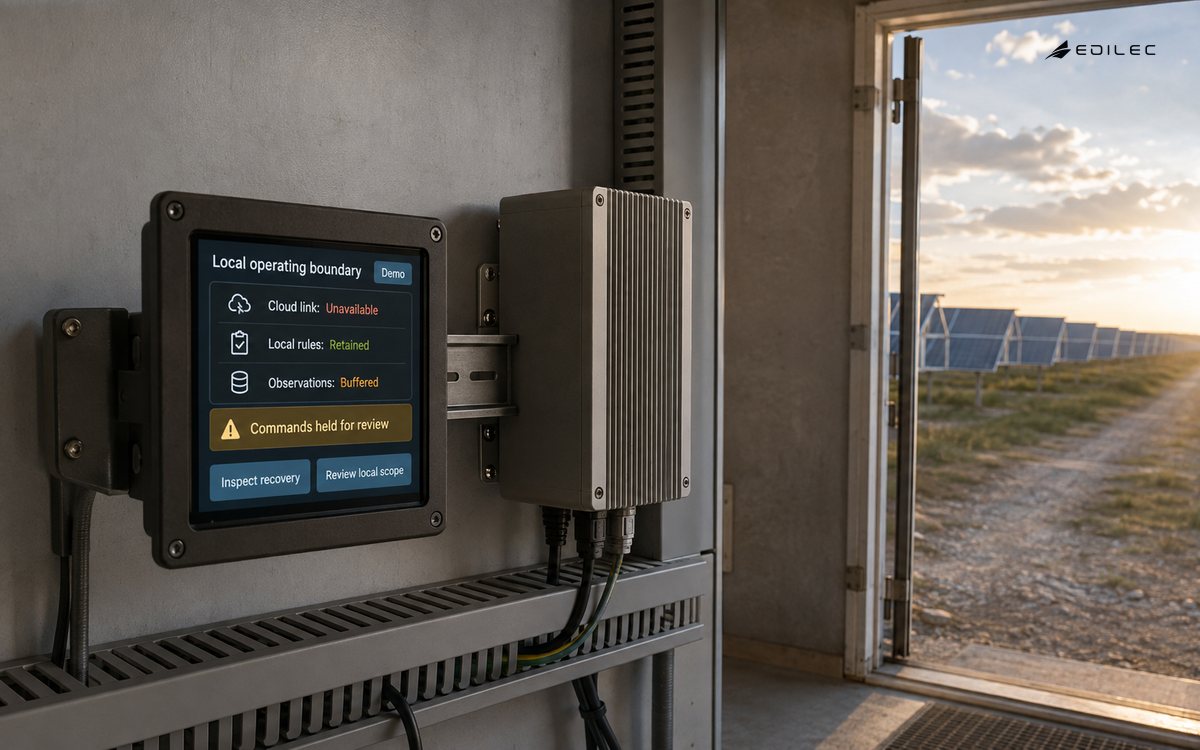
Local autonomy needs a boundary. A gateway may be allowed to buffer observations and apply a pre-approved safety rule, while a pricing change, customer entitlement decision, or broad configuration update must wait for central confirmation. Document these modes and expose them locally. Site staff should not have to infer from a blinking light whether the gateway is safely degraded or acting on stale authority.
First-build gateway decisions — Operate the edge fleet as a product
Maintain a tested hardware and software inventory, compatibility matrix, release ring, support window, and end-of-life plan. Review sites with recurring recovery work for environmental or network causes, not just software defects. Edge installations live in physical conditions that a central service does not, and the operating model has to respect that difference.
First-build gateway decisions — Keep decision evidence usable
For edge gateways, decision evidence combines gateway identity, local configuration version, connectivity state, local action, queued or replayed record markers, and central reconciliation result. This tells an investigator whether a decision was made under current central authority, a pre-approved local rule, or a degraded condition. The distinction is essential when a site continues operating during an outage and later needs to explain what happened.
First-build gateway decisions — Frequently asked questions about edge gateways
First-build gateway decisions — What should the team decide first?
When should logic run on an edge gateway? Run it locally when the required response cannot tolerate network delay or outage, when bandwidth makes raw transmission impractical, or when equipment integration needs a local protocol boundary. Keep centrally governed decisions central unless there is a clear reason to decentralize them.
First-build gateway decisions — What makes the implementation durable?
Are edge gateways a single point of failure? They can be. Design the local process to fail safely, use redundancy only where the consequence warrants it, and ensure that a gateway outage has a documented manual or degraded operating procedure.
First-build gateway decisions — Conclusion: make edge gateways reviewable
Reliable edge-gateway operation comes from a defined decision, explicit authority, controlled change, and evidence that survives a difficult day. Start with local processing that continues safely when cloud connectivity or central services are unavailable, prove the path under normal and adverse conditions, and use the findings to make the next release more dependable. That produces a capability that operations, security, and engineering can improve together instead of a system that only works while its original builders are nearby.
Next review: rehearse a site-level recovery with the people who would actually perform it. Confirm contacts, physical access, spare hardware or reset procedures, and data reconciliation. The exercise is successful when a site can return to a known, explainable operating state without improvising authority.
Keep the local runbook available at the site in a form that remains usable during the outage it describes. A recovery document that depends on an unavailable central portal is not an effective part of the edge design.
First-build gateway decisions — Authoritative sources
The operating pattern draws on NIST SP 800-82 Rev. 3: Guide to Operational Technology Security, NIST IR 8259A: IoT Device Cybersecurity Capability Core Baseline, Kubernetes documentation, and NIST Cybersecurity Framework 2.0. Apply the requirements of the relevant equipment, sector, contracts, and jurisdiction before changing a live environment.
First-build gateway decisions — Decide What Not to Build Yet
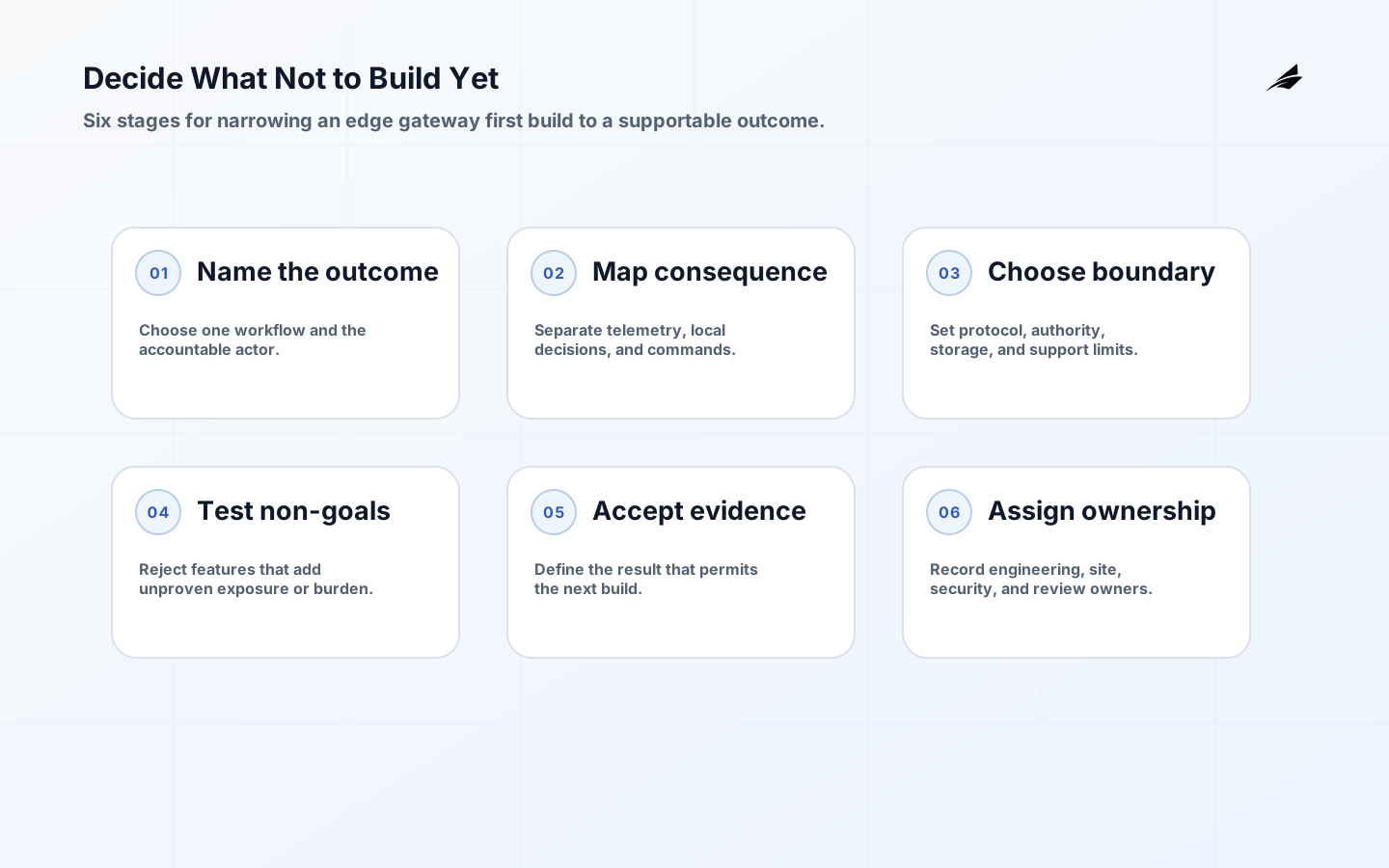
Before the first edge gateways build, make the non-goals visible. A team may want one appliance to translate every protocol, run local analytics, host a dashboard, accept remote commands, and become the fleet update path. That combination creates a large trust boundary before the workflow is understood. Choose one narrow outcome, such as preserving machine state through an unreliable link, and defer capabilities that do not change that outcome. A written non-goal is a design control: it gives reviewers permission to reject a convenient feature that would add authority, data retention, or support burden.
| First-build choice | Why it matters | Defer when |
|---|---|---|
| Protocol scope | Limits translation logic and diagnostic surface. | No workflow depends on the extra protocol yet. |
| Local autonomy | Defines what continues during upstream loss. | The safe local decision is not understood. |
| Remote access | Changes identity, exposure, and support risk. | A local procedure is sufficient for the pilot. |
| Data retention | Determines storage, privacy, and replay work. | No consumer needs the extra history. |
Use two contrasting cases to test the decision. In a cold-storage site, local buffering and a safe alarm state may matter more than real-time remote control. In a water-treatment site, command mediation, current-state checks, and an explicit operator approval may matter more than broad telemetry volume. The same gateway architecture cannot hide those consequences behind a generic “edge” label. NIST SP 800-82 and NISTIR 8259A help keep the discussion grounded in OT reliability, device capabilities, and lifecycle responsibility. Convert each chosen capability into an acceptance test with a named reviewer.
Selected references for this topic include NIST SP 800-82 Rev. 3: Guide to Operational Technology Security, NIST IR 8259A: IoT Device Cybersecurity Capability Core Baseline, Kubernetes documentation, NIST Cybersecurity Framework 2.0. The selected publications anchor first-build gateway decisions; apply them with site procedures and deployment obligations.
For adjacent operating patterns, compare Sensor Pipeline Decisions Before the First Build, Firmware Updates Decisions That Matter before the First Build, A Field Guide to MQTT Brokers for Growing Teams. The neighboring references connect edge gateways decisions that matter before the first build to its wider operating context.