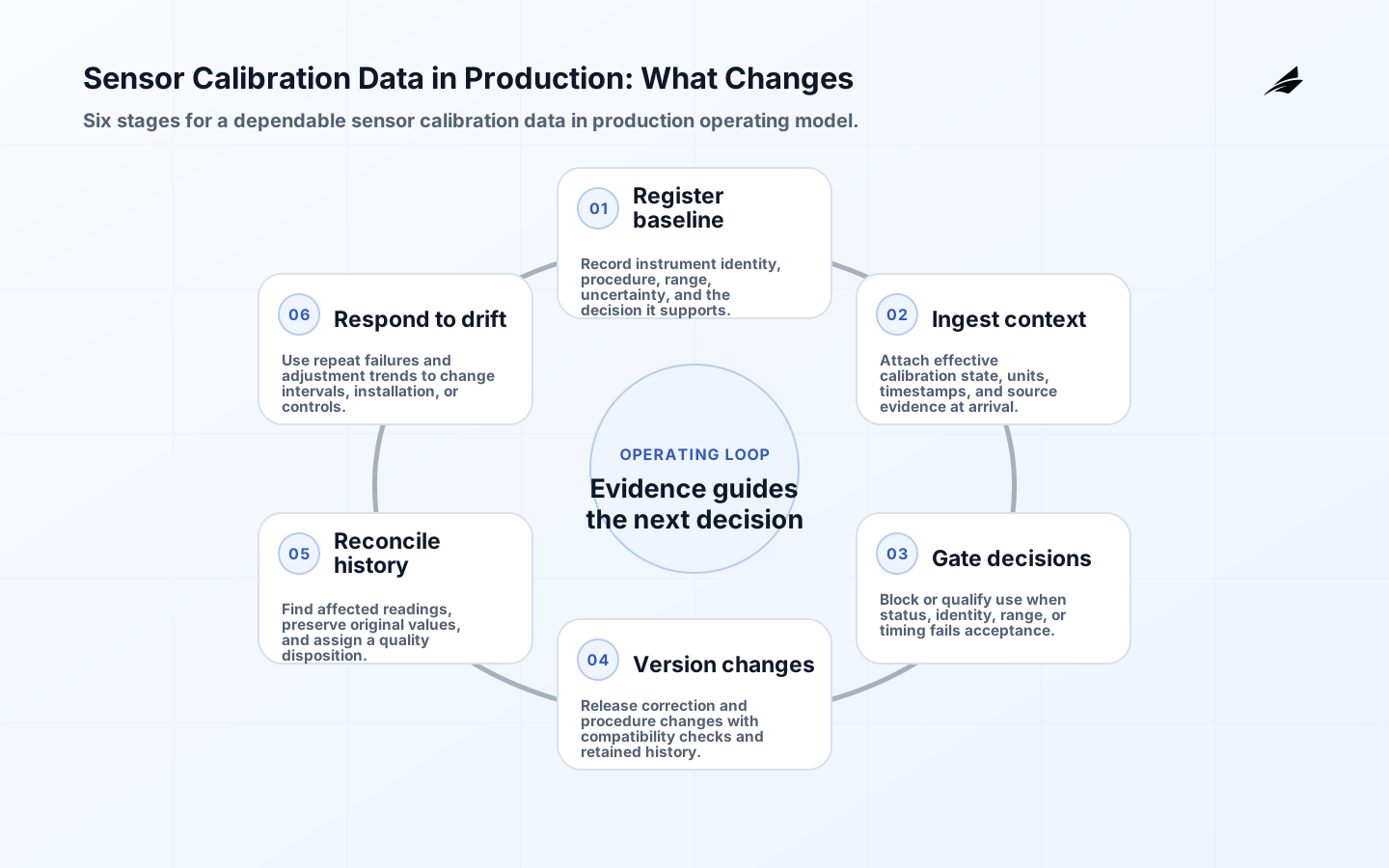
Moving sensor calibration data into production changes the problem from recording a laboratory result to governing a live decision. In a test, a team can inspect a few records and correct them by hand. In production, sensor calibration data arrives late, devices are replaced, firmware changes units, network paths fail, and a downstream rule may act before a reviewer sees the exception.
Production calibration release controls
In production, calibration data needs explicit state transitions: accepted, stale, disputed, quarantined, superseded, or released for use. Name who may change a correction, who reviews affected history, and what evidence must remain after a device, procedure, or service version changes. Ground the controls in NISTIR 8259A, NIST OT security guidance, NIST SP 800-53, and NIST SP 800-218. For related practice, compare the field-service portal guide, device-identity guide, and edge-gateway guide.
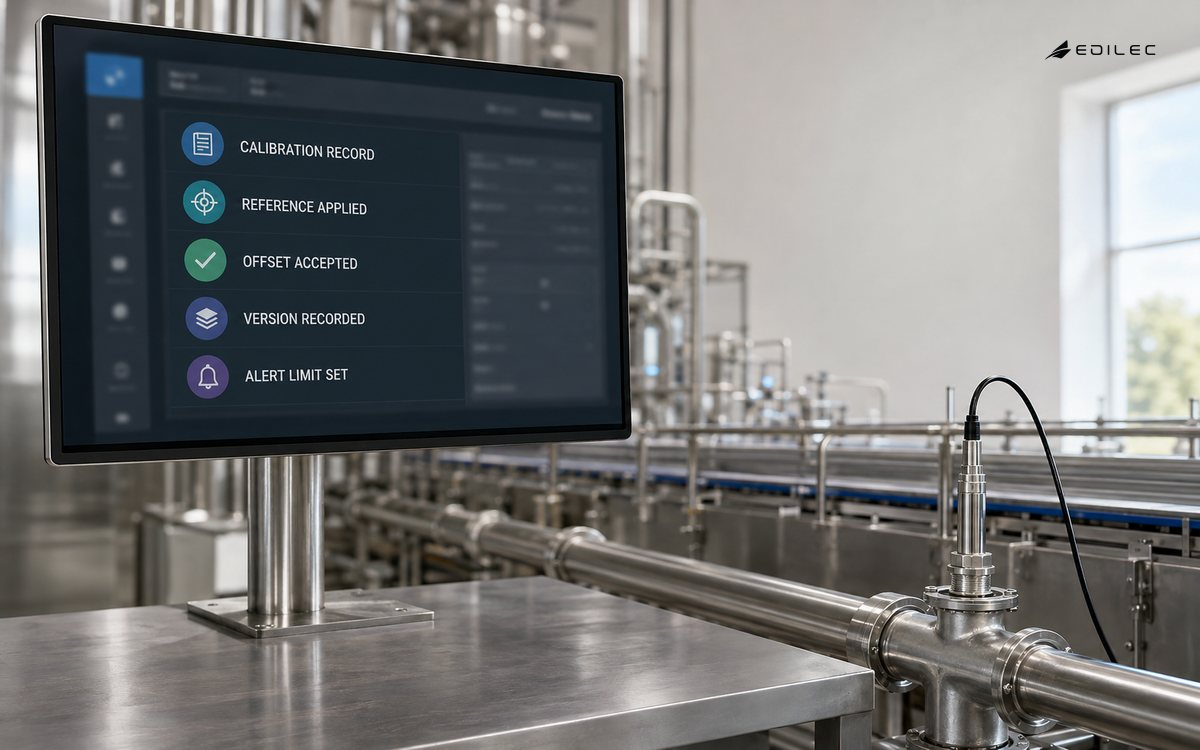
Use a representative production cohort to test a calibration change across normal capture, delayed synchronization, restart, correction-factor update, and a disputed result. Compare the before-and-after interpretation without deleting the earlier evidence, and identify which downstream decisions may have been affected. A release is credible when quality staff can explain the state of every affected record and support staff know the next action for a quarantined item. Measure traceability, disposition time, and repeat drift alongside service availability.
| Decision area | Production-calibration question | Production-calibration evidence |
|---|---|---|
| Purpose | For production calibration, answer this question: Which real decision does the system change? | For production calibration, record the scenario, owner, and acceptance example. |
| Boundary | For production calibration, identify what is allowed, and what is deliberately excluded? | For production calibration, retain policy, identity, and version details. |
| Failure | For production calibration, identify what happens when data, network or dependency fails? | For production calibration, retain a contingency test and visible status. |
| Change | For production calibration, answer this question: Who can alter rules, mappings or access? | For production calibration, retain approval, diff and rollback point. |
| Review | For production calibration, answer this question: What shows the design remains useful? | For production calibration, retain outcome, exception and correction record. |
Production calibration takeaways to retain
- Start sensor calibration data with one accountable decision, not a broad platform promise.
- In production calibration, preserve identity, time, source, quality, and ownership wherever facts cross a boundary.
- In production calibration, test degraded conditions and recovery before expanding the rollout.
- In production calibration, measure whether people can make and later explain the intended decision.
Define the decision boundary for sensor calibration data
Define the measurand, accepted unit, operating range, required accuracy, calibration interval, and action when a device is out of tolerance. Link those rules to the physical asset and sensor serial number, not merely to a model family. Distinguish an observed value from derived engineering units and from a pass or fail decision. The NIST approach to measurement traceability is helpful here: a result needs an unbroken, documented relation to stated references and associated uncertainty.
| Question | Production-calibration decision to document | Production-calibration evidence in operation |
|---|---|---|
| Purpose | For production calibration, identify which action or review does this capability support? | For production calibration, retain named owner and an observable outcome. |
| Authority | For production calibration, identify which system or person may change the relevant state? | For production calibration, retain actor, source, time, and policy record. |
| Failure | For production calibration, identify what is safe when required evidence is missing? | For production calibration, define visible pending, rejected, or manual-review state. |
| Recovery | For production calibration, answer this question: How is an exception resolved and closed? | For production calibration, retain case history and reconciliation result. |
Preserve calibration meaning across production boundaries
Store a calibration record with the instrument identifier, procedure or reference, calibration date, result, uncertainty where applicable, due date, technician or laboratory, and status. At ingestion, attach the calibration status effective at observation time, not whatever status happens to be current when a dashboard is opened. This protects historical analysis after a recalibration or correction. Use controlled reference data for units and conversions, and keep any adjustment coefficients versioned and reviewable.
Controls for live calibration decisions
Do not automatically correct every historical reading after an out-of-tolerance result. The appropriate investigation depends on the interval, process risk, and evidence of drift. Flag the affected population, preserve raw observations, and let an accountable quality or engineering role decide whether recalculation, inspection, or no action is justified. Access controls should prevent a convenience edit to a calibration date from rewriting the meaning of production data without an audit trail.
| Control area | Practical implementation | Review signal |
|---|---|---|
| Identity | In production calibration, use unique, scoped identities for people, devices, and services. | For production calibration, retain unexpected access, expired credentials, or orphaned accounts. |
| Change | For production calibration, retain version schemas, configuration, and release approvals. | For production calibration, define rollback, incompatibility, or unreviewed drift. |
| Resilience | For production calibration, define degraded behavior, buffering, and manual recovery. | For production calibration, retain delayed work, queue age, or unresolved exceptions. |
| Evidence | For production calibration, record material actions and data-quality status. | For production calibration, define ability to reconstruct a consequential decision. |
Release sensor calibration data in bounded stages
Choose one instrument class with a real downstream decision, then reconcile a sample from the calibration system through ingestion to the user view. Test late certificates, a missing serial number, a unit mismatch, a reading outside the validated range, and a backdated correction. Train users to see status and limitation rather than a misleading green indicator. Expand after the exception path works, not merely after normal data appears.
Signals that expose calibration drift
Track the percentage of active instruments with a current calibration status, unmatched serial numbers, readings processed without a valid range, overdue interval exceptions, time to close a quality investigation, and the number of downstream decisions affected by a correction. These measures expose whether calibration is functioning as operational evidence instead of a separate compliance exercise.
Set acceptance criteria for sensor calibration data
An implementation for sensor calibration data should have acceptance criteria that an operator, engineer, and accountable owner can all inspect. In production calibration, start with the stated outcome and write normal, degraded, and recovery examples before configuring production services. A practical acceptance test follows a calibrated reading from instrument serial number through the published decision view, then repeats it for an overdue and out-of-tolerance instrument. The expected result is not always a blocked workflow, but it must be an intelligible status and a recorded owner for the resulting disposition.
For production calibration, keep the first release deliberately narrow. In production calibration, it is easier to compare a bounded path with its prior process, correct an unclear ownership rule, and teach a support team a real response. In production calibration, expansion should be based on evidence from the representative workflow, including exceptions, rather than on a count of integrated assets or enabled accounts. For sensor calibration data, this means choosing the smallest path that still exposes the relevant ownership, failure, and recovery conditions.
Calibration ownership from instrument to consumer
Quality or metrology owns the calibration decision, integration teams own the data binding, and operational users own the interpretation within their procedure. The system should show those boundaries rather than inviting a dashboard user to improvise a correction.
Use a controlled record for procedure changes, coefficient updates, interval changes, and status corrections. It should state effective dates, affected assets, downstream impact, approval evidence, and the route for reviewing past decisions.
Handle calibration exceptions without rewriting history
A failed calibration can affect only a narrow condition or call a long period of readings into question. The system should make the affected scope queryable by asset, range, date, and use case, while retaining the original observation and calibration evidence. Quality teams can then select an appropriate response, such as retest, inspection, correction, or documented acceptance, instead of applying an automatic blanket adjustment.
Make calibration data part of engineering review
Review overdue instruments, recurring out-of-tolerance results, data mapping failures, and downstream exceptions together. Patterns may reveal an unsuitable interval, an environmental condition, a poor installation, or a conversion defect. The purpose is not to maximize calibration activity; it is to keep the fitness of a measurement aligned with the decision that relies on it.
Keep calibration evidence reconstructable
For sensor calibration data, decision evidence connects the measurement, serial number, effective calibration record, range, unit conversion, and quality disposition. A reader should be able to start from a reported value and determine what instrument produced it and whether its calibration status was valid for that observation time. This trace is especially valuable when a customer, auditor, or engineering team asks whether an older result remains fit for its original use.
FAQ: questions for production calibration teams
Which production calibration decision comes first?
Can calibration status be a simple Boolean? A Boolean may be convenient for a narrow screen, but the underlying record needs more: effective dates, range, procedure, result, and a reason for any exception. A reader investigating a questionable measurement needs context, not just a pass indicator.
What keeps production calibration durable?
Who owns calibration data? Metrology or quality typically owns the calibration decision, while engineering owns integration and operations owns the use of the signal. Write the handoff explicitly. Shared access without named accountability is how expired status and unreviewed corrections become routine.
Production calibration also needs a clear ownership boundary between metrology, engineering, operations, and support. Metrology can determine whether a reference and uncertainty treatment are acceptable, while engineering maintains the binding and operations decides how the result affects work. Preserve that distinction in the record, especially when a correction is disputed or a device is replaced. A short review after each release should ask which records were delayed, which were quarantined, and whether the next user could explain the status without opening a separate system.
Conclusion: release calibration with evidence
Reliable sensor calibration data comes from a defined decision, explicit authority, controlled change, and evidence that survives a difficult day. Start with measurements whose uncertainty and fitness are visible to the users who rely on them, prove the path under normal and adverse conditions, and use the findings to make the next release more dependable. In production calibration, that produces a capability that operations, security, and engineering can improve together instead of a system that only works while its original builders are nearby.
Next review: select a completed operational decision and trace the calibration context that was available at the time. This verifies that effective dates and quality dispositions still reach the reader. It also identifies screens where a status label needs more explanatory context.
Primary calibration references
The production calibration discussion draws on NISTIR 8259A, NIST SP 800-82 Rev. 3, NIST SP 800-53 Rev. 5, and NIST SP 800-218. In production calibration, apply the requirements of the relevant equipment, sector, contracts, and jurisdiction before changing a live environment.