Gateway security is where a connected product stops being a set of devices and becomes a trust boundary. A gateway can translate protocols, buffer data during an outage, and provide remote management, which also makes it a high-value path into local networks. Production design must therefore answer who may administer it, which workloads it may reach, and what it does when its cloud relationship is unavailable. The first deliverable should be a shared operating boundary for gateway security: a controlled route between local equipment and approved services.
Production gateway security: checks that must survive launch
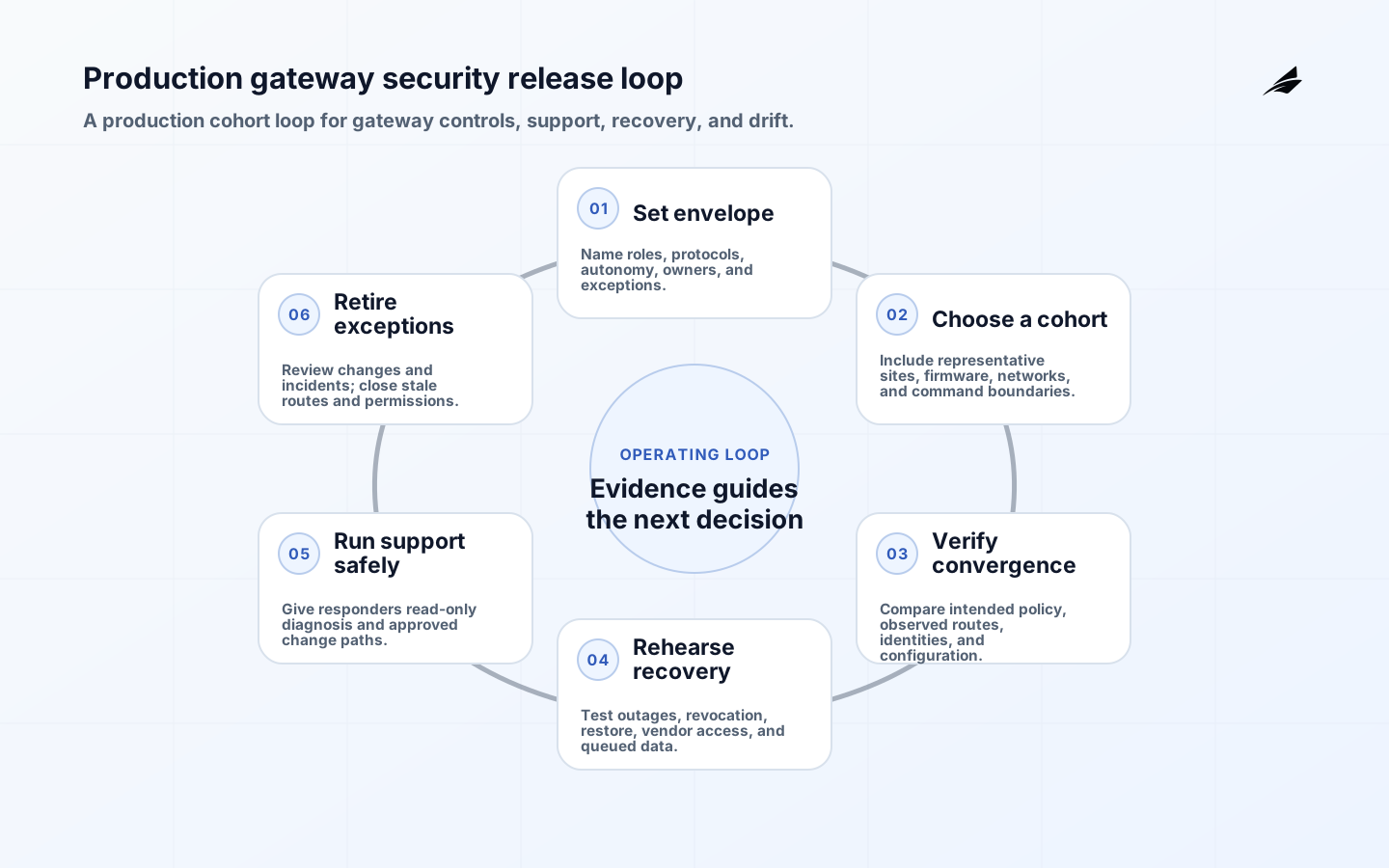
Moving gateway security into production changes the question from whether a control exists to whether it remains effective across people, sites, vendors, and failure modes. A prototype may rely on one administrator, a known network, and a clean device list. Production must handle ownership changes, expired certificates, replacement hardware, partial connectivity, and support requests that arrive during an incident. Define the operating envelope explicitly: supported gateway roles, approved protocols, local autonomy, management path, update policy, and evidence retained for each decision. Anything outside that envelope should become a visible exception with an owner and expiry.
A practical rollout starts with a representative cohort rather than the easiest devices. Include an older firmware version, a constrained site, a normal site, and one gateway that exercises the highest-consequence command boundary. Measure enrollment success, policy convergence, message delay, rejected actions, buffer recovery, and operator comprehension. Do not treat a successful deployment as proof that recovery works. Disconnect the upstream service, revoke a credential, restore a known image, and verify that queued telemetry does not become an unauthorized command. The release gate is evidence that the intended boundary survives ordinary disruption.
Production support needs a decision tree that is narrower than a troubleshooting wiki. When a gateway stops reporting, first verify identity and last-known configuration, then distinguish transport failure from local process failure and policy denial. Give the responder a safe read-only diagnostic route and a separate approval path for changes. If a vendor needs access, record the vendor identity, target, purpose, start and end time, approver, commands permitted, and evidence of closure. A shared emergency password hides accountability and makes it difficult to know whether the original risk was actually removed.
The right review cadence follows change and consequence. Recheck gateway security after a site network change, firmware family change, new protocol adapter, ownership transfer, or incident. Compare intended and observed routes, identities, policies, and reachable assets. Use the review to retire stale exceptions rather than continuously adding compensating rules. A gateway that cannot be mapped to an owner, current image, approved network path, and tested recovery action should be quarantined from new capability until those facts are restored.
| Check | Evidence to capture | Decision if missing |
|---|---|---|
| Identity and ownership | Stable asset, service, site, and accountable owner. | Hold the action and route the exception. |
| Freshness and quality | Observation time, state, source, and known delay. | Qualify or reject the result according to risk. |
| Change and authority | Policy version, permitted role, approval, and expiry. | Do not widen access or automate the action. |
| Recovery | Tested degraded path, reconciliation, and named responder. | Keep the cohort narrow until recovery is proven. |
For adjacent implementation context, see gateway security architecture, sensor pipeline decisions, and event streaming decisions. These references help separate the gateway security decision from neighboring concerns such as data movement, connected operations, and support in a production gateway. Use them to compare boundaries, not to copy a design: the right choice depends on the asset, consequence, timing, people, and evidence in the local workflow in a production gateway.
The official references should be read alongside the operating record. NIST IR 8259A provides a baseline for device capabilities; NIST OT Security explains why physical process constraints affect controls; NIST SP 800-53 gives a control vocabulary; and the CISA exposure-reduction guidance helps organize governance, protection, detection, response, and recovery. Taken together, they support a practical rule: select the smallest capability that satisfies the named decision, make its authority explicit, test degraded behavior, and retain enough evidence to explain both normal and exceptional outcomes in a production gateway.
Production gateway security: what to carry forward
- Start gateway security with one accountable decision, not a broad platform promise.
- Preserve identity, time, source, quality, and ownership wherever facts cross a boundary.
- Test degraded conditions and recovery before expanding the rollout.
- Measure whether people can make and later explain the intended decision.
Set the production trust envelope
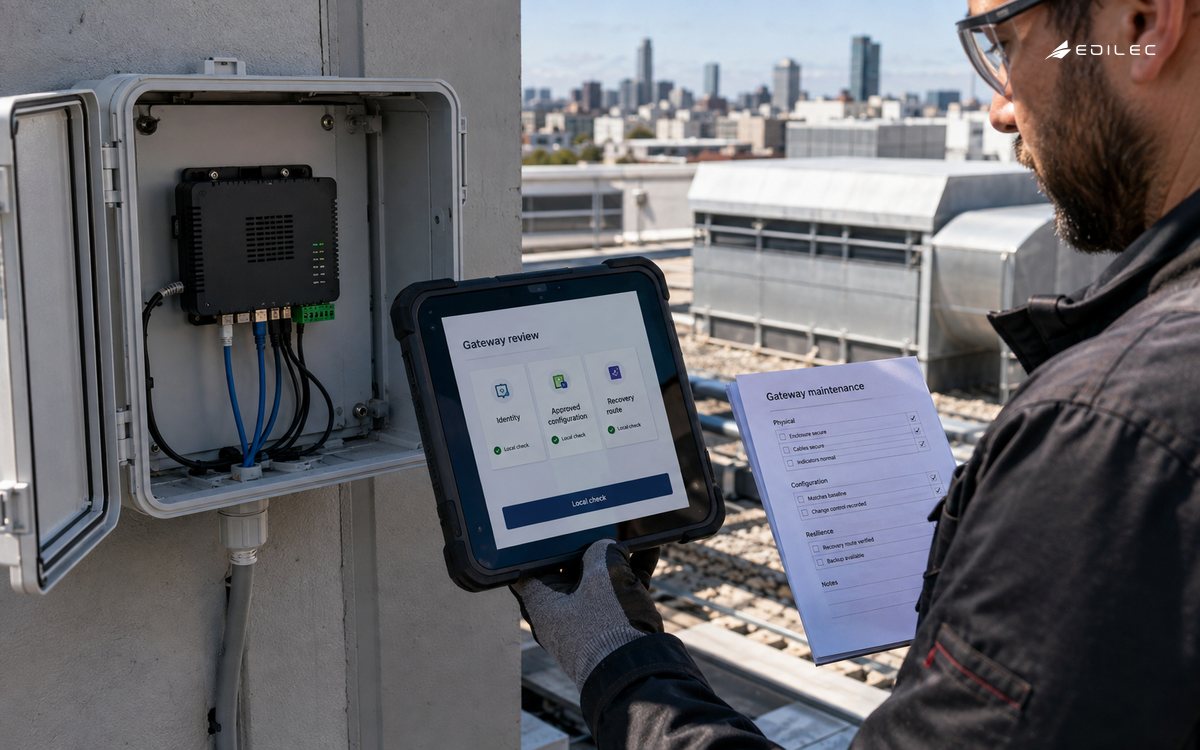
Inventory each gateway as an identifiable asset with hardware model, software version, owner, location, network role, and recovery contact. Decide whether it is only forwarding telemetry, performing local control, or terminating remote support. Those roles deserve different credentials and network paths. NIST IR 8259A frames device identification, configuration, data protection, logical access, software update, and cybersecurity state awareness as baseline capabilities; that is a practical checklist for gateway requirements.
| Question | Decision to document | Evidence in operation |
|---|---|---|
| Purpose | Which action or review does this capability support? | Named owner and an observable outcome. |
| Authority | Which system or person may change the relevant state? | Actor, source, time, and policy record. |
| Failure | What is safe when required evidence is missing? | Visible pending, rejected, or manual-review state. |
| Recovery | How is an exception resolved and closed? | Case history and reconciliation result. |
Place the gateway in a constrained architecture
Place gateways in a constrained zone with explicit outbound destinations rather than broad enterprise reachability. Use mutually authenticated connections to a broker or management plane, and have the gateway validate server identity before accepting configuration. Separate the data plane from an administrative plane. A technician who can view diagnostics need not be able to change routing, install software, or open a remote shell. Preserve local policy and the last known safe configuration so loss of cloud connectivity has a predictable effect.
Match controls to gateway failure modes
Secure boot and signed updates reduce the chance that a gateway starts unapproved code, but they do not replace lifecycle controls. Rotate or revoke credentials, record administrative changes, restrict debugging interfaces, and test the recovery route for a failed update. NIST SP 800-82 emphasizes that operational environments have reliability and safety requirements alongside confidentiality. A maintenance window, rollback package, and on-site contact are controls, not project paperwork.
| Control area | Practical implementation | Review signal |
|---|---|---|
| Identity | Use unique, scoped identities for people, devices, and services. | Unexpected access, expired credentials, or orphaned accounts. |
| Change | Version schemas, configuration, and release approvals. | Rollback, incompatibility, or unreviewed drift. |
| Resilience | Define degraded behavior, buffering, and manual recovery. | Delayed work, queue age, or unresolved exceptions. |
| Evidence | Record material actions and data-quality status. | Ability to reconstruct a consequential decision. |
Move from pilot to production by cohort
Pilot at a representative site with normal connectivity and a deliberately constrained connection. Verify certificate renewal, DNS or address changes, broker unavailability, local disk pressure, and a support session that is approved and later reviewed. Roll out in cohorts, pin the approved software version, and pause expansion when health evidence points to a common defect instead of trying to repair the fleet one unit at a time.
Measure gateway behavior after deployment
Watch unauthorized administration attempts, certificate-expiry lead time, update success and rollback rate, connection failures by network, local storage headroom, and time from a vulnerability notice to a scoped disposition. Pair telemetry with a periodic access review: the question is not simply whether the gateway is online, but whether the identities and routes it currently trusts are still justified.
Write acceptance tests for live gateways
An implementation for gateway security should have acceptance criteria that an operator, engineer, and accountable owner can all inspect. Start with the stated outcome and write normal, degraded, and recovery examples before configuring production services in a production gateway. A practical acceptance test proves that an unassigned gateway cannot reach management services, a valid gateway can renew its credential, and a failed update returns to a known state. Include a local recovery exercise because an otherwise sound remote design can fail when the only reachable device is at a site with no specialist present.
Keep the first release deliberately narrow. It is easier to compare a bounded path with its prior process, correct an unclear ownership rule, and teach a support team a real response in a production gateway. Expansion should be based on evidence from the representative workflow, including exceptions, rather than on a count of integrated assets or enabled accounts in a production gateway. For gateway security, this means choosing the smallest path that still exposes the relevant ownership, failure, and recovery conditions.
Make gateway ownership explicit
Product teams own intended gateway behavior, security teams own boundary requirements, and service operations own the maintenance procedure. Each group needs a visible handoff so a firmware release does not unexpectedly change field support or exposure.
Use a change record for routing, certificates, remote administration, and installed software. It should identify the gateways affected, the maintenance window, expected health checks, and the verified rollback route.
Prepare recovery for lost gateway trust
A gateway that loses time, trust anchors, or its management route can fail in awkward ways: it may reject a valid renewal, accept stale configuration, or remain reachable only through a local console. Define who can approve break-glass access, what evidence they must record, and how temporary access is removed. Test the procedure on a representative unit so the response does not depend on a retired technician or an undocumented cable.
Keep gateway evidence useful in the field
Review gateway inventory, software posture, active credentials, and network exceptions with operations at a regular cadence. Security findings need a consequence and a feasible maintenance path; field changes need a clear trust-boundary review. This shared routine catches gateways that were moved, repurposed, or left on an old network before those facts become an incident.
Record the facts behind a gateway decision
For gateway security, decision evidence includes the gateway identity, approved software and configuration versions, credential state, network policy, administrator, and recovery action. A site owner should be able to answer whether a given gateway was eligible to contact a service at a point in time. That answer depends on inventory and change evidence being connected; a current configuration snapshot alone cannot explain an earlier remote session or a past exception.
Questions about production gateway security
What must a production gateway prove first?
Is a VPN enough for gateway security? A VPN can protect a transport path, but it does not establish device identity, authorize an action, protect local interfaces, or prove that a remote session was appropriate. Use it as one layer in a design that includes scoped identities, network policy, update controls, and recorded administration.
What makes gateway controls durable?
Should every gateway have a unique certificate? Yes, where the operating model can sustain it. Per-device credentials support revocation, attribution, and a smaller blast radius. Avoid shared fleet secrets that turn a single recovered credential into access to every installed location.
Conclusion: operate gateway security as a service
Reliable gateway security comes from a defined decision, explicit authority, controlled change, and evidence that survives a difficult day. Start with a controlled route between local equipment and approved services, prove the path under normal and adverse conditions, and use the findings to make the next release more dependable. That produces a capability that operations, security, and engineering can improve together instead of a system that only works while its original builders are nearby in a production gateway.
Next review: compare the gateway inventory with network discovery and support records. Differences often reveal an unmanaged replacement, a moved unit, or a forgotten maintenance route. Resolve the difference through the lifecycle process instead of adding an informal exception to make a dashboard look complete.
Primary references for production gateway security
The production guidance draws on NIST IR 8259A: IoT Device Cybersecurity Capability Core Baseline, NIST SP 800-82 Rev. 3: Guide to Operational Technology Security, NIST SP 800-53 Rev. 5, and CISA Internet Exposure Reduction Guidance. Apply the requirements of the relevant equipment, sector, contracts, and jurisdiction before changing a live environment in a production gateway.