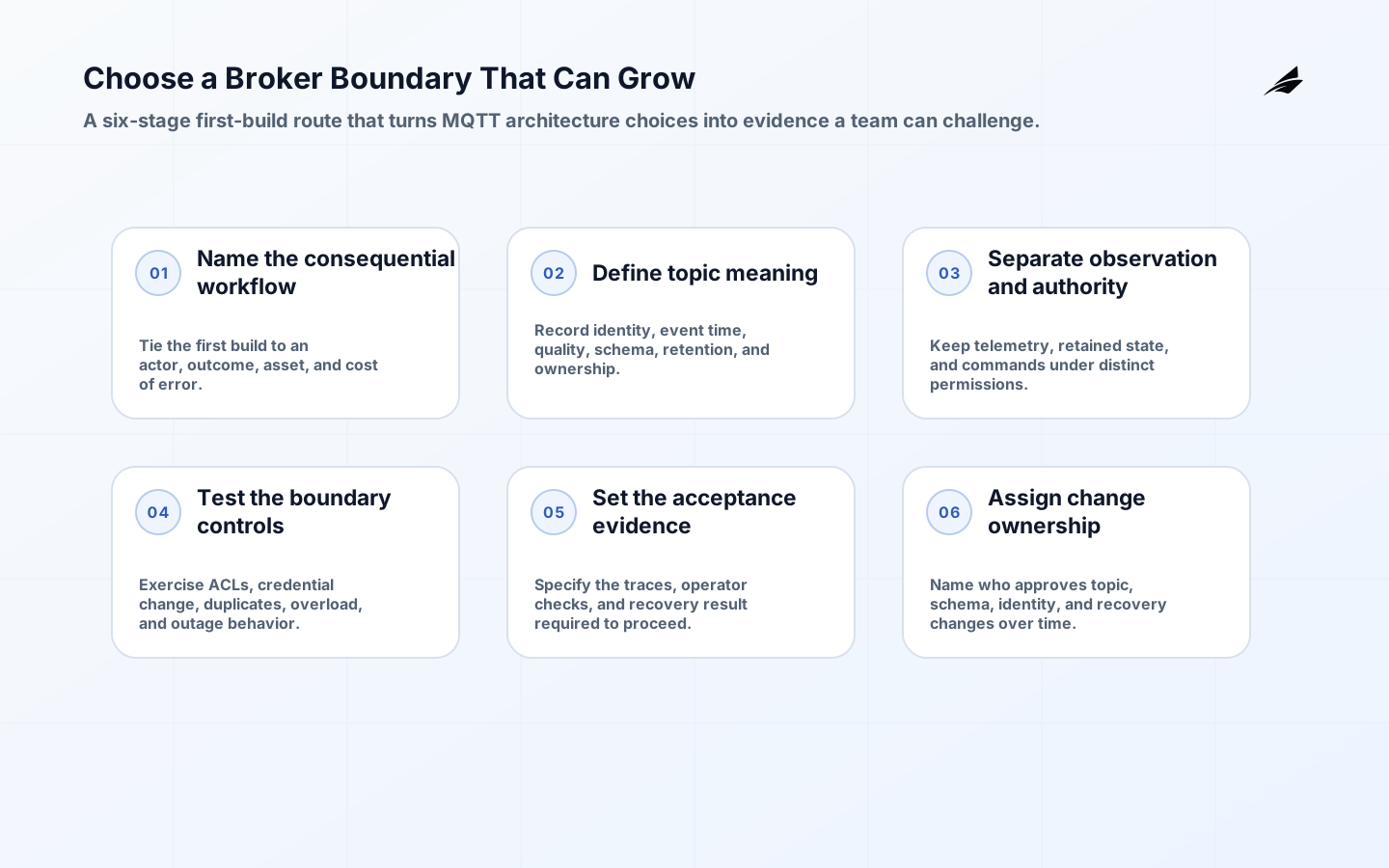
MQTT brokers are often introduced as lightweight plumbing for connected devices. In production, they become the place where clients authenticate, sessions persist, retained state is distributed, and topic permissions determine which parts of a fleet can observe or influence each other. Broker selection therefore cannot be separated from the message contract and the team that will operate failed sessions at an inconvenient hour. The first deliverable should be a shared operating boundary for MQTT brokers: reliable, controlled message exchange between devices, services, and human-operated systems.
Choose the MQTT Boundary Before the Build
Example: Separate Telemetry From Commands
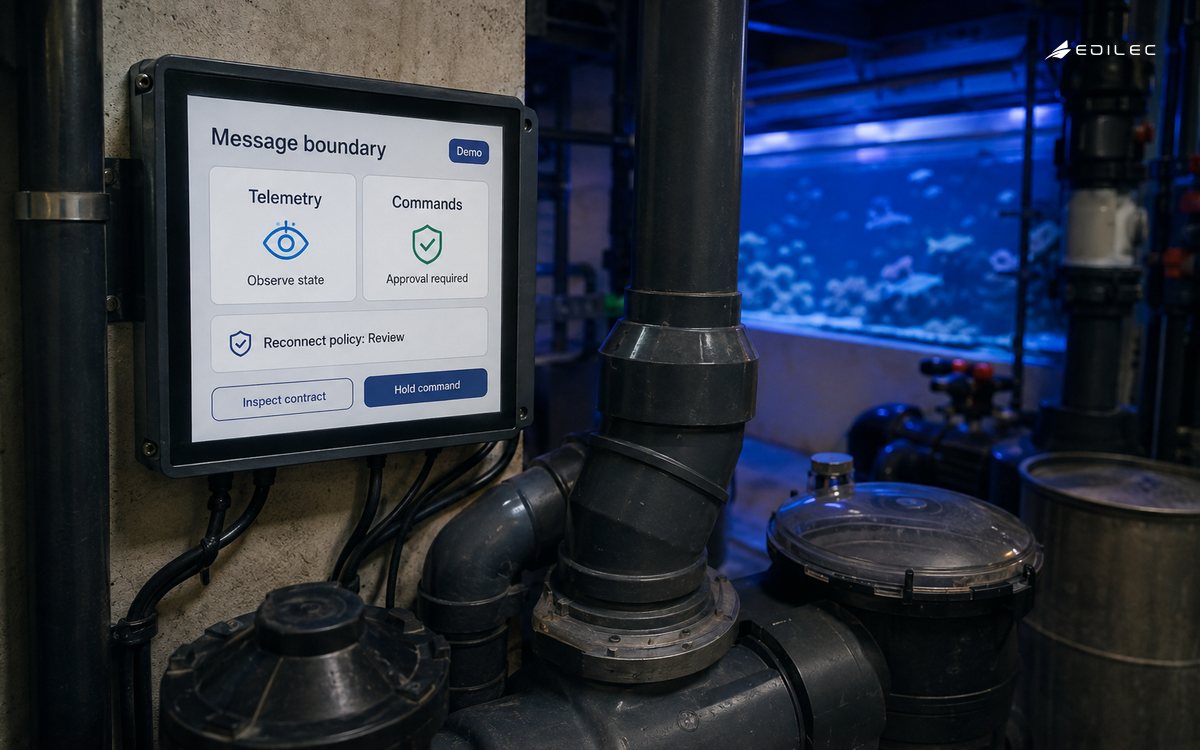
A first-build decision becomes clearer when the topic tree is drawn from real actions. For a building fleet, site/17/ahu/3/telemetry can carry observations while site/17/ahu/3/command carries a request that requires stronger authorization and a separate confirmation path. Do not let a convenient wildcard subscription flatten those distinctions. A support dashboard may read telemetry, while a control service needs an explicit capability, an approval rule, and a record of the resulting state.
Keep the message envelope stable even when payload fields evolve. Include an event identifier, source identity, observed time, ingestion time where available, schema version, unit, and quality state. Decide how a correction is represented and how consumers handle duplicates. These choices are cheap to document before the first build and expensive to reconstruct after several teams have inferred different meanings from the same topic.
The first build should include a deliberately boring failure test. Stop the broker, delay the identity service, send a duplicate event, and publish an oversized payload from a non-authorized client. The expected result should be written before the test: what is rejected, what is queued, what is visible, and who owns the follow-up. That acceptance record is more valuable than a broad feature checklist.
The AWS MQTT and policy references clarify topic permissions and protocol behavior; the systems-security engineering guide frames architecture decisions; and the key-management publication anchors identity and credential choices. AWS IoT Core policies; AWS IoT Core MQTT; SP 800-160 Vol. 1 Rev. 1: Systems Security Engineering; SP 800-57 Part 1 Rev. 5: Key Management.
If the design needs broader context, compare the connected-systems guide, the event-streaming guide, and the device-identity primer before choosing a broker boundary. Before the first MQTT build, Edge Gateway Scope Decisions Before the First Build clarifies one boundary; Offline Sync Decisions That Matter before the First Build adds a complementary operating pattern; and A Field Guide to IoT Telemetry for Growing Teams helps connect the decision to a wider connected-systems workflow.
MQTT Decision Key Takeaways
- Start MQTT brokers with one accountable decision, not a broad platform promise.
- Before the first MQTT build, preserve identity, time, source, quality, and ownership wherever facts cross a boundary.
- First-build MQTT: test degraded conditions and recovery before expanding the rollout.
- First-build MQTT: measure whether people can make and later explain the intended decision.
MQTT Decision: Name the Authority Boundary
Define topic ownership and message purpose before deciding on a cluster topology. A telemetry topic, a command request, an acknowledged command result, and a device configuration update should not be interchangeable names under a broad wildcard. The MQTT 5.0 specification provides features such as session expiry, message expiry, reason codes, shared subscriptions, and user properties; use them deliberately instead of assuming a client library default expresses your operational intent.
| Question | Decision to document | Evidence in operation |
|---|---|---|
| Purpose | First-build MQTT: which action or review does this capability support? | Named owner and an observable outcome. |
| Authority | First-build MQTT: which system or person may change the relevant state? | Actor, source, time, and policy record. |
| Failure | First-build MQTT: what is safe when required evidence is missing? | First-build MQTT: visible pending, rejected, or manual-review state. |
| Recovery | First-build MQTT: how is an exception resolved and closed? | Case history and reconciliation result. |
MQTT Decision: Preserve Meaning Across Topics
Choose a topic hierarchy that supports scoped authorization and predictable subscription patterns. Give every client a unique identity, specify whether clean start and session expiry suit its recovery needs, and make retained messages rare and clearly documented. Retained state can help a new subscriber learn a current value, but it can also deliver an obsolete instruction if teams confuse state publication with a safe command. Use separate response or correlation paths for commands and limit wildcard subscriptions to trusted operations roles.
MQTT Decision: Match Controls to Consequence
Require encrypted transport and mutual authentication where the device and operating model support it. Broker authorization should permit only the publish and subscribe actions needed for a client role. Protect administrative APIs, audit changes to ACLs and listener settings, and rate-limit or isolate problematic clients. NIST guidance on IoT capabilities reinforces the need to identify devices, manage configuration, restrict logical access, and make cybersecurity state observable.
| Control area | Practical implementation | Review signal |
|---|---|---|
| Identity | First-build MQTT: use unique, scoped identities for people, devices, and services. | First-build MQTT: unexpected access, expired credentials, or orphaned accounts. |
| Change | First-build MQTT: version schemas, configuration, and release approvals. | First-build MQTT: rollback, incompatibility, or unreviewed drift. |
| Resilience | First-build MQTT: define degraded behavior, buffering, and manual recovery. | First-build MQTT: delayed work, queue age, or unresolved exceptions. |
| Evidence | First-build MQTT: record material actions and data-quality status. | First-build MQTT: ability to reconstruct a consequential decision. |
MQTT Decision: Stage the First Release
Test a small set of real clients through reconnect, failover, certificate renewal, retained-message handling, oversized payload rejection, and an unavailable consumer. Exercise the quality-of-service behavior you selected: QoS 1 can duplicate delivery, while QoS 2 adds coordination cost and still does not turn a message into a business transaction. Publish a runbook for draining a broker, diagnosing a subscription denial, and safely revoking a client credential.
MQTT Decision: Measure Useful Delivery
Track connection churn, authentication and authorization failures, subscription count, dropped or expired messages, queue depth, delivery delay, retained-message inventory, and client-version spread. Correlate broker metrics with workflow evidence, such as command acknowledgement rate, so a healthy broker does not mask an ineffective device action path.
MQTT Decision: Set Evidence-Based Acceptance
An implementation for MQTT brokers should have acceptance criteria that an operator, engineer, and accountable owner can all inspect. Before the first MQTT build, start with the stated outcome and write normal, degraded, and recovery examples before configuring production services. A practical acceptance test uses a named client to publish, subscribe, reconnect, lose authorization, and receive a retained state where one is permitted. Confirm that the application sees the correct reason and that an operator can revoke the client without disrupting unrelated topics. This makes the topic and session design observable before fleet traffic depends on it.
First-build MQTT: keep the first release deliberately narrow. It is easier to compare a bounded path with its prior workflow, correct an unclear ownership rule, and teach a support team a real response. Before the first MQTT build, expansion should be based on evidence from the representative workflow, including exceptions, rather than on a count of integrated assets or enabled accounts. For MQTT brokers, this means choosing the smallest path that still exposes the relevant ownership, failure, and recovery conditions.
MQTT Decision: Name Owners for Change
Application teams own message meaning, platform teams own broker availability and baseline policy, and security teams own identity standards and privileged review. The broker administrator should not be the only person who can explain why a device was denied or why a message was retained.
Use a change record for ACLs, topic hierarchy, QoS, session expiry, and retained messages. It should state client populations, migration compatibility, monitoring changes, and the rollback method for a failed policy deployment.
MQTT Decision: Expose Degraded Broker State
A broker can be reachable while an individual client is unauthorized, stuck behind an expired certificate, or accumulating an offline queue that will overwhelm it after reconnect. Surface client-specific conditions and define limits for queueing, session persistence, payload size, and reconnect behavior. Application teams need these signals because their workflow, not the broker workflow alone, determines whether a delayed message is still useful.
MQTT Decision: Revisit Topics as Fleets Change
Topic trees tend to grow by convenience. Periodically review wildcard privileges, retained data, inactive clients, anonymous-looking shared accounts, and obsolete paths. Pair that review with product owners so a security cleanup does not interrupt a necessary field workflow. The resulting changes should be versioned, announced, tested, and reversible.
MQTT Decision: Keep Evidence Ready for Review
For MQTT brokers, decision evidence includes client identity, topic, requested operation, authorization result, session behavior, message identifier where applicable, and the downstream acknowledgement that matters to the workflow. Broker logs alone may be high volume and short lived, so define which correlated records are retained for investigation. That design prevents an important command dispute from becoming a forensic puzzle after routine logs have expired.
For decisions that sit beside the first broker build, compare the boundary with Edge Gateway Scope Decisions Before the First Build, Offline Sync Decisions That Matter before the First Build, and A Field Guide to IoT Telemetry for Growing Teams. The first broker boundary should make one consequential decision easier to authorize, inspect, and repair before it attempts to serve an entire fleet.
MQTT Decisions FAQ
Which MQTT Decision Has Priority?
Which QoS should we use? Select the lowest level that meets the consequence of loss. QoS 0 fits disposable observations, QoS 1 requires idempotent consumers, and QoS 2 is reserved for cases where the added handshake is warranted. None removes the need for application-level deduplication and state design.
What Keeps an MQTT Decision Durable?
Can one broker serve every environment? Separate development, test, and production at minimum, and consider tenant or criticality boundaries in production. Shared infrastructure can be efficient, but broad topic visibility and accidental cross-environment credentials are expensive failures.
Conclusion: Make MQTT Decisions Reviewable
Reliable MQTT brokers comes from a defined decision, explicit authority, controlled change, and evidence that survives a difficult day. Start with reliable, controlled message exchange between devices, services, and human-operated systems, prove the path under normal and adverse conditions, and use the findings to make the next release more dependable. Before the first MQTT build, that produces a capability that operations, security, and engineering can improve together instead of a system that only works while its original builders are nearby.
Next review: choose a critical topic and trace its permissions, active client population, retained state, and workflow acknowledgement. This reveals whether the broker contract still matches current product behavior. Include a test client in the review so the result is observable rather than documented only in policy.
Also document the human escalation for a client that repeatedly reconnects or receives authorization denials. That pattern may indicate a compromised credential, an outdated deployment, or a broken assignment workflow, and it deserves investigation beyond a broker restart.
MQTT Decision Source Notes
The guidance below draws on MQTT Version 5.0 specification, NIST IR 8259A: IoT Device Cybersecurity Capability Core Baseline, NIST SP 800-82 Rev. 3: Guide to Operational Technology Security, and NIST Cybersecurity Framework 2.0. Before changing a live environment, verify the requirements set by the relevant equipment, sector, contracts, and jurisdiction.