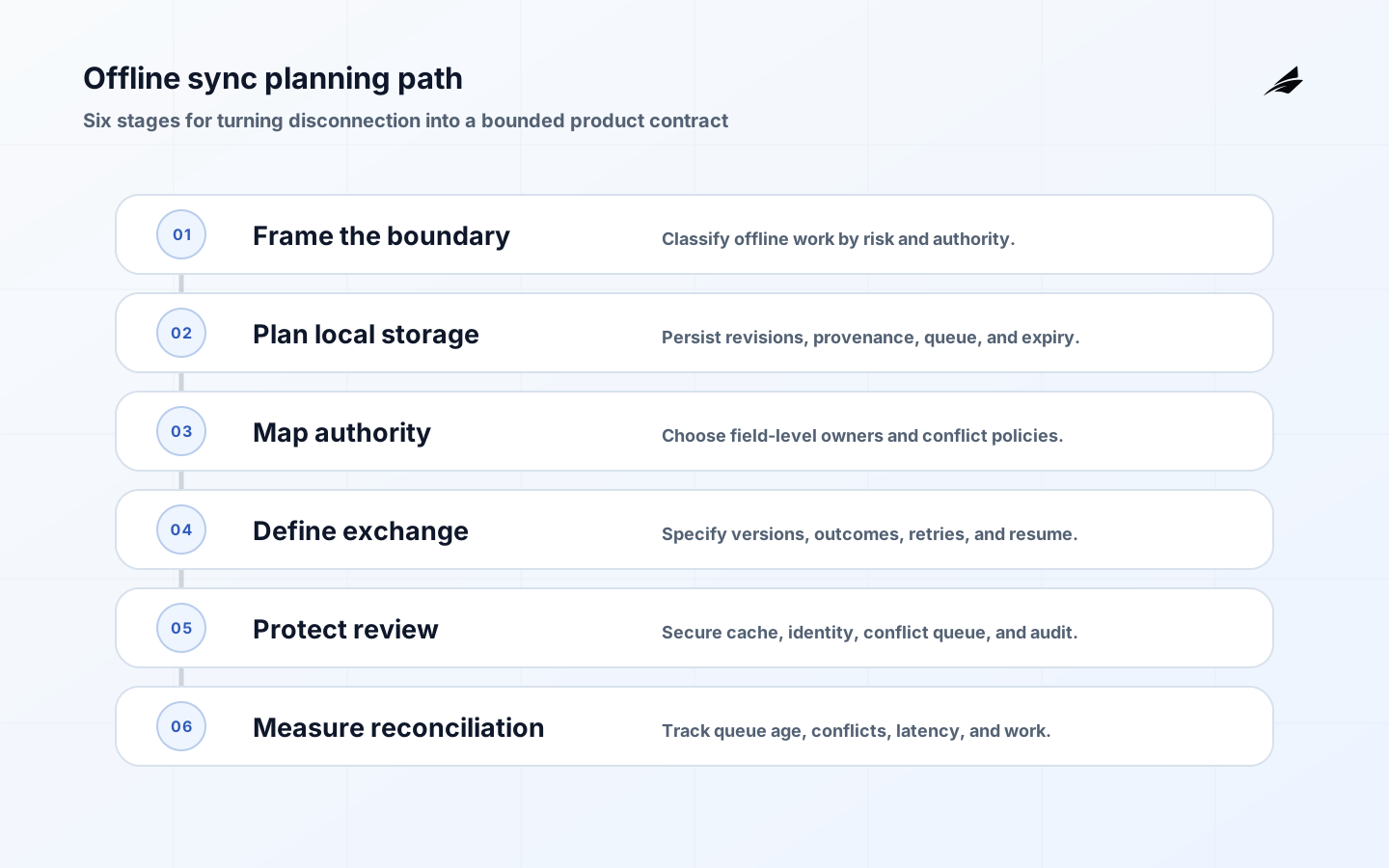
Offline sync planning begins when a product must remain useful during disconnection, not when a team selects a replication library. The planner must define which work is safe to perform locally, how local records survive restart, who owns each field, what a conflict means, and how the user is told that an action is pending. CouchDB’s technical overview describes incremental replication and conflict handling as normal distributed-system concerns. AWS’s Device Shadow service shows how desired and reported state can be separated during connectivity gaps. Use these concepts to build a plan that product, engineering, security, and operations can test together.
Frame the Offline Decision
Write the outcome in terms of work, risk, and time. “Technicians can complete an inspection in a basement with no signal and the office receives a trustworthy record within an hour of reconnection” is a useful target. It says nothing about unlimited offline editing or instant global consistency. Link to the plain-language offline sync guide to establish shared vocabulary. List the actions that are read-only, append-only, mergeable, approval-dependent, or prohibited offline. This classification keeps implementation bounded and prevents a well-intended offline feature from becoming a second unrestricted control plane.
| Work class | Offline policy | Review question |
|---|---|---|
| Read context | Cache assigned records with expiry. | Is the cached context still safe to use? |
| Capture evidence | Write locally with provenance. | Can the record be validated after reconnect? |
| Edit shared status | Queue with revision check. | Who resolves concurrent changes? |
| High-impact command | Require current authority. | What is the safe state if the link fails? |
Plan the Local Store
Define record identifiers, revisions, event time, local write time, author, device identity, sync state, retry count, and error reason. Keep an outbox for writes and a read model for the user interface. Use durable storage rather than an in-memory cache, encrypt sensitive data, bound capacity, and define eviction by priority and age. Decide how the store behaves on logout, account change, app update, device replacement, and failed migration. A plan should include a support view that exposes queue age and status without revealing private payloads. If local storage cannot preserve the work after a crash, the feature is not offline-capable yet.
Map Authority Field by Field
Create an authority matrix for records and fields. The central service may own assignment and billing, a device may own its observation time, a technician may own a note until approval, and an automated process may own derived state. CouchDB’s replication and conflict model demonstrates why concurrent edits need an application policy rather than a vague “last write wins” promise. Choose merge, append, revision rejection, server authority, or human review for each conflict class. Include the user who resolves it, evidence retained, and the condition that makes the decision final.
| Conflict policy | Best fit | Do not use when |
|---|---|---|
| Field merge | Independent notes or metadata. | Fields carry coupled safety meaning. |
| Append events | Measurements and observations. | Events can be replayed as commands. |
| Revision reject | Shared status or approval. | Users cannot recover without losing work. |
| Human review | Critical or ambiguous edits. | The queue has no staffed owner. |
Bind Work to the Right Identity
An offline write needs to identify the user, application, device, tenant, assignment, and record version without trusting only client-provided labels. Cache the minimum authorization context and set an expiry. Re-check authority during synchronization because a worker may have been reassigned or a customer may have changed access. Separate device authentication from user authorization. For high-risk work, require a fresh factor or connection. A queued record should make clear whether it was created by a person, a device, or an automated rule. Identity ambiguity becomes especially costly when two people edit the same record in a dead zone.
Define the Sync Exchange
Specify what the client sends, what the server returns, how versions are compared, how errors are classified, and how the client resumes after interruption. Use idempotency keys so a timeout after server commit does not create a second side effect. Return accepted, rejected, conflict, retryable, and expired outcomes separately. Preserve the server’s authoritative version and the client’s local version for review. The plan should also state whether downloads are full, incremental, filtered by assignment, or event-based. A sync exchange that returns “failed” for every case forces users and support staff to guess.
Model Pending and Confirmed State
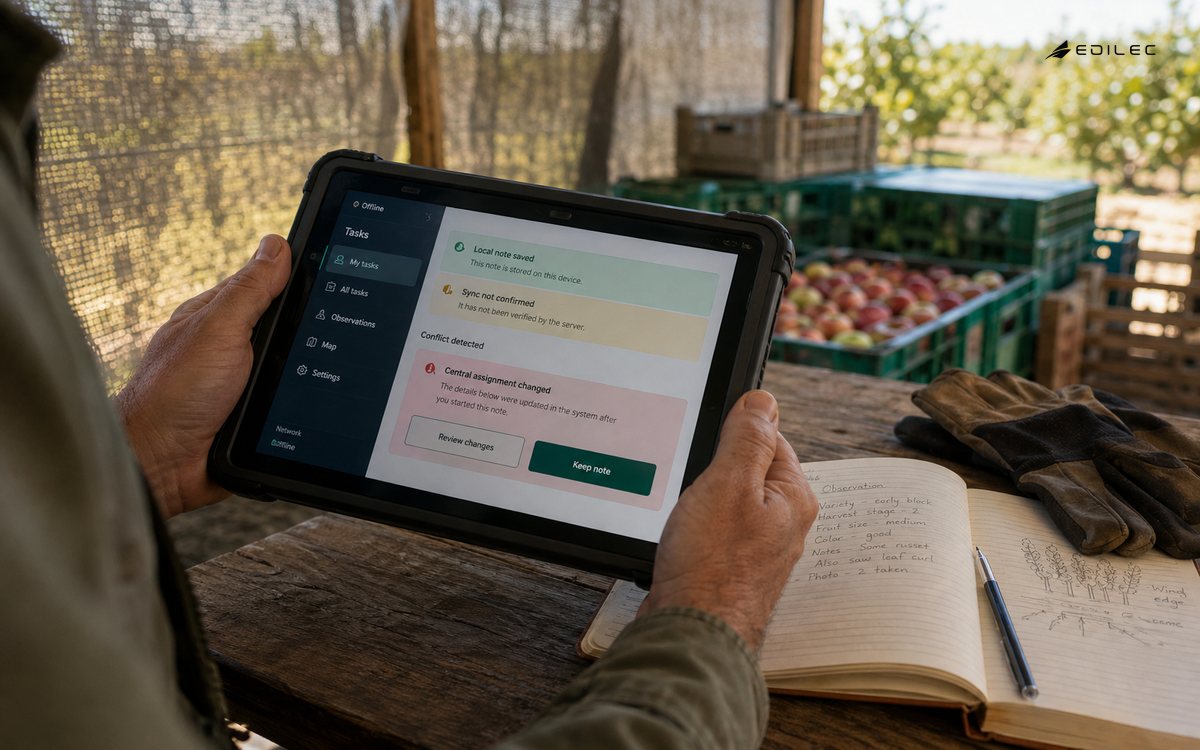
Users need a truthful status vocabulary: saved locally, queued, uploading, accepted, rejected, conflicted, expired, or confirmed by target. Do not use one green check for all stages. The shadow model in AWS IoT documentation is helpful because desired state can exist before a device reports it; use the same separation for work intent and result. Put expiry on commands and approvals. Show the last successful sync and the source of the displayed data. A transparent state model reduces duplicate taps, support calls, and unsafe assumptions about what happened while offline.
Design the Review Queue
Every unresolved conflict needs a queue, owner, priority, reason, affected record, versions, and next action. Give reviewers field-level comparison and safe choices. Preserve the losing or superseded value where the business needs audit, and record why the chosen value won. Do not let conflict resolution silently mutate a record without attribution. CouchDB eventual consistency guidance explains that replicas can converge while application meaning still requires a policy. Plan a backlog limit and escalation path; a queue that grows without ownership turns offline work into hidden operational debt.
Protect Data Outside the Center
Offline clients carry data into locations where central controls may not apply. Encrypt local databases and attachments, protect device unlock, minimize records by assignment and expiry, and support revocation or wipe where appropriate. Verify sync endpoints, validate tenant scope, and audit downloads as well as uploads. Do not place secrets in cached payloads or trust client clocks for authorization. Test a lost device, a stolen session, an expired assignment, and a tampered local record. Security planning should preserve usability: a technician needs a safe recovery path, not a hidden bypass when the phone loses connectivity.
Choose Measures That Expose Risk
Measure offline completion rate, local queue age, queue size, sync latency, retry rate, validation rejection, conflict count and age, local storage pressure, stale-context usage, and time to resolve a conflict. Separate a network outage from a client bug and an authorization change. Track work outcome too: fewer return visits, faster completion, fewer duplicate records, and customer confirmation. The companion sensor data pipelines guide is useful when offline payloads include telemetry. Metrics should guide a correction decision rather than become a scorecard that rewards hiding failures.
Run a Reconnection Pilot
Select one workflow and two realistic network conditions. Test airplane mode, app restart, battery failure, partial upload, duplicate upload, server timeout, schema upgrade, concurrent edit, expired permission, and a record that must be reviewed. Observe the user and support team, not only the API logs. Compare the planned state machine with what the interface communicates. Use offline sync for growing teams as a related planning reference. Scale only after the team can find all pending work, recover it safely, and explain every conflict that the pilot creates.
Turn the plan into a state table that engineers and operators can both use. For each local record, specify the transition from created to queued, uploading, accepted, rejected, conflicted, expired, or confirmed. Include the event that causes the transition, the retry behavior, the user message, and the owner of the next action. This catches ambiguous states such as a record that is locally saved but already superseded on the server.
A useful planning workshop includes a technician or field operator, a support person, a security owner, and an engineer responsible for storage or synchronization. Each sees a different risk: lost work, stale authority, privacy exposure, or non-idempotent writes. Resolve those concerns in the contract before the implementation locks them into a library or database choice.
The plan is ready for implementation when a reviewer can answer five questions for every offline action: who may create it, where it is stored, which version it changes, what happens after reconnect, and who resolves ambiguity. If any answer depends on a library default, make it explicit in the application contract before the pilot.
Keep a written decision for what happens to local work after a user account is disabled, a device is lost, or an app version is retired. The safest answer may be to quarantine records for review rather than delete them or replay them automatically. This belongs in the plan because lifecycle events rarely wait for a good connection.
Practical Takeaways
- Set a bounded offline outcome and classify actions by risk and authority.
- Make the local store durable, encrypted, versioned, and visible through sync status.
- Define authority and conflict policy at the field or operation level.
- Use idempotency keys and distinct outcomes for accepted, rejected, retryable, and conflicted writes.
- Protect cached data and re-check authorization during reconciliation.
- Measure real work completed and the age of unresolved sync debt.
FAQ: Planning Offline Sync
Should the server always win conflicts?
Only when the server owns the field and the loss of local work is acceptable. Independent fields may merge, observations may append, and critical edits may need human review. Choose from authority and consequence, not from implementation convenience.
Can commands be queued offline?
Only when the command is safe to delay, the target and authority remain valid, and expiry plus acknowledgement are explicit. High-impact actions usually need current authorization and confirmation rather than an indefinite offline queue.
Conclusion
Offline sync planning is a product and operating-model exercise before it is a replication exercise. Set the boundary, local model, authority, sync exchange, conflict queue, identity controls, and measures, then prove them with reconnection tests. A carefully bounded offline experience protects user effort while keeping the organization honest about what has and has not been confirmed.