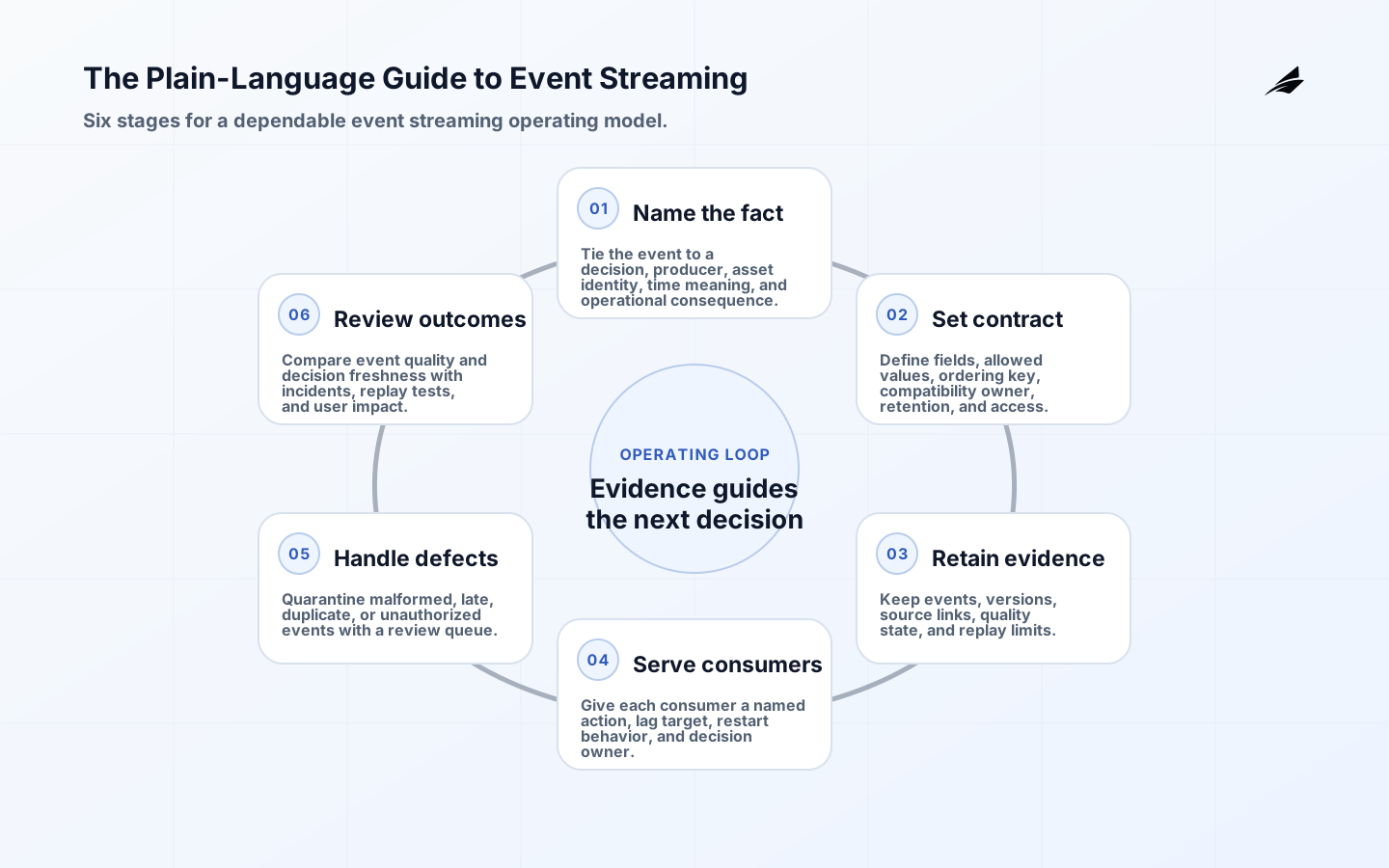
Event streaming carries time-ordered facts from producers to consumers without requiring every consumer to be present at the moment a fact occurs. The important question is not whether a broker moves messages; it is whether an event preserves identity, time, schema, provenance, and policy context so a consumer can make a safe decision later.
What Event Streaming Means
An event is an immutable statement about a change, not the current state of an asset. A temperature reading and a threshold-crossing alert are different events; a device's current temperature is a state derived from many readings. That distinction makes replay possible. A new consumer can rebuild a view from retained events without asking the device to reproduce yesterday's conditions. It also prevents a common design error: publishing a mutable database row as though it were a reliable historical record. Name the event in past tense, assign it an identifier, and include the producer time as well as the time a platform received it.
The first design conversation should be about a decision, not a broker. For example, a maintenance planner may need to know whether a pump has entered a sustained vibration condition, while a reliability engineer needs the raw observations and calibration context behind that conclusion. Those are separate consumers with different latency, retention, and access needs. Event streaming for connected systems is easier to scope when each consumer's action and evidence threshold are explicit.
| Event element | Practical rule | Event-stream significance |
|---|---|---|
| Identity | Use a stable event ID and asset identifier. | Deduplication and traceability survive retries. |
| Time | Keep event, ingest, and processing times distinct. | Late arrivals can be explained instead of silently misordered. |
| Schema | Version the payload and document compatibility. | Consumers can change without guessing field meaning. |
| Provenance | Record producer, gateway, and quality status. | A downstream action can be audited. |
Build the Event Streaming Architecture Around Contracts
A dependable architecture separates producers, the durable event log, stream processing, and consumer views. Devices and gateways should publish through a small, controlled contract rather than exposing every vendor payload to every application. A gateway may normalize units, attach connection quality, and assign a monotonic sequence where the device cannot. The log retains the accepted record; processors enrich, filter, or correlate it; consumers receive only the form they need. This separation lets a reporting service evolve without changing a command service or a safety review workflow.
Partitioning is a business continuity decision as much as a throughput decision. Choose a key that keeps related records in order where order matters, such as asset ID or work-order ID. Do not promise global ordering that the transport cannot deliver. Instead, define how consumers deal with duplicates, gaps, and out-of-order delivery. Idempotent consumers, explicit sequence checks, and a visible dead-letter path are usually more valuable than a fragile attempt to make every delivery exactly once.
Operate for Late Data and Failed Consumers
Connected sites experience maintenance windows, radio loss, gateway restarts, and clocks that drift. A stream design should make those conditions visible. Store the original device time when it exists, validate whether it is plausible, and avoid overwriting it with ingest time. Set retention from the longest justified replay or investigation need, then test a replay against a copy of production-like data. Retention is not an unlimited archive; it has cost, privacy, and access implications that an owner must review.
Consumer lag is meaningful only in context. A dashboard that refreshes every shift can tolerate a different delay from an interlock-monitoring service. Set a service objective for each consumer, alert on sustained breach rather than one noisy sample, and show the affected topic and partition to the on-call person. The operational question is whether a delayed consumer changes the safe action. If it does, the workflow needs a defined degraded mode and escalation route.
| Failure mode | Design response | Event-stream evidence |
|---|---|---|
| Duplicate publish | Make processing idempotent using event identity. | Duplicate count and disposition. |
| Schema change | Run compatible producers beside consumers during rollout. | Schema version and migration approval. |
| Poison event | Quarantine with reason and replay controls. | Original payload reference and resolution owner. |
| Consumer outage | Track lag and restore from committed position. | Outage window, backlog, and recovery result. |
Start With One Observable Workflow
Choose a first workflow where the source is known, an operator already cares about the outcome, and replay adds clear value. A fleet gateway connection event feeding an outage queue is often a better first case than a company-wide data platform. Map the producer, topic, contract, consumer, exception owner, and success measure on one page. Then exercise normal, duplicate, late, malformed, and unavailable-producer cases before expanding. This produces a supportable pattern rather than an impressive but unowned integration.
- Write a plain-language event contract with field owner and allowed values.
- Choose an ordering key from the decision that consumes the event.
- Set retention and access rules before the first production topic exists.
- Test replay, duplicate delivery, and a consumer restart with real operational staff.
- Give every dead-letter queue a review owner and service target.
- Review consumer lag beside business impact, not as an isolated infrastructure number.
Security and Access Boundaries
Streams can expose facility behavior, personnel activity, asset location, and control-adjacent signals. Apply least privilege at the topic or stream level, authenticate producers distinctly, and avoid sharing broad credentials among gateways. NIST's OT guidance emphasizes that security choices must account for availability and safety constraints, especially where IT and operational technology meet. Keep command events separated from observation events; a consumer entitled to read telemetry should not gain authority to issue an actuator command because both happen to use the same platform.
Logging should answer who published, who read, which contract version was used, and which administrative change altered access. It should not casually copy sensitive payloads into every troubleshooting system. Review the data classification with the operations owner before creating a long-lived topic. When a supplier needs access, provide a bounded route, time limit, and audit record rather than a shared account that quietly becomes permanent.
The event-stream contract boundary
For event streaming, name the fact being carried, producer, contract owner, ordering key, retention, access boundary, consumer action, and review path for malformed or late records. Keep derived conclusions separate from original events so a later rule can be tested against history. Consult the Kafka 4.3 protocol reference, W3C Trace Context, NIST OT security guidance, and NISTIR 8259A. For an event stream, for related Edilec reading, compare the event-streaming production guide, telemetry decision guide, and protocol-selection review.

Start with one event that changes a real decision, such as a gateway connection loss feeding an outage queue. Follow it through publication, validation, retention, consumer restart, duplicate delivery, late arrival, quarantine, replay, and the operator’s response. Keep contract version, producer identity, event time, processing time, and source references visible. Measure decision freshness, valid identity, consumer lag with business impact, and the age of unresolved defects rather than throughput alone.
| Decision area | Event-stream question | Event-stream evidence |
|---|---|---|
| Purpose | For event streaming, answer this question: Which real decision does the system change? | For event streaming, record the scenario, owner, and acceptance example. |
| Boundary | For event streaming, identify what is allowed, and what is deliberately excluded? | For event streaming, retain policy, identity, and version details. |
| Failure | For event streaming, identify what happens when data, network or dependency fails? | For event streaming, retain a contingency test and visible status. |
| Change | For event streaming, answer this question: Who can alter rules, mappings or access? | For event streaming, retain approval, diff and rollback point. |
| Review | For event streaming, answer this question: What shows the design remains useful? | For event streaming, retain outcome, exception and correction record. |
Event-streaming takeaways that protect meaning
- Event streaming preserves operational facts so multiple systems can act without losing provenance.
- A contract must state identity, time, schema, quality, and ownership before scale.
- Ordering, replay, and retention should be tied to a real decision and recovery need.
- Late data and failed consumers are normal operating conditions, not edge cases.
- Access controls need to distinguish observation from command authority.
Keep analytical conclusions separate from the events that support them. A correlation service may infer that several connection-loss records represent a site outage, but it should publish that inference as a new record with its rule version, evaluation window, and source references. It should not overwrite the original events. That gives operators a way to challenge the conclusion, lets engineers test an improved rule against history, and makes it clear when a work order came from a model rather than a direct observation. When a derived event drives a consequential action, display its confidence and expiry alongside the accountable owner.
FAQ: event-streaming questions for operators
Is event streaming the same as a message queue?
Not necessarily. A queue often distributes work so one worker completes a task, while an event log retains a fact that several consumers may read independently. Products can support both patterns. The important choice is whether a new consumer needs history and independent replay, or whether the message should disappear after a worker completes it.
Which event-stream metric deserves attention first?
Measure the decision outcome alongside stream health. For an outage workflow, track time from connection-loss event to acknowledged triage, the percentage of events with valid asset identity, and the number of unresolved quarantined records. Throughput alone can hide a stream that moves bad data quickly.
An event stream should make operational history easier to inspect, not merely move messages faster. Let an operator trace a derived outage record to the source events, contract versions, processing window, and consumer that acted on it. When a record is late, malformed, or disputed, preserve it in a visible state and give a named owner a way to resolve it. These habits make replay a controlled engineering tool and keep conclusions separate from facts.
Conclusion: let events carry their meaning
Good event streaming makes change legible across a connected operation. Start with an event that has a clear producer and operational consumer, preserve its context, and prove that the team can recover from late or bad data. The broader platform can follow once the first stream has earned trust through visible ownership and repeatable recovery.
Primary references for event-stream contracts
For implementation detail, consult the Kafka 4.3 protocol reference, NIST SP 800-82 Rev. 3, NISTIR 8259A, and NIST SP 800-213A. These sources support the contract, lifecycle, and operational-security principles used here; a deployment still needs site-specific engineering review.