Gateway security is the discipline of protecting the system that bridges local equipment, field networks, and cloud or enterprise services. A gateway may translate protocols, cache telemetry, run local rules, and hold credentials that represent many devices. That makes it a high-leverage target and a high-leverage control point. A founder does not need to choose every cipher suite, but does need to fund the mundane capabilities that keep a deployed fleet defensible: an inventory, unique identity, secure update, protected administration, logging, and an owner who can respond when one site behaves strangely.
Set the Gateway Trust Boundary
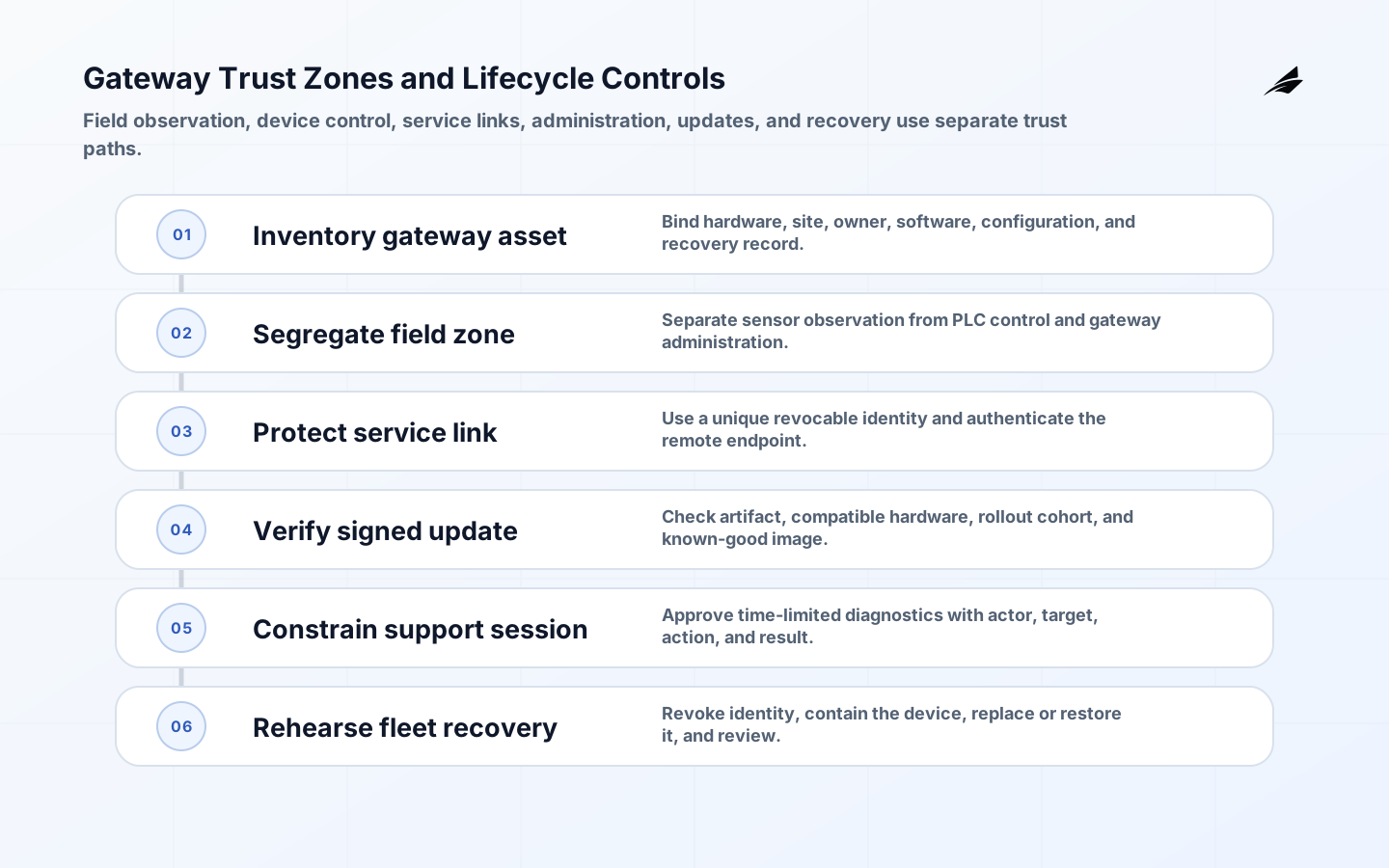
Draw what the gateway can reach and what can reach it. The field side may include sensors, PLCs, serial buses, or a local Wi-Fi network; the service side may include a broker, API, support tunnel, and update service. Do not flatten these into one trusted network. A compromise on a low-cost sensor should not automatically permit an attacker to administer the gateway, alter a setpoint, or query customer data. Separate observation from command paths and require an explicit policy decision before traffic crosses from one zone to another.
| Asset | Required decision | Useful control |
|---|---|---|
| Gateway hardware | Which model, software build, and owner are deployed at each site? | Signed inventory and version reporting |
| Local device network | Which protocols and peers are permitted? | Allowlisted routes and protocol-aware segmentation |
| Remote administration | Who can open a support session and for how long? | Strong operator authentication, approval, session logging |
| Cloud connection | Which endpoint may the gateway contact? | Mutual authentication and certificate validation |
Give Every Component an Identity
Do not ship a fleet with one shared password or one reusable client certificate. Give the gateway an identity that can be revoked without interrupting every other customer. Bind it to an asset record and a permitted service role, then use short-lived or renewable credentials where the platform supports them. The gateway should also verify the identity of its service endpoint; encryption without endpoint authentication can still carry data to an impostor. Store private keys in hardware-backed storage when practical, and design replacement procedures so a field technician does not need to copy secrets through a ticket.
- Create the device identity during a controlled provisioning step, not from a public default credential.
- Limit each credential to the telemetry, command, or update operations it actually needs.
- Record certificate serial number, expiry, device owner, and rotation status in the fleet inventory.
- Reject expired, unknown, or wrongly scoped identities with an auditable reason.
- Test revocation and replacement against an offline gateway, not only a lab device.
Protect Management and Updates
An update path is part of gateway security, not a later maintenance feature. Verify a signed artifact before installation, associate it with compatible hardware and configuration, and preserve a known-good recovery image. Roll out to a small cohort, measure boot success and application health, then expand only after the evidence is good. Management interfaces deserve the same care: no exposed default ports, no permanent vendor account, and no broad remote shell simply because it is convenient during a pilot. A support session should be time-bounded and leave a record of actor, target, action, and result.
| Control | Question to test | Failure signal |
|---|---|---|
| Signed update | Will the gateway reject a modified package? | Signature or version validation failure |
| Rollback | Can the last working image return after a failed boot? | Repeated boot loop or unavailable service |
| Admin session | Can a technician access only the assigned site? | Cross-tenant or unapproved session attempt |
| Configuration | Can an untrusted source change command rules? | Unexpected policy hash or configuration drift |
Make Security Operable
Security controls fail quietly when no one can see their state. Report software version, secure-boot state where available, certificate expiry, configuration digest, last contact, and failed authentication counts to an inventory that operations can use. Decide which alerts merit immediate containment: a gateway connecting to an unknown destination, repeated privileged-login failures, an unsigned update attempt, or a configuration drift that enables commands. Device provisioning explains how these identities enter service; edge gateways covers the operational role they play.
Fund the First Security Release
Build one complete secure path before scaling the fleet: provision a gateway, connect it using its own identity, receive a signed update, open an approved support session, revoke the identity, and recover it. Include an installer and support representative in the exercise. Their work reveals where an elegant design asks for an impossible field action. The initial operating metric is not the number of controls listed in a policy; it is the percentage of deployed gateways with a known owner, current software, valid identity, and tested recovery route.
Gateway Security FAQ
Is a VPN enough to secure a gateway?
No. A VPN can protect a network path, but it does not establish per-device authorization, prevent an untrusted update, or tell operations which software and configuration a gateway runs. Use it as one transport control inside a broader identity and lifecycle design.
Should gateways accept remote shell access?
Only when a documented support case truly needs it. Prefer purpose-built diagnostics and time-limited, approved access through a controlled jump path. Permanent remote shell access makes investigation and least privilege much harder.
Key Takeaways
- Make every deployed gateway identifiable, accountable, and revocable.
- Separate device observation, control, administration, and update paths.
- Treat secure updates and recovery as shipping requirements.
- Exercise containment with the people who will do it under pressure.
Conclusion
Gateway security becomes manageable when it is treated as an operating system rather than a one-time hardening task. Know each gateway, constrain what it can do, verify what it runs, and rehearse how it returns to service. Those capabilities protect both the business and the field teams asked to keep connected systems running.
Run an Operational Review
Implementation Notes
Implement gateway security as a sequence of observable releases. In the first release, keep the producer or source, identity registry, validation rule, one consumer, and support view connected end to end. Capture a baseline before switching users over: current completion time, recurring error, number of manual reconciliations, and the records that are difficult to explain. During a limited rollout, compare the new path with that baseline and look for unexpected gaps between the digital record and the physical or operational reality. A release that makes uncertainty visible is safer than one that reports success because traffic is flowing.
Configuration deserves the same discipline as application code. Version thresholds, mappings, topic or route permissions, asset associations, and retention rules; review changes with the owner of the affected workflow; and record when the new configuration became effective. This protects gateway security from a common production failure: correct software interpreting a changed environment with an old assumption. Build a rollback that restores the previous known-good behavior, then test it with evidence that downstream consumers, users, and support tools see a coherent state.
Capacity planning is also a correctness concern. Estimate peak rather than average input, reconnect storms after a site outage, retained history, processing windows, and the time needed to catch up without making live work stale. Set quotas and backpressure behavior deliberately. If the system must shed load, define the least harmful data to defer and how an operator will know that it happened. Review cost alongside quality because an uncontrolled gateway security design may become so expensive that teams disable retention or diagnostics precisely when they are needed for an incident.
Finally, give users an honest interface to system state. Show whether the latest information is fresh, whether an action is pending or confirmed, and who owns the next exception. Do not represent a queued request as a completed business result. Provide a stable case or correlation identifier that lets a technician, analyst, and support engineer discuss the same occurrence without copying opaque payloads into chat. These details turn gateway security from infrastructure that only specialists can interpret into a dependable part of daily operations.
Gateway security deserves a scheduled operating review because production evidence changes the design assumptions made during delivery. Review a representative week of normal activity and one difficult incident with the people who own the asset, service, security, and data responsibilities. Trace a record from its first observation to its final use. Check identity, timestamps, configuration or schema version, access decision, retry history, and the person who handled the exception. This is where a team discovers that a technically successful message had no business owner, an alert reached the wrong queue, or a recovered device quietly produced an older configuration. Record each finding as a concrete change with an accountable owner and due date. For Gateway Security: A Founder's Guide to Connected Systems, that review is more valuable than a generic maturity score because it tests the actual route users depend upon.
Use a small scorecard that measures reliability and usefulness together. Count incomplete records, stale evidence, unassigned exceptions, manual workarounds, recovery time, and decisions later reversed because context was missing. Segment those measures by site, device class, software version, and workflow state so a broad average does not hide a troubled cohort. Then test a repair: replay an event or record, rotate an identity, restore a blocked integration, and confirm the person doing the work can explain the result. The aim is not perfect data or zero alerts. It is a gateway security service whose limitations are visible, whose failures have a practiced route, and whose next improvement is selected from evidence rather than anecdote.