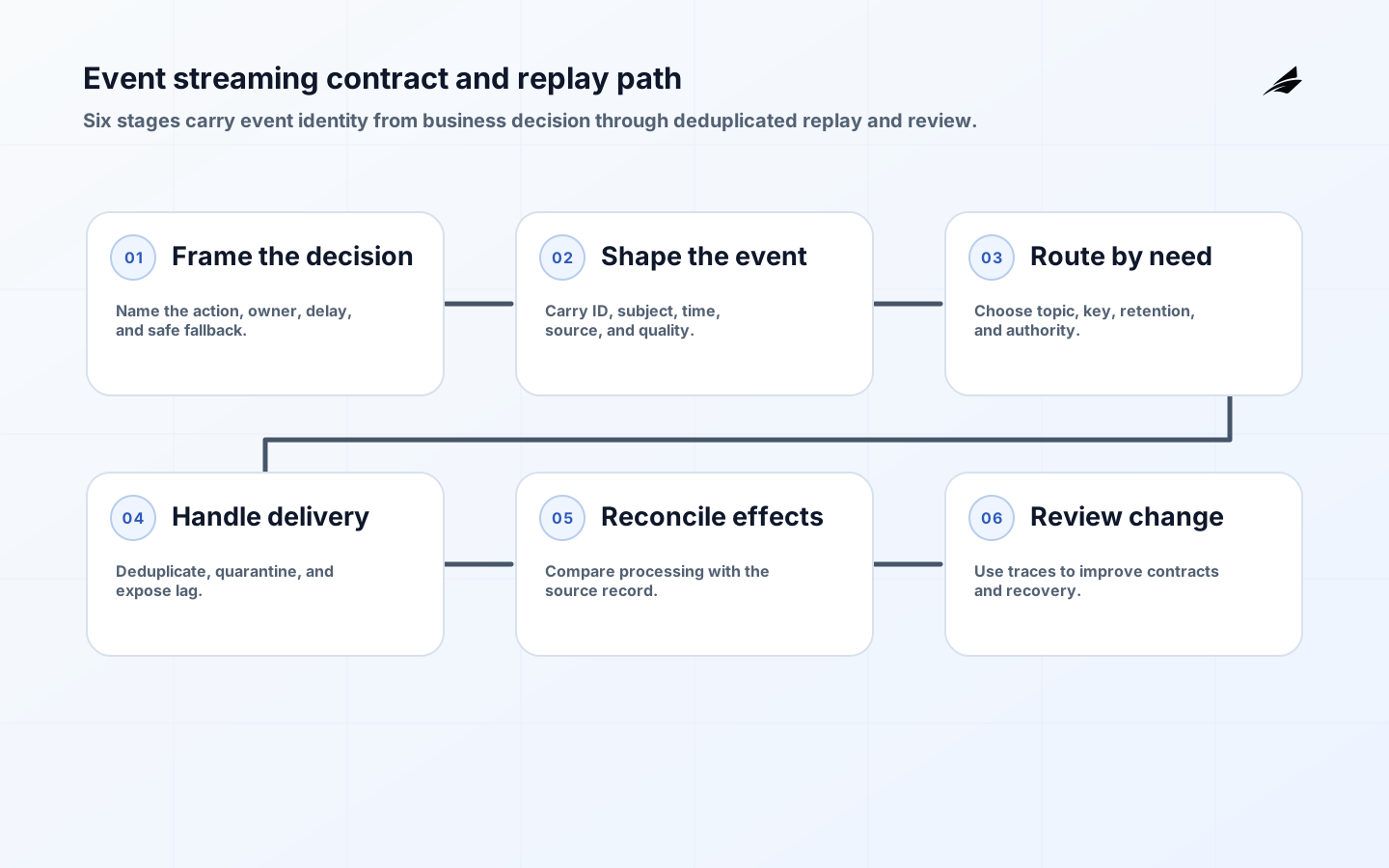
Event streaming for connected systems becomes valuable when a device observation, service decision, and customer-visible status can be traced through one dependable path. Start with the decision that needs better evidence, then define the event, owner, timing, and safe response before choosing a broker or consumer pattern.
Define the event streaming for connected systems decision and boundary
Start with one outcome, such as identifying excursions that require quality review. Define producer, shared asset ID, event and receive time, quality state, and consumer accountable for the next action. Events describe facts; commands that change equipment belong on a controlled request path.
| Decision area | Question to settle | Evidence to retain |
|---|---|---|
| Outcome | Which decision does event streaming improve? | Scenario, owner, delay limit, and success measure. |
| Authority | Who may change or override the path? | Role rule, escalation route, and audit record. |
| Data | Which record is authoritative? | Identity, time rule, quality state, and lineage. |
| Recovery | What happens when a dependency fails? | Safe alternative, reconciliation rule, and support owner. |
Design a dependable event streaming for connected systems contract
Use a versioned envelope with event ID, source, subject, occurrence time, schema version, and quality. Partition only for ordering a consumer really needs, commonly per asset. Retention, compaction, and archive rules should differ for raw readings, state changes, and auditable events.

| Design choice | Practical rule | Operating signal |
|---|---|---|
| Identity | Use stable IDs instead of display names or shared credentials. | Duplicate, unmatched, or unauthorized records. |
| Time and state | Preserve time and explicit quality or status. | Late, stale, unknown, and conflicting items. |
| Change | Version policy, interfaces, and configuration. | Compatibility errors and drift. |
| Evidence | Keep source and reason near consequential decisions. | Traceability from a view to source data. |
Implement event streaming for connected systems as a thin, testable path
Make publication durable beside the system that owns the fact, and make consumers store processed event IDs with their effects. Test duplicates, late arrival, unavailable consumers, and schema changes. An operator should see whether an item is waiting, rejected, replayed, or reconciled.
- Write the event streaming contract in plain language, including delayed and disputed states.
- Assign operational and technical ownership before release.
- Use representative devices, sites, and network conditions in a controlled rollout.
- Capture configuration and approval evidence with stable identifiers.
- Test recovery from a missing dependency.
- After the first live cycle, have a producer owner and a consumer owner compare one completed business effect with its source record.
Protect the event streaming for connected systems operating boundary
Authorize named producers and subscribers, encrypt transport, rotate credentials, and log administrative changes. Topic names can disclose assets and customer context. In OT, a messaging broker must not become an unreviewed route between enterprise and control networks.
Operate event streaming for connected systems with evidence
Measure producer errors, priority-aware lag, dead-letter age, schema failures, and traceability back to source data. The usual failure is promising exactly-once business results from transport settings alone; durable deduplication and reconciliation create the trustworthy outcome.
Create a decision record for event streaming for connected systems
Before expanding event streaming for connected systems, write a decision record that a shift lead, engineer, and support owner can challenge. For a cold-chain excursion before shipment release, name the trigger, the assessor, the evidence threshold, the latest useful time, and the safe response when evidence is absent. Include the event ID, shipment subject, occurrence time, source, schema version, and quality state. The record should also state how a late or contradictory input is handled and who resolves a disagreement before automation proceeds. Product, operations, and security can then test the boundary against a failed handoff rather than judging it from a successful demonstration.
Work through a realistic event streaming for connected systems example
Use a cold-chain excursion before shipment release as a rehearsal with a measurable handoff. Follow its identifier from the physical asset through evaluation, operator display, action record, and later confirmation. Mark which facts tolerate caching, which require current evidence, and who may grant a temporary override. Label queued, rejected, stale, and acknowledged states distinctly so the interface cannot imply resolution prematurely. The rehearsal should leave behind a small acceptance set for late delivery, contradictory readings, and replay after reconnection.
Release and recover event streaming for connected systems deliberately
A production release should state its compatibility assumptions, cohort, rollback trigger, and evidence owner. Start with sites or devices that represent real variation, then verify event identity, subject, occurrence time, source, schema, and quality after normal processing, restart, degraded connectivity, and version change. Rehearse a consumer that repeats an effect and one that receives an older event after a newer state. Give the recovery queue a named decision-maker and explicit outcomes for retry, repair, rejection, and reconciliation. Preserve diagnostic records instead of deleting inconvenient failures; that turns an incident into bounded work the next shift can resume.
Review event streaming for connected systems on an operating cadence
Review event streaming for connected systems with the people who own its consequences. Examine producer rejects, priority-aware lag, schema failures, dead-letter age, and source traceability beside a few real shipment or device cases. A fleet average can conceal one firmware cohort, site, customer workflow, or technician route that fails repeatedly. Record changes, workarounds, unresolved exceptions, and near misses, then assign each finding to a contract edit, validation improvement, training action, capacity change, or conscious no-op. The review should show whether the stream is reducing uncertainty and rework, not simply increasing the volume of telemetry.
Choose event semantics that survive delay and replay
An event streaming design earns its place when a consumer can distinguish a new fact from a repeated delivery, a correction, and a command. Give every event a stable identifier and carry both occurrence time and ingestion time; the first says when the source observed a condition, while the second explains when the platform became able to process it. Add a source identity, schema version, subject, correlation key, and quality state. For a cold-chain service, a reading of 8°C received after a network outage is not equivalent to a current reading of 8°C. Keeping that difference in the contract lets a downstream rule decide whether to notify, queue, or wait for confirmation. CloudEvents provides a useful common vocabulary for event context, while MQTT quality-of-service choices remind teams that delivery guarantees still need business-level deduplication.
For planning event replay, compare Managing Event-Stream Cost and Capacity in Production, Event Streaming for IT Managers: An Operating Guide, IoT Telemetry for Connected Systems: A Practical Guide; together they frame event replay, ownership, and recovery without asking the reader to infer the operating boundary.
- Preserve occurrence time and ingestion time as different facts.
- Make duplicate handling and replay authority part of the consumer contract.
- Keep event publication separate from commands that change equipment or business state.
- Retain enough context for a person to explain a delayed, rejected, or replayed event.
Event streaming for connected systems takeaways for operators
- Start event streaming with a defined decision, not a generic platform objective.
- Preserve identity, time, ownership, and quality where meaning changes.
- Make exceptions and recovery visible to people who resolve them.
- Release in cohorts and test adverse conditions.
- Restrict authority to the smallest useful scope.
- Use operating signals to improve the contract, not merely a dashboard.
Event-streaming questions for a live connected system
What must an event contract identify before publication?
Record the event ID, subject, source, occurrence time, quality state, schema version, producer owner, and the consumer responsible for the next business effect.
How should replay be made safe?
Make consumers idempotent, preserve the original event ID, separate replay from new occurrence time, and reconcile the result with the authoritative record.
When is an event-streaming path ready to expand?
After a representative producer and consumer survive duplicate, late, rejected, and schema-compatible events with visible ownership and recovery evidence.
Conclusion: keep event replay explainable
Reliable event streaming for connected systems depends on a contract that preserves context through delay, change, and replay. Start with one accountable path, make its evidence inspectable, and expand only after operators can explain the next safe action from the record itself.
A useful production exercise follows one event from creation to business effect while the team deliberately changes the conditions around it. Begin with a normal reading, then delay delivery, repeat the message, alter a compatible field, and make the consumer unavailable for one interval. The record should retain the original event identity, occurrence time, producer, consumer group, processing attempt, and resulting state. Ask the operator to decide whether the event should be applied, held, rejected, or reconciled; do not let a successful transport acknowledgement answer that question. For a cold-chain workflow, the safe outcome may be to hold a shipment while a reviewer confirms whether a late temperature is still actionable. For a maintenance workflow, the same pattern may require suppressing a duplicate work order while preserving both delivery attempts. Capture the decision, evidence used, and owner who approved the exception. This turns event streaming from a broker configuration into a repeatable operating control.
Primary references for event streaming contracts
Use these primary references to test event contracts and recovery: CloudEvents Specification v1.0.2, MQTT Version 5.0 OASIS Standard, NIST SP 800-82 Rev. 3, and NIST SP 800-61 Rev. 3. Validate the resulting choices against local safety and jurisdiction rules.