The gateway security model is the engineering of a computer that sits between devices, local networks, and upstream services. A gateway may translate protocols, buffer telemetry, run local logic, expose remote support, and distribute updates. That concentration makes it valuable, but it also makes it a high-consequence boundary. The goal is not to make a gateway universally trusted. The goal is to make its allowed work explicit and to limit what follows if its software, credentials, or physical environment are compromised. A product team should start from the assets and decisions the gateway affects, then build controls that can be operated in a field environment.
Gateway security: Define the gateway role before adding controls
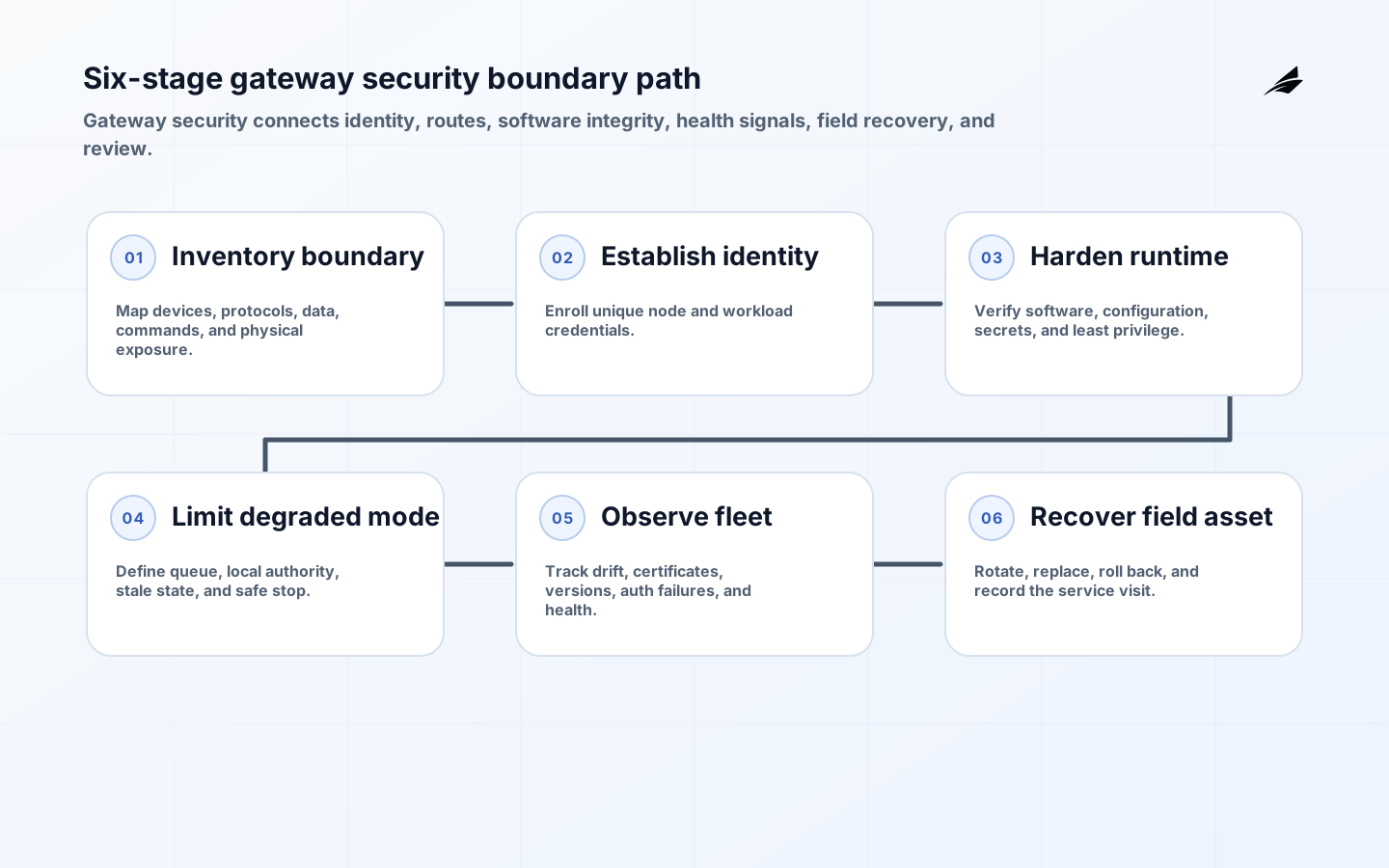
Write down which protocols enter on each interface, which data or commands leave, and whether the gateway is allowed to transform, store, or originate a command. A protocol bridge that forwards sensor values has different risk from a local controller that can alter a setpoint. Include administration, time synchronization, name resolution, certificate enrollment, update delivery, and support tunnels in the map; these commonly become the broadest routes. The edge gateway checklist is a useful companion for placement and lifecycle choices. A role statement also lets procurement reject features that create an unmanaged general-purpose computer at every site.
Gateway security: Establish a narrow trust boundary
Use separate interfaces or enforced zones for device-facing traffic, local administration, and upstream services whenever the deployment allows it. Permit only required destinations, ports, and protocols; an outbound connection should be limited to documented service endpoints rather than unrestricted internet access. Administrative sessions should enter through a managed path with named accounts, multifactor authentication where feasible, approval, and session logging. Do not rely on a gateway's location alone as proof of trust. A compromised gateway should not be able to discover peer devices, reach controller management interfaces, or retrieve arbitrary software from the network. Network boundaries and gateway authorization should reinforce each other.
| Gateway function | Control to require | Failure to test |
|---|---|---|
| Device protocol translation | Allowlisted protocol parser and input limits | Malformed frame exhausts memory or changes routing |
| Cloud telemetry | Mutual authentication and endpoint allowlist | Credential reuse reaches another tenant or service |
| Remote support | Time-bounded named session through a jump path | Vendor tunnel remains available after work |
| Local storage | Encryption, retention limit, and secure erase procedure | Removed unit exposes retained readings or keys |
Gateway security: Give each gateway an accountable identity
Every gateway needs a unique identity bound to an inventory record, not a shared password copied into an image. Record its hardware model, serial number, installed software, owner, site, interfaces, certificates, and support state. Protect private keys with hardware-backed storage when the platform supports it, and make renewal possible before expiry. A bootstrap credential should have less authority than the operational identity it receives after registration. Separate machine credentials from human accounts so an incident can revoke one without interrupting the other. The important engineering test is whether a replacement unit can join only the intended estate and whether a stolen unit can be denied without a fleet-wide secret change.
Gateway security: Control software and configuration drift
Build a minimal operating image, remove unused services, and record a cryptographic digest for approved releases. Sign updates, validate compatibility before activation, and retain a known recovery route. Configuration should be versioned as carefully as code: record the desired state, the applied state, the approver, and a rollback artifact. Treat containers as packaging, not isolation magic; a privileged container or an exposed management socket can defeat the intended boundary. Monitor for unexpected listening ports, disabled logging, changed trust anchors, and deviations from the approved image. A field gateway must tolerate slow links and power loss, so a security improvement that cannot recover safely is not production-ready.
| Change type | Release evidence | Rollback decision |
|---|---|---|
| Operating system patch | Signed artifact, vulnerability assessment, cohort result | Revert if boot health or required driver fails |
| Protocol adapter | Representative device and malformed-input test | Disable adapter if parsing errors rise |
| Certificate rotation | New credential accepted before old expiry | Use overlap window; never restore a revoked key |
| Firewall policy | Allowed and denied flow capture | Restore prior rule only after impact is contained |
Gateway security: Make gateway health and misuse observable
Collect enough logs and metrics to answer what identity connected, which policy decision occurred, what version ran, and whether the gateway continued its required local function. Useful signals include repeated authentication failures, new outbound destinations, configuration changes, storage pressure, update status, time drift, and device protocol errors. Send security-relevant evidence off the gateway soon enough that a damaged or stolen unit cannot erase the only copy, while respecting bandwidth and privacy constraints. Pair telemetry with a runbook that says who can isolate the gateway, how local operations behave during isolation, and how evidence is preserved. Silence is not a healthy state unless it is expected and measured.
Gateway security: Plan for physical and operational reality
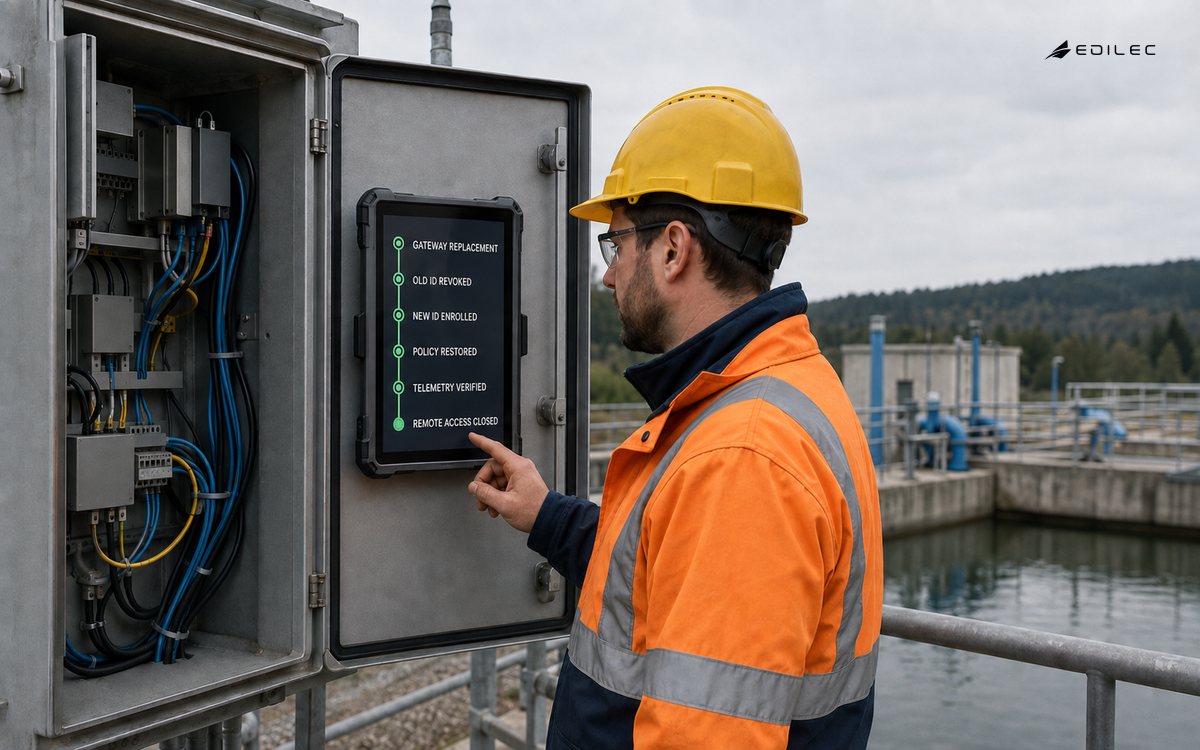
Gateways are often installed in cabinets, vehicles, temporary sites, or customer premises. Document who may touch ports, where reset controls are located, what happens after power loss, and whether a technician can identify the unit without exposing sensitive data. Restrict removable media, disable unused radio interfaces, and require a deliberate action for factory reset. Field staff need a fast, legitimate recovery process; otherwise shared support accounts and improvised workarounds will reappear. Include a degraded-mode decision: does the gateway store readings, continue local control, stop accepting commands, or fail closed? The answer should reflect safety and service consequence, not a generic security slogan.
Key takeaways for gateway security
- Constrain a gateway to a documented role and a small set of reachable services.
- Use unique identities, recorded ownership, and revocable credentials for every unit.
- Version software and configuration, then prove a safe update and recovery path.
- Monitor policy decisions, drift, and local health as part of normal operations.
- Treat replacement, loss, and physical access as design scenarios rather than help-desk exceptions.
Frequently asked questions about gateway security
Can a gateway share a credential with its devices? It should not; shared credentials blur accountability and make revocation expensive. Is encryption enough for a gateway connection? No. Encryption protects transport but does not decide where the gateway may connect or what it may do after authentication. How often should gateways be patched? Use a risk-based, supportable cadence, with urgent remediation for material exposure and staged validation before broad rollout. What is the first drill? Simulate loss of a unit and prove its identity, access, and local data can be revoked without stopping unrelated sites.
Conclusion: make the boundary defensible
The gateway security model is strongest when the unit has a narrow job, a unique identity, controlled routes, and an evidence-backed recovery process. These engineering notes turn a gateway from an opaque bridge into an operational boundary that product, security, and field teams can all inspect and support.
For acceptance, choose a production-like unit and attempt the things the architecture says must not work: log in with a retired credential, reach an unrelated controller, install an unsigned image, use a support path after its approval has expired, and recover a replacement without copying the old unit's keys. Capture the policy decisions and the local operational effect. Then repeat an allowed maintenance task from a named account. This balanced test avoids an unrealistic security review that proves only denial while leaving legitimate field work unsupported.
Make the gateway inventory actionable during incidents. It should answer which units use a vulnerable component, which have an expiring credential, which sit at a named site, and which operational dependency will be affected by isolation. Integrate the record with change, service, and asset-management processes rather than creating a security-only list that field teams cannot trust. When a device is decommissioned, record the return, destruction, or wipe outcome and verify that upstream accounts, certificates, routes, and monitoring entries are also removed. A lifecycle report that contains active but unreachable ghost devices is a warning that the control surface is less reliable than the architecture claims.
Gateway security: Gateway security acceptance checks
- Inventory maps each gateway identity to owner, site, software, and support status.
- Device-facing and management-facing routes are tested as separate network paths.
- A retired credential is denied and the denial is visible to responders.
- A signed update succeeds through a cohort with a recorded health result.
- An unsigned or incompatible artifact is rejected before local activation.
- A replacement unit receives new credentials rather than copied secrets.
- Remote support uses a named, approved, time-bounded session path.
- Security logs leave the gateway before a local loss or reset.
For gateway security, define the protected service, device identity, allowed protocol, trust boundary, health expectation, and operator who can revoke access. Preserve firmware versions, authentication events, configuration changes, and incident receipts so an anomalous connection can be investigated across the physical and network boundary today.
For gateway security, simulate expired credentials, firmware drift, replayed traffic, lost connectivity, clock skew, sensor mismatch, and emergency revocation. Confirm that the gateway fails safely, preserves enough telemetry for diagnosis, and returns to service only after identity and configuration checks pass with security and operations owners before restoring traffic after review.
| Decision area | Question to answer | Evidence or response |
|---|---|---|
| Define scope | What must be true before release? | Named owner and boundary record |
| Validate evidence | Is the input current and authoritative? | Source, version, and test result |
| Apply control | What action is allowed? | Policy decision and durable receipt |
| Review state | What happens when assumptions change? | Status, exception route, and owner |
Review gateway security under change
The release is not complete when the gateway security model works once. Exercise a new device, revoked certificate, malformed frame, full local queue, clock drift, failed update, lost upstream link, and physical service visit. For each case, name the authoritative source, accountable owner, decision window, safe degraded state, and evidence that must survive correction, for the field gateway. Decide in advance whether the result is held, marked provisional, quarantined, retried, reversed, or escalated to a person, at the device boundary. Keep a durable receipt with the input version, policy or rule version, actor, timestamp, correlation identifier, outcome, and reason for any exception, during fleet review. This makes a later investigation answerable without relying on memory or a screenshot, for the field gateway. Review both false alarms and missed failures: a noisy control teaches operators to ignore important signals, while a silent failure creates unrecorded business risk, at the device boundary. Measure the signals that matter to the decision, such as freshness, exception age, manual bypasses, correction time, duplicate effects, failed dependencies, and the percentage of cases that reach a named owner before the deadline, during fleet review. Do not treat activity as success; a report viewed, workflow completed, or gateway connected can still be operationally weak if users export data, work around the control, or cannot recover safely, for the field gateway. For gateway security, compare the first related canonical guide, the second related canonical guide, and the third related canonical guide as adjacent context. Expand scope only after the first path has a stable ownership model, a tested exception route, and evidence that users make a better or safer decision because the service exists, at the device boundary. The next iteration should remove one repeated ambiguity, reduce one costly manual handoff, and make one failure condition easier to see, during fleet review. That is the practical standard for a professional operating release: bounded authority, inspectable evidence, visible uncertainty, and a recovery path that remains usable after the original builder has moved on, for the field gateway. A gateway acceptance record should identify hardware, firmware, configuration, certificates, local data policy, upstream dependency, and replacement procedure. Have a second operator perform recovery without the original builder. If the procedure depends on undocumented console access or a one-off firewall rule, treat that as unresolved design debt. Fleet security is proven by repeatable recovery. Ground the review in NIST SP 800-82 Rev. 3, NISTIR 8259A, NIST SP 800-207, and NIST SP 500-325, using each as a contextual check on OT boundaries, device capability, identity, and placement.