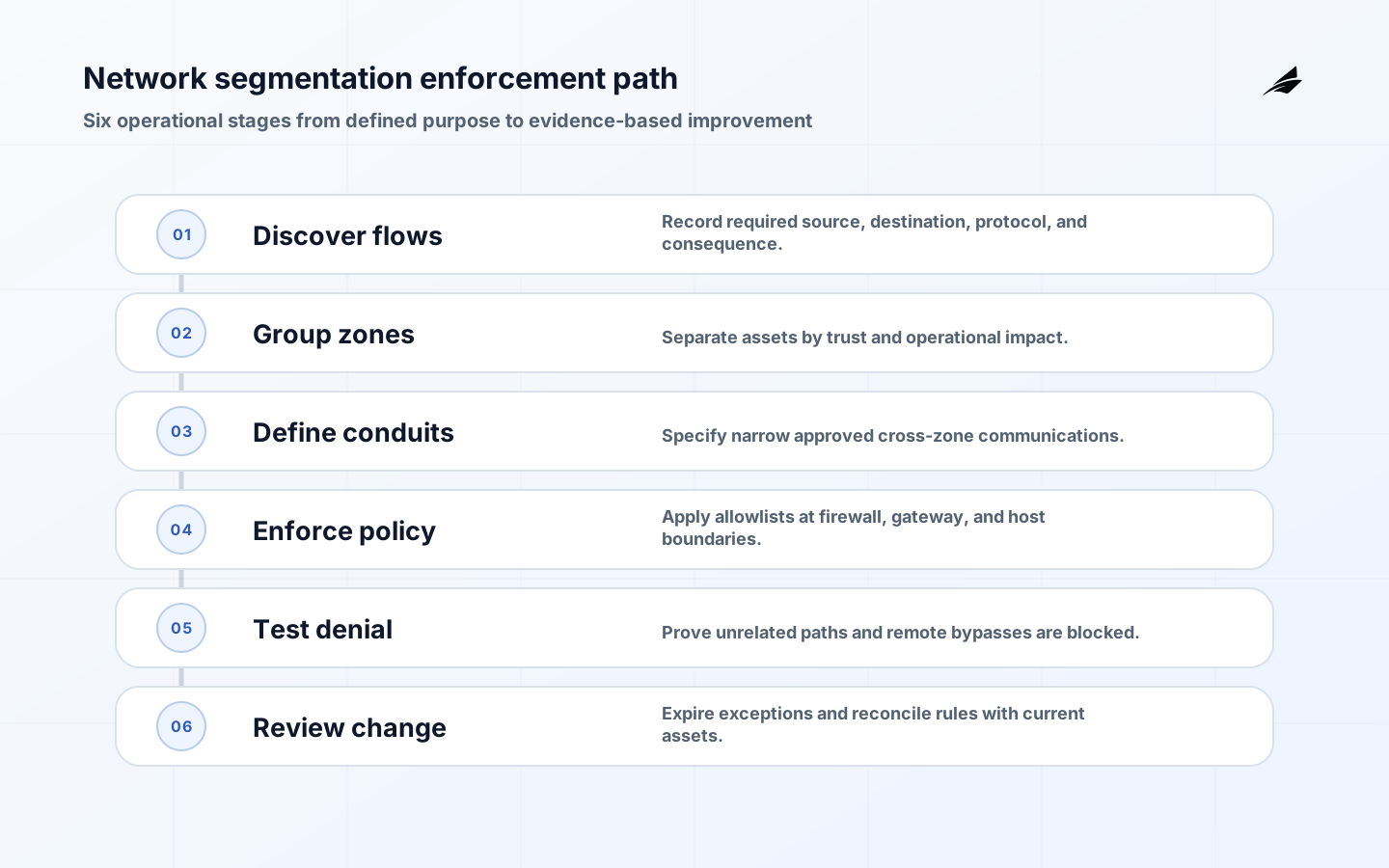
Network segmentation is the practice of deliberately dividing a network into zones and tightly governed connections, so a device, user, or service can reach only what its work requires. In connected systems, the useful question is not whether there is a VLAN. It is whether a compromised engineering laptop, an exposed gateway, or a misconfigured cloud connector can move from a low-consequence path to a safety, production, or customer-data path. A network observability guide helps verify the answer, but it cannot substitute for a boundary that is explicit in routing, policy, identity, and operations. For this cost decision, name the accountable owner, supporting evidence, exception route, and next measurable check.
Start with the consequence, not the switch configuration
Inventory communication flows before naming zones. Record the source and destination asset, protocol and port, direction, frequency, owner, data sensitivity, and what happens when the flow is denied. Include management paths, time synchronization, backup, remote support, certificate enrollment, DNS, and update delivery; those services are often omitted from an initial diagram yet become broad bypasses. In an industrial environment, distinguish a monitoring flow from a control command and identify which delay or interruption could affect production or safety. A zone is useful when it groups assets with comparable trust and consequence, not simply because they are physically nearby. Within this part of the system, name the accountable owner, supporting evidence, exception route, and next measurable check.
Choose a segmentation architecture that can be operated
Most estates combine coarse and fine controls. Routing boundaries, firewalls, and industrial demilitarized zones reduce the blast radius between enterprise and operational networks. Within a zone, host firewalls, workload identity, application authorization, and management-plane restrictions reduce lateral movement that an IP subnet alone cannot prevent. Put remote administration through a controlled jump path with named users, strong authentication, session logging, and time-bounded approval. Avoid a flat trusted engineering network: shared credentials and shared remote-access tools make it difficult to tell legitimate maintenance from an intrusion. When implementing this design choice, name the accountable owner, supporting evidence, exception route, and next measurable check.
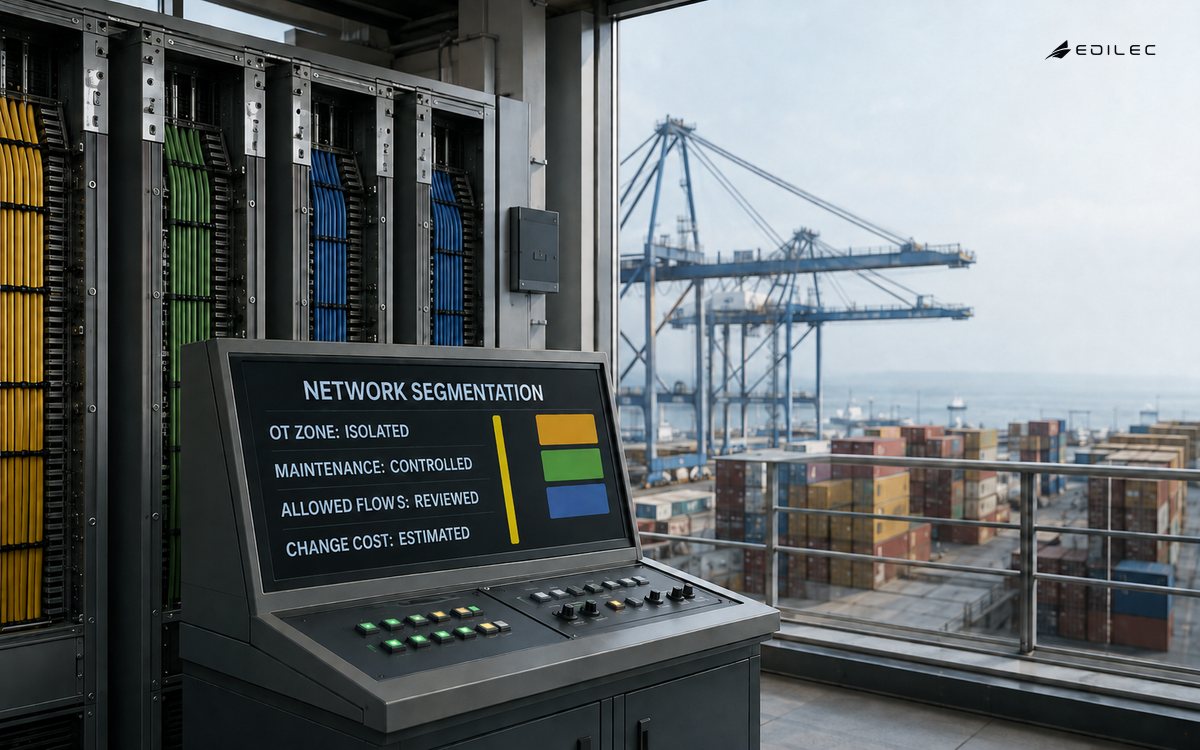
| Boundary | Useful control | Common failure |
|---|---|---|
| Enterprise to OT | Allowlisted proxy or broker in a DMZ | Direct workstation access to controllers |
| Device to gateway | Protocol allowlist and unique device identity | One rule permits an entire subnet |
| Operations to cloud | Outbound service endpoint and certificate validation | Unreviewed remote-access tunnel |
Write policies as communications contracts
Each permitted flow should have a business purpose, an accountable owner, a narrow source and destination, protocol details, and a review date. Prefer a broker, proxy, or gateway where it reduces many device-to-service paths to one inspected path. Rules based only on IP address become fragile when workloads move or devices are replaced; where the platform supports it, combine network location with authenticated workload or user identity. Define an exception format that captures the request, risk, compensating control, approver, expiry, and removal check. This creates a usable queue for operators instead of a collection of unexplained firewall objects. Before releasing this part of the system, name the accountable owner, supporting evidence, exception route, and next measurable check.
Compare the cost drivers before expanding the design
The main cost is usually discovery and operating discipline, not the first firewall. A small plant with stable, well-known flows can start with documented zones and a managed policy gateway. A fleet with frequent device changes need repeatable enrollment, templates, logging, and ownership data, or every installation will create a bespoke exception. Microsegmentation can reduce east-west exposure, but it demands reliable asset identity and support processes. Measure change lead time, denied-flow investigation time, stale-rule count, and the percentage of high-consequence flows with a named owner; those indicators show whether the model is scaling. While operating this cost decision, name the accountable owner, supporting evidence, exception route, and next measurable check.
| Approach | Best fit | Operating commitment |
|---|---|---|
| Zone and conduit | Stable sites and distinct trust areas | Maintain flow inventory and firewall review |
| Identity-aware segmentation | Mobile workloads and shared infrastructure | Integrate identity, policy, and endpoint management |
| Application gateway | Protocol translation or cloud exposure | Operate gateway patches, certificates, and capacity |
Validate normal traffic and failure paths
Test representative allowed flows and deliberately denied flows after every material rule change. Capture evidence that a controller cannot reach an unrelated controller, a vendor account cannot bypass the jump host, and a cloud service cannot initiate an unexpected session into a site. Monitor policy denials, new listening services, unusual cross-zone connections, configuration drift, and remote-access sessions. Tune detections with operations staff so expected maintenance does not drown out meaningful changes. Network evidence is especially valuable when paired with the device state and alert context described in the alert routing architecture guide. When changing this part of the system, name the accountable owner, supporting evidence, exception route, and next measurable check.
Implement in reversible stages
Begin with one high-value boundary, such as enterprise-to-OT access or site-to-cloud telemetry. Observe flows long enough to understand scheduled work and failover behavior, propose a least-privilege allowlist, and test it with a maintenance window and rollback plan. Move to enforcement gradually: alert on violations, correct documentation and dependencies, then block newly unapproved paths. Keep a versioned network diagram, rule export, approvals, and test results together. The result is a control that can be improved site by site rather than a one-time redesign that no operator can safely change. During support for this part of the system, name the accountable owner, supporting evidence, exception route, and next measurable check.
Build acceptance evidence for network segmentation
For network segmentation, trace a maintenance laptop, a gateway, and a cloud service through the proposed boundaries. Confirm that each can reach required dependencies and cannot reach an unrelated controller, management plane, or peer zone. Exercise a denied connection and capture the policy decision, device logs, and recovery steps. Test scheduled maintenance and a failover path as well as the normal production flow. This distinguishes a diagram from a usable control. It also exposes the routinely forgotten services, such as name resolution, time, certificate status, backup, and remote support, before an enforcement change affects an operating site. To validate this evaluation, name the accountable owner, supporting evidence, exception route, and next measurable check.
Control change in network segmentation
Every change to network segmentation needs a bounded request, an accountable owner, a versioned configuration or artifact, and a validation result that can be reviewed later. Classify changes by consequence and decide which require peer review, maintenance coordination, staged deployment, or explicit approval. Keep the prior approved state and an operational reversal or containment route. Temporary exceptions should include reason, compensating control, expiry, and removal evidence. This prevents an urgent workaround from becoming an undocumented operating standard. It also gives support and incident responders a shared reference when the system behaves differently after a release. To govern this control, name the accountable owner, supporting evidence, exception route, and next measurable check.
Assign lifecycle ownership for network segmentation
For delivery teams working on network segmentation, this ownership decision should connect search intent, canonical URLs, rendered content, structured metadata, crawl paths, and measurable search outcomes to evidence an accountable owner can inspect. Name owners for product behavior, operations, security, source data, integrations, and vendor dependencies. The same person need not own every layer, but handoffs must be explicit: who approves access, who watches health, who updates documentation, who handles an expired credential or failed rollout, and who decides retirement. Maintain an inventory that connects the deployed component, its configuration, identity, version, support status, and location or business role. Review this inventory after replacement, change, or incident. Clear lifecycle ownership makes a distributed technical choice supportable after the original project team has moved on. In this operating review, move beyond the ownership decision only after the owner can show the accepted result, the exception path, and the signal for another review.
Learn from network segmentation operations
Use a short recurring review of real cases rather than an abstract maturity score. Look at denied requests, stale data, retries, failures, operator overrides, exceptions, and recovery time. Select one case and compare expected contract with observed behavior: what was known, who acted, what evidence was missing, and which control or instruction should change. Track the correction through implementation and retest it. This feedback loop keeps network segmentation aligned with changing devices, workloads, people, and suppliers while avoiding a cycle of broad redesigns that never reaches the operating teams. For this part of the system, test one expected case, one ambiguous case, and one failure with a documented recovery action.
Measure network segmentation without distorting it
Choose a small set of operational measures for network segmentation that link technical behavior to the stated outcome. Measure completion or availability alongside quality: freshness, reconciliation success, denied access, recovery time, failed change, and unresolved exception can be more informative than raw volume. Define numerator, denominator, time window, exclusions, owner, and source for each measure. Avoid a target that encourages unsafe behavior, such as closing alerts quickly without confirming recovery or maximizing throughput by discarding difficult records. Review trends with the people doing the work and investigate meaningful variation using retained event and configuration evidence. Within this evaluation, test one expected case, one ambiguous case, and one failure with a documented recovery action.
Apply network segmentation to one real operating case
Take one recurring case for Network Segmentation: Cost and Scaling Guide and write the exact path from trigger to completion. Include the human role, device or service identity, message or data contract, policy decision, authoritative record, visibility to the user, and failure fallback. Then run the case with an expected input and a deliberately awkward one: delay, duplicate, loss of connectivity, permission denial, or stale configuration. Record what the system reports, what the operator sees, and what proves the final state. This compact exercise turns broad guidance into a reviewable implementation plan and catches assumptions before they become production incidents. When implementing this part of the system, test one expected case, one ambiguous case, and one failure with a documented recovery action.
Key takeaways
- Define zones by consequence and permitted communications, not building layout.
- Protect remote administration and management services as carefully as production protocols.
- Give every allow rule an owner, purpose, expiry or review date, and tested failure behavior.
- Scale through repeatable discovery, templates, and evidence rather than broader network access.
- Review network segmentation against a real exception each cycle, then document and retest the correction before relying on it at broader scale.
Frequently asked questions
Is a VLAN enough for network segmentation? A VLAN can create a useful routing boundary, but it needs enforced inter-VLAN policy, controlled management access, and monitoring to become a dependable security boundary. Should every device have its own zone? Usually no. Start with asset groups that share consequence and communications, then use host or identity controls where the risk justifies more precision. How often should rules be reviewed? Review after material changes and on a planned cadence; high-consequence or temporary access deserves shorter review intervals. Before releasing this part of the system, test one expected case, one ambiguous case, and one failure with a documented recovery action.
Conclusion
Good network segmentation makes the permitted path easy to explain and the unexpected path hard to use. Map real communications, enforce the smallest practical set of connections, test recovery, and keep ownership current. That is how a segmentation architecture remains protective as connected systems grow. While operating this part of the system, test one expected case, one ambiguous case, and one failure with a documented recovery action.