The meaning of a data pipeline matters to operations teams that need reporting and automation to agree with source systems. In practical terms, it is the managed sequence that extracts or receives data, validates and transforms it, and delivers it to a defined consumer such as an operational system, warehouse, dashboard, or model. That definition is more useful than a product label because it points to decisions a team can test: what the boundary is, what information is trusted, which failure conditions are acceptable, and who responds when the normal path breaks. The related concerns of data contracts, data quality monitoring, ETL and ELT should be designed as part of the operating model, not appended after an initial launch.
What data pipeline meaning means
Data pipelines should be explained in the language of responsibilities and observable behaviour. A pipeline is more than a scheduled script. Its contract includes the source owner, fields, expected timing, schema changes, failure handling, destination semantics, and who is accountable when a result is late or wrong. A useful definition therefore includes the information that crosses the boundary, the actors allowed to change it, the evidence retained, and the conditions in which the system refuses to proceed. That gives practitioners a way to challenge vague requirements before they become fragile implementation assumptions.
Architecture decisions to make first
The architecture is not a diagram of components alone. It is the set of contracts that lets operations teams that need reporting and automation to agree with source systems operate the capability repeatedly. Make the following decisions explicit before choosing a platform feature or writing an integration. Each one affects the likely failure mode, the test plan, and the people who will need evidence later.
| Decision | What to define |
|---|---|
| Business consumer | Name the decision or downstream process that will use the result. |
| Data contract | Specify fields, types, permitted values, freshness, and change notification. |
| Processing mode | Choose batch, micro-batch, streaming, or event-driven processing from the actual latency need. |
| Recovery point | Define how to replay, deduplicate, reconcile, and communicate a failed run. |
Implementation path
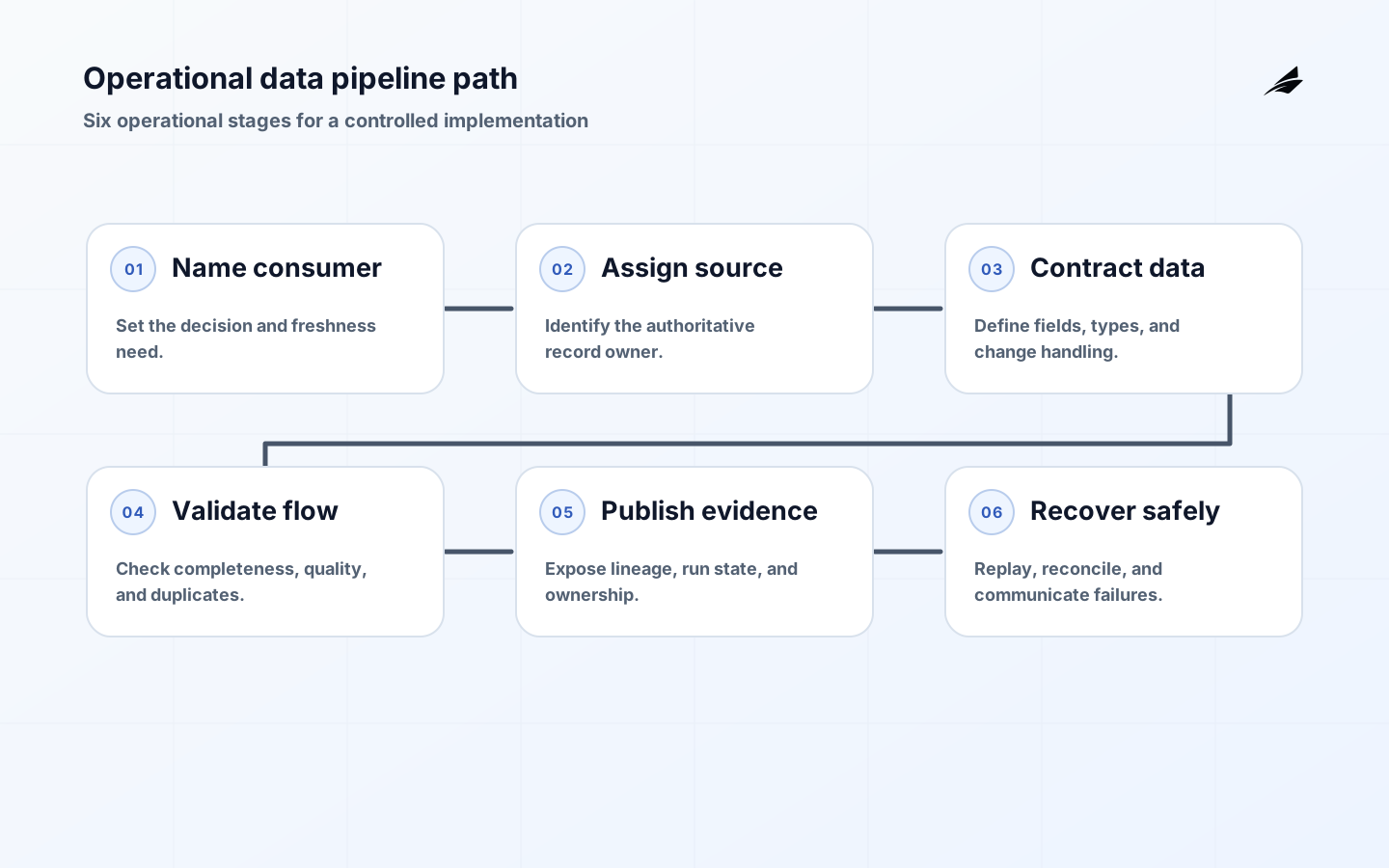
- Start with the decision that needs data and name its acceptable freshness.
- Inventory sources and identify which record is authoritative for each business fact.
- Write a versioned data contract before building transformations.
- Validate completeness, type, range, and referential expectations at boundaries.
- Publish lineage, run state, and owner contact where downstream users can find them.
- Reconcile aggregate outputs against a controlled source before trusting automation.
Build a thin, inspectable path first. It should include the unpleasant cases as well as the demonstration case: a missing identifier, a delayed message, an expired credential, a rejected record, or an unavailable dependency. Give that path named inputs and outputs, a clear retry or escalation rule, and a way to prove what happened. This is where data contracts becomes operational rather than aspirational.
Risks and controls
Reliable pipelines make bad inputs visible rather than quietly manufacturing plausible output. A late source, duplicate event, deleted reference record, or changed unit can all produce a technically successful job and an incorrect decision. Quarantine records that violate a stated contract, preserve their reason, and give an owner a bounded remediation path. Idempotent writes and stable event identifiers are practical protections when retries or replays occur.
| Operating signal | What it shows |
|---|---|
| Freshness SLO attainment | Share of published datasets within the agreed delivery window. |
| Data quality failure rate | Contract violations by source, field, and severity. |
| Reconciliation variance | Difference between controlled source totals and delivered outputs. |
| Mean time to recover | Elapsed time from detected pipeline failure to validated output. |
Review and measurement
Measurement should tell the team whether data pipeline meaning is still meeting its contract, not merely whether infrastructure is running. Review the signals in the table with the owner who can change the workflow. Look at trends, samples of failures, and the gap between detected and resolved issues. When a metric changes, follow the evidence back to the contract, implementation version, and real user or device behaviour before declaring a fix.
- Set a service objective for the consequence that matters, not only a technical average.
- Sample successful and failed cases to verify that data quality monitoring is understandable.
- Make a named owner responsible for triaging exceptions and publishing the resolution.
- Review access, configuration, and retention choices whenever the process or fleet changes.
- Use controlled tests to rehearse recovery before an incident requires improvisation.
Operational scenario
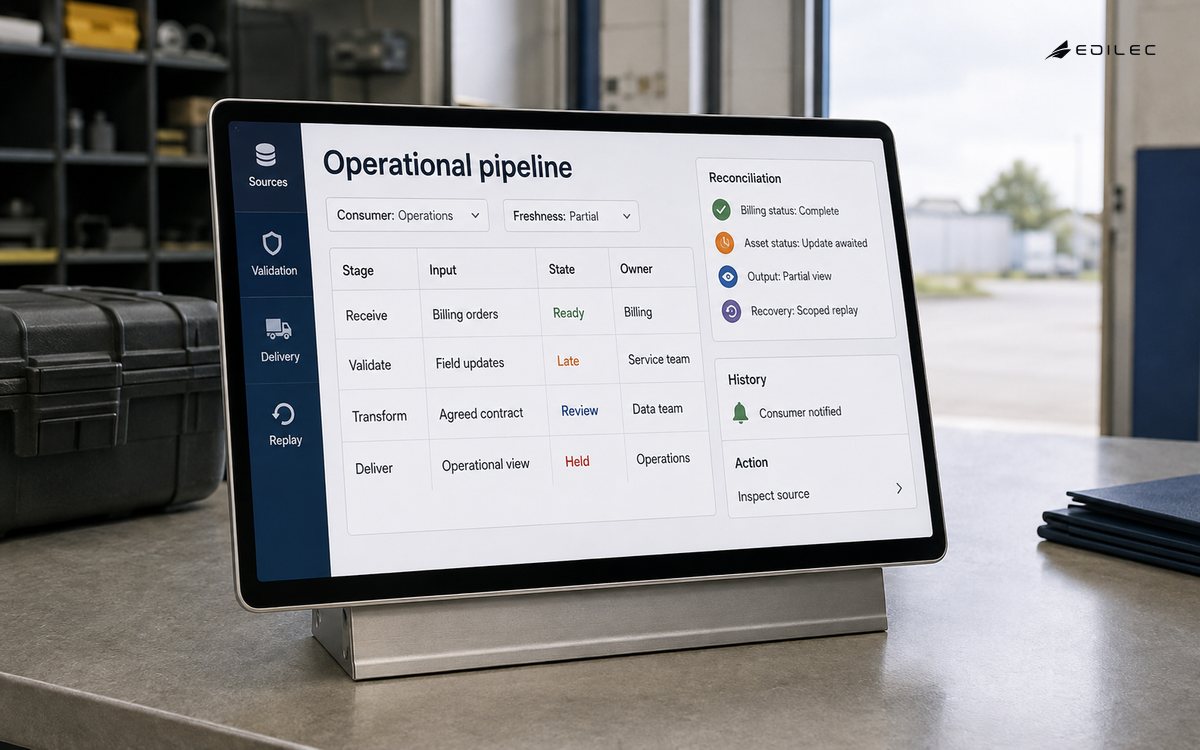
Imagine an operations team combining orders from a billing platform with asset status from a field service system. An order can be complete in billing while a late mobile update makes the asset look unavailable. The pipeline should not silently decide which system is “right” in every context. It should publish a reconciled operational view with a freshness label and an exception queue, while preserving the source records and transformation rule. The business intelligence meaning guide is useful here: a dashboard is only as trustworthy as the definitions and lineage behind its numbers.
Evidence and testing
A practical delivery packet includes the versioned schema, a sample input and output, the freshness objective, the quality rules, runbook, and owner for both source and pipeline. Test backfills with a limited range before replaying a whole history; confirm that replay does not duplicate records or overwrite later corrections. Where a financial or compliance total is involved, establish a periodic reconciliation that names the tolerated variance and its reviewer. These artifacts turn an incident from a hunt through jobs into a testable contract.
Design review questions
During review, challenge every transformation that changes meaning rather than format. A timezone conversion, currency rate, status mapping, or deleted-record rule can be reasonable, but it must be visible to the consumer and reproducible later. Inspect schema-change handling as carefully as current data quality: sources evolve during ordinary business work. A pipeline that fails loudly on incompatible changes is often safer than one that silently converts an unfamiliar field into a null or a default value.
Practical operations
A reliable data pipeline has an explicit owner for each handoff. The source owner publishes expected changes, the pipeline owner maintains validation and recovery, and the consumer owner confirms that a delivered result remains fit for the decision. Establish a lightweight change notice for new fields, removed values, code-list revisions, and changed schedules. Pair it with a sample-data test that runs before production release. This is especially important when operational reporting feeds an automated action: a schema change that quietly converts a status into a default value can be more harmful than a job that stops and asks for review.
Limits and tradeoffs
Pipelines always trade latency, cost, completeness, and complexity. A streaming path is not automatically better when a well-governed hourly batch meets the business need. Conversely, a daily batch is not acceptable for an exception that must be acted on within minutes. State the decision window first, then select the processing mode and service objective. Reserve effort for lineage, reconciliation, and recovery; those capabilities preserve trust when the convenient path fails.
- Name the accountable owner before adding another integration or policy.
- Keep a representative failure test beside the normal acceptance test.
- Record the version of the contract, configuration, or rule in use.
- Use evidence from real operations to improve the next release.
- Make temporary exceptions visible, approved, and time-bounded.
- Review the boundary whenever the business process or fleet changes.
Adoption and change management
Source-system releases, changing business definitions, and growing demand for self-service reporting are the moments when an undocumented pipeline contract is exposed. Prepare for them with a small change record that names the proposed change, contract or policy version, expected operational effect, affected owners, test evidence, rollout window, and reversal decision. Give users and support teams a plain-language explanation of the behaviour that will change, especially where a new denial, warning, or data-quality status can be mistaken for a defect. Monitor the first production cases closely and compare them with the pre-change baseline. When an exception appears, decide whether it is a valid new requirement, a training issue, a data defect, or a control that must remain firm. This practice keeps data pipeline meaning connected to the people who operate it. It also prevents a series of urgent local fixes from becoming an undocumented alternate system. Retire obsolete rules and integrations deliberately, preserve the evidence needed for a later review, and update runbooks so the next team member inherits a working explanation rather than a collection of historical assumptions.
Key takeaways
- A data pipeline is a contract between technical components, people, and operations.
- Define boundaries and ownership before optimising a tool or interface.
- Treat data quality monitoring as a first-class output, with evidence for failure and recovery.
- Make exceptional conditions testable and visible to an accountable owner.
- Revisit the contract as customers, devices, data, or regulations change.
Frequently asked questions
What is the difference between ETL and ELT?
ETL transforms data before it is loaded into a destination; ELT loads first and transforms within the destination. Either may be appropriate. The important design work is documenting the transformation, validating inputs and outputs, and knowing which version of a fact a consumer is reading.
Does a dashboard query count as a data pipeline?
It can be part of one, but a query alone does not create operational reliability. A pipeline needs an explicit consumer, accountable source, transformation rules, freshness expectation, observability, and recovery behaviour.
Conclusion
A useful data pipeline turns a business question into an observable delivery contract. Define the data owner, consumer, freshness, transformations, and recovery process before optimising tools. That produces a system that can explain a surprising number instead of simply returning one.