Document Routing Decisions That Matter Before the First Build
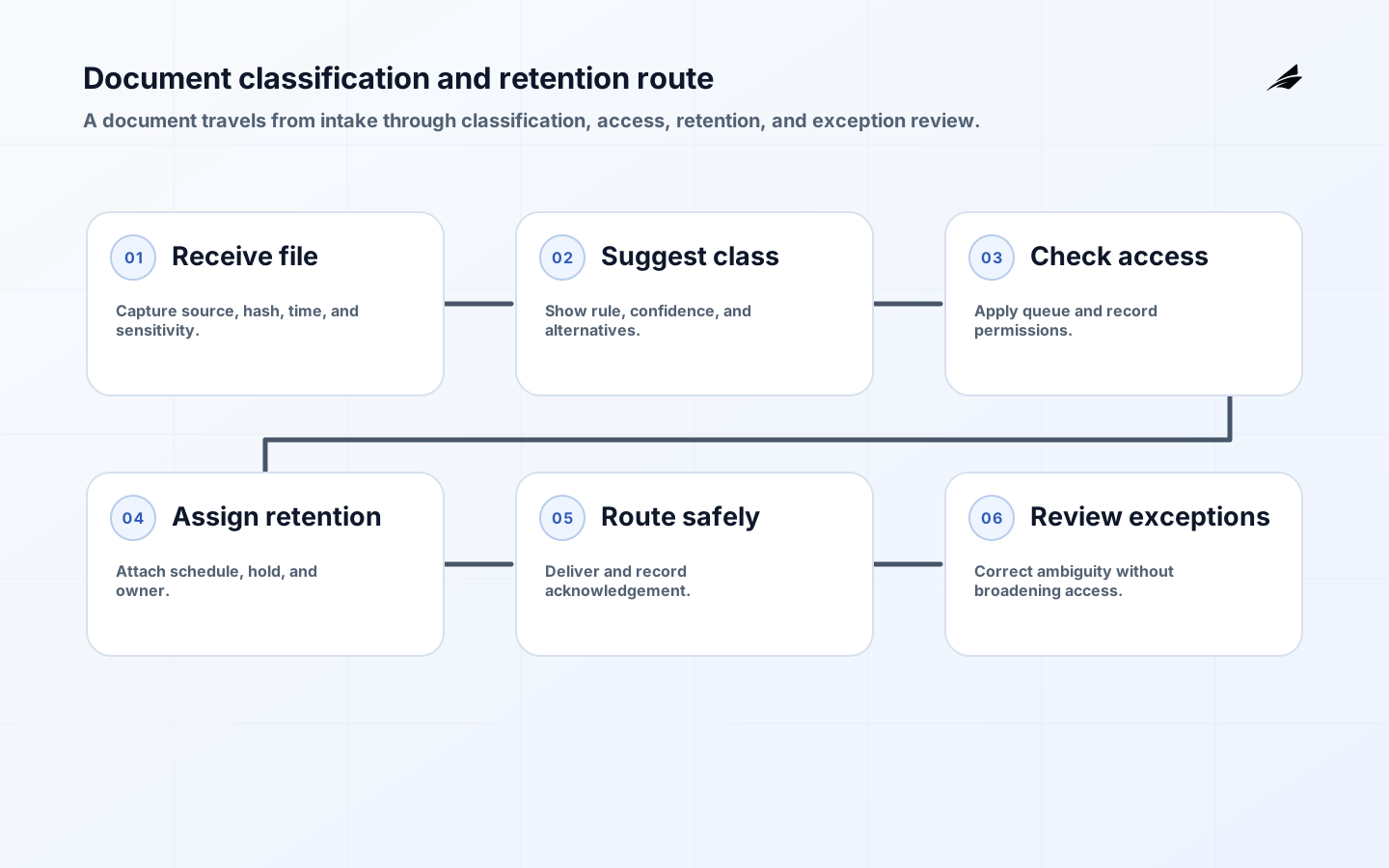
A document routing workflow is dependable when its classification, access, retention, and recovery decisions are visible. Document routing is a decision service disguised as a queue. A file arrives with incomplete context, a classifier suggests a destination, an authorized person may need to correct it, and retention or access obligations may begin before the work is complete. The design question is not simply whether a file reaches a folder. It is whether a reviewer can understand why it was routed, what authority applies, and how to recover a wrong decision. Compare this boundary with the semantic layers guide, the inventory systems guide, and the firmware updates guide.
Set the intake contract

List the document classes the first release accepts, the minimum metadata, the source systems, and the action that follows a route. A “document” is too broad for a useful control; an invoice, incident report, employee record, and engineering drawing have different owners and retention needs. Capture source identity, received time, content hash, declared sensitivity, and the person or system that submitted it.
Make malformed, encrypted, duplicate, and unreadable files explicit states. They should not enter a normal queue wearing a generic “received” label. The NIST Privacy Framework 1.1 is a useful lens for identifying processing context and privacy risk, but local policy determines which classes require a hold or additional review.
Use confidence without hiding uncertainty
A classifier can suggest a class, destination, and confidence, but confidence is not authorization. Define which fields are allowed to drive automatic routing and which outcomes require a human. Set a conservative threshold for high-consequence classes and preserve the model or ruleset version. If the input is ambiguous, show the competing cues and the missing evidence rather than presenting a false single answer.
Create a small labelled set that includes near neighbours, scans with poor quality, multilingual content, and documents with conflicting dates. Measure false routes and missed sensitive classes separately. A low overall error rate can still be unacceptable if it hides a rare record type whose exposure cost is high.
Bind access to the routed record
Routing changes who can see a document, so access must be checked at delivery and retrieval, not only when the queue is created. Map queue membership to roles and business scope; avoid granting broad access because a classifier is uncertain. The Microsoft Graph permissions reference shows why permission names and application scopes need careful review when a service handles files on behalf of people.
Keep a durable audit event for view, move, download, correction, and share actions. Minimize copied content in logs and use a reference to the protected object where possible. When a user loses access, existing queue items should follow the current policy unless a documented legal or operational rule says otherwise.
Assign retention with authority
Retention is not a timer guessed from upload date. It depends on the record class, event that starts the period, legal hold, business owner, and approved disposition. The NARA General Records Schedules provide a useful example of why schedule authority and record category matter. Do not claim that routing alone determines the legal retention period.
Keep the retention decision distinct from a convenience archive. A correction should not erase the history of the original route or remove evidence needed for an investigation. When the schedule is unknown, place the document in a controlled review state with a responsible records owner and an explicit deadline.
Make the exception queue actionable
The exception view should show the document reference, suspected class, confidence or missing field, current access state, deadline, and safe actions. A reviewer should be able to correct the route without downloading sensitive content to a personal workstation. Separate technical failures from policy questions, privacy concerns, and disputed ownership because they require different escalation.
Do not auto-retry a move that could create duplicate records or broaden visibility. Use an idempotent operation key, retain the original source reference, and record the final disposition. A visible “held for review” state is more honest than a completed status that leaves the file in an unknown location.
Integrate queues through stable contracts
The intake source, classifier, document store, case system, and notification service should share a durable document identifier and state vocabulary. Define whether a message means accepted, classified, routed, delivered, or acknowledged. Test delayed notifications, duplicate events, permissions revoked during processing, and a store outage.
Preserve enough lineage to answer who supplied the file, which rule or model ran, which queue accepted it, and who corrected the result. The NIST Privacy Framework 1.0 offers a way to describe data categories and processing context without pretending that a broad label such as “sensitive” is sufficient for every use.
Pilot one class and one destination
Start with a document class whose owner can review both normal and ambiguous cases. Run a shadow comparison against the current route, then have operators inspect representative files with access controls active. Track false routes, time to correction, queue age, duplicate rate, and unauthorized access attempts. Include a deliberately unclear scan and a document with a legal hold signal.
Acceptance requires that the receiving team can find the file, understand its reason for arrival, and return it safely when the class is wrong. The records owner must be able to verify retention assignment, while an administrator can revoke access without interrupting unrelated queues.
Review classification drift
Documents change when forms, suppliers, policies, and business language change. Review new templates, recurring exception reasons, confidence distributions, and access incidents. Re-label a sample after material source changes, and version the rule or model rather than silently adjusting it. A routing dashboard should show the workload and risk of exceptions, not only the number of files processed.
Keep a correction loop from operations to the people who own taxonomies, permissions, and retention schedules. If a queue repeatedly asks reviewers to make the same decision, the problem may be an incomplete class definition or an absent metadata field rather than a need for a faster classifier.
Choose automation with a recovery budget
Compare tools by classification fit, access enforcement, audit depth, retention integration, explainability, and the people needed to recover errors. A managed service may speed delivery while constraining unusual retention or residency rules; a local pipeline may fit better but leave the team with patching and model maintenance.
Record an exit path and a minimum evidence set before selecting a platform. The right system is the one whose failed route can be found, corrected, and explained without giving every operator broad access.
| Decision point | Evidence to retain | Safe default |
|---|---|---|
| Intake | Source, hash, received time, declared sensitivity | Hold malformed or unknown input |
| Classification | Class, rule/model version, confidence, reviewer | Send ambiguity to a restricted queue |
| Delivery | Destination, access check, acknowledgement | Do not broaden visibility on uncertainty |
| Retention | Schedule authority, trigger event, hold status | Escalate unknown schedule to records owner |
Key takeaways
- Define a narrow document class and destination before adding a classifier.
- Treat confidence as a routing signal, never as permission.
- Keep access, retention, and exception ownership visible at the point of action.
- Preserve source, rule, route, and correction evidence without copying sensitive content widely.
- Pilot ambiguous cases and recovery, not just clean scans.
| Signal | Question | Response |
|---|---|---|
| False-route rate | Which classes are confused? | Adjust taxonomy or labelled set |
| Queue age | Who is waiting and why? | Assign owner or change deadline |
| Access denial | Did policy or scope change? | Review role and queue membership |
| Duplicate documents | Is intake replaying an event? | Use source reference and idempotency |
Frequently asked questions
Should every document be routed automatically? No. Automate stable, low-consequence classes and send ambiguity or sensitive categories to a qualified reviewer.
How should a team measure document-routing quality? Separate false routes, missed sensitive classes, queue age, correction time, duplicate intake, and access incidents. A single accuracy percentage can hide material harm.
Who decides document retention? The records or legal authority responsible for the relevant class and schedule. Routing software can apply the decision and preserve evidence, but it should not invent the schedule.
Access and retention should travel with the document reference through every handoff. A queue that is safe in the source system can become unsafe after export, notification, or manual download. Test the entire path with real roles, including a person whose access expires during review. Make the safe alternative visible: hold, return, request a records decision, or escalate to a named privacy owner. The route is complete only when the exception can be closed without an unofficial copy.
Classification quality depends on the material the route receives. Include scans, attachments with multiple subjects, signed forms, duplicate submissions, and documents whose title conflicts with their content. Keep a reference to the original object and the evidence used for the route. When a reviewer changes the class, record whether the problem was taxonomy, missing metadata, source quality, or a genuine edge case. Those distinctions guide improvement more reliably than a single accuracy figure.
A good route also needs a review boundary for policy change. When a new document class, repository, or legal hold rule appears, name the affected queues and decide whether open items keep their old decision or are re-evaluated. Record that choice with the effective time. It prevents a quiet taxonomy update from changing the meaning of work already in flight.
Conclusion
Document routing becomes dependable when classification, access, retention, and correction are visible at the same boundary. Begin with one class and destination, give uncertainty a real owner, and expand only after operators can recover a wrong route without spreading protected content.