A Field Guide to Approval Workflows for Growing Teams
Approval workflows turn a policy into a sequence people can actually follow. They are needed when an organization must decide who may commit money, release a change, grant access, sign an agreement, or make an exception. The goal is not to add clicks. It is to make a decision proportionate to risk, timely enough for the work, and recoverable when information changes. A poor workflow sends everything to the most senior person. A good one makes authority, evidence, delegation, and escalation clear before a request becomes urgent.
Approval workflows: Translate policy into decision rules
Write the policy in operational terms: what is being approved, which factors change the required authority, what evidence is mandatory, when delegation is allowed, and what expires. Separate a decision rule from its presentation. A purchase request might need amount, supplier risk, budget owner, data-access impact, and contract term to determine its path. A form can gather that information, but the rule should remain readable and testable outside the form. This protects the organization when a new channel, system, or exception process is introduced.
| Decision | Rule inputs | Approval evidence |
|---|---|---|
| Spend commitment | Amount, budget, supplier, contract term, risk. | Authorized approver, dated decision, linked request. |
| Production release | Change type, impact, test result, rollback plan. | Release authority and tested exception record. |
| Access grant | Role, system, business purpose, duration. | Manager or data owner approval and expiry. |
| Policy exception | Rule affected, rationale, compensating control, end date. | Risk owner acceptance and review date. |
Approval workflows: Design a short path with explicit exceptions
Keep routine approvals short and reserve extra review for conditions that actually increase risk. An approver needs a concise decision packet, not a long record they must reconstruct. Show the request summary, source evidence, policy rule, impact, previous decisions, and the choices available. Include rejection, request-more-information, delegation, expiry, and emergency escalation as first-class paths. A workflow without these paths encourages side-channel decisions that later appear as unexplained changes in a system of record.
BPMN 2.0 supports clear representations of steps and exception events, while DMN 1.4 is useful for transparent decision tables. NIST SP 800-53 provides control concepts for authorization and audit, and W3C PROV-DM helps express the relation between a request, activity, and decision. These sources reinforce a practical standard: a later reviewer should be able to see why this person had authority for this decision at that time.
| Path | When to use it | Control |
|---|---|---|
| Standard approval | Request falls within normal authority and risk bands. | Decision has a target time and named approver. |
| Delegated approval | Primary approver is unavailable within stated limits. | Delegation is pre-authorized, scoped, and time-limited. |
| Exception approval | Policy condition cannot be met. | Risk owner records rationale and compensating control. |
| Emergency approval | Delay would create greater documented harm. | Immediate authority is logged and later reviewed. |
Approval workflows: Pilot a high-friction but bounded decision
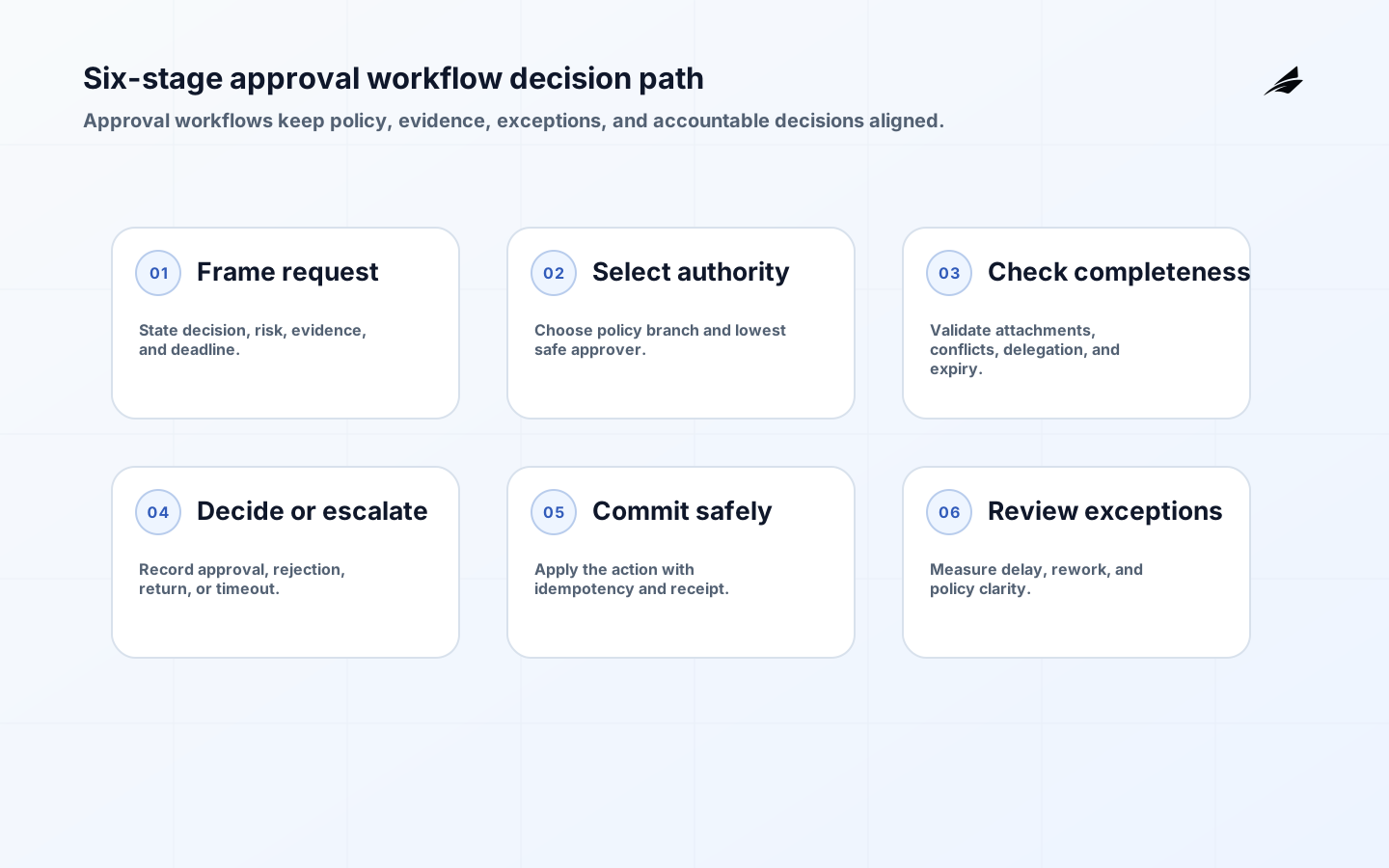
Select a request type that frequently waits or is decided informally, such as vendor onboarding, production change, or temporary privileged access. Map recent examples, including a rejected request and an urgent exception. Build the smallest usable request and decision packet, then test it with approvers under ordinary working conditions. Measure how often information must be chased, how long decisions wait, and whether people bypass the workflow. The first release should remove ambiguity, not automate a poorly understood policy.
- Assign an owner for the policy and a separate maintainer for the workflow configuration.
- Use decision tables for repeatable authority rules and publish examples for ambiguous cases.
- Set delegation limits before an approver is absent, rather than improvising during a deadline.
- Record emergency approvals for later review even when rapid action is justified.
Approval workflows: Prevent rubber stamps and approval dead ends
Approval fatigue appears when every request has the same long chain regardless of risk. People then approve without reading, work moves to private messages, and records become ceremonial. The opposite problem is a dead end: a request waits because an approver has left, the budget is unclear, or the rule has no outcome for incomplete information. Use escalation timers, alternate authority, and explicit return-to-requester paths. Review approval patterns to find policies that are too vague or controls that are asking the wrong person to decide.
Approval workflows: Review speed, quality, and exceptions together
Track decision time by path, rework caused by missing evidence, expired requests, delegation use, emergency approvals, and exception recurrence. Review a sample of approvals near a material threshold because those are especially vulnerable to accidental or deliberate splitting. Ask whether the approver had enough context and whether the outcome matched the policy intent. Use findings to simplify rules, clarify evidence, or adjust authority limits. A faster workflow is only better when it still produces a decision the organization can explain.
Approval workflows: Version policy and workflow together
As the organization adds entities, teams, and systems, version the authority rules with effective dates. Do not overwrite a decision table and lose the basis for past approvals. Communicate a change in plain language, migrate in-flight requests carefully, and test the new rule against historical edge cases. Integrate approval outcomes with downstream systems through stable identifiers so a posting, access grant, or release can be traced to its authorization without exposing more request detail than the consumer needs.
Approval workflows key takeaways
Maintain an approval register for policies and decision tables, including their effective date, accountable owner, and examples of borderline cases; for policy changes. At review time, compare approved requests with the policy intent and look for patterns such as repeated exceptions, split purchases, or approvals returned for missing evidence; for policy changes. The answer may be a simpler rule, better requester guidance, or a different authority limit; for policy changes. This evidence-based review prevents the workflow from becoming an unexamined bottleneck and keeps authority aligned with actual business risk; for policy changes. Maintain an approval register for policies and decision tables, including their effective date, accountable owner, and examples of borderline cases; for decision tables. At review time, compare approved requests with the policy intent and look for patterns such as repeated exceptions, split purchases, or approvals returned for missing evidence; for decision tables. The answer may be a simpler rule, better requester guidance, or a different authority limit; for decision tables. This evidence-based review prevents the workflow from becoming an unexamined bottleneck and keeps authority aligned with actual business risk; for decision tables.
For approval workflows, make the next review concrete: select a recent exception, trace the record from its first source through every handoff, compare the stated rule with the action taken, and record the owner of the correction. Include timing, access, communication, and reconciliation rather than treating the technical result alone as success, for the approval request. This compact evidence exercise reveals where the workflow is unclear and gives the team a measured basis for its next improvement, at the authority gate.
For approval workflows, ask approvers whether the request packet supplied the exact evidence they needed, then remove fields that did not influence the decision and clarify those that did. This keeps control focused on real judgment.
- Approval workflows should make authority and evidence proportionate to the decision risk.
- Design delegation, expiry, rejection, and emergency paths deliberately rather than treating them as exceptions to documentation.
- Version decision rules so past approvals remain understandable after policy changes.
- Related reading: ticketing workflows, finance systems, and ERP integration.
Approval workflows FAQ
How many approval levels are enough?
Use the fewest levels that provide the required authority and independent review. More layers do not automatically reduce risk; they can obscure who is accountable and slow time-sensitive work. Base routing on material factors such as amount, data sensitivity, legal obligation, or service impact. Test the rule on real cases and remove levels that rarely change a decision.
Can approval happen in chat or email?
Conversation can help an approver understand a request, but the decision record should capture the authorized actor, evidence, time, scope, and outcome in the controlled workflow. A link or attachment can preserve relevant discussion without making a chat transcript the only source of authority. This is especially important when downstream systems act automatically on the approval.
Conclusion: make authority usable
An approval workflow is successful when it lets ordinary work move at a sensible pace while making consequential choices answerable later. Start with one recurring decision, expose the real exceptions, and give approvers the evidence needed to exercise judgment. The result is not bureaucracy for its own sake; it is a durable way to make commitments with the right people involved.
For approval workflows, define the request type, accountable approver, delegation limit, evidence required, timeout, and safe fallback before adding another level. Preserve the policy version and decision receipt so a challenged approval can be explained to the requester, reviewer, and process owner before release carefully.
For approval workflows, simulate incomplete evidence, conflicting approvers, delegation expiry, timeout, rejection, resubmission, and an urgent request. Check that the process preserves the reason and policy branch, prevents silent escalation, and gives the requester a clear, accountable next step before teams depend on the workflow for consequential work in production daily.
| Decision area | Question to answer | Evidence or response |
|---|---|---|
| Define scope | What must be true before release? | Named owner and boundary record |
| Validate evidence | Is the input current and authoritative? | Source, version, and test result |
| Apply control | What action is allowed? | Policy decision and durable receipt |
| Review state | What happens when assumptions change? | Status, exception route, and owner |
Review approval workflows under change
The release is not complete when approval workflows works once. Exercise a routine request, threshold breach, missing attachment, delegated approver, conflict of interest, timeout, and changed facts after approval. For each case, name the authoritative source, accountable owner, decision window, safe degraded state, and evidence that must survive correction, at the authority gate. Decide in advance whether the result is held, marked provisional, quarantined, retried, reversed, or escalated to a person, during exception review; for policy changes. Keep a durable receipt with the input version, policy or rule version, actor, timestamp, correlation identifier, outcome, and reason for any exception, for the approval request. This makes a later investigation answerable without relying on memory or a screenshot, at the authority gate. Review both false alarms and missed failures: a noisy control teaches operators to ignore important signals, while a silent failure creates unrecorded business risk, during exception review; for policy changes. Measure the signals that matter to the decision, such as freshness, exception age, manual bypasses, correction time, duplicate effects, failed dependencies, and the percentage of cases that reach a named owner before the deadline, for the approval request. Do not treat activity as success; a report viewed, workflow completed, or gateway connected can still be operationally weak if users export data, work around the control, or cannot recover safely, at the authority gate. For approval workflows, compare the first related canonical guide, the second related canonical guide, and the third related canonical guide as adjacent context. Expand scope only after the first path has a stable ownership model, a tested exception route, and evidence that users make a better or safer decision because the service exists, during exception review; for policy changes. The next iteration should remove one repeated ambiguity, reduce one costly manual handoff, and make one failure condition easier to see, for the approval request. That is the practical standard for a professional operating release: bounded authority, inspectable evidence, visible uncertainty, and a recovery path that remains usable after the original builder has moved on, at the authority gate.

Keep the exception visible beside the ordinary result, and make the next safe action easy for the accountable operator to find, for the approval request. Make approval states legible: submitted, waiting for evidence, awaiting authority, approved, rejected, expired, or superseded. Each state needs one next action and one owner. Run the workflow with real examples before launch, including awkward cases policy writers tend to omit. The result should reduce uncertainty at the moment a decision matters.