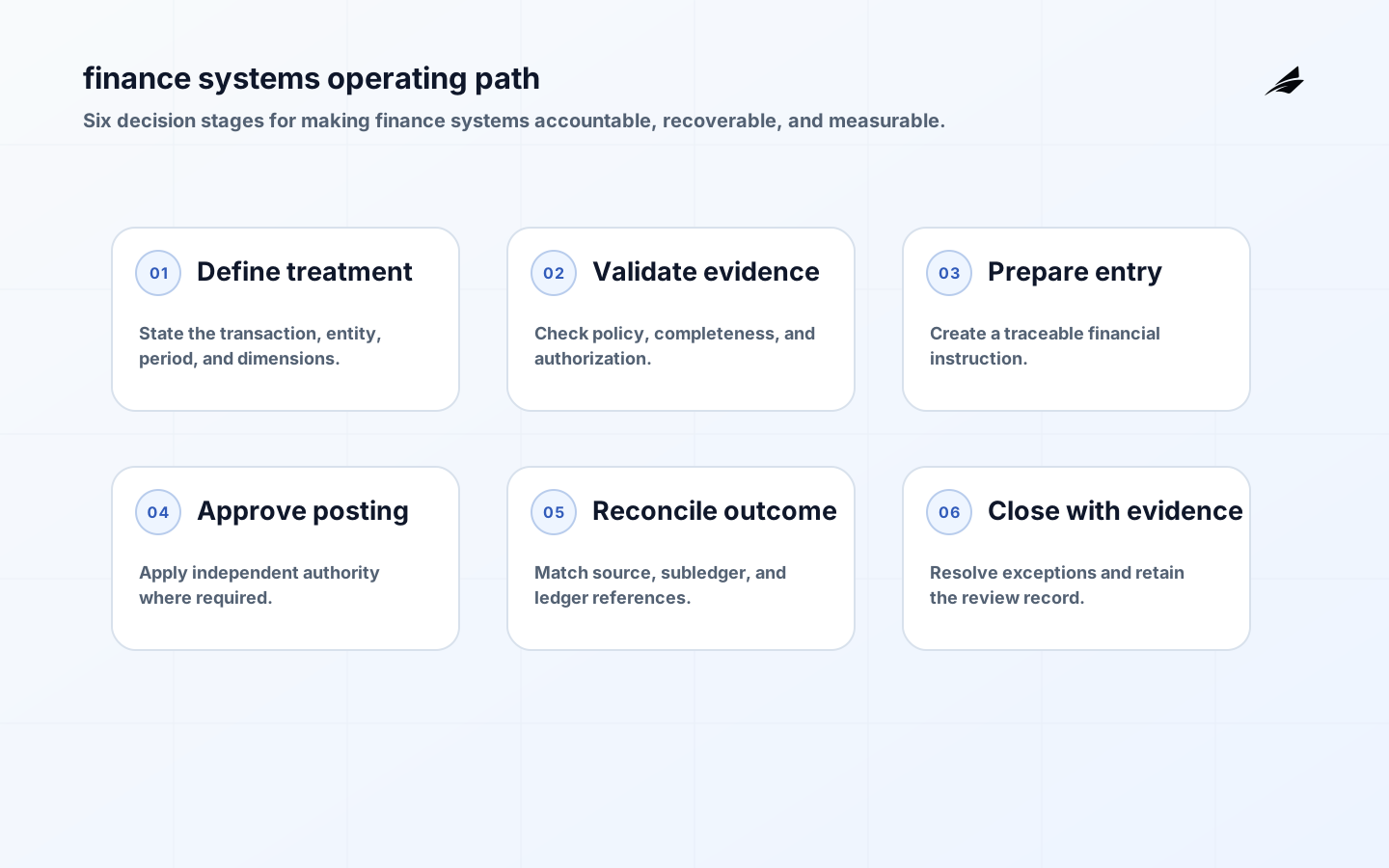
Finance systems deserve a different standard of precision because they convert operational activity into accountable financial records. Before building an integration or workflow, teams need agreement on accounting period, entity, chart-of-accounts treatment, approval authority, and the evidence needed for a reconciliation. A technically successful posting that lands in the wrong period or legal entity is still a business failure.
Set the decision boundary for finance systems
Pick one controlled financial process such as expense reimbursement, vendor invoice approval, cash application, or revenue posting. Define the source transaction, required accounting dimensions, date rules, approval, and when the entry is eligible to post. Clarify which changes are corrections to a prior period and which are current-period adjustments. This framing keeps accounting policy visible in the design.
| Design concern | Decision to make | Evidence to retain |
|---|---|---|
| Source transaction | Invoice, expense, payment, or revenue event | Stable ID, evidence, and effective date |
| Accounting treatment | Entity, account, dimensions, currency, and period | Validated mapping and policy rule |
| Authorization | Preparer, approver, and posting role | Separation-of-duties evidence |
| Financial outcome | Posted, held, reversed, or adjusted | Ledger reference and reconciliation status |
Keep records that explain the outcome
Each material record needs transaction and source IDs, amount and currency, legal entity, accounting date, account and dimensions, preparer and approver, posting reference, and links to reversal or adjustment entries. Keep the original evidence and a reason for exceptions. These fields allow a controller to trace from a reported balance to the business event without treating the general ledger as an unexplained black box.
Design finance systems as an accountable flow
Separate operational capture, validation, subledger or workflow processing, general-ledger posting, and reporting. Use interfaces that return an explicit accepted, rejected, or held outcome. Support reversal and compensation as business processes rather than database edits. Reconciliation jobs should compare counts and values across the boundary while preserving the individual references needed to investigate a difference.

| Operating stage | Control to design | Signal to review |
|---|---|---|
| Validation | Accounting combination and period checks | Rejected and held transaction value |
| Posting | Idempotent submission and explicit response | Duplicate suppression and posting latency |
| Reconciliation | Count and value comparison by reference | Unmatched balance and aged difference |
| Close review | Exception, access, and recovery evidence | Manual journal and overdue task trend |
Put authority and evidence into the controls
Implement segregation of duties in both the application and its integration accounts. The person who prepares a payment batch should not silently approve it through an automation they also configured. Protect financial data, restrict elevated capabilities, retain audit logs, and rehearse recovery for an interrupted close. NIST control, logging, and contingency guidance provide a useful baseline for these operational safeguards.
For finance systems, NIST's Cybersecurity Framework is helpful for identifying financial-process dependencies and protecting privileged posting paths. SP 800-53, SP 800-34, and SP 800-92 reinforce controlled access, close recovery, and records that support a financial review.
Release with exceptions in view
Start with a period and entity that allow disciplined parallel reconciliation. Test a duplicate import, an invalid accounting combination, a closed-period attempt, a reversal, and a reporting refresh during a partial outage. Obtain finance sign-off on the reconciliation method before the first live posting. It is much easier to tune a mapping before volume obscures the cause of differences.
Measure operating reliability, not activity alone
Track posting rejects, suspense or held entries, reconciliation differences, manual journal volume, approval turnaround, close-task completion, and time to resolve an exception. Measure value as well as count. A small number of high-value unreconciled items may matter more than hundreds of harmless format rejects.
Pre-build decision register
- For finance systems, confirm accounting date and reporting period selection; write the rule, named owner, effective time, audit evidence, failure signal, and recovery action into the build decision record before release.
- For finance systems, test accounting date and reporting period selection with normal, delayed, corrected, and failed inputs; retain the result so the operating team can explain and safely repeat the decision.
- For finance systems, confirm legal-entity and currency validation; write the rule, named owner, effective time, audit evidence, failure signal, and recovery action into the build decision record before release.
- For finance systems, test legal-entity and currency validation with normal, delayed, corrected, and failed inputs; retain the result so the operating team can explain and safely repeat the decision.
- For finance systems, confirm chart-of-accounts and dimension mappings; write the rule, named owner, effective time, audit evidence, failure signal, and recovery action into the build decision record before release.
- For finance systems, test chart-of-accounts and dimension mappings with normal, delayed, corrected, and failed inputs; retain the result so the operating team can explain and safely repeat the decision.
- For finance systems, confirm source evidence required for a posting; write the rule, named owner, effective time, audit evidence, failure signal, and recovery action into the build decision record before release.
- For finance systems, test source evidence required for a posting with normal, delayed, corrected, and failed inputs; retain the result so the operating team can explain and safely repeat the decision.
- For finance systems, confirm separation between preparation and approval; write the rule, named owner, effective time, audit evidence, failure signal, and recovery action into the build decision record before release.
- For finance systems, test separation between preparation and approval with normal, delayed, corrected, and failed inputs; retain the result so the operating team can explain and safely repeat the decision.
- For finance systems, confirm accepted, held, and rejected posting outcomes; write the rule, named owner, effective time, audit evidence, failure signal, and recovery action into the build decision record before release.
- For finance systems, test accepted, held, and rejected posting outcomes with normal, delayed, corrected, and failed inputs; retain the result so the operating team can explain and safely repeat the decision.
- For finance systems, confirm reversal and adjustment policy for corrections; write the rule, named owner, effective time, audit evidence, failure signal, and recovery action into the build decision record before release.
- For finance systems, test reversal and adjustment policy for corrections with normal, delayed, corrected, and failed inputs; retain the result so the operating team can explain and safely repeat the decision.
- For finance systems, confirm idempotency keys for submitted entries; write the rule, named owner, effective time, audit evidence, failure signal, and recovery action into the build decision record before release.
- For finance systems, test idempotency keys for submitted entries with normal, delayed, corrected, and failed inputs; retain the result so the operating team can explain and safely repeat the decision.
- For finance systems, confirm access to financial exports and replay tools; write the rule, named owner, effective time, audit evidence, failure signal, and recovery action into the build decision record before release.
- For finance systems, test access to financial exports and replay tools with normal, delayed, corrected, and failed inputs; retain the result so the operating team can explain and safely repeat the decision.
- For finance systems, confirm value-based reconciliation across system boundaries; write the rule, named owner, effective time, audit evidence, failure signal, and recovery action into the build decision record before release.
- For finance systems, test value-based reconciliation across system boundaries with normal, delayed, corrected, and failed inputs; retain the result so the operating team can explain and safely repeat the decision.
- For finance systems, confirm close-task ownership and completion evidence; write the rule, named owner, effective time, audit evidence, failure signal, and recovery action into the build decision record before release.
- For finance systems, test close-task ownership and completion evidence with normal, delayed, corrected, and failed inputs; retain the result so the operating team can explain and safely repeat the decision.
- For finance systems, confirm recovery procedure for interrupted period close; write the rule, named owner, effective time, audit evidence, failure signal, and recovery action into the build decision record before release.
- For finance systems, test recovery procedure for interrupted period close with normal, delayed, corrected, and failed inputs; retain the result so the operating team can explain and safely repeat the decision.
Key takeaways for finance systems
- Expose accounting period, entity, dimensions, and approval in the business contract.
- Use reversals and adjustments to correct financial history without erasing it.
- Separate preparation, approval, posting, and reconciliation duties.
- Require finance-owned reconciliation evidence before increasing live volume.
Frequently asked questions
Why is a reversal preferable to editing a posted record?
A reversal preserves the history and reason for the correction, enabling review and reconciliation of both the original and correcting entries.
What should an integration return after a posting attempt?
An explicit outcome with a financial reference or a reason the transaction was rejected or held.
How should a closed-period error be handled?
Follow the organization’s accounting policy, with an attributable correction or adjustment rather than an unauthorized historical rewrite.
Conclusion
A dependable finance systems implementation is a system of explicit choices: what is authoritative, who can decide, which state is real, how an exception is recovered, and how the team verifies the result. Build the smallest flow that proves those choices with real evidence, then extend it deliberately. Related reading: finance systems in production, billing operations, procurement software.