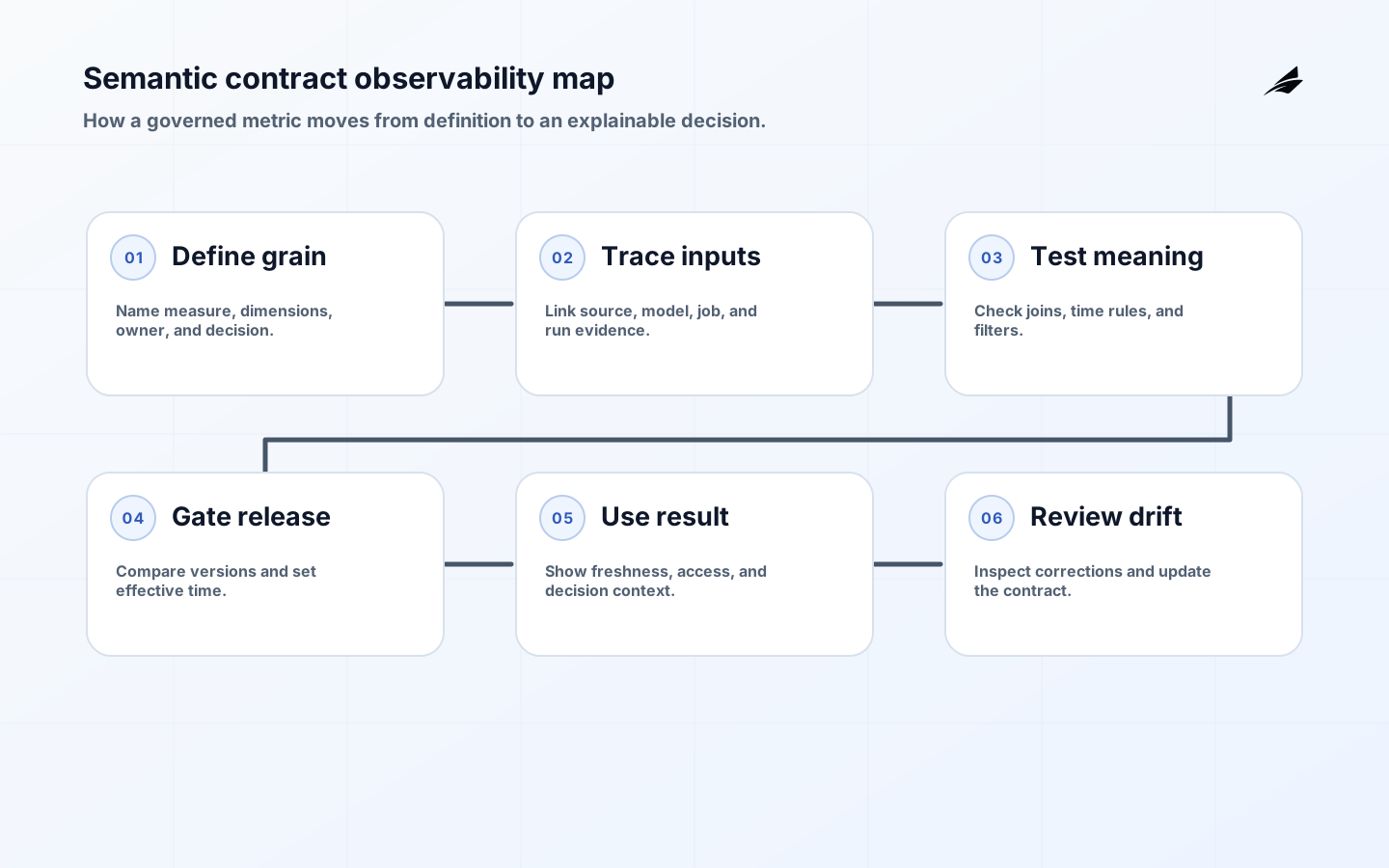
What Changes When Semantic Layers Move into Production
A semantic layer becomes valuable when a team can answer a concrete question consistently: what does this measure mean, which rows belong to it, and which change would make yesterday's answer incomparable with today's? In production, the layer is less a catalog than a control surface for shared decisions. This guide follows a planning metric from definition to review, with attention to grain, lineage, access, freshness, and change management. For adjacent operating patterns, see the decision boundary in the document routing guide, the inventory systems field guide, and the connected operations playbook.
Define the decision before the metric

Start with the decision a metric is meant to support, not with the field list. A planning lead may need committed revenue by customer and contract date; a support manager may need unresolved cases by service tier. State the consumer, decision window, acceptable delay, and action that follows. The same numeric value can be fit for a trend and unfit for an approval if its freshness or grain is unclear. A short decision statement prevents the semantic layer from becoming a warehouse glossary with no operating owner.
Write the smallest contract that makes disagreement visible: measure, dimensions, grain, time zone, filters, null treatment, and owner. Include an example that is deliberately awkward, such as a late-arriving event or a customer whose contract changes mid-period. That example is more useful than a page of abstract naming rules because it exposes the boundary a production query must honor.
Make grain and time semantics testable
Grain is the first place a shared metric quietly fails. “Orders” might mean order headers, order lines, shipments, or successful payments. Name the row represented by each model and declare which joins preserve that grain. Then separate event time, effective business time, and processing time. A dashboard that silently mixes them can appear stable while answering a different question after a backfill. The contract should say which timestamp drives inclusion and how a correction changes the visible history.
Metric definitions should carry their filters and dimensional relationships close to the implementation. The MetricFlow documentation is useful here because it treats metric modeling as more than a label: the relationship between metrics, semantic models, dimensions, and time must be resolvable. Test one-to-many joins with a fixture that would inflate a naive sum. A failed test should block release or prominently mark the result as provisional.
Trace provenance across the path
A production answer needs a route back to its inputs. Capture the source relation, transformation version, job or query run, execution time, and materialization that produced the result. Provenance is not the same as a dashboard link; it lets a reviewer distinguish a source correction, a model change, and a consumer filter. The W3C PROV overview provides a useful vocabulary for describing entities, activities, and agents without pretending that lineage alone proves data quality.
Use an event or run identifier that survives retries and can be joined to release records. The OpenLineage object model gives a practical way to think about dataset, job, and run relationships. Store enough context to reproduce the calculation without retaining sensitive row-level data everywhere. When provenance is incomplete, the result should carry an explicit limitation rather than a confident label.
Govern access to meaning and data
A semantic layer can simplify access while still exposing sensitive dimensions. Separate permission to discover a metric from permission to query its underlying attributes. A finance analyst may see a regional total while a restricted role cannot slice it by individual customer. Apply authorization where the query is executed, and test combinations of filters that could reconstruct a protected value. Record the policy version with the query result when access changes the interpretation.
Keep business definitions readable without making raw evidence broadly visible. Review who can create, approve, publish, and retire a definition; those roles should not collapse into one powerful service account. A failed permission check belongs in the operational history, with enough context for an administrator to correct the policy without asking the analyst to resend sensitive data.
Design freshness and correction policy
The freshness rule is a decision promise, not a decorative badge. Define when a value is expected, the tolerated delay, the safe display state, and the person who owns recovery. A delayed source may justify showing the last accepted snapshot for a trend but not authorizing a cash commitment. Correction policy matters just as much: specify whether a late event restates history, creates an adjustment, or waits for a controlled close.
Run a reconciliation that compares the semantic result with an independent total at a meaningful boundary. Alert on unexplained divergence, but route the alert to someone able to investigate the source, model, or consumer. Treat a backfill as a change with a review note. The note should identify affected periods, decision owners, and any reports that must be reissued.
Make release and rollback legible
A metric change needs a release gate when it can alter a forecast, target, customer communication, or regulated report. Compare the old and new definition on representative periods, document expected differences, and make the effective time clear. Keep a compatibility view when consumers cannot move together. A rollback is not simply restoring code; it may require restoring the previous definition, refreshing dependent tables, and telling decision owners which answer is authoritative.
Separate a semantic change from a plumbing change in the release record. An index improvement can preserve meaning, while a new denominator changes it even if the query still succeeds. Use a named approver for material definition changes and retain the test evidence that supported approval. This creates a reviewable boundary between ordinary maintenance and a change in organizational meaning.
Pilot one consequential metric family
Choose one metric family with a real decision owner and a bounded consumer set. Run it beside the existing report long enough to compare definitions, not merely totals. Ask users to explain why the number changed and what action they would take; a technically correct result that cannot be interpreted is not ready. Include late data, a permission boundary, a failed job, and a definition revision in the pilot acceptance set.
Measure disagreement rate, time to explain a variance, freshness breaches, correction effort, and the number of decisions that waited for manual evidence. Avoid treating query volume or dashboard count as proof of value. Expand only when the owner can show the metric contract, lineage, test result, and exception route to a new reviewer without relying on private context.
Operate definitions as living controls
Assign a review cadence to definitions that matter, with an earlier trigger for source-system or policy changes. Sample successful and corrected results, inspect lineage after major pipeline changes, and remove unused dimensions that invite accidental interpretation. Keep the change history beside the definition rather than in a separate project document. The dbt Semantic Layer documentation can inform the platform shape, but local owners still decide what evidence is required for a decision.
When a metric dispute reaches support, treat it as a product signal. Record whether the problem came from ambiguous language, an incorrect join, stale data, access policy, or an unannounced change. The corrective action may be a test, a definition edit, a permission adjustment, or training. Closing the ticket without changing the relevant control invites the same disagreement to return.
Choose a platform boundary deliberately
Buy or build decisions should follow the contract. A managed semantic capability may reduce maintenance for common metric patterns, while a local model may better fit unusual temporal rules or strict data residency. Compare query behavior, versioning, access controls, lineage depth, testing hooks, recovery ownership, and exit options. Do not let a product demo decide whether the organization can explain a disputed number.
Write the decision record with assumptions and a review date. Include which definitions remain portable, how consumers are migrated, and how the team will prove that a vendor or platform change did not alter meaning. A small, well-owned boundary is more durable than a wide rollout whose terms no one can state.
| Field | Decision to record | Failure it prevents |
|---|---|---|
| Measure and grain | What one row represents and how the measure aggregates | Inflated totals from an unsafe join |
| Time rule | Event, effective, or processing time and timezone | Reports answering different periods |
| Freshness state | Expected arrival, tolerance, and safe display | Confident use of stale evidence |
| Change authority | Approver, effective date, and rollback owner | Unannounced meaning changes |
Key takeaways
- Tie every shared metric to a named decision and accountable owner.
- Declare grain and time semantics before optimizing query shape.
- Carry lineage, tests, freshness, access, and change evidence into the release record.
- Pilot with an awkward case, not only a clean dashboard example.
- Expand when a new reviewer can explain the number and recover its path.
| Signal | Inspect | Action when it moves |
|---|---|---|
| Definition drift | Filters, joins, and denominator against the contract | Open a semantic change review |
| Lineage coverage | Source, run, model, and release references | Hold publication until provenance is repaired |
| Correction effort | Manual restatements and explanation time | Improve the rule or recovery path |
| Access exceptions | Denied queries and unusual slice requests | Review policy and least privilege |
Frequently asked questions
When should a team introduce a semantic layer? Introduce one when several consumers need the same business meaning and disagreements are slowing decisions. Begin with a bounded metric family and an owner rather than modelling the entire warehouse.
Can a semantic layer replace data quality checks? No. It can centralize meaning and make some tests easier to apply, but freshness, reconciliation, source quality, and access controls still need explicit checks.
What should happen when a metric definition changes? Record the old and new definitions, compare representative periods, set an effective time, notify affected owners, and retain a rollback or compatibility path where decisions require continuity.
Conclusion
A semantic layer is ready for production when a decision owner can define the measure, inspect its lineage, understand its freshness, and challenge a change without private context. Begin with one metric family, make the awkward case visible, and let observed evidence decide whether the boundary should grow.