A Field Guide to Document Routing for Growing Teams
For a CTO, document routing is an integration boundary with a privacy and records consequence. The hard part is not moving bytes; it is preserving identity, classification, access, retention, and correction meaning as a document crosses storage, workflow, and notification services. This article treats the route as a contract that engineering can test and operations can recover. See the document routing decisions guide, the plain-language routing guide, and the semantic layers guide for adjacent perspectives.
Set the boundary

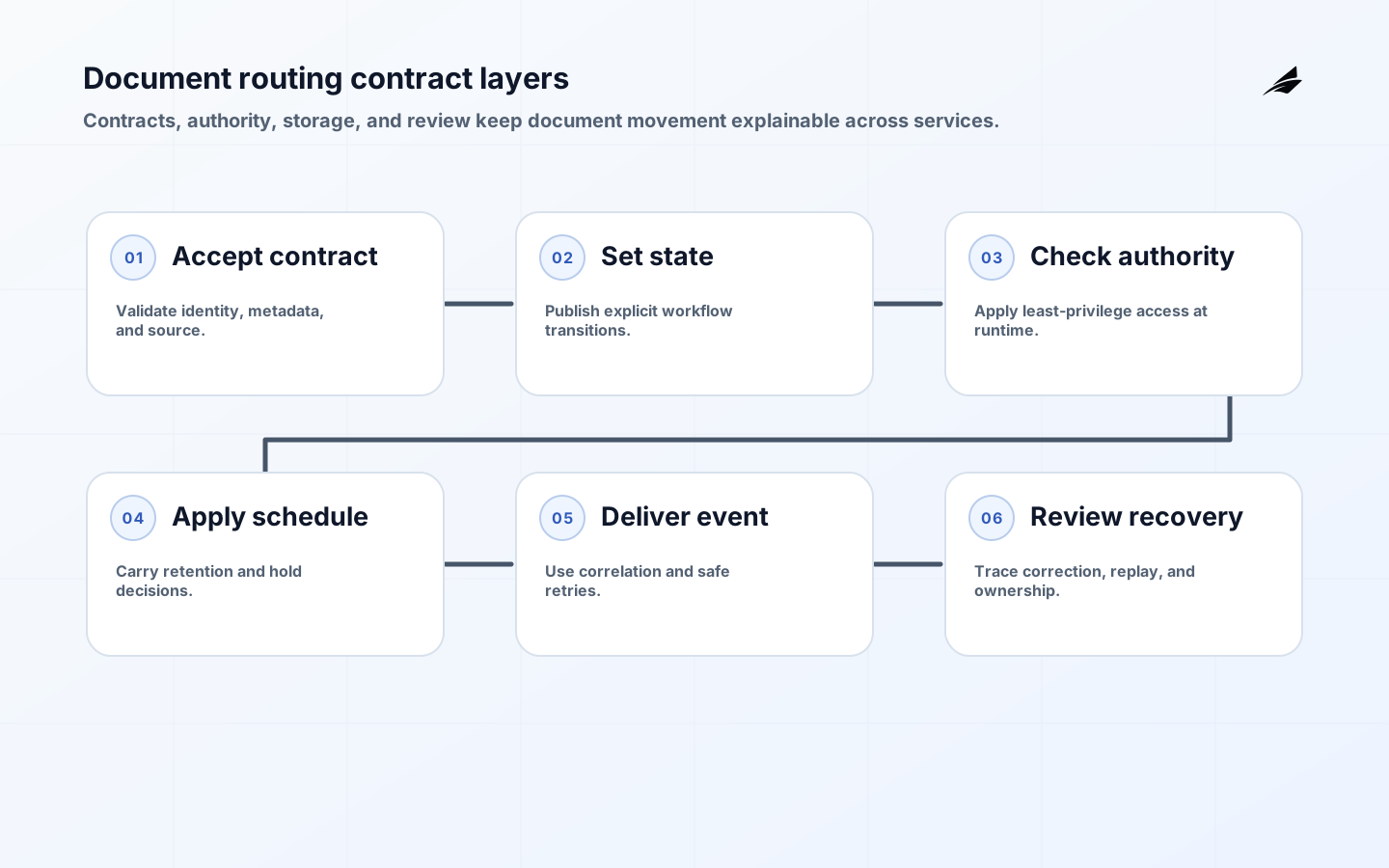
A CTO should state whether the routing service owns content, metadata, state, or only a recommendation. Define accepted classes, storage authority, downstream queues, and the result of an unsupported or unauthenticated input. A narrow contract prevents a temporary bridge from becoming an accidental system of record.
Make state and identity durable
Use document and content-version identities that survive retries, renames, and storage migration. Define accepted, classified, held, routed, acknowledged, corrected, and disposed as different states. Preserve original decisions and corrections so a replay does not invent a second history.
Control permissions at runtime
A service account should not have repository-wide access merely because it is convenient. Apply least privilege at intake, classification, movement, and retrieval. The Microsoft Graph permissions reference helps engineers review named permissions against the exact action they enable.
Connect schedules to records
Retention depends on record class, trigger, hold, and authority. The NARA records management guidance shows why engineering should carry schedule and disposition state rather than invent the legal period. Pause deletion on a hold and name the owner.
Validate and quarantine
Reject malformed metadata, unsupported types, impossible timestamps, and unauthorized references before normal routing. Keep suspicious or uncertain content in a restricted queue. The OWASP Application Security Verification Standard is a useful source for validation, access control, and audit themes.
Make retries repairable
Carry correlation keys, idempotency, and source order across services. Test duplicate events, delayed notifications, storage outages, and out-of-order corrections. A repair must be safe to repeat and must retain the policy context that produced the original decision.
Observe the evidence path
Measure transition failures, queue age, access denials, holds, replay collisions, and correction volume. Traces should connect source to acknowledgement without copying document contents. The NIST Privacy Framework 1.1 helps ask who processes which data and who is accountable.
Pilot one route
Choose one source, class, storage authority, and destination. Prove that operators can find the authoritative state, engineers can replay without duplication, and records owners can pause disposition. Do not widen scope while a private script is still required for recovery.
Review ownership after change
Revisit repositories, identity providers, classifiers, schedules, and consumers together. Sample normal, ambiguous, revoked-access, and corrected routes. Keep a decision record with assumptions, data flows, recovery evidence, and owners.
| Field | Engineering rule | Operational proof |
|---|---|---|
| Identity | Stable document and content version | Authoritative object is findable |
| State | Explicit transition meanings | Safe next action is visible |
| Authority | Role, scope, actor, time | Permission can be challenged |
| Recovery | Replay key and correction link | Repair does not duplicate |
Key takeaways
- Make ownership and state explicit before choosing services.
- Use least privilege, stable identity, replay keys, and retention authority.
- Keep privacy-aware evidence close to the decision.
- Test real failures with operators.
- Expand only when recovery is routine.
| Signal | Risk | Response |
|---|---|---|
| Transition failure | Contract mismatch | Inspect boundary state |
| Access denial | Scope or role drift | Review authorization |
| Retention hold | Schedule uncertainty | Assign records owner |
| Replay collision | Weak idempotency | Repair key design |
Frequently asked questions
Should document routing be a microservice? Only when a distinct ownership and integration boundary justifies it. A module inside an existing system can be safer if it preserves the same contracts and evidence.
How can routing retries avoid duplicate documents? Use a durable source reference, content version, correlation key, and idempotent move or acknowledgement operation, then reconcile states that disagree.
Who owns retention logic in a routing architecture? Records, legal, or policy owners define schedules and holds; engineering exposes those decisions, enforces them, and preserves the evidence of application.
An architecture decision should explain why the chosen boundary is worth its operational cost. Record assumptions about source reliability, repository limits, identity, data residency, retention, and recovery staffing. Name the conditions that would trigger a redesign, such as a new document class, a new jurisdiction, or a change in authoritative storage. This makes the route adaptable without turning every change into an emergency rewrite.
Capacity planning should include exception work and retention operations. A route that handles normal volume but leaves sensitive documents waiting for days is not healthy. Measure queue age by class, correction time, access-denial rate, storage write latency, and disposition backlog. Set ownership for the tail, not only for median performance. Review the expensive cases with records, privacy, support, and engineering together.
Notification is part of the route contract. A notification should point to the authoritative state, identify the action owner, and avoid leaking content in subject lines or message bodies. Treat delivery failure as a state that can be reconciled, not as proof that the workflow failed. Test duplicate notifications and users who lose access after the message is sent. The document should remain protected even when the notification path is noisy.
Recovery needs a first-class queue. Present the affected reference, current state, last successful transition, dependency response, policy version, and safe options together. Classify whether the operator should retry, reconcile, return, hold, or escalate. Avoid asking support to search raw logs across services. A concise recovery view reduces the temptation to edit storage directly and gives engineering better evidence for a contract fix.
Access review should include automation identities, delegated users, groups, and emergency roles. A least-privilege design is not complete if a repair tool can read every repository or if an emergency role never expires. Sample the permission graph after deployment and after an organizational change. Record the reason for a temporary grant and connect its removal to the incident or maintenance record that created it.
API contracts should state whether a consumer may ignore unknown fields, how a new state is introduced, and which fields are immutable. Version a policy or schema change when it changes meaning. Preserve the effective time of a route decision separately from the time a worker processed it. These distinctions matter when a delayed message arrives after a permission change or when a retention hold begins while a file is waiting in a queue.
For a service owner, the document reference is the thread that keeps the route coherent. Carry it from intake through classification, storage, queue delivery, notification, correction, and disposition. If a downstream system creates its own identifier, store the mapping rather than replacing the original. This lets an operator search from either side of a failure and prevents a successful handoff from becoming an untraceable fork.
A route is ready for wider adoption when a second team can use the contract without a private briefing. Ask that team to integrate a source, exercise a denied access case, recover a duplicated message, and explain a retention hold. Their questions are evidence about the design. Resolve them in the contract or runbook before adding more repositories.
Review the cost of evidence as part of architecture. Retaining every payload in every service may increase exposure and storage burden, while retaining only a status code may make an investigation impossible. Keep references, hashes, policy versions, actors, timestamps, and correction links centrally, and retain protected content only where the business or legal purpose requires it.
Keep operational runbooks close to the contract. The runbook should explain how to find a correlation key, inspect state, pause disposition, retry a safe transition, and escalate a privacy or legal question. It should also state which actions are forbidden. This reduces the chance that an urgent repair becomes an uncontrolled access grant.
Test the route with a new repository and a revoked identity before a migration. Verify that old links do not expose a file, that the source reference remains searchable, and that a held document still has a records owner. Migration acceptance should include a sample of corrected and disposed items, not only files that reached the destination.
Design the data flow so each boundary has one accountable owner. The intake team owns source acceptance, the routing service owns state transitions, the repository owner owns storage and access, the records owner owns schedule decisions, and support owns the recovery handoff. Shared responsibility can work when the handoff evidence is explicit; “the platform” is not an owner.
A route should also state how a source change affects open work. If a repository changes permission policy, a classifier is replaced, or a schedule is revised, identify which documents are rechecked and which retain their original decision. Store the effective time and the reason. This is particularly important for delayed events that arrive after an operator has already acted.
During an incident, preserve the distinction between a missing document, an inaccessible document, and a document whose route is unknown. Each condition changes the safe action and may involve a different authority. Give responders a read-only evidence view first, then a controlled repair action. This keeps urgency from turning into broad repository access and makes the eventual post-incident review more precise.
Conclusion
A document routing architecture earns its place when service contracts preserve identity, authority, retention, and recovery across every boundary. Keep the first route narrow, test the failure states, and make the authoritative state clear to both engineers and operators.