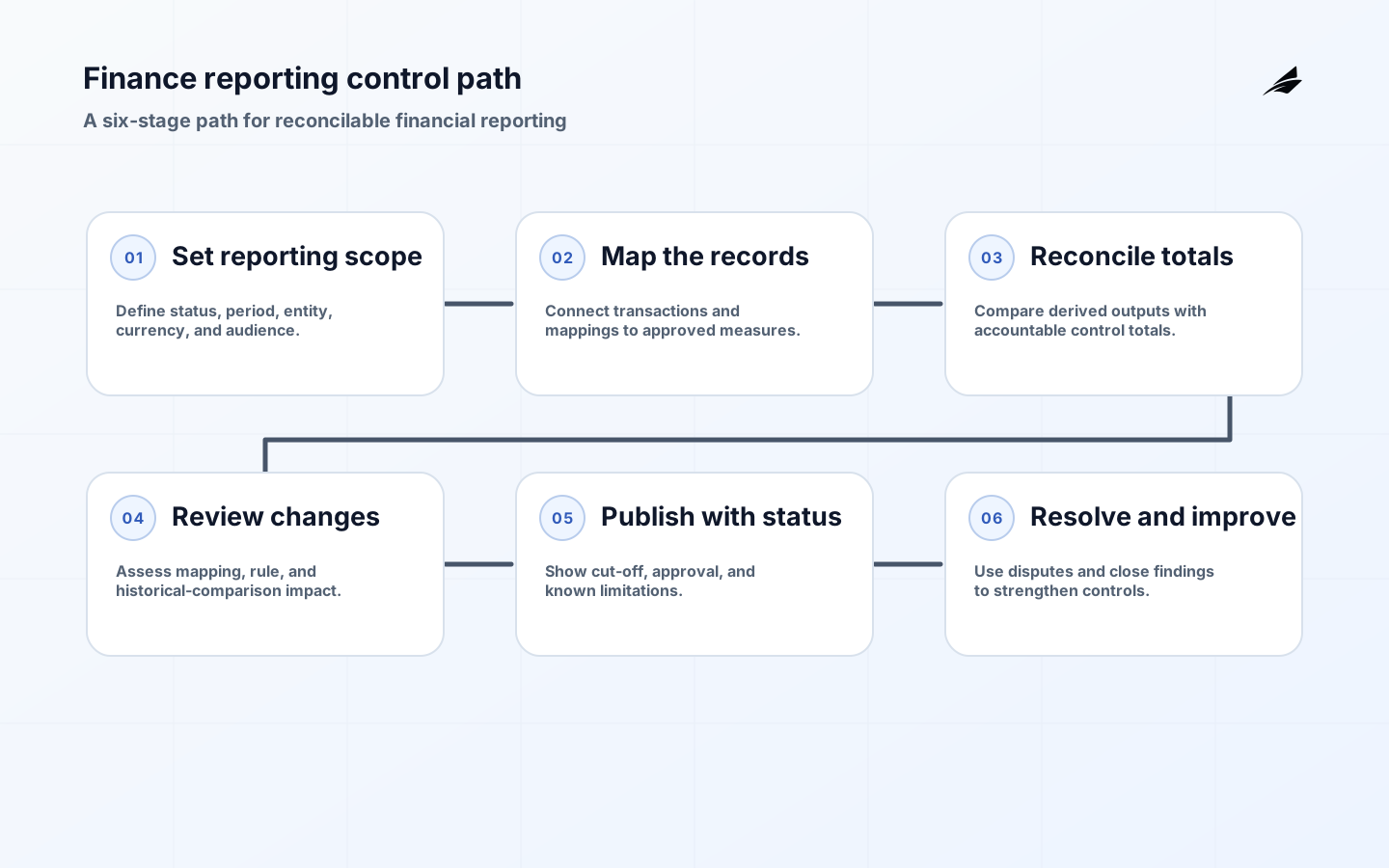
Finance reporting mistakes rarely announce themselves as broken charts. More often, a perfectly formatted report combines an unclosed ledger with a forecast, compares different legal-entity scopes, or applies an undocumented mapping that changed last quarter. The practical fix is to make financial reporting a controlled information product. Each measure needs a defined status, period, entity, currency treatment, accountable source, and reconciliation route. Readers can then use management reporting quickly without mistaking a directional operational signal for a final financial result. For adjacent practice, see the plain-language data quality guide and the BI dashboard guide, alongside the data lineage guide.
Make reporting status and scope explicit
The first fix is labels that communicate meaning rather than decoration. State whether a result is draft, preliminary, closed, forecast, or budget; show the data cut-off, accounting period, entities included, currency basis, and material exclusions. These details are not footnotes when a team is deciding spend or performance action. A weekly cash estimate may be timely and useful, while a monthly P&L may require approved journals and consolidation. Both belong in finance reporting, provided the reader can tell which promise each number makes and where its treatment differs.
- Show reporting status, cut-off, period, entities, and currency with material totals.
- Keep forecast, budget, operational estimate, and actuals visibly distinct.
- Define whether comparative periods use restated mappings or historical treatment.
- Record material exclusions, pending adjustments, and source limitations.
- Use one agreed definition for each headline measure across recurring reports.
Reconcile finance reporting from detail up
A report should trace back to detailed, accountable records. Preserve journal, invoice, payment, and allocation references in the transformation path, then establish a control total for each published aggregate. Reconciliation is not only a month-end activity; it is how a team detects a duplicate join, incomplete extract, or incorrect entity filter before a total enters a leadership discussion. When management categories remap the chart of accounts, version the mapping and keep a clear owner. That makes a variance explainable as a business movement, accounting treatment, or data issue rather than a mystery hidden in a spreadsheet.
| Reporting mistake | Typical effect | Fix |
|---|---|---|
| Mixed status | Forecast is interpreted as final actuals. | Label status and separate result types. |
| Unversioned account mapping | Historical comparisons change unexpectedly. | Version mapping and state restatement policy. |
| No control total | Aggregate errors escape into management packs. | Reconcile to an accountable source by period. |
| Broad export access | Sensitive detail spreads beyond its purpose. | Use role-based views and governed access. |
Manage financial rule changes and access
Finance transformations contain rules that deserve change control: account mappings, allocation bases, consolidation adjustments, foreign-exchange treatment, and period logic. A change should explain its purpose, show before-and-after results for representative periods, identify downstream reports, and receive the right approval. Access needs equivalent discipline. A budget owner may need a cost-center view; a finance controller may need journal detail; a broader manager may need only an approved aggregate. The NIST data governance profile is a sound reference for linking responsibilities and management practices around sensitive data.
- Review mapping and accounting-rule changes with finance ownership before deployment.
- Use least-privilege roles for detailed transactions and payroll-related data.
- Keep release notes for corrections, restatements, and changed comparisons.
- Test data completeness and reconciliations before publishing a period.
- Set an escalation route for disputed numbers or access anomalies.
Make finance reporting releases controlled
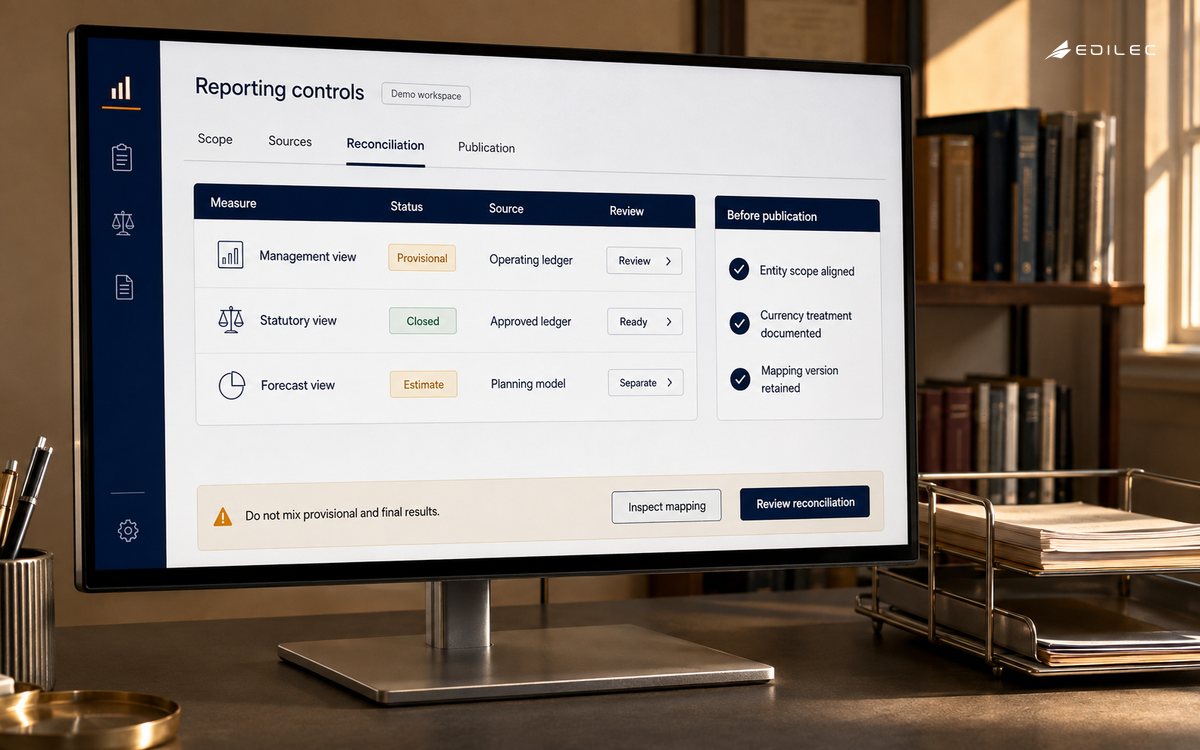
Build the reporting release around the real close and management rhythm. Define the source-arrival window, transformations, reconciliation checks, reviewer sign-off, and publication status. Quality assertions should be executable where possible; dbt data tests provides a practical mechanism for checks on modeled data. The finance dashboard architecture guide complements this by showing how management surfaces can remain connected to controlled financial evidence. When a check fails, the system should make the limitation visible rather than merely retry in the background.
| Control point | Evidence | Response when it fails |
|---|---|---|
| Source readiness | Arrival timestamps and expected record counts. | Publish a provisional state or hold the affected section. |
| Transformation test | Key, valid-value, and reconciliation results. | Investigate logic or input before sign-off. |
| Review approval | Named reviewer and period-specific confirmation. | Do not represent the result as closed. |
| Distribution | Role and report audience record. | Restrict or replace an over-broad export. |
A practical finance reporting example
Consider a monthly operating review that compares actual spend with budget by department. The report should identify the accounting period, entity scope, budget version, account mapping, and whether actuals are closed or preliminary. A department leader who sees an unfavorable variance needs a drill path to the relevant accounts and transactions, plus an explanation of known allocations or one-time adjustments. This does not mean giving every leader unrestricted journal access. It means presenting the right level of evidence and a controlled route to finance when more detail is required.
Suppose finance changes the mapping of a software subscription account from general administration to product development. The numerical total may be unchanged, but departmental trend comparisons will move. The correct response is to version the mapping, test representative historical periods, determine the approved restatement treatment, and explain the change in the report. Hiding the shift creates a recurring trust problem because readers will reasonably ask whether a business outcome changed. A clear note lets them separate a classification change from a real spending movement and adjust their interpretation accordingly.
The reporting cadence should include time to resolve exceptions, not only to refresh a dashboard. If a source fails reconciliation, the team needs a named owner, a threshold for materiality, an approved decision about whether to publish provisionally, and a record of the eventual correction. These controls support speed because they avoid ad hoc negotiations during every close. Once users know what a provisional state means and where to find the impact, they can focus their attention on the differences that truly require finance judgment.
- Label each result with reporting status, period, data cut-off, entity scope, and currency treatment.
- Reconcile material totals to named ledger, billing, bank, or approved planning control sources.
- Version account mappings, allocations, and business rules that affect management comparisons.
- Test corrections and restatements on representative prior periods before publication.
- Require finance approval for changes that alter accounting or reporting meaning.
- Use least-privilege views for transaction detail, payroll context, and sensitive operational data.
- Publish response procedures for late sources, failed reconciliations, and disputed results.
- Keep source links and document references available for controlled investigation of material variances.
- Record reader-facing release notes for definition, mapping, and historical-treatment changes.
- Review recurring finance-report questions to improve visibility of assumptions and limitations.
A finance report is easier to trust when its reviewers can reproduce the essential path in a short time. For a selected variance, they should be able to see the versioned definition, relevant period and entity filters, mapped source accounts, control-total result, and any approved adjustment. This does not require embedding every accounting workpaper in a dashboard. It requires a controlled link between the summary and the evidence finance already maintains. When that link is tested during the close, the report becomes a dependable communication layer instead of a second, informal accounting system.
Keep that reconstruction path available after publication as well. Late questions are inevitable, and a preserved evidence trail lets finance answer them without recreating the period from informal files.
Finance reporting takeaways for the close
- Status, period, scope, and currency are part of every financial number’s meaning.
- Reconciliation gives management reporting a route back to evidence.
- Mappings and rules need versioned, approved change control.
- Visible limitations are safer than falsely final reports.
Use this article's decision boundary as an operating contract. Name the user or operator, trusted inputs, the owner who can act, the response window, and the safe state when evidence is late or wrong; finance review context remains explicit. Before widening scope, capture a baseline and test one normal path plus one credible exception; finance review context remains explicit. Record the version, approval, observed signal, and recovery result in the same review record; finance review context remains explicit. This makes a failure interpretable: the team can tell whether the rule, data, permission, or handoff caused the outcome; finance review context remains explicit. Keep controls close to the consequence, explanations close to the next decision, and the pilot small enough to reverse; finance review context remains explicit. At review, remove checks that create work without changing behaviour and add only the smallest next hypothesis; finance review context remains explicit. The result is a capability that can survive turnover, explain exceptions, and improve from production evidence rather than confidence alone; finance review context remains explicit. For finance reporting, make period, currency, ownership, and correction authority explicit. Use the Power BI governance roadmap, Google data architecture overview, and W3C Data Quality Vocabulary draft to frame evidence.
Finance reporting FAQ for reviewers
Can preliminary numbers be useful? Yes, if their status, cut-off, and limitations are plain and the decision tolerates that uncertainty. What is a finance control total? An agreed aggregate from an accountable process used to test a derived report. When should history be restated? Follow the organization’s approved accounting and reporting policy, and communicate the treatment clearly. Who owns a metric? Finance owns business and accounting meaning; technical teams own delivery and traceability, working through a documented approval path.
Conclusion: make every number’s status inspectable
Good finance reporting does not ask readers to trust a polished page blindly. It shows what the number represents, how final it is, which records support it, and what changed since the last period. That transparency gives finance teams a faster way to investigate and leaders a more responsible basis for action. Fix the definition, reconciliation, and access path first; the dashboard becomes more useful because it reflects those controls instead of obscuring them.
For Finance Reporting Mistakes and Practical Fixes, the durable implementation is a sequence of bounded decisions. State the operating context, identify the evidence that can change the decision, name the owner who can act, and record the condition that triggers review; finance review context remains explicit. This keeps the guidance useful after launch: a team can compare intended outcomes with observed behavior, explain exceptions without normalizing them, and choose the next smallest corrective action; finance review context remains explicit. For Finance Reporting Mistakes and Practical Fixes, the useful record preserves the evidence that lets the owner choose the next safe action.
A production decision about finance reporting mistakes should be tested against a concrete operating scenario, not only a design diagram. Use the article's concern—Make reporting status and scope explicit; Reconcile finance reporting from detail up; Manage financial rule changes and access; Make finance reporting releases controlled—to name the input, the responsible owner, the expected signal, and the point at which the team stops or reverses the change. Evidence should include both the normal path and the first credible exception: late data, an unavailable dependency, an unexpected permission, a changed schema, a noisy alert, or a customer-visible delay; finance review context remains explicit. Record the observed condition and the decision made so a later reviewer can tell whether the control worked or merely appeared to work; finance review context remains explicit. The finance-close record should stay tied to the reporting workflow and its period-specific acceptance evidence.