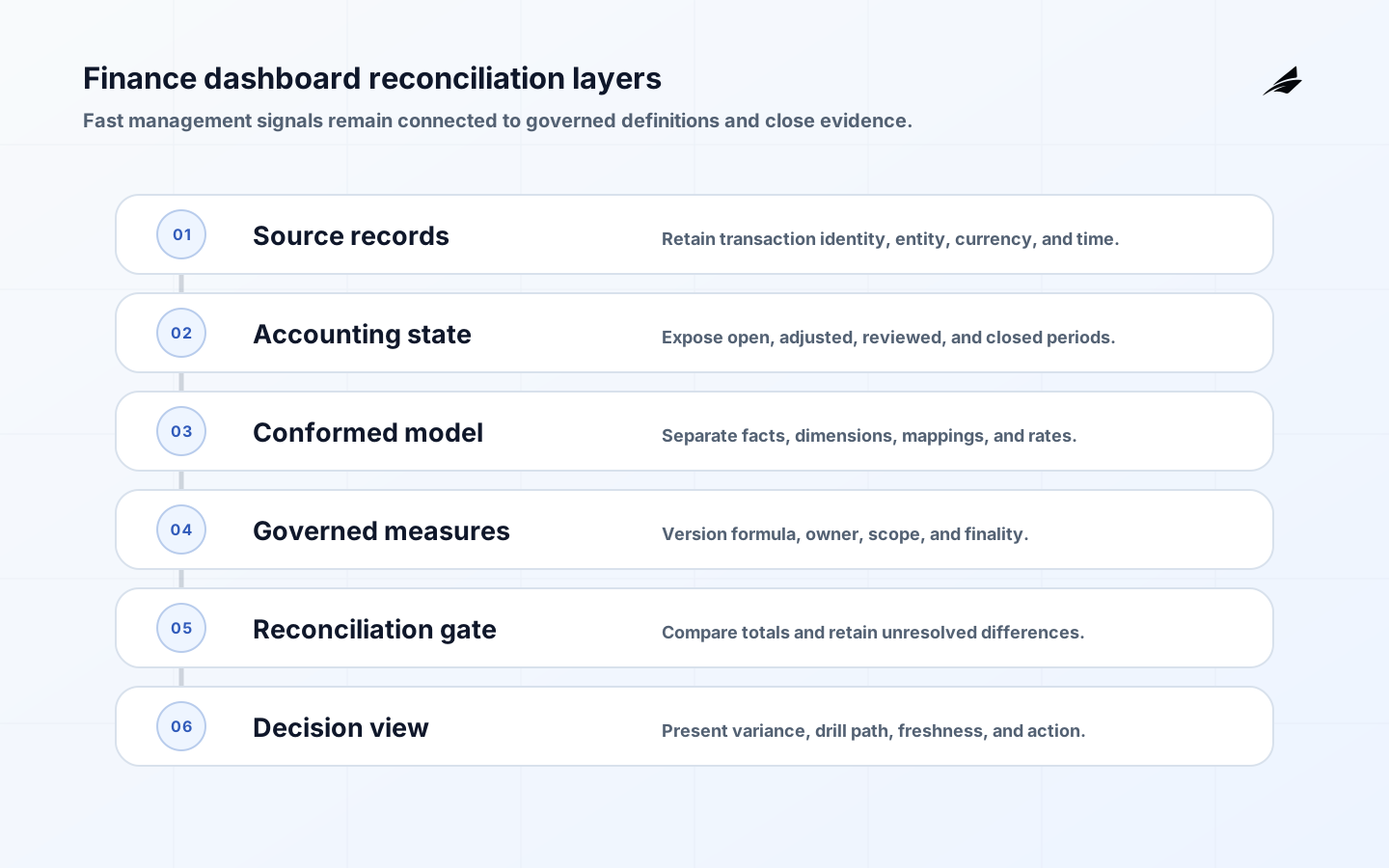
Finance dashboard architecture should shorten the route from a management question to an explainable answer, not create a parallel ledger. Growing companies commonly pull revenue, cash, payroll, expense, bookings, and pipeline signals into one place, then discover that the measures do not share the same accounting period, entity scope, or approval status. A good architecture makes those boundaries visible. It distinguishes preliminary operating signals from closed financial results, retains a link to accountable systems, and presents a clear date and currency context. The aim is fast discussion with a reliable path back to evidence.
Separate management signals from the financial close
A monthly board pack, a daily cash view, and a sales forecast are all legitimate, but they should not be labeled as though they have the same finality. Start by classifying each measure: operational, management estimate, or close-controlled financial result. Then define the cut-off, legal entity, currency treatment, and adjustment policy. For example, a bookings trend can be useful before invoices are issued; it is not a substitute for recognized revenue. This distinction reduces recurring argument because readers know whether they are looking at a directional indicator, a reconciled balance, or an approved variance explanation.
- State the reporting period and the data cut-off on every material finance view.
- Show legal entity, currency, and consolidation assumptions with aggregate measures.
- Keep draft forecasts separate from approved budget and actuals.
- Give each adjustment a reason, approver, and effective period.
- Define which numbers may be exported for external use.
Design a reconciliable finance data model
Model financial facts at a grain that can be reconciled. A general-ledger posting, invoice line, payment, payroll journal, and budget version answer different questions and should not be joined casually. Preserve source document references, posting dates, accounting dates, and the chart-of-accounts mapping. When management categories differ from the ledger, maintain a versioned mapping rather than hard-coding labels in a visualization. The data architecture overview from Google Cloud usefully frames architecture as the path from collection through use; for finance, that path must include a durable reconciliation point.
| Measure type | Authoritative input | Essential context |
|---|---|---|
| Actual expense | Posted ledger entries | Entity, accounting period, account, cost center, and journal status. |
| Cash position | Bank balances and cleared transactions | Bank, currency, retrieval time, and pending-item policy. |
| Revenue outlook | Approved forecast model and pipeline assumptions | Version, probability policy, horizon, and owner. |
| Budget variance | Approved budget version and actuals | Scenario, mapping version, and period comparison. |
Control changes, access, and exceptions
Finance data is unusually sensitive to quiet changes. A revised account mapping or FX rule can move a headline without any source record being wrong. Treat these as governed changes: document the old and new treatment, test representative periods, approve the release, and identify the historical impact. Access deserves the same precision. Executives may need consolidated results; finance operations may need transaction detail; other teams may need a limited management view. The Microsoft governance guidance emphasizes ownership and policies that fit day-to-day work, which is especially important when reports become decision inputs.
- Reconcile each published aggregate to a defined financial control total.
- Require review for mapping, consolidation, allocation, and currency-rule changes.
- Show an exception state when a source, reconciliation, or approval is incomplete.
- Use role-based access and avoid emailing extracts as a workaround.
- Retain release notes with the metric definition and affected periods.
Build the finance dashboard release path
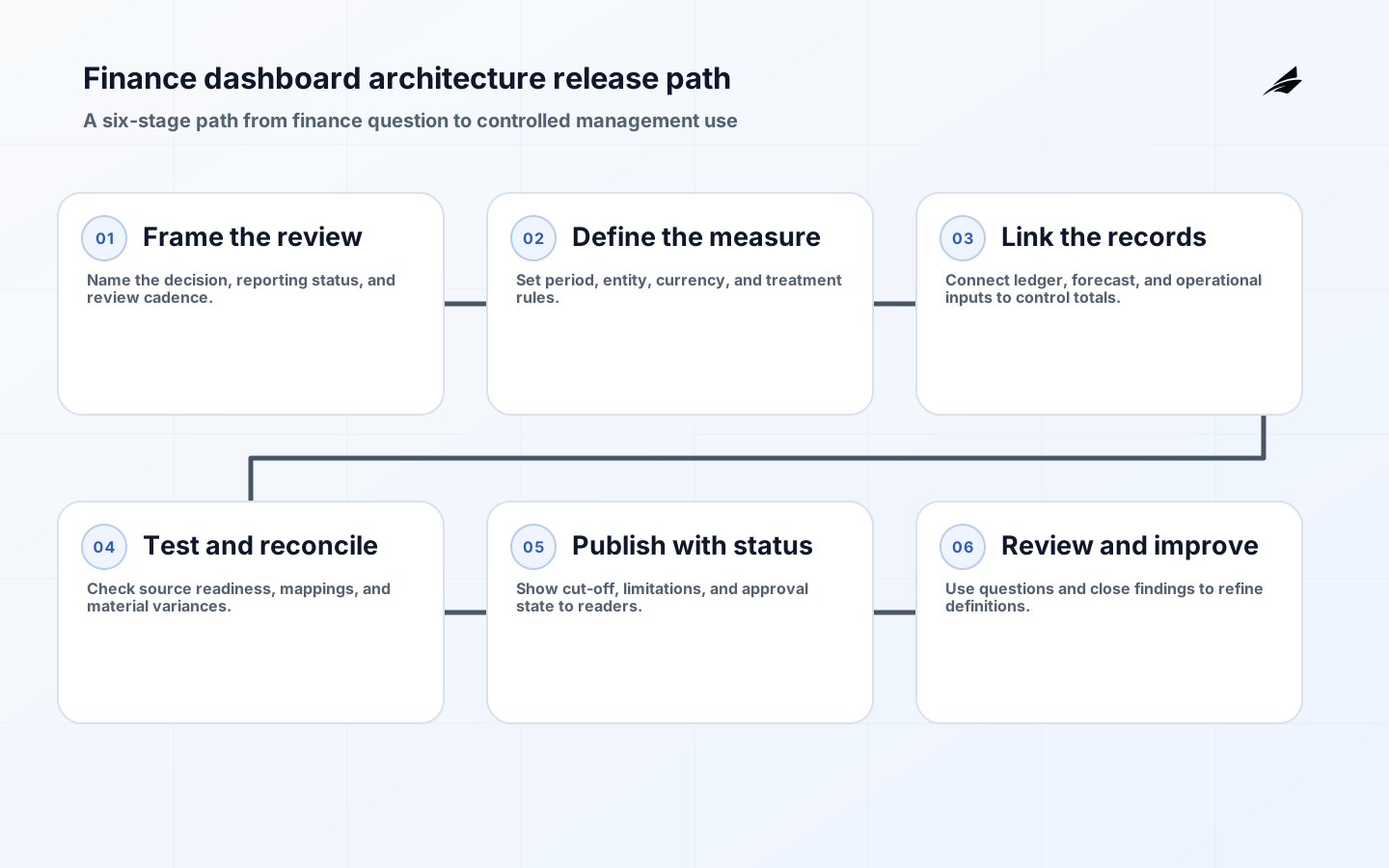
Release one decision surface at a time. A cash runway review or a monthly operating variance review is a sensible first scope because its users, cadence, and investigation path are clear. Work backward from the meeting: identify what must be settled before it starts, who validates it, and which drill path explains a variance. Automate repeatable assertions close to the transformation; dbt data tests provides a practical model for checking assumptions in data assets. Connect the result to finance reporting controls so an operational dashboard does not become an isolated second reporting regime.
| Release check | Question | Owner action |
|---|---|---|
| Period readiness | Are all required ledgers and source feeds within the stated cut-off? | Mark the view provisional or hold publication. |
| Reconciliation | Does the aggregate tie to the agreed control total? | Investigate material variance before decision use. |
| Definition change | Did a mapping or rule alter the prior comparison? | Version and explain the change beside the result. |
| Access review | Can each reader see only the detail required? | Adjust roles and revoke obsolete access. |
A practical finance dashboard example
Imagine a growing company reviewing cash runway every Monday. The executive question is not “what is every bank transaction?” but “does the expected cash position require a change in hiring, spend, or collections activity?” A useful view starts with cleared bank balances at a stated retrieval time, adds approved near-term payments and receivables under a documented inclusion policy, and keeps uncertain pipeline or forecast inputs visibly separate. It shows currency, legal entity, and whether the position includes pending cash movements. The finance owner can then explain which part of the result is controlled actual data and which part is a planning assumption.
Suppose a payment feed arrives late on the morning of the review. The answer should not be a silent refresh that leaves readers unsure whether the number changed. The dashboard can show the affected source and time, identify the potentially incomplete cash category, and either mark the whole view provisional or apply an approved fallback that is clearly labeled. This small design choice protects decision quality. It lets the team decide whether the uncertainty is tolerable for a planning discussion, while preserving the expectation that the final finance record will be reconciled through the normal close process.
Over time, the most important dashboard improvement may be a definition change rather than a new visual. For example, finance may decide that deferred revenue should be reported differently for a management planning measure. That change needs a worked comparison between old and new treatment, ownership approval, a note about historical comparability, and an update to any downstream report that uses the measure. When the release process handles this well, readers learn that a changed number has an explicit reason. That is what allows a growing company to move quickly without converting finance reporting into a collection of unexplained exceptions.
- Confirm each headline measure identifies its accounting status, reporting period, entity scope, and currency basis.
- Reconcile every material aggregate to a named control total before the scheduled management review.
- Check that forecast versions cannot be confused with approved budget or closed actuals.
- Test account mapping changes on prior periods and record whether comparison history is restated.
- Review whether unpaid, pending, or disputed items are included in every cash-oriented measure.
- Validate dashboard access with finance, department, and executive reader roles rather than generic permissions.
- Publish a clear response path for late bank feeds, incomplete ledgers, and unresolved reconciliation differences.
- Keep approval evidence for changes to allocation, currency, consolidation, and revenue treatment.
- Measure recurring questions in finance reviews to identify unclear definitions or missing drill paths.
- Periodically remove obsolete measures that no longer influence a planning or finance decision.
Build an explicit bridge from the close to the dashboard
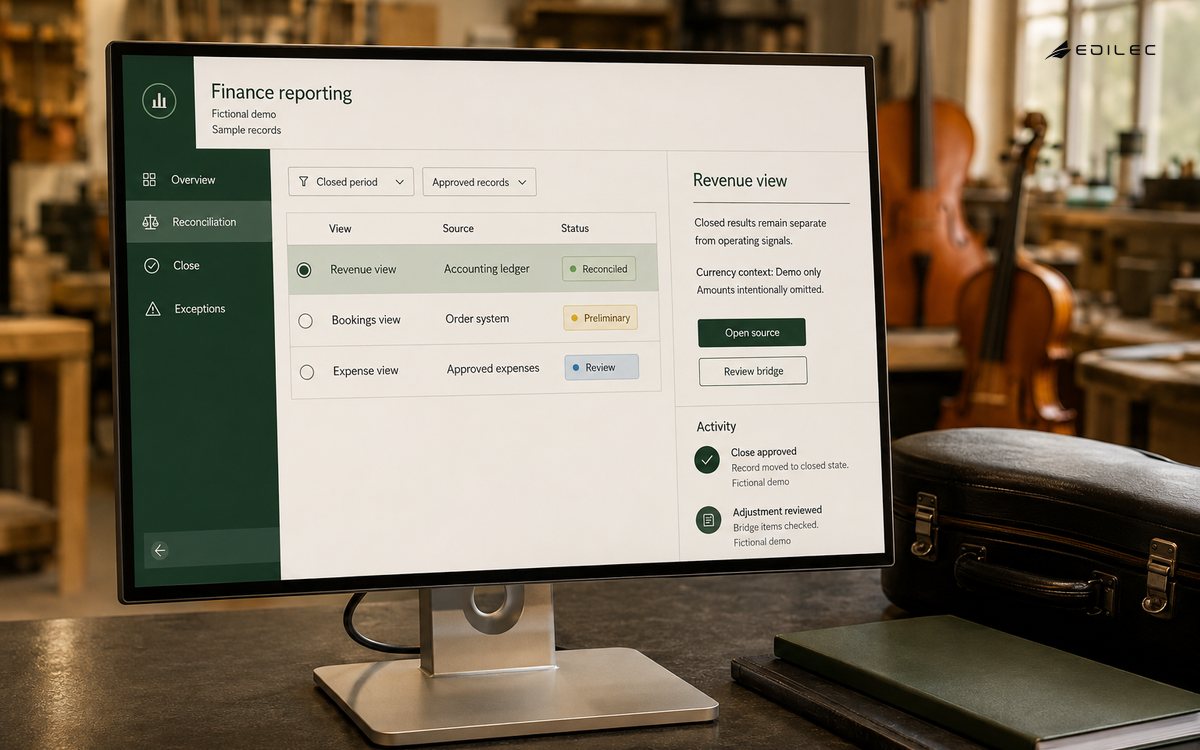
A finance dashboard needs a repeatable bridge between source transactions and the approved reporting state. Capture the ledger period status, last successful source load, reconciliation control total, unresolved difference, adjustment version, and approving role. Freeze or label prior periods according to an agreed restatement policy. If management wants a near-real-time cash or bookings signal, publish it as preliminary and keep the route to closed actuals visible. This is not cosmetic labeling: it prevents a reader from comparing an open current month with a closed prior month and treating the resulting variance as operational fact.
Model finance facts at a declared grain and keep dimensions such as legal entity, account, product, customer, department, currency, and date conformed across measures. Microsoft's star-schema guidance explains why fact tables support summarization while dimensions support filtering and grouping. For finance, that separation also makes reconciliation testable: duplicate transaction keys, unmapped accounts, invalid entity combinations, and missing exchange rates can fail before publication. Add a release check that compares dashboard totals to the finance-owned control report and stores the result with the dataset version. Readers can then drill from a variance to its definition and evidence instead of debating whose spreadsheet is current. NIST's developing Data Governance and Management Profile also emphasizes connecting data governance to privacy, cybersecurity, and AI risk. The same principles underpin Edilec's data analytics services.
Key takeaways for finance dashboard architecture
- Make finality, cut-off, entity, and currency explicit.
- Model records so every management total can be reconciled.
- Treat rule changes and access decisions as controlled releases.
- Design the first view around a real finance review ritual.
Frequently asked questions about finance dashboards
Can a finance dashboard show operational data? Yes, when its status and purpose are clear. Order intake or utilization can explain a financial outcome without being booked actuals. How often should it refresh? Match the decision: intraday cash monitoring and a closed monthly P&L have different needs. What is a control total? It is an agreed number from an accountable process used to test whether a derived result is complete and correctly scoped. Who approves a metric change? The finance owner should approve business meaning, while the technical steward documents implementation and release impact.
Conclusion: speed comes from an explainable foundation
The strongest finance dashboard architecture makes management conversations quicker because it does not conceal the work needed to trust a number. It names the relevant period, source, treatment, and status, then leaves a route back to the detailed evidence. Start with one review that matters, publish clear provisional states, and make every mapping change visible. That discipline lets the dashboard evolve with the company while preserving finance ownership of the records and controls that underpin it.