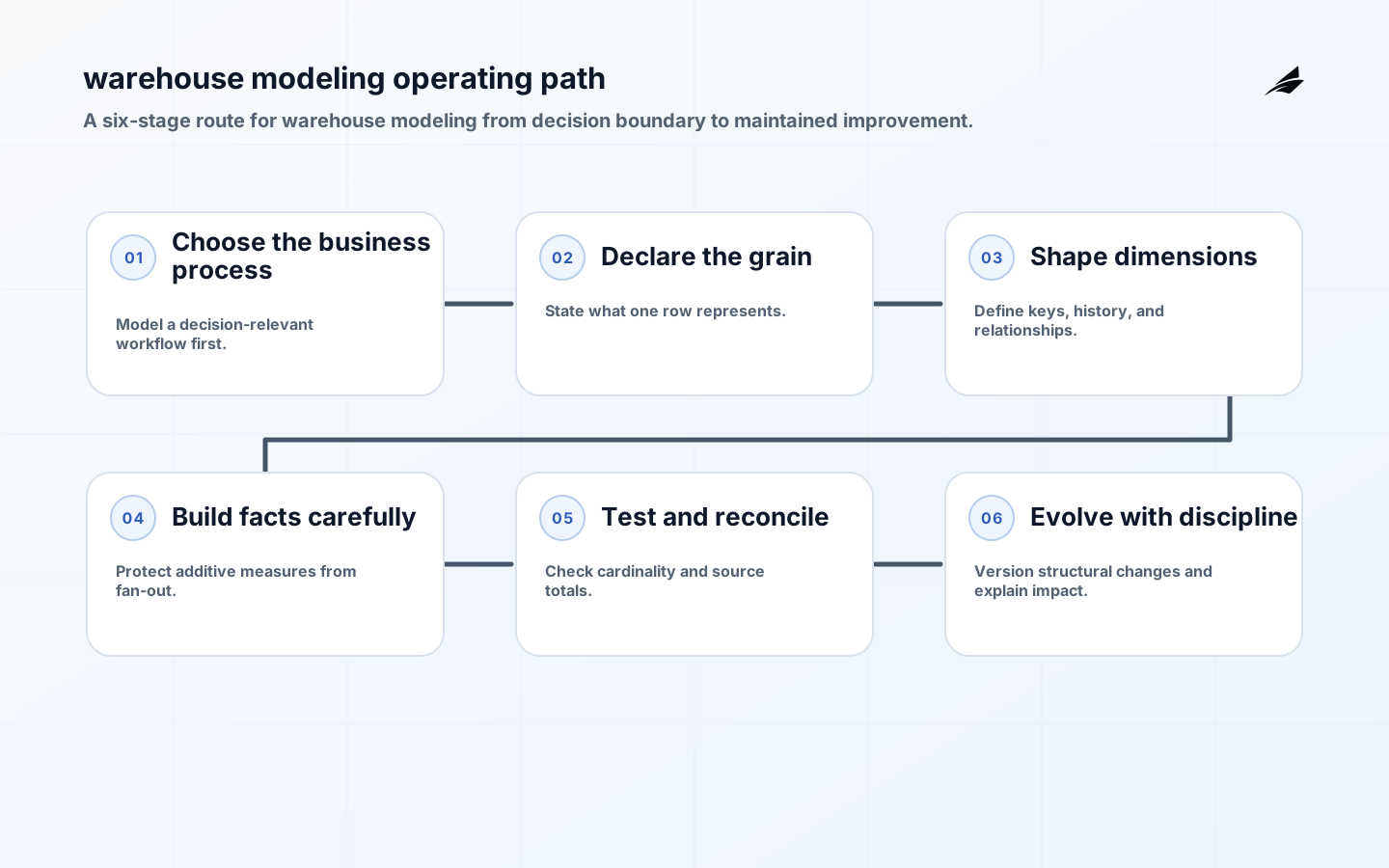
Warehouse modeling mistakes usually begin before a query runs: the grain is implied, a join relationship is assumed, or a correction policy is left to memory. A model can return plausible numbers while overstating revenue, dropping late records, or exposing a result to the wrong audience. This guide connects those failures to explicit contracts, representative tests, provenance, controlled access, and a recovery route.
Define warehouse modeling in terms of a reader’s decision
Plain language matters because teams often give a warehouse model a broad label and then make incompatible assumptions about its job. Here, warehouse modeling means an analytical representation of a business process designed to serve a known decision or operational need. Its accountable owner is the domain data owner and the engineer responsible for the model contract. Its working inputs are business process, declared grain, dimensions, measures, history policy, and source reconciliation. That definition is deliberately narrower than “all available data.” It gives a team something it can review, test, and improve The dbt models documentation provides useful implementation context, while dbt data tests documentation helps frame provenance, accessibility, or contract evidence that readers may need. dbt models documentation provides implementation context for model boundaries and published interfaces.
- Name the decision, the person who makes it, and the deadline before choosing tools or visuals — For warehouse-modeling mistakes, apply the test to the join grain, provenance, and repair step.
- Write the unit of analysis and the boundary: what is included, excluded, estimated, or still pending — For warehouse-modeling mistakes, apply the test to the join grain, provenance, and repair step.
- Give the reader a visible freshness, completeness, or release state rather than implying certainty — For warehouse-modeling mistakes, apply the test to the join grain, provenance, and repair step.
- Keep an owner and a recovery route beside the definition so questions do not become anonymous support work — For warehouse-modeling mistakes, apply the test to the join grain, provenance, and repair step.
Set a boundary before adding tables or consumers
A small boundary makes the trade-offs visible. Begin with one audience, one decision cadence, and one source-to-consumer path — For warehouse-modeling mistakes, apply the test to the join grain, provenance, and repair step. Then ask what can go wrong at each point: a late source, a changed definition, a denied permission, a partial rerun, or an action that is not recorded The answer does not need to be elaborate; it needs to be operational — For warehouse-modeling mistakes, apply the test to the join grain, provenance, and repair step. For warehouse modeling, the essential components are clear grain, conformed dimensions where appropriate, tested relationships, history choices, and documented source mapping. A team should be able to point to the owner for each component and show where its current state is recorded That is more useful than declaring a platform “trusted” without a way to inspect its behavior — For warehouse-modeling mistakes, apply the test to the join grain, provenance, and repair step.
| Boundary question | Concrete answer to record | Why it changes decisions |
|---|---|---|
| Reader and action | Which CTOs member uses a warehouse model, and what action follows? | Prevents a general-purpose artifact from becoming an unowned report. |
| Meaning and grain | What does one record, value, or result represent? | Stops apparently similar totals from being compared as if they were equivalent — For warehouse-modeling mistakes, apply the test to the join grain, provenance, and repair step. |
| Timing promise | What cut-off, lateness window, or release cadence applies? | Lets readers distinguish current signals from settled results. |
| Failure route | Who investigates an unexpected, late, or unavailable result? | Turns uncertainty into a controlled operational response. |
Design the model for grain, history, and access
Design choices should make correct use easier than accidental misuse. Put scope and status close to the result, then offer detail only where it supports investigation — For warehouse-modeling mistakes, apply the test to the join grain, provenance, and repair step. Separate business meaning from implementation mechanics but connect them through stable identifiers and links This is especially important when the same output reaches different teams or tools — For warehouse-modeling mistakes, apply the test to the join grain, provenance, and repair step. The W3C PROV overview is a useful reference for recording lineage and operational context; the NIST SP 800-53 Rev 5 provides a control-oriented lens for access, change, and recovery. Neither replaces local decisions about who may use the result and what evidence they need — For warehouse-modeling mistakes, apply the test to the join grain, provenance, and repair step. For warehouse modeling, the W3C PROV overview supports traceable result explanations, while NIST SP 800-53 Rev. 5 helps frame controlled change. dbt data tests documentation helps frame executable checks around grain and relationship assumptions.
- Make the default view answer one named question; use drill-down for diagnosis rather than placing every field on the first screen — For warehouse-modeling mistakes, apply the test to the join grain, provenance, and repair step.
- Expose source or model status where a reader can see it before acting on an incomplete result — For warehouse-modeling mistakes, apply the test to the join grain, provenance, and repair step.
- Treat identifiers, classifications, and access rules as part of the design, not post-launch administration — For warehouse-modeling mistakes, apply the test to the join grain, provenance, and repair step.
- Keep release notes short and decision-focused: what changed, when it takes effect, who is affected, and where to ask questions — For warehouse-modeling mistakes, apply the test to the join grain, provenance, and repair step.
| Design choice | Good operational behavior | Failure it avoids |
|---|---|---|
| Explicit status | Show the stated timing promise for an analytical representation of a business process. | A reader mistakes an in-progress result for a final one. |
| Named ownership | Display or link to the domain data owner and the engineer responsible for the model contract. | A question waits while teams debate who should respond. |
| Traceable change | Link release, source, or transformation evidence. | A changed number becomes impossible to explain after the fact. |
| Proportionate access | Give each role only the detail required for its decision. | Sensitive data spreads through convenient exports or broad workspaces. |
Implement the smallest path that proves the promise
For Warehouse Modeling Mistakes: Grain, Joins, and Recovery, prove the promised behavior on one representative path before expanding coverage, then exercise its first credible failure. Keep the test data and expected outcome available for future change review — For warehouse-modeling mistakes, apply the test to the join grain, provenance, and repair step. A successful run is not the same as a useful result: the acceptance check should include data outcome, timing, permissions, documentation, and the reader's ability to act This sequence also reveals whether an upstream agreement or a business definition needs work before the design is replicated elsewhere — For warehouse-modeling mistakes, apply the test to the join grain, provenance, and repair step.
Operate the model with tests and recovery evidence
After release, use real operating evidence to decide what deserves improvement. Review models when a business process, source lifecycle, or reporting definition changes. Record incidents in terms readers can understand: what decision product was affected, what promise was missed, what scope changed, and how the result was corrected Pair that record with technical signals such as freshness, job state, contract violations, test results, or access events The point is not to create an endless dashboard about dashboards; it is to make it possible for the responsible person to see risk early and choose an appropriate response — For warehouse-modeling mistakes, apply the test to the join grain, provenance, and repair step.
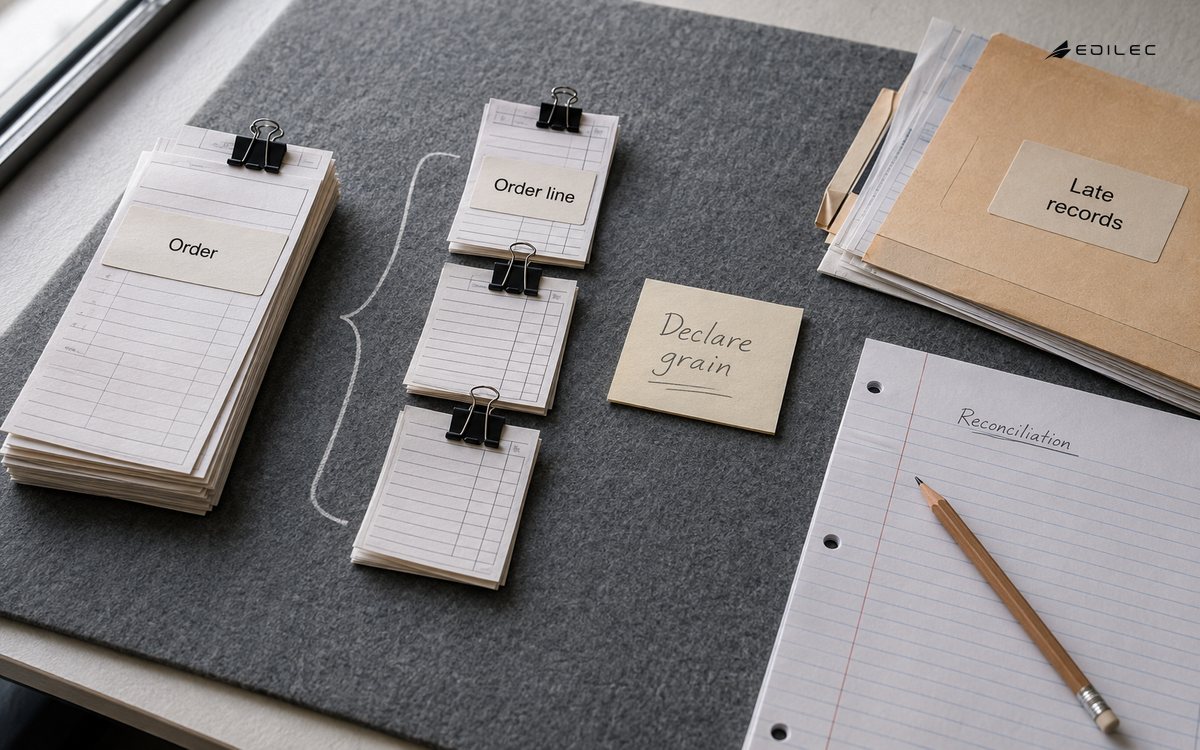
Before modeling a new process, draw five sample business events and show which fact row and dimensions each would produce. Include a correction, a missing relationship, and a late-arriving attribute. This low-cost exercise catches grain confusion before the model is hidden behind a large transformation graph. It also makes reconciliation conversations with domain owners much more precise than generic requests for “clean data.”
Mistake remediation should leave behind a test that would have exposed the original failure. For a grain problem, keep a fan-out example and an expected total; for a late dimension, retain the event, unknown-member behavior, and correction rule; for an access problem, verify that the published result is visible only to the intended audience. Link each test to the model definition and owner. The next reviewer should be able to tell what changed, why the fix is safe, and how to respond if the same condition returns. Use KPI governance, finance reporting mistakes and fixes, and real-time analytics for related operating cases.
Key Takeaways
- Warehouse modeling earns trust through a clear decision boundary, not through volume or visual polish.
- A named owner, visible timing promise, and tested failure route make the output usable when conditions change — For warehouse-modeling mistakes, apply the test to the join grain, provenance, and repair step.
- Test accepted examples and degraded paths before scaling to more teams, consumers, or source systems — For warehouse-modeling mistakes, apply the test to the join grain, provenance, and repair step.
- Treat every material definition or access change as a release that affected readers can understand — For warehouse-modeling mistakes, apply the test to the join grain, provenance, and repair step.
Frequently Asked Questions
The questions below focus on the failure modes that make warehouse models look plausible while serving the wrong decision. Review grain, late-arriving dimensions, post-run reconciliation, and the control or runbook changed after an incident.
The repair is incomplete if it only changes SQL. Update the model definition, test fixture, source contract, access rule, and runbook that allowed the mistake to reach a reader. Record the affected decision and verify the correction on both a normal example and the edge case that exposed the failure. A short review with the domain owner can reveal whether the model’s meaning changed or whether the implementation simply failed to honor an existing promise. Preserve that conclusion so future maintainers do not reintroduce the same ambiguity.
Conclusion
The durable version of warehouse modeling is a maintained agreement between people, data, and a decision. Start with the narrowest valuable use, make its meaning and timing visible, give it an owner, and rehearse how it behaves when the inputs are imperfect That approach creates useful evidence for expansion without claiming certainty that the system cannot provide As the workflow grows, preserve the decision boundary and let each material change earn trust again — For warehouse-modeling mistakes, apply the test to the join grain, provenance, and repair step.
A useful warehouse-modeling review preserves examples that reveal grain errors: a fan-out join, late dimension, unknown member, and corrected source record. Link each example to the model test, definition, and owner so the team can see whether a fix protects the intended decision.
Before adding another consumer, reconcile a representative slice and ask a domain reviewer to explain the result from source to measure. Exercise a degraded input and recovery route; if trust depends on oral history, the contract is incomplete.