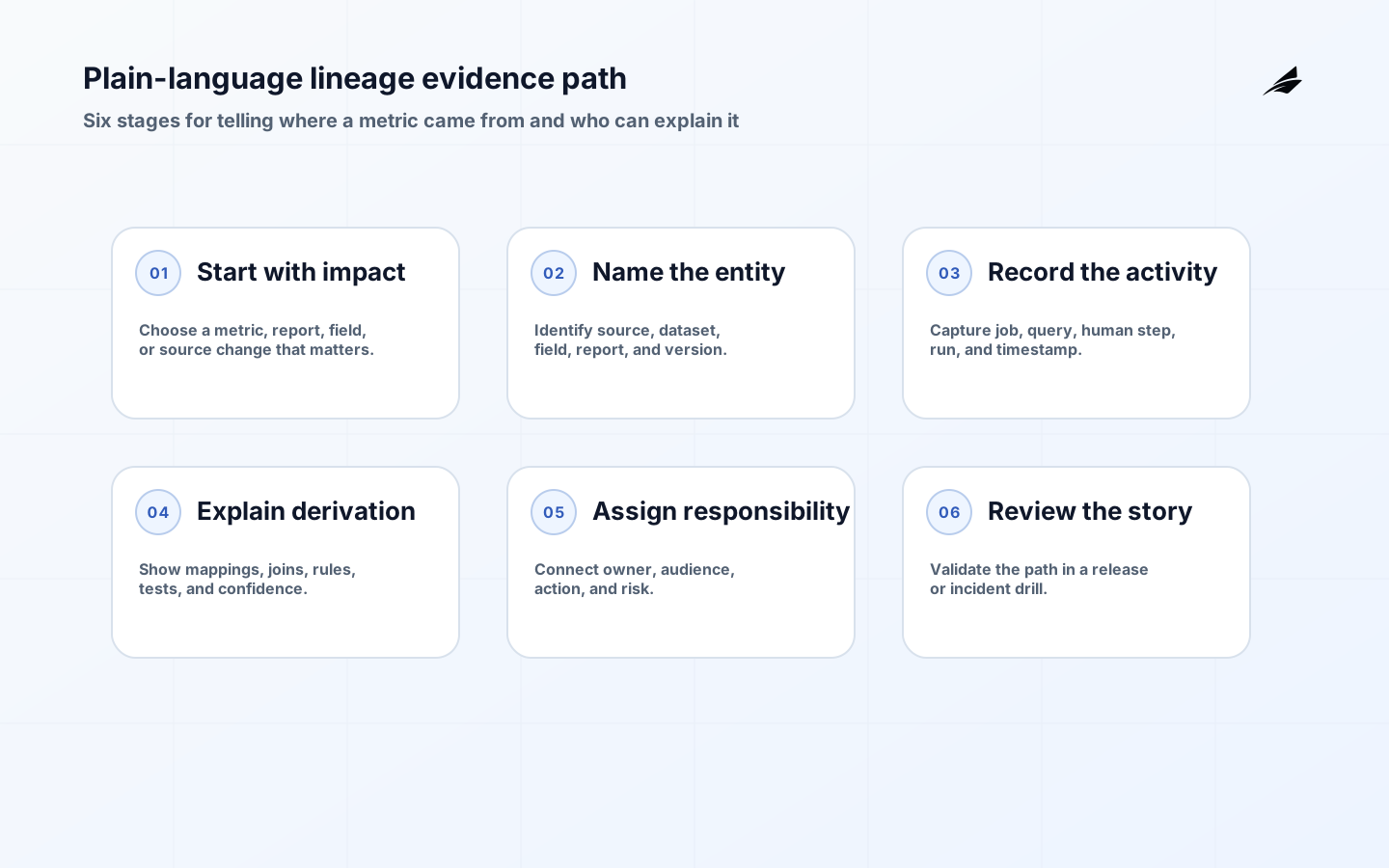
Plain-Language Data Lineage: A Reader's Guide
Data lineage is the evidence-backed story of how a value came to exist, what changed it, and who or what was responsible along the way. In plain language, it answers where a number came from, what may break if its source changes, and who should investigate when it looks wrong. A graph with hundreds of nodes but no definitions, timestamps, or owner can look impressive while leaving an incident responder no closer to an answer. Start with the consequence the map must illuminate.
Start with the consequence the map must explain
Choose a critical report, metric, export, or model and write the questions a reviewer needs answered. Which source feeds it? Which business rule changes meaning? Which teams consume it? What version and cutoff produced the current value? Who owns the source, transformation, definition, and decision? For a CTO, the most important question may be the blast radius of a schema change; for a data steward, it may be the path of a sensitive field; for an operator, it may be the last healthy run before a dashboard changed. Prioritize questions before choosing dataset-level or field-level detail. More granularity is useful only when someone can act on it.
| Lineage idea | Plain-language meaning | Example evidence |
|---|---|---|
| Entity | A source, dataset, field, report, or other thing being described. | Table ID, column, report version, or file hash. |
| Activity | A job, query, transformation, export, or human step that acts on data. | Run ID, code version, schedule, and status. |
| Derivation | The relationship between an input and an output created from it. | Query, mapping, join, model dependency, or rule. |
| Agent | The person, team, service, or system responsible for the work. | Owner, role, on-call route, and approval record. |
Join provenance facts to business meaning
Technical lineage can identify source tables, jobs, models, and reports. Business lineage explains what those assets mean, which decision they support, and what happens when they change. Capture both. A report called orders_daily could mean placed orders, shipped orders, or revenue-recognized orders; only the owner and definition resolve that ambiguity. Add time and status so the map can distinguish a current relationship from a historical one. Add confidence so an inferred parser edge is not mistaken for a manually verified contract. If a manual spreadsheet or external system affects a high-impact metric, register it as part of the path even if the tool cannot discover it automatically.
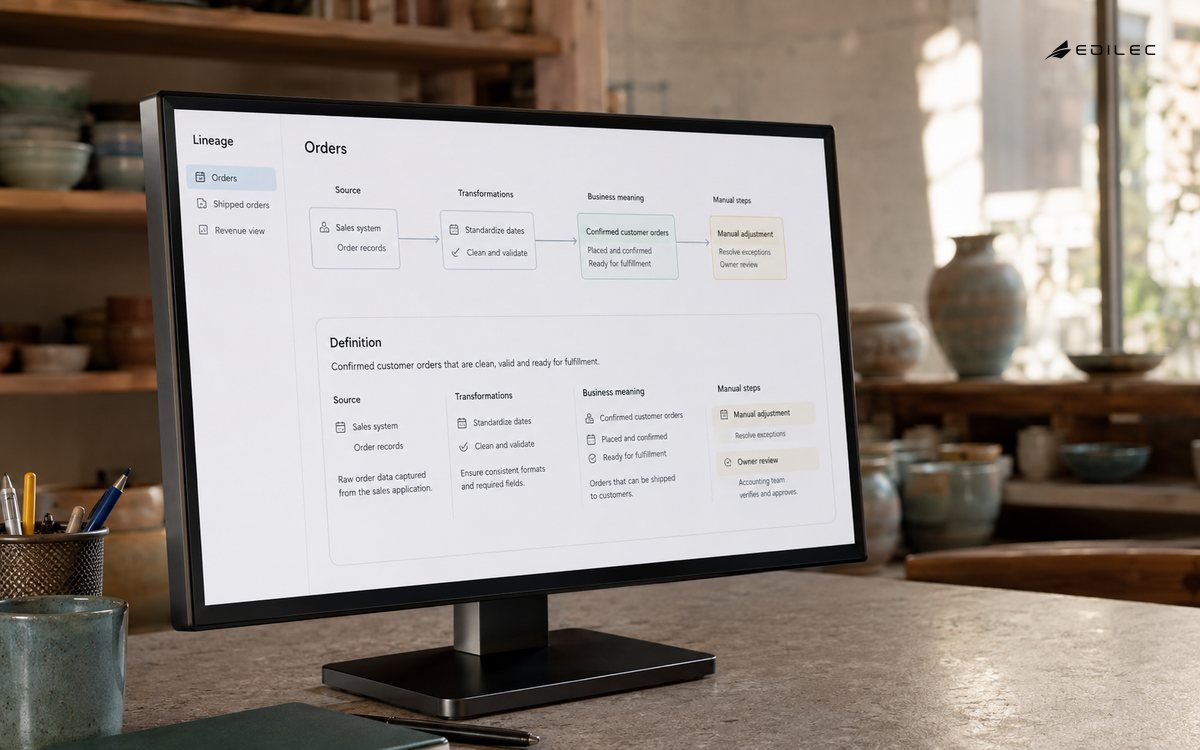
Lineage should also show quality evidence. A data test can prove that a key is unique or a relationship holds for a run, but it does not prove the source was complete or the business definition was accepted. Link tests, freshness, reconciliation, and exception state to the output. The plain-language guide to data pipelines provides a complementary view of source, timing, transformation, and recovery boundaries.
| Use case | Minimum map | Human judgment still needed |
|---|---|---|
| Release impact | Changed asset, downstream dependencies, owners, and effective date. | Which consumers are material and how to communicate. |
| Incident investigation | Output, run, inputs, code/config version, and quality state. | Whether movement is defect, late data, or real change. |
| Privacy review | Field, transformations, copies, access, retention, and audience. | Purpose, lawful use, and acceptable exposure. |
| Metric explanation | Definition, model, source, cutoff, tests, and report context. | Whether the metric fits the decision and incentive. |
Label gaps, confidence, and sensitive copies
Lineage becomes stale when it is captured only at project launch. Emit metadata with jobs and runs, update definitions with semantic changes, and register manual steps when they become material. Use a release gate for critical outputs: a new source or model should have owner, dependency, version, quality, and consumer information before publication. Review the map by walking a real change from source to decision. Ask where the map was inferred, where a manual edge was missing, and whether the impact result was complete enough to act. Retire assets and edges when systems are decommissioned so old paths do not obscure current risk.
A useful lineage review is short and practical. Bring one normal release, one changed definition, one sensitive field, and one recent incident. Compare expected dependencies with observed runs and user reports. Measure time to identify impact, number of unowned critical assets, stale-edge rate, coverage of priority outputs, and cases where an operator found the map misleading. The purpose is not to maximize graph density; it is to make change, explanation, and correction safer. Power BI guidance on lifecycle, security, monitoring, and model design can help teams connect lineage to the surfaces where business users actually consume data.
Tell one changed metric's story end to end
Take a metric whose value moved unexpectedly and narrate it in six sentences: the source record, the activity that processed it, the transformation or derivation, the person or system responsible, the output that changed, and the decision that may be affected. If any sentence is impossible, the lineage gap is concrete. Add the timestamp, version, test state, and confidence label that let a reviewer distinguish a true business change from late data or a defect. This exercise is accessible to executives and engineers because it starts with a number people care about rather than an abstract graph.
Repeat the exercise after a source change and after an incident. The map should show what changed, which consumers were notified, and whether a correction was published. Keep manual steps visible: a spreadsheet upload, analyst adjustment, or approval can be a legitimate part of the lineage if it is controlled and attributed. The goal is not to make every path fully automatic; it is to make the path honest enough that a reader knows where automation ends and judgment begins.
A practical review card can make the story reusable. Put the changed asset at the top, followed by source cutoff, run or query version, derivation summary, quality state, owner, affected audience, and confidence. For a metric change, show one before-and-after record or aggregate that illustrates the rule; for a sensitive field, show where it is copied, who may read it, and when the copy is retired. Ask the reviewer to choose one of three actions: approve the change, request evidence, or pause publication. This small interface prevents lineage from becoming a passive catalog because it links traceability to a decision. When the reviewer chooses pause, preserve the last certified output and record the exact missing edge or ambiguous definition that blocked approval.
Related Edilec reading: data quality in plain language, ELT workflows in plain language, and warehouse modeling in plain language extend the evidence story.
Source context: PROV-DM provides the provenance vocabulary; OpenLineage documents runtime entities, facets, and integrations; dbt data tests demonstrate evidence for key and relationship assumptions; and the W3C Data Quality Vocabulary supplies traceability, understandability, availability, and recoverability context.
Key takeaways
- Lineage tells the story of source, activity, derivation, responsibility, and decision impact.
- Begin with a critical question and choose only the granularity users can act on.
- Join technical dependencies with definitions, owners, classifications, timestamps, and confidence.
- Link tests and quality state to lineage so a path includes evidence, not just arrows.
- Use release and incident drills to find stale or inferred edges, then retire noise.
Frequently asked questions
Is lineage just a data catalog feature?
A catalog can display lineage, but useful lineage also needs runtime events, business definitions, ownership, quality evidence, confidence, and a change process. Treat it as an operating capability connected to releases and incidents, not a static navigation feature.
When is field-level lineage worth it?
It is worth the cost for sensitive fields, regulated reports, breaking schema changes, or metrics whose exact derivation matters. Dataset-level lineage can be enough for broad scheduling and job impact. Prioritize from risk and decision consequence.
Can automated lineage be trusted?
Automation is valuable but incomplete. Show how an edge was collected, when it was observed, what code or query produced it, and which manual or dynamic paths may be missing. Validate critical paths with owners and real drills.
Take one changed metric and write its story for two readers: the engineer who must find the changed input and the manager who must decide whether to use the new value. Include source field, cutoff, run or query version, derivation rule, quality state, audience, owner, confidence, and any manual adjustment. Mark which edges are observed, inferred, or awaiting confirmation. The reader should be able to choose approve, qualify, or pause and know what evidence supports that choice.
Plain-Language Data Lineage: a decision you can operate
Lineage is worth maintaining when it turns an unexplained value into a traceable story. Connect provenance entities and activities to definitions, quality, ownership, access, confidence, and the audience that must act. Be explicit about manual steps, dynamic queries, sensitive copies, and retired systems; a labeled gap is safer than false certainty.
Tell the story of a changed weekly active-user metric in six named facts. The entity is the product-event table and its event-time column. The activity is the ingestion and deduplication run identified by a job version. The derivation is the filter for qualifying events, the account join, and the seven-day window. The agent is the product analytics team that approved the definition and the data platform team that operated the run. The output is the dashboard tile and an executive report that changed by eight percent. The impact is a planning decision that may need to be revisited. Add the source cutoff, test state, and confidence label to each fact. If the change came from a new event name, say so; if it came from late mobile data, say that instead. This structure helps a reader separate a real product shift from a pipeline defect without reading every SQL statement.
Use the six-fact story in a release review and an incident review. In the release, ask which consumers will see a new field, altered population, or changed access boundary, then record the owner and effective time. In the incident, start from the published value and walk backward through the run, derivation, source, and quality state. Mark automatic edges as observed only when the event or query metadata supports them; mark parser inference, manual adjustment, and owner confirmation separately. A missing edge is not a reason to invent certainty. It is a concrete action to instrument a job, register a manual input, add a test, or clarify a definition.
Validate the map with a changed metric or release-impact drill. The result should help a reader find the evidence and responsible person before a plausible number becomes an irreversible decision.