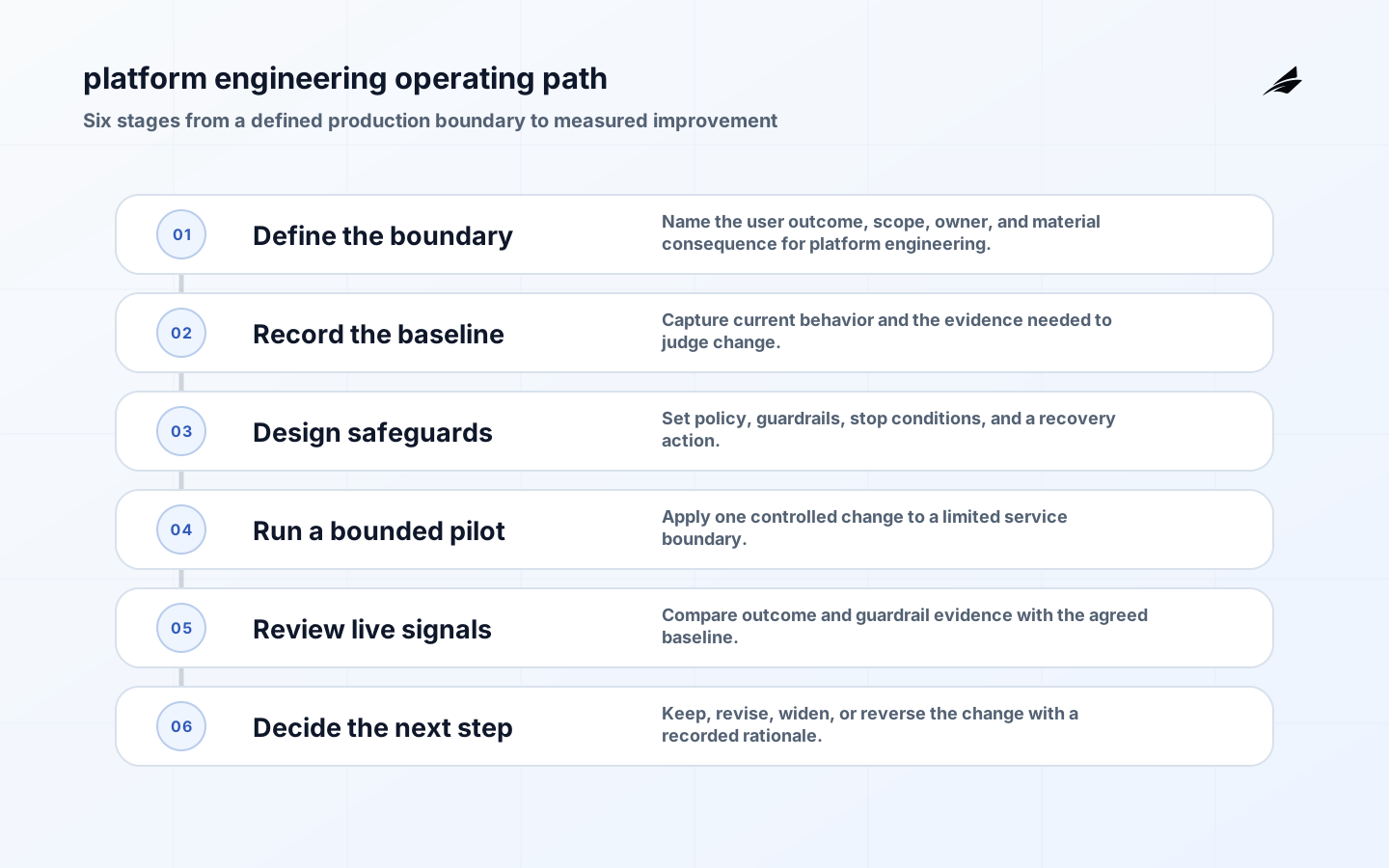
Platform engineering becomes production work when a shared team takes responsibility for a repeatable developer workflow, not when it publishes a catalog of tools. The platform is an internal product: its users need a clear entry point, reliable defaults, support boundaries, and a way to recover when automation fails. The AWS Operational Excellence Pillar and Google Cloud’s operational-excellence framework both ground the work in operating procedures, observability, and continual improvement. That framing is more useful than treating a platform as a pile of infrastructure components.
Draw the platform boundary around a real developer journey
The first production artifact is a documented golden path with its supported use case, self-service interface, service-level expectation, escalation route, and owning platform team. It turns an abstract initiative into a boundary that someone can operate. Write the user outcome, the systems included, the named owner, the decision cadence, and the condition that stops the change For platform engineering, the important risk is building an internal product with broad promises but no dependable workflow, adoption evidence, or capacity to support its users. A boundary is useful only when it makes that risk visible before customers discover it.
Choose one developer journey with recurring friction, such as creating a service with policy-compliant delivery, requesting a preview environment, or obtaining a standard observability baseline. Interview the people who perform it and measure the current lead time, failure modes, and handoffs. The first golden path should reduce a real burden while preserving an escape hatch for exceptional cases. A common interface does not require every team to use the same runtime; it requires the shared path to be clearer and safer than rebuilding the basics.
| Decision element | Question to settle | Evidence to retain |
|---|---|---|
| Outcome | What user or operator result should platform engineering improve or protect? | A baseline, target, and named service owner. |
| Scope | Which services, environments, and actors are included? | A current inventory and explicit exclusions. |
| Guardrail | What harm must stop the work? | Thresholds, alert query, and stop authority. |
| Recovery | How is normal behavior restored? | A tested runbook and decision record. |
Shape an internal product people can operate
Design the platform around contracts. The interface may be a template, portal, API, or repository, but it must declare inputs, generated assets, ownership, policy checks, and support expectations. Integrate existing identity, source control, delivery, and monitoring systems instead of creating an opaque second control plane. Every automation should leave an understandable audit trail and a manual recovery route. Platform teams earn trust when a developer can see what happened to a request and how to correct it.
For platform engineering, keep the architecture legible to the person on call. Show the entry point, authoritative records, identities, policy or control points, telemetry, and the path to a safe state Google Cloud operational excellence framework is a useful reference for the underlying mechanisms. In local design reviews, ask a practical question: when the expected result is absent, which component, owner, and record will establish what happened That question usually exposes missing dependencies sooner than an elaborate diagram does.
Release one supported path and learn from use
Pilot with a small group that has a real deadline and is willing to give feedback, not with a showcase project that hides the difficult edges. Treat adoption as evidence, not a mandate: measure whether the path removes steps and whether teams can complete it without private help. Release documentation, templates, and runtime changes together. The CNCF Platforms whitepaper is useful context for capability boundaries, but local ownership matters more than a reference architecture.
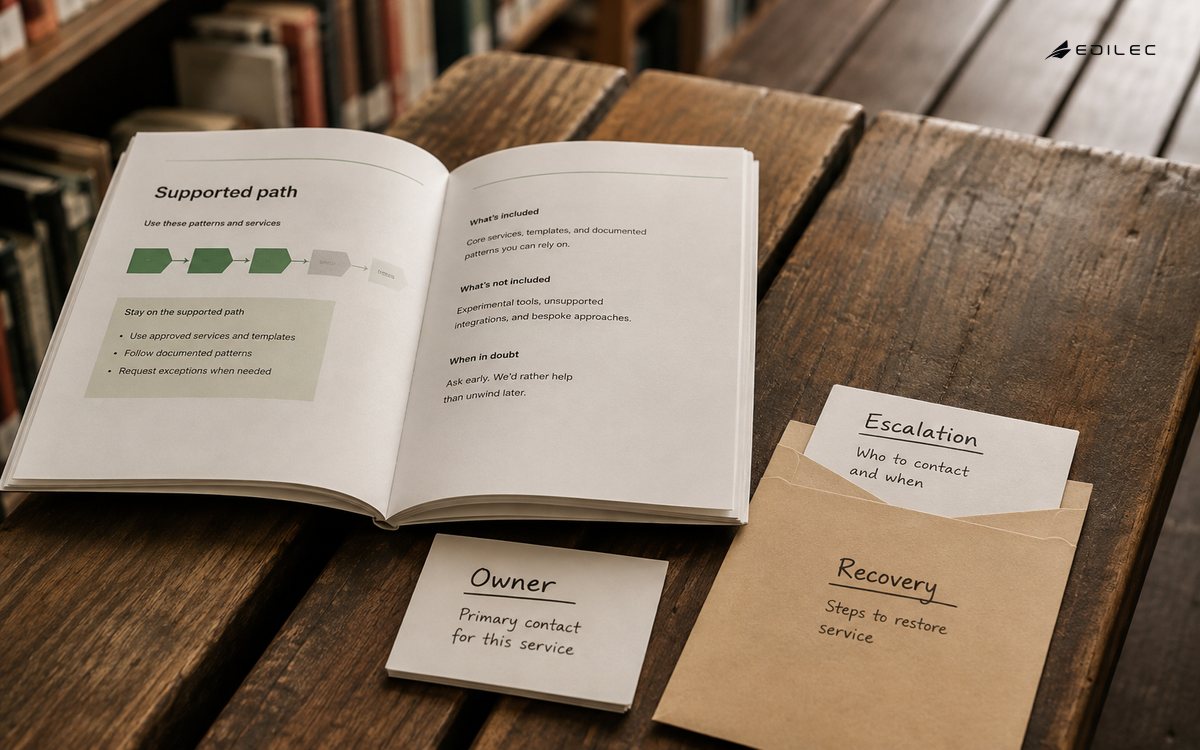
For platform engineering, make the release record specific enough for another operator to continue the work: baseline, exact configuration or revision, expected effect, affected cohort, observation window, guardrail queries, and recovery action. In internal-platform reviews, use the related delivery guide to keep the surrounding change process clear. A small pilot is not a ceremonial prelude; it is how the team learns whether its measurement and response assumptions survive production conditions
| Stage | Minimum output | Decision gate |
|---|---|---|
| Discover | Current boundary, baseline, owner, and known constraints. | The problem can be measured without guessing. |
| Design | Controls, evidence path, and recovery action. | The main consequence has a practical safeguard. |
| Pilot | A limited change with explicit stop conditions. | Observed behavior supports a wider use. |
| Operate | Runbook, alert owner, and review cadence. | Normal turnover will not erase knowledge. |
| Improve | A recorded lesson and next hypothesis. | Evidence, rather than urgency, selects the next change. |
Balance developer experience with production guardrails
Use lead time for a supported change, successful self-service completion, platform reliability, adoption by intended teams, and support demand by capability. Pair a direct outcome measure with a guardrail so a local improvement cannot hide a broader regression Segment by the boundary that matters, such as revision, region, workload, cohort, or service route. Each query should have an owner who understands its limitations and a written action for breach. Google SRE Workbook: Practical Alerting provides authoritative context, but the threshold must reflect the consequence and operating capacity of this service.
Operate the platform as a service. Publish availability and support hours for critical workflows, monitor the internal user journey, and maintain a backlog that distinguishes defects from requests for new capability. A platform incident may be a blocked deployment, a failed access request, or broken template output, not just a cluster outage. Use feedback from support tickets and delivery metrics to simplify the golden path. Retire unsupported paths explicitly rather than allowing each version to remain indefinitely.
Find the platform risks that scale quietly
The typical failure is building a broad portal before proving one reliable path. Another is enforcing standards without providing an easy compliant route, which drives teams back to bespoke scripts. Avoid measuring success by the number of integrations. Measure whether the intended user can make a safe, supported change faster and with fewer surprises. The platform should make good decisions easier, while keeping exceptions visible enough to learn from them.
A sound platform engineering review separates evidence from explanation. Confirm the timeline, scope, and customer effect; then identify the assumption, control, or handoff that failed Use observability and incident context to improve the investigation path rather than adding vague monitoring. Close the review with one owned correction, a due date, and an explicit decision about whether the operating boundary can widen
Leave an evidence trail for platform decisions
A platform roadmap needs an explicit non-goal list. Without it, every request for a dashboard, cluster feature, or bespoke integration looks equally urgent and the golden path becomes an unmaintainable collection. Explain what the team supports today, what belongs to application teams, and how an exception is evaluated. Clear limits make the internal product more trustworthy because users can predict the response they will receive.
For platform engineering, treat a failed self-service request as product feedback. The team should know whether the cause was policy, confusing interface design, an unavailable dependency, or an unsupported case before adding more automation.
Key Takeaways
- Platform engineering should begin with a defined user outcome and a named operating boundary.
- Keep the first production change small enough to observe, stop, and reverse.
- Use an outcome signal with guardrails so apparent improvement does not conceal harm.
- Treat ownership, evidence, and recovery as implementation requirements, not documentation afterthoughts
- Expand only when the team can explain the result and sustain the operating work.
Frequently Asked Questions
When is platform engineering ready for production? In internal-platform reviews, when the scope, accountable owner, evidence, control, and recovery action are explicit and have been exercised for a bounded use. What should a small team do first for platform engineering? In internal-platform reviews, pick one meaningful journey, record a baseline, and make one reversible change; broad programs create evidence gaps. How often should it be reviewed? Review after a material change or incident and on a cadence proportionate to the consequence What if the data is incomplete? Make the uncertainty visible, narrow the action, and improve the measurement before making an irreversible decision This related operations guide can help establish the surrounding reliability practice
Conclusion
The durable version of platform engineering is an operating promise: what the team is improving or protecting, who can decide, which evidence matters, and how harm is contained. Start with the smallest decision that matters, keep the path reversible, and let measured production behavior determine the next investment That approach produces a capability the team can explain, operate, and improve under real pressure.
A production platform earns room to grow when its owning team can show the supported journey, service expectation, dependency map, adoption evidence, and last recovery exercise. Review those artifacts with a developer and an on-call responder together. Their questions expose different weaknesses: the first tests whether the path is usable, while the second tests whether the promise can survive pressure.
For this platform-in-production case, test a new developer path with a real service, then make one dependency unavailable and one permission deliberately too narrow. The review should capture task completion, user friction, platform health, escalation time, and the decision to widen, revise, or pause. Ask the next operator to repeat the recovery without the original author present. Compare the result with the support promise and capacity available to the platform team. The result is an evidence-backed boundary for the next cohort, not a claim that every future workload is already supported.
Platform engineering becomes durable when its internal products have explicit consumers, contracts, and support limits. Review a golden path from request to production, including identity, observability, policy changes, incident escalation, and retirement. If a team must open a ticket for every routine change, the platform has not yet made the boundary usable. Measure successful self-service and the exceptions that still require specialist help, then improve the narrowest interface that blocks delivery.