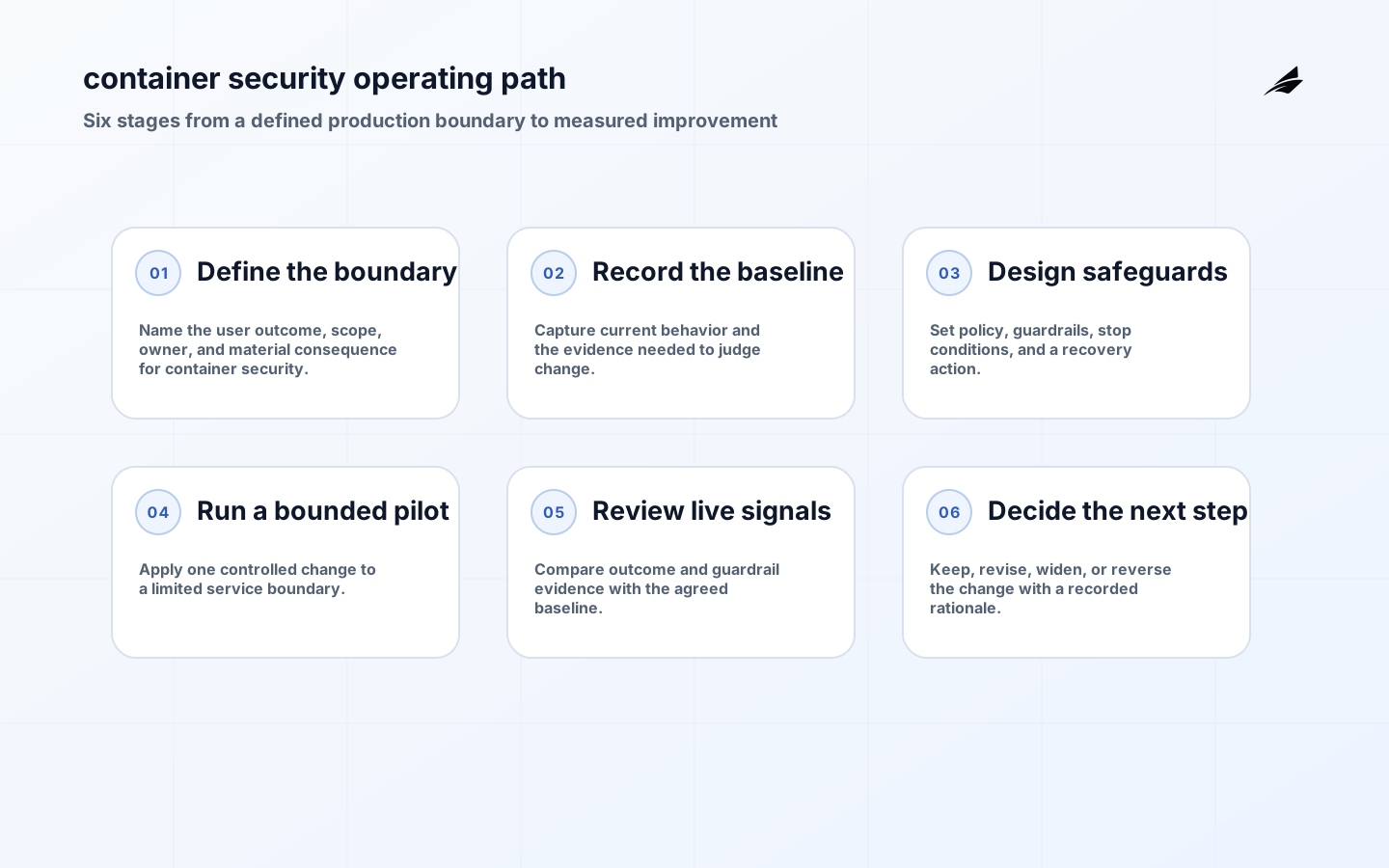
Container security is a chain of decisions from source code to runtime, not a vulnerability scan bolted onto an image registry. An image can be clean when built and still run with excessive privileges, a writable filesystem, exposed credentials, or unbounded network access. NIST SP 800-190 describes the lifecycle and host, image, registry, and orchestrator concerns; Kubernetes Pod Security Standards translate several runtime constraints into practical policy levels. A production approach needs evidence at each handoff.
Name the container consequence and evidence
The first production artifact is a supply-chain record that connects source revision, build system, image digest, vulnerability assessment, deployment policy, runtime identity, and incident owner. It turns an abstract initiative into a boundary that someone can operate; runtime review context remains explicit. Write the user outcome, the systems included, the named owner, the decision cadence, and the condition that stops the change; runtime review context remains explicit. For container security, the important risk is shipping an image or runtime configuration with unnecessary privilege, unknown provenance, exposed credentials, or an unpatched exploitable component. A boundary is useful only when it makes that risk visible before customers discover it; runtime review context remains explicit.
Define the security boundary for a workload before selecting controls. Identify the service account, data classification, network peers, image source, deployment namespace, and the action that would constitute meaningful compromise. Start with a baseline that removes known unnecessary privilege: non-root execution where compatible, read-only filesystems where feasible, dropped capabilities, explicit resource limits, and scoped identity. Exceptions should name the reason, owner, expiry, and compensating control instead of becoming invisible annotations.
| Decision element | Question to settle | Evidence to retain |
|---|---|---|
| Outcome | What user or operator result should container security improve or protect? | A baseline, target, and named service owner. |
| Scope | Which services, environments, and actors are included? | A current inventory and explicit exclusions. |
| Guardrail | What harm must stop the work? | Thresholds, alert query, and stop authority. |
| Recovery | How is normal behavior restored? | A tested runbook and decision record. |
Make the source-to-runtime chain legible
Preserve provenance from commit to deployed digest. Builds should use controlled dependencies and generate an immutable image reference; the deployment should admit only images that satisfy the organization’s policy; runtime telemetry should identify the image and workload identity involved in an event. Keep secrets outside images and manifests that are broadly readable. Kubernetes’ security checklist offers a practical inventory of cluster and workload controls, but do not mistake a cluster setting for application authorization.
For container security, keep the architecture legible to the person on call. Show the entry point, authoritative records, identities, policy or control points, telemetry, and the path to a safe state; runtime review context remains explicit. Kubernetes Pod Security Standards is a useful reference for the underlying mechanisms. In local design reviews, ask a practical question: when the expected result is absent, which component, owner, and record will establish what happened; runtime review context remains explicit. That question usually exposes missing dependencies sooner than an elaborate diagram does; runtime review context remains explicit.
Pilot one workload with an explicit exit
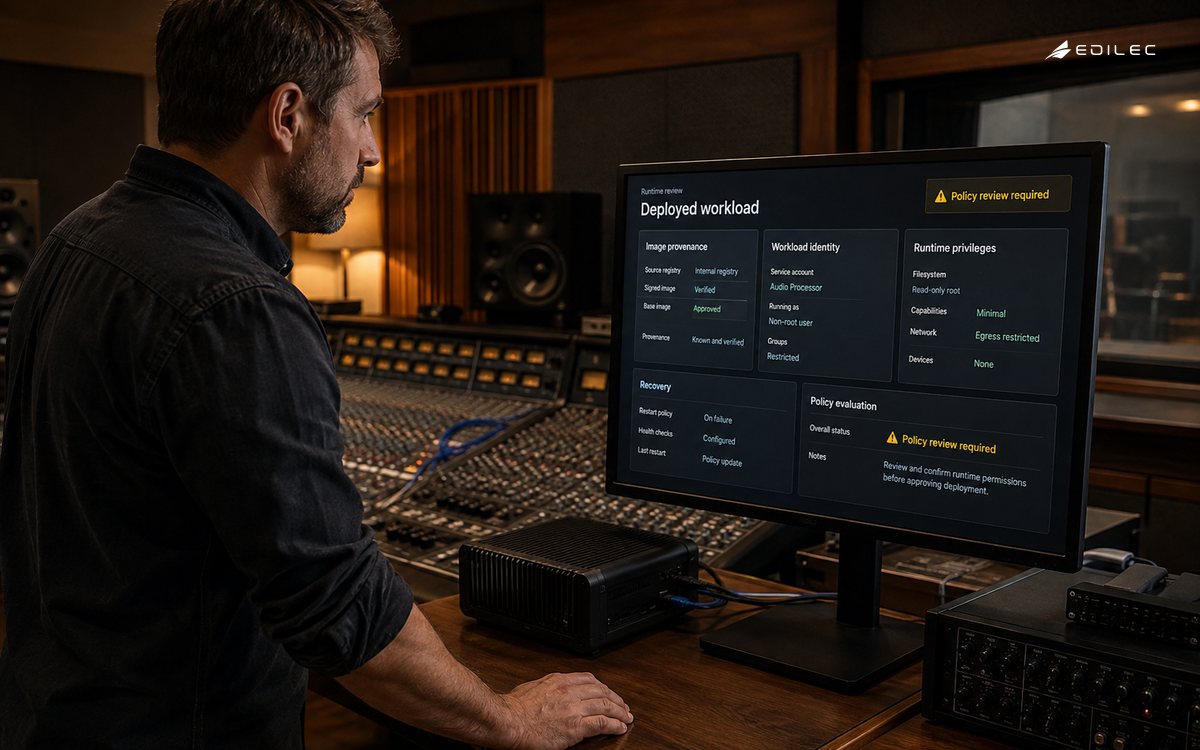
Introduce enforcement in stages. Begin in audit mode to learn which workloads violate a proposed rule and whether the rule catches a meaningful condition. Fix configuration patterns and base images before blocking teams, then enforce for new workloads and progressively for existing services. Test the emergency exception workflow as carefully as the policy itself. A security gate that cannot be understood or resolved during a release will be bypassed at the worst possible time.
For container security, make the release record specific enough for another operator to continue the work: baseline, exact configuration or revision, expected effect, affected cohort, observation window, guardrail queries, and recovery action. Use the related delivery guide to keep the surrounding change process clear. A small pilot is not a ceremonial prelude; it is how the team learns whether its measurement and response assumptions survive production conditions; runtime review context remains explicit.
| Stage | Minimum output | Decision gate |
|---|---|---|
| Discover | Current boundary, baseline, owner, and known constraints. | The problem can be measured without guessing. |
| Design | Controls, evidence path, and recovery action. | The main consequence has a practical safeguard. |
| Pilot | A limited change with explicit stop conditions. | Observed behavior supports a wider use. |
| Operate | Runbook, alert owner, and review cadence. | Normal turnover will not erase knowledge. |
| Improve | A recorded lesson and next hypothesis. | Evidence, rather than urgency, selects the next change. |
Use runtime evidence to choose the next move
Use signed-image coverage, critical-vulnerability remediation time, policy violations blocked before runtime, runtime alert quality, and privileged-workload count. Pair a direct outcome measure with a guardrail so a local improvement cannot hide a broader regression; runtime review context remains explicit. Segment by the boundary that matters, such as revision, region, workload, cohort, or service route; runtime review context remains explicit. Each query should have an owner who understands its limitations and a written action for breach; runtime review context remains explicit. Kubernetes Security Checklist provides authoritative context, but the threshold must reflect the consequence and operating capacity of this service.
Runtime security needs a response path. Collect only the events that an owner can investigate, correlate them with workload identity and image digest, and tune alerts using real benign behavior. Patch and rebuild schedules should reflect exploitability and exposure, not just a raw scanner count. OWASP Docker guidance is valuable for developer-facing hygiene such as minimal images and avoiding secrets in Dockerfiles. Review drift between the declared policy and the workloads actually admitted.
Test the edge cases that bypass a clean scan
The shallow approach scans images once and calls the job finished. It misses base-image change, transitive dependency exposure, misconfigured admission, and risky runtime behavior. The opposite mistake is a blanket block that stops delivery while offering no supported remediation. Tie each control to a threat and a recovery action. Security becomes durable when engineers can ship a compliant workload by default and responders can identify what ran, where, and with which authority.
A sound container security review separates evidence from explanation. Confirm the timeline, scope, and customer effect; then identify the assumption, control, or handoff that failed; runtime review context remains explicit. Use observability and incident context to improve the investigation path rather than adding vague monitoring; runtime review context remains explicit in the first pass. Close the review with one owned correction, a due date, and an explicit decision about whether the operating boundary can widen; runtime review context remains explicit.
Leave a record another responder can use
Security exceptions must be designed for expiry. A temporary privileged workload, permissive network rule, or unsigned development image should carry an owner, reason, compensating protection, and automatic review date. Measure exceptions as operational debt, not as normal configuration. This avoids the familiar situation in which a critical control technically exists but most production workloads are permanently excluded from it.
For container security, investigate policy violations in the context of workload purpose and exposure. A clear remediation path for a build image, runtime identity, or privilege request keeps the security control useful during delivery pressure.
Make the compliant path the convenient path by maintaining secure base images and working deployment patterns. Otherwise policy becomes an obstacle rather than a repeatable engineering practice.
Key Takeaways
- Container security should begin with a defined user outcome and a named operating boundary.
- Keep the first production change small enough to observe, stop, and reverse; runtime review context remains explicit.
- Use an outcome signal with guardrails so apparent improvement does not conceal harm; runtime review context remains explicit.
- Treat ownership, evidence, and recovery as implementation requirements, not documentation afterthoughts.
- Expand only when the team can explain the result and sustain the operating work; runtime review context remains explicit.
Use this article's decision boundary as an operating contract. Name the user or operator, trusted inputs, the owner who can act, the response window, and the safe state when evidence is late or wrong; runtime review context remains explicit. Before widening scope, capture a baseline and test one normal path plus one credible exception; runtime review context remains explicit. Record the version, approval, observed signal, and recovery result in the same review record; runtime review context remains explicit. This makes a failure interpretable: the team can tell whether the rule, data, permission, or handoff caused the outcome; runtime review context remains explicit. Keep controls close to the consequence, explanations close to the next decision, and the pilot small enough to reverse; runtime review context remains explicit. At review, remove checks that create work without changing behaviour and add only the smallest next hypothesis; runtime review context remains explicit. The result is a capability that can survive turnover, explain exceptions, and improve from production evidence rather than confidence alone; runtime review context remains explicit. For runtime security, record the effective policy, image digest, observed behaviour, exception owner, and recovery action. Keep enforcement at the consequence boundary and keep the explanation available to the next approver.
FAQ: container security production questions
When is container security ready for production? Use the runtime boundary only after its owner, evidence, enforcement rule, and recovery drill are explicit. What should a small team do first for container security? Trace one workload path, establish its baseline, and make a reversible hardening change before widening scope. How often should it be reviewed? Recheck the runtime rule after a release or incident, using a review rhythm set by exposure. What if the data is incomplete? When runtime evidence is incomplete, limit exposure, improve the signal, and defer irreversible action. This related operations guide can help establish the surrounding reliability practice.
Conclusion
The durable version of container security is an operating promise: what the team is improving or protecting, who can decide, which evidence matters, and how harm is contained. Start with the smallest decision that matters, keep the path reversible, and let measured production behavior determine the next investment; runtime review context remains explicit. That approach produces a capability the team can explain, operate, and improve under real pressure; runtime review context remains explicit.
For What Changes When Container Security Moves into Production, the durable implementation is a sequence of bounded decisions. State the operating context, identify the evidence that can change the decision, name the owner who can act, and record the condition that triggers review; runtime review context remains explicit. This keeps the guidance useful after launch: a team can compare intended outcomes with observed behavior, explain exceptions without normalizing them, and choose the next smallest corrective action; runtime review context remains explicit. For Container Security: Runtime Evidence, the useful record preserves the evidence that lets the owner choose the next safe action.
A useful operating decision for What Changes When Container Security Moves into Production begins with a specific boundary. Name the service, workflow, data set, or team in scope; then state which outcome matters and which trade-off is acceptable; runtime review context remains explicit. For container security, that means separating the design choice from the controls that make it safe to operate. A small pilot should expose the assumptions most likely to fail: ownership, dependency order, permissions, capacity, timing, or evidence quality; runtime review context remains explicit. Record those assumptions before implementation and revisit them after real traffic or real decisions arrive; runtime review context remains explicit. When the result differs from the plan, classify the gap rather than hiding it; runtime review context remains explicit. Is the issue a missing control, an incorrect model, an unmeasured dependency, or a changed requirement; runtime review context remains explicit. Each answer leads to a different next action. Keep the corrective action narrow enough to test, give it an owner and review date, and preserve the evidence in the team’s normal working record; runtime review context remains explicit. This approach keeps the practice useful as systems evolve because it connects day-to-day execution with a repeatable decision loop; runtime review context remains explicit.