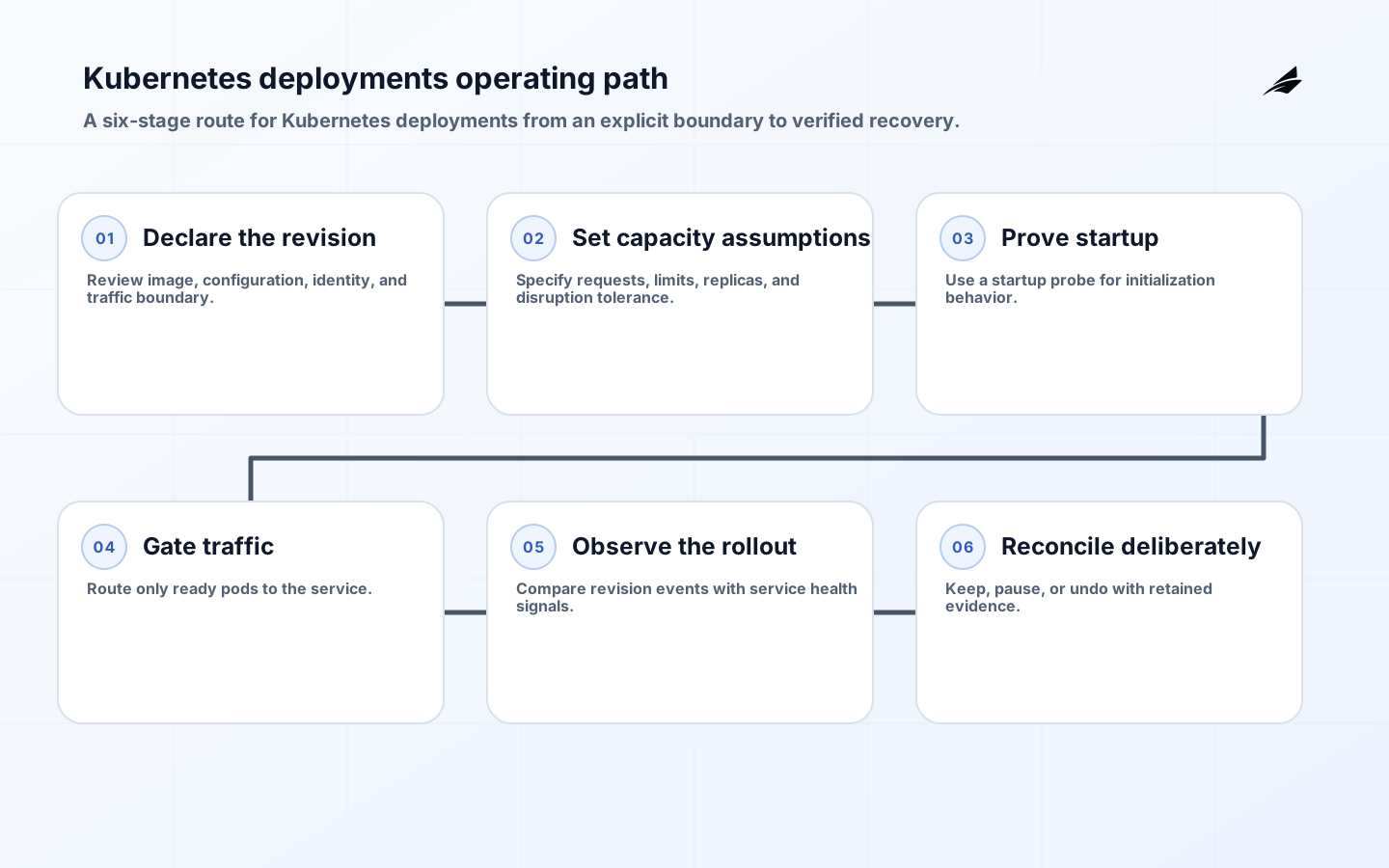
Kubernetes deployments decisions belong before implementation because the difficult work is not choosing a tool; it is defining what must remain true when rolling a new ReplicaSet into a live service. For engineering teams, the starting point is a declared workload revision, its pod template, and the traffic and capacity assumptions around it. Treat that unit as a product boundary: name its owner, its acceptable failure modes, the evidence needed to change it, and the people who can stop a risky action. Kubernetes probe documentation describes a disciplined operational perspective, while Kubernetes resource management guidance grounds the same idea in repeatable practices. A first build becomes more useful when it is built against these decisions rather than used to discover them under production pressure.
Start with the decision frame
The core decision for Kubernetes deployments is whether a proposed change is understandable enough to approve and bounded enough to reverse. That means writing down the unit being changed, the affected customers or systems, the dependency that can make the change unsafe, and the expected evidence after it runs. A team does not need a committee for every edit. It does need a stable rule for changes that alter availability, security, money movement, regulated data, or a shared platform. When the rule is explicit, routine work can move quickly and unusual work receives the attention it deserves.
Use a small decision record before committing to a production design. Capture the desired outcome, the assumptions that make it safe, the owner who accepts operational consequences, and the first signal that would tell you the assumption is wrong. This is deliberately more concrete than a tool comparison. It prevents a healthy demo from becoming a fragile operating model. Kubernetes deployments should give a later responder enough context to distinguish intended behavior from an accidental side effect, even when the original implementer is unavailable.
Define boundaries and ownership
A useful boundary limits both blast radius and ambiguity. For this topic, the boundary is a declared workload revision, its pod template, and the traffic and capacity assumptions around it. Decide which inputs are trusted, which identities may act, where credentials are held, and which dependent system owns durable truth. Then state the handoff: who approves a high-risk change, who watches the outcome, and who is responsible for repair. Broad access is not a substitute for an operating model. Narrow permissions and named ownership make it possible to understand why a change occurred and to halt it without needing every administrator online.
The boundary also needs a time dimension. Some changes can be retried safely, some must be serialized, and some have an irreversible moment such as a customer notification, a schema removal, or a credential rotation. Make that moment visible in the design. A reversible technical action can still be operationally irreversible once an external effect has escaped. This distinction is especially important when product, platform, and security teams share responsibility but observe different parts of the system. In kubernetes deployments, identify that point explicitly: it is where the system changes from an intention into an effect that another team or customer must live with.
| Decision area | Question to settle before build | Evidence to keep |
|---|---|---|
| Ownership | Who can approve, operate, and stop the change? | Named role, escalation path, and access review. |
| Boundary | What inputs, identities, and dependencies are in scope? | Contract, permission policy, and dependency map. |
| Exposure | How much customer or system impact is acceptable initially? | Cohort, rate, or environment limit. |
| Recovery | What restores a safe state and who may invoke it? | Practiced procedure and completion check. |
Build an operating model, not just an implementation
The most durable design turns the important sequence into an ordinary path: describe the intended state, verify it, make a bounded change, observe the result, and preserve a route to repair. A Deployment manages ReplicaSets and rollout history, while readiness probes determine whether a container is ready to accept traffic; resource requests influence scheduling decisions. This is not a claim that every failure can be prevented. It is a way to keep failures legible. The implementation should expose the same identifiers across its change record, runtime activity, and operator view so a person can connect cause, effect, and decision without reconstructing a story from scattered consoles.
Choose controls for real failure modes
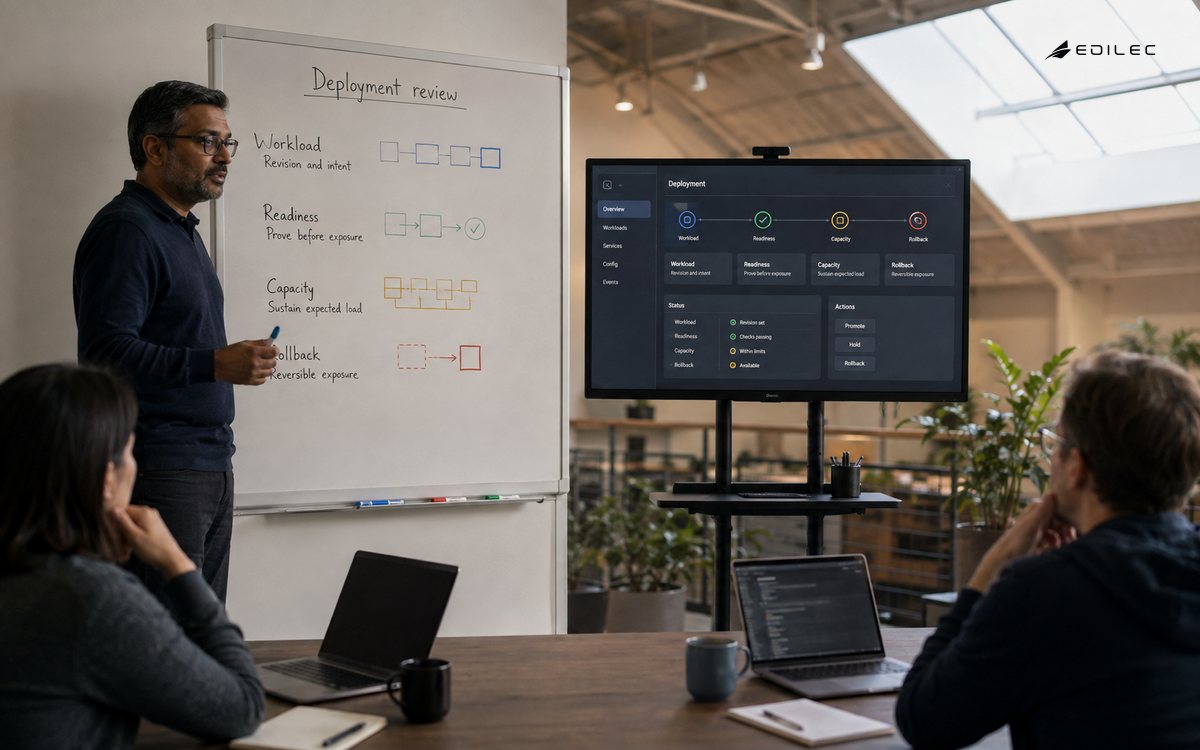
Controls are useful only when they interrupt a credible path to harm. The main risk here is a manifest that conflates application readiness, liveness, resource needs, and rollout speed. Match each control to a failure mode: review catches an unintended design choice; least privilege limits an unwanted action; a staged exposure limits customer impact; an immutable record supports investigation; and an exercised recovery path limits duration. Avoid compensating for a vague risk with a long checklist. A shorter control set that is owned, automated where appropriate, and tested after change is far more likely to work when conditions are messy.
Separate preventive controls from detective and corrective controls. A policy or validation step may prevent a known bad state, but it cannot prove the production result is healthy. Runtime signals detect the gap; pausing or undoing a revision only after checking that configuration and dependent data remain compatible provides the corrective option. Keeping these roles separate prevents the common mistake of declaring success merely because a deployment, apply, sync, or invocation returned without an immediate error.
| Failure mode | Proportionate control | Operational check |
|---|---|---|
| Unintended change | Reviewable version and policy validation | Confirm the executed revision matches approval. |
| Excessive exposure | Small initial cohort or scoped target | Compare outcome with a pre-change baseline. |
| Missing context | Stable identifiers and structured records | Trace the action across system boundaries. |
| Bad outcome | Prepared corrective path with authority | Exercise recovery and verify the expected state. |
Measure the outcome that matters
Choose signals that answer whether the design is doing its job, not simply whether a component is busy. For Kubernetes deployments, watch available replicas, rollout conditions, readiness failures, scheduling pressure, saturation, and request-level service outcomes. Pair a technical signal with a customer or business completion signal where possible. A queue draining, a deployment becoming available, or a job returning success can be misleading when the customer journey remains broken. Establish a baseline before a material change and decide which movement triggers investigation, pause, or escalation. That turns telemetry into evidence for a decision rather than a stream of reassuring numbers.
Evidence should stay close to the work. Link the change record to its review, execution identity, operational dashboard, and follow-up issue. That makes learning cheaper after both successes and incidents. It also makes audit and handoff practical without making every engineer memorize the history. The adjacent guidance on Kubernetes deployment checklist, rollback architecture, and service-level objectives is useful when these signals reveal a broader delivery or reliability problem.
Sequence the first implementation
For Kubernetes deployments, begin with one bounded production path rather than a broad rollout. Pick an owner, a representative service or environment, and a known customer journey. Implement the contract and minimum controls first; then run a deliberately safe exercise that proves the team can observe, pause, and recover. In this domain, the exercise should deliberately test the dependency most likely to invalidate the design. Expand only after the evidence is useful to the people who will operate it; the aim is a repeatable operating path, not a perfect first diagram.
- Write the Kubernetes deployment boundary, accountable owner, and decision authority in the service record.
- Define one expected outcome and one stop condition before enabling rolling a new ReplicaSet into a live service.
- Implement identifiers that connect review, execution, and the affected runtime behavior.
- Run a scoped exercise that tests a normal path and the most likely harmful failure mode.
- Record observed available replicas, rollout conditions, readiness failures, scheduling pressure, saturation, and request-level service outcomes and compare it with the agreed baseline.
- Turn lessons into a small change to the contract, control, or recovery runbook.
Key takeaways
- Kubernetes deployments is an operating decision before it is a tooling decision.
- A clear boundary and named authority reduce both blast radius and response time.
- Evidence must connect the approved change to the actual runtime result.
- Preventive controls need complementary production signals and a corrective path.
- A practiced recovery is more credible than a recovery claim in documentation.
Frequently asked questions
What is the minimum viable starting point? Begin with one bounded Kubernetes deployment, a named owner, an explicit change record, one meaningful outcome signal, and a tested corrective action. That foundation is enough to reveal the next constraint without prematurely standardizing every team. What should trigger a pause? Pause when the expected operational or customer signal moves beyond the agreed limit, when the execution cannot be tied to an approved revision, or when the recovery action is no longer understood well enough to use safely.
How often should kubernetes deployments be reviewed? Review it after material incidents, meaningful changes in dependency or data sensitivity, and scheduled recovery exercises. The cadence should reflect the consequence of this specific system, not calendar habit. The review should test whether the current owner, signal, stop condition, and corrective action still describe production reality. Its useful output is an updated decision record that corrects assumptions before they harden into a response problem.
Conclusion
Good Kubernetes deployments design makes the next safe action obvious. Define a declared workload revision, its pod template, and the traffic and capacity assumptions around it, make the risk and authority visible, preserve evidence, and prove that a bad outcome can be contained. Those choices create a practical foundation for implementation and give engineering teams something better than a promising first build: a system that can be changed, understood, and repaired under real operating conditions.