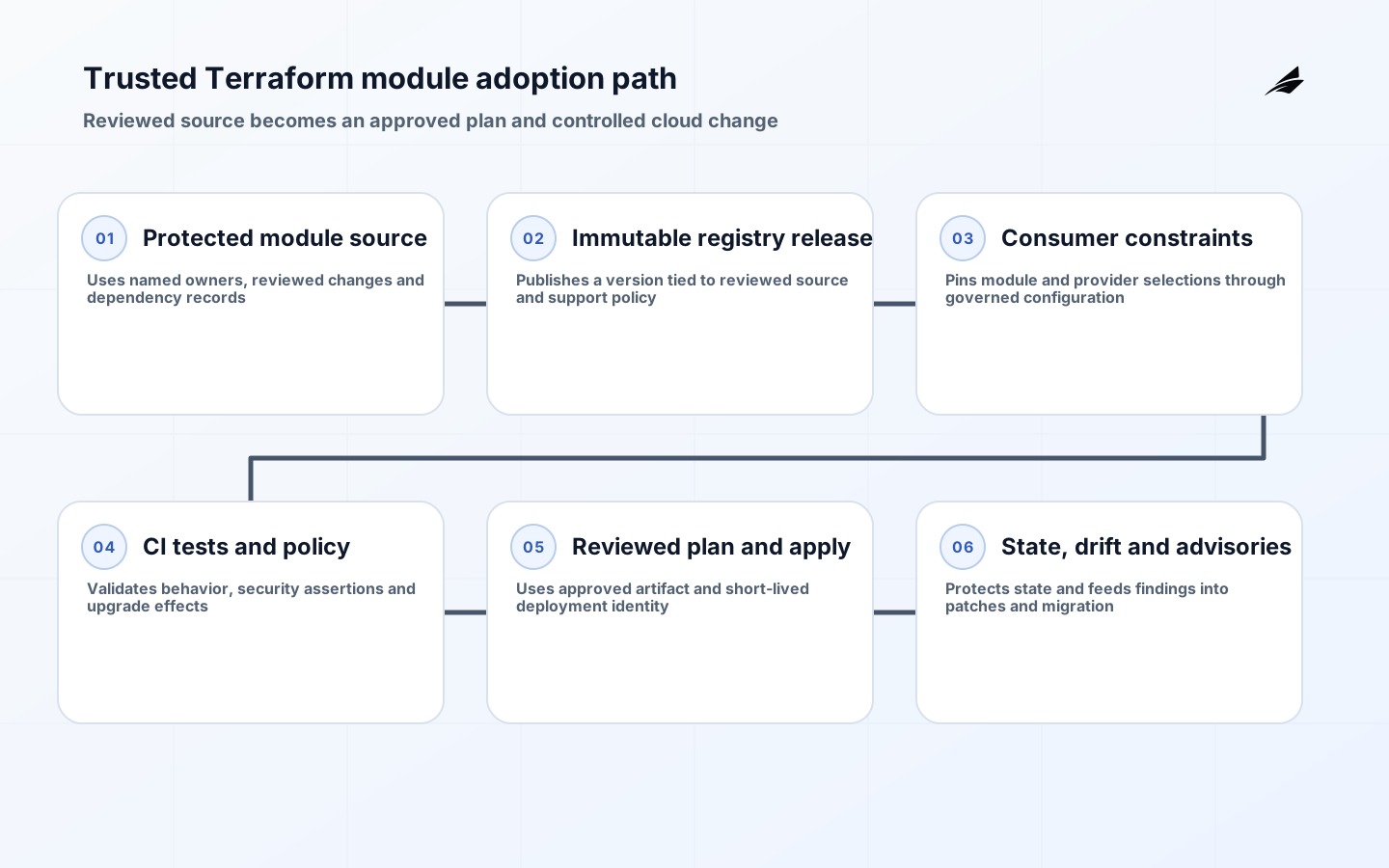
A Terraform module packages infrastructure resources behind inputs and outputs. Reuse can standardize secure defaults and reduce repeated configuration, but it also multiplies mistakes and privilege. A networking or identity module may create high-impact resources in every environment that consumes it. Security review must therefore cover the module's behavior, interface, source, release process, provider permissions, state data, upgrade path and operating context. Passing a static scanner is useful evidence, not a complete review.
Review the smallest coherent unit. Understand the root module that calls it, nested modules, provider configuration, data sources, external scripts and resources created indirectly. Generate a plan in a representative environment and compare it with documentation. A module that appears to create a storage service may also create keys, roles, logs and network rules. Scope the review to specific source and version; a registry name or moving branch is not an immutable artifact.
Key takeaways
- Treat reusable modules as privileged software with owners, versions, provenance and vulnerability response.
- Keep module boundaries cohesive and interfaces narrow enough to preserve secure invariants.
- Pin module and provider selections through a governed dependency and lock-file process.
- Review planned resources, IAM relationships, state exposure and destructive change, not syntax alone.
- Test defaults, invalid inputs, upgrades, imports, drift and failure before broad adoption.
- Publish approved modules through a registry with deprecation, migration and emergency withdrawal paths.
Establish source and release trust
Record repository, owner, license, support status, version, commit, registry publisher, dependencies and release method. Prefer a trusted private or verified registry path for organizational modules. HashiCorp notes that registry publication supports versioning and generated documentation, but consumers still need governance. Avoid unpinned VCS branches. Review the dependency lock file for provider selections and verify how automation updates it. Module source constraints and provider constraints solve different dependency problems; govern both.
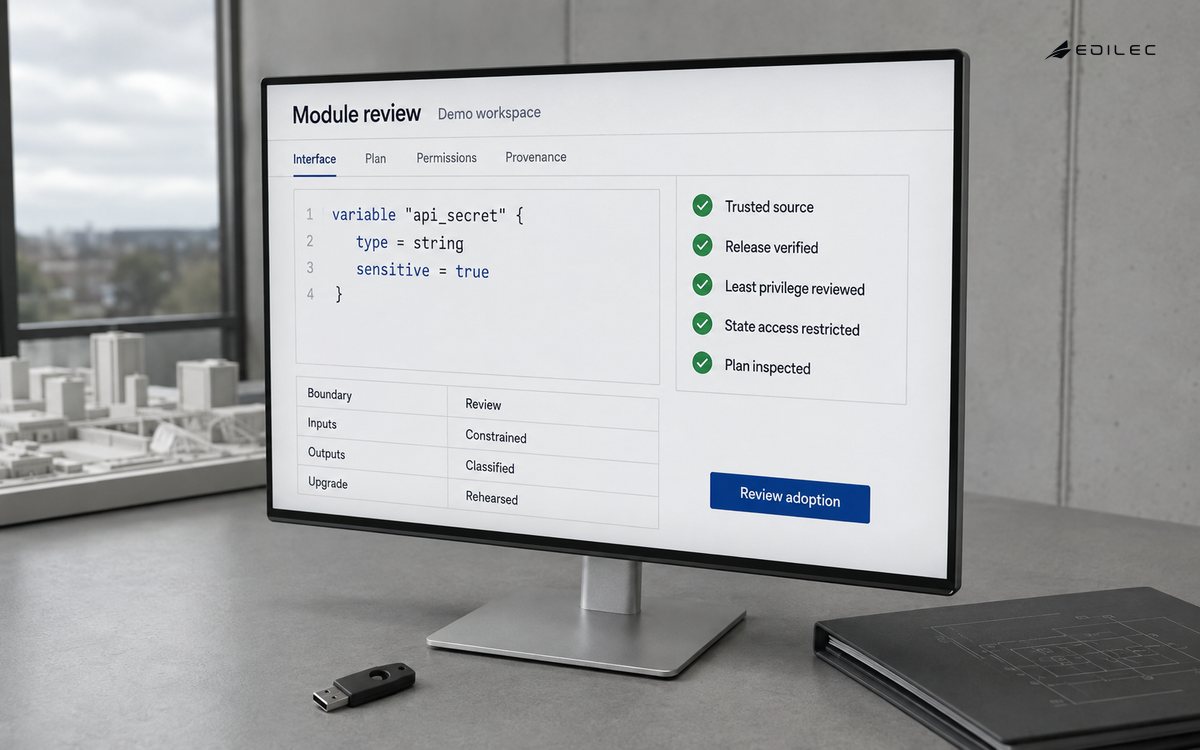
Protect the source repository with reviewed changes, strong maintainer identity, branch rules and limited release authority. Releases should be immutable and traceable to reviewed source. Generate attestations or provenance where the build and distribution process supports them, applying SLSA concepts according to risk. Maintain a security contact, vulnerability intake, supported-version policy and emergency advisory process. Forking an abandoned public module creates ownership obligations; it does not freeze the risks in its providers or cloud APIs.
| Trust question | Evidence | Reject or escalate when |
|---|---|---|
| Who owns it? | Named maintainers and support policy | Ownership is anonymous or inactive |
| What was reviewed? | Immutable version and source commit | Source uses a moving reference |
| How was it released? | Protected workflow and provenance | Maintainer workstation can publish silently |
| What does it depend on? | Nested modules and provider constraints | Dependencies are hidden or unconstrained |
| How is risk handled? | Advisory and patch process | No supported upgrade or disclosure path |
| Can it be withdrawn? | Registry controls and consumer inventory | Consumers cannot be identified |
Review module boundaries and interfaces
HashiCorp recommends moderation and relatively flat composition because excessive modules and nesting reduce reuse and clarity. A security boundary should group resources that share purpose, privilege, lifecycle and rate of change. Highly privileged identity or routing resources may deserve a separate module and stricter ownership. Do not create a module merely to hide a single resource, and do not combine an entire platform into one module whose plan is impossible to reason about or upgrade safely.
Inputs should express supported decisions, not expose every provider argument. Secure defaults are valuable only when documented and suitable for the intended context. Mark sensitive variables, but remember that sensitivity mainly controls display and does not keep values out of state. Use validation, preconditions and mutually exclusive options to reject unsafe combinations. Outputs should be minimal, stable and nonsecret where possible. Avoid outputting whole resource objects because they expand coupling and may expose sensitive attributes.
Inspect resources, identity and network effects
Read each resource and data source against provider documentation. Check encryption, public access, logging, retention, deletion protection, backup, network exposure, key ownership and regional placement. Trace IAM principals, trust policies, actions and resource scopes. Wildcards may be necessary for some provisioning operations, but require explanation and deployment-role boundaries. Separate the permissions Terraform needs to create infrastructure from permissions workloads receive at runtime. Running Terraform as a broad administrator defeats least privilege even if created roles are narrow.
Review implicit effects: default security groups, service-linked roles, public endpoints, generated credentials, DNS changes and replacement behavior. Confirm provider aliases and account or subscription selection cannot route resources to the wrong boundary. Validate tenant, environment and region identifiers from trusted workspace configuration. External data sources, local-exec and remote-exec provisioners introduce arbitrary execution and secret leakage risk; avoid them where provider resources or image build processes can perform the job more predictably.
| Review area | Questions | Test evidence |
|---|---|---|
| IAM | Who can assume, create and use each role? | Policy simulation and negative access tests |
| Network | Which paths are public, inbound or cross-boundary? | Rendered rules and connectivity test |
| Data | What is stored, logged, backed up and deleted? | Configuration plus restore or deletion exercise |
| Keys and secrets | Where are values generated and persisted? | State inspection and rotation test |
| Lifecycle | What changes force replacement or destroy? | Upgrade and changed-input plans |
| Observability | Can owners detect drift and failure? | Enabled telemetry, alerts and response owner |
Protect state, plans and automation credentials
Terraform state can contain identifiers, topology and sensitive values, including secrets returned by providers. Use a remote backend with encryption, access control, versioning or recovery, locking and audit logs appropriate to risk. Segregate state by environment and trust boundary so one workspace identity cannot read unrelated systems. Restrict state downloads and local copies. A variable marked sensitive can still be persisted. Prefer secret references or post-provisioned secret delivery when the provider and workload design allow it.
Plans also reveal configuration and can become stale. Generate and apply through a protected workflow, preserve the approved plan artifact where feasible, and ensure the apply uses the intended code, variables and identity. Use short-lived workload credentials rather than long-lived cloud keys. Separate plan, policy approval and apply permissions for high-risk environments without making routine changes depend on informal credential sharing. Sanitize logs and pull-request comments that may expose plan details or secrets.
Test behavior and apply policy at the right layer
Run formatting and validation, then static security checks, custom policy tests and Terraform's testing capabilities where appropriate. Create fixtures for minimal, typical and high-assurance configurations. Assert resource properties and outputs, and ensure invalid or unsafe inputs fail. Generate plans against sandbox accounts to catch provider behavior. Test idempotence, import, refresh, moved resources, version upgrade and destroy. For critical modules, apply and verify with cloud APIs, then clean up under controlled credentials.
Policy as code can evaluate configuration or plans for prohibited exposure, missing encryption, unapproved regions and required ownership. A plan offers resolved values but some remain unknown until apply, so define how unknowns are handled. Do not pass an uncertain high-risk property automatically. Link rules to policy owners, version them, test exceptions and record evaluation results. Runtime controls and cloud organization policies can enforce invariants that review alone cannot guarantee; use layered controls rather than expecting one scanner to catch everything.
Govern adoption, upgrades and deprecation
Publish approved versions with purpose, examples, required providers, inputs, outputs, security assumptions, cost implications and upgrade notes. Start with one consumer and inspect the actual plan. Track consumers through registry or repository metadata so maintainers can notify them. Allow exceptions when a module does not fit, but require an owner, rationale, review and expiry. A golden module should reduce safe-path effort; forcing every edge case through it encourages bypasses and giant interfaces.
Use semantic versioning consistently and explain whether changes alter resources, state addresses or defaults. Test upgrades from supported prior versions with realistic state. Use moved blocks or documented state migration carefully and rehearse rollback. Deprecation needs a replacement, dates, consumer communication and security support boundary. If a release is compromised or dangerous, the registry and pipeline should prevent new use while maintainers assess existing deployments and provide remediation. Deleting a tag is not a complete incident response.
Run a risk-based review and record decisions
Begin with purpose, data and privilege, then threat-model misuse and compromise. Review source and dependencies, interface, planned resources, identity, network, state, automation, tests and lifecycle. Assign findings with severity, evidence, owner and retest. Residual risks need explicit acceptance by the party accountable for the environment. Record the reviewed version and assumptions. Re-review when privilege, provider major versions, resource types, release process or security defaults materially change.
Cost includes reviewer time, test environments, policy maintenance, registry operation, consumer migration and support. Balance review depth with blast radius: a module creating tags requires less assurance than one creating organization-wide identity or network controls. Measure approved-path adoption, exception age, upgrade lag, failed plans, drift, security findings and time to remediate vulnerable versions. Do not reward module count. A smaller catalog of supported, composable modules is often safer than a large shelf of unowned examples.
Frequently asked questions
Are public registry modules safe to use?
Publication is not a security guarantee. Verify publisher, source, version, license, maintenance, dependencies and behavior. Review the plan and code according to privilege and data risk. Pin an approved version and monitor advisories and updates.
Is a clean scanner result enough?
No. Scanners catch known configuration patterns. They may miss IAM relationships, state exposure, unsafe interfaces, provider behavior, supply-chain compromise, migration risk and business-specific policy. Combine automation with plan inspection, testing and accountable review.
Should Terraform create secrets?
Only with a clear state and rotation design. Provider-generated values often enter state. Prefer creating secret containers and granting workloads controlled retrieval, or use a dedicated secret-generation workflow. If Terraform must handle a value, tightly protect state, plans, logs and operators.
Conclusion
A Terraform module deserves the same care as any reusable privileged component. Establish immutable source and accountable maintenance, keep boundaries and inputs intentional, and inspect the real cloud plan. Protect state and automation credentials, test lifecycle behavior and apply enforceable policy in layers. Publish only versions the organization can support and migrate. This review discipline turns reuse into a security advantage: teams receive an easier path to consistent infrastructure without hiding the authority, data and operational consequences behind a convenient module call.