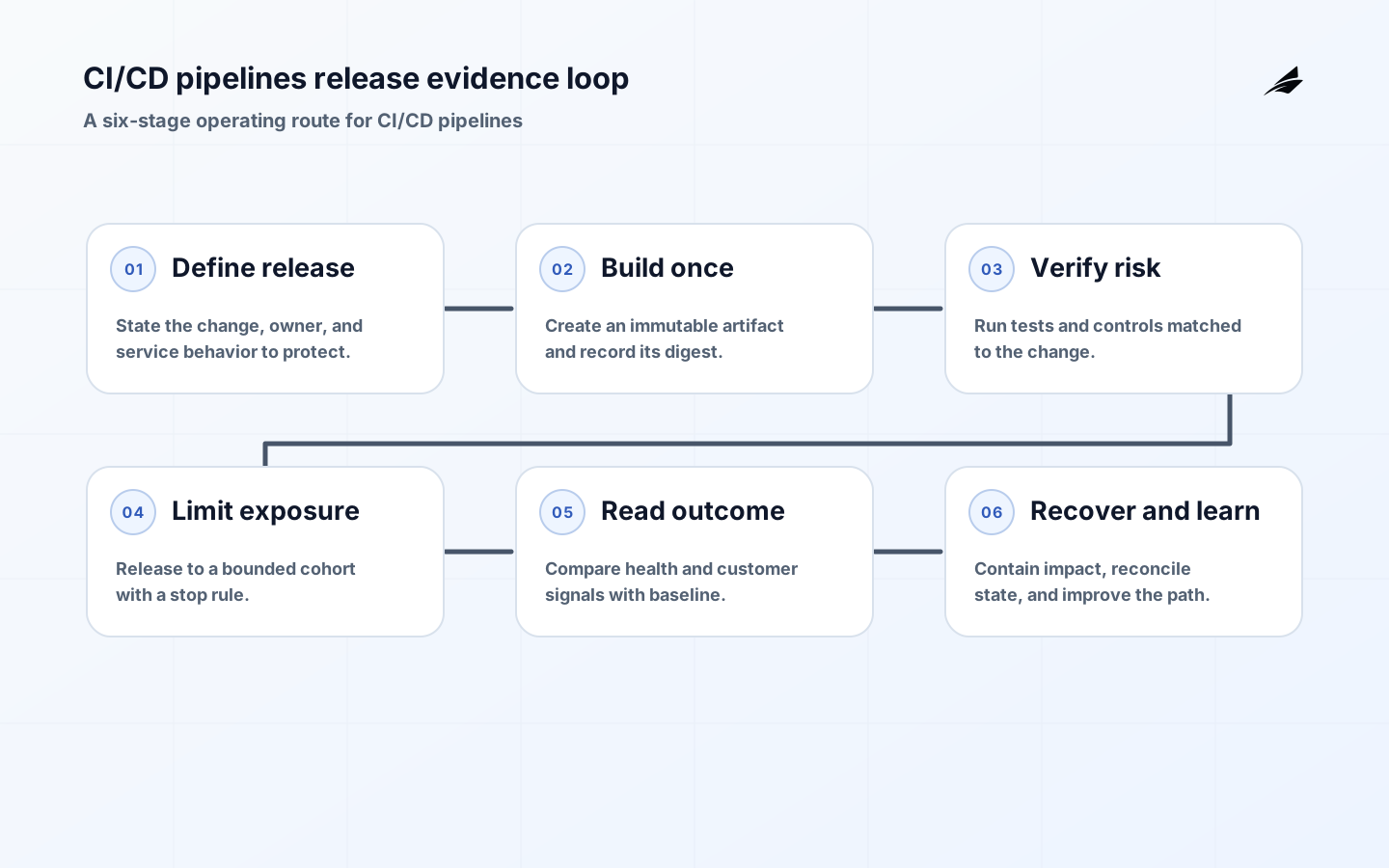
CI/CD pipelines need an operating model, not a loose collection of tools. A pipeline is not merely a chain of jobs. It is the repeatable decision path that turns a reviewed change into observed production behavior. The useful boundary starts with a change record and ends only after the team can identify the artifact, configuration, exposure, and resulting service signals. This guide focuses on the choices that make the work inspectable by the people who build, operate, and support it.
Key takeaways
- Define the boundary and accountable owner before standardizing CI/CD pipelines.
- Keep the records that explain an outcome close to the action that created it.
- Use controls that match the consequence of failure instead of copying generic checklists.
- Test an uncomfortable but realistic failure path while impact is bounded.
- Measure recovery and operating effort alongside speed or throughput.
- Turn repeated exceptions into an owned improvement rather than private knowledge.
What CI/CD pipelines mean in practice
Continuous integration asks teams to integrate and test changes frequently. Continuous delivery keeps a verified candidate deployable; continuous deployment is the policy of releasing it automatically. Those terms matter because the risk controls and approval rules should be chosen for the consequence of a change, not inherited from a slogan. For adjacent operating decisions, compare Kubernetes deployments and distributed tracing.
| Decision area | Question to settle | Useful evidence |
|---|---|---|
| Boundary | What part of CI/CD pipelines is in scope? | Named owner, entry point, and expected outcome. |
| Identity | Which version, record, or state is authoritative? | An inspectable identifier tied to the action. |
| Control | What condition must hold before expansion? | A test, review, or policy result with a decision rule. |
| Recovery | How will the team verify a safe outcome? | A documented action, check, and accountable responder. |
An operating model for CI/CD pipelines
Build an immutable artifact once, record its digest and provenance, then promote that same artifact with environment-specific configuration. Keep deployment credentials short-lived and scoped to the target action. The run should connect the commit, test result, artifact digest, configuration revision, target cohort, and release owner so a responder can reconstruct an outcome without guessing. The design should make the next decision easier for someone who did not create the original implementation.
A practical implementation path
Begin with one service and a change class that has a visible health signal. Define required checks, an exposure cohort, an observation window, and a stop rule before automating promotion. Treat database work separately: make a schema change additive, ship code that tolerates both shapes, migrate deliberately, then remove compatibility only after the old path is gone. Prefer a sequence that creates evidence at every stage rather than a broad first release that makes causality difficult to recover.
Risks and controls to make explicit
A green build can conceal weak controls. Workflow definitions are supply-chain code and need protected review paths; third-party actions and dependencies should be pinned or constrained where practical. Do not use a long-lived administrator token because it is convenient. A denied deployment that produces an understandable record is safer than a successful deployment with unbounded access. Write the exception route down as well: an emergency action may be necessary, but it should leave an attributable record and return to normal control once the immediate condition is resolved.
| Stage | What to check | Decision rule |
|---|---|---|
| Prepare | Scope, identity, access, and prerequisites. | Do not proceed when ownership or required evidence is unclear. |
| Change | The control that addresses the main failure mode. | Pause when a required test, policy, or review fails. |
| Observe | Technical and user-facing consequences. | Expand only when the agreed signals remain inside bounds. |
| Recover | State, data, and follow-up work. | Close only after the relevant verification is recorded. |
Signals that show whether it is working
Track lead time and deployment frequency alongside change failure rate and time to restore. Add local measures: releases with linked test evidence, manual overrides, failed gates, rollback duration, and alert noise during the observation window. The goal is not a single perfect metric; it is an operating record that distinguishes a slow process from a risky one. Review the signals with a real example, because a metric becomes useful only when it changes a decision or confirms that an earlier decision was sound.
A CI/CD pipelines checklist for the next change
Run one controlled recovery exercise before declaring the pipeline standard. Release a compatible change to a small cohort, invoke the stop rule, restore the expected behavior, and verify the records and alerts. The awkward details found in that exercise usually identify missing ownership, hidden configuration, or a rollback assumption that would fail under pressure. The result should be a short, owned change to the routine, not a retrospective statement that the team should have been more careful.
A worked decision example
A profile service adds a normalized address field. The team first adds the column without removing the old representation, deploys dual-read code, and routes internal traffic to the new version. A parsing error raises the agreed error-rate threshold, so exposure stops and the prior application version returns. The data is reconciled with a query; it is not assumed to reverse itself with the application rollback.
How to phase adoption
Phase CI/CD pipelines by change consequence, not by organizational ambition. Begin with a service that has testable health signals and a release owner who can explain the artifact and configuration in use. Let the first path prove immutable promotion, scoped deployment identity, and a bounded rollback. Only after that path can be exercised should teams standardize templates or add automation for higher-risk systems. This order prevents a convenient build tool from becoming an unexamined production control plane.
Decision records and ownership
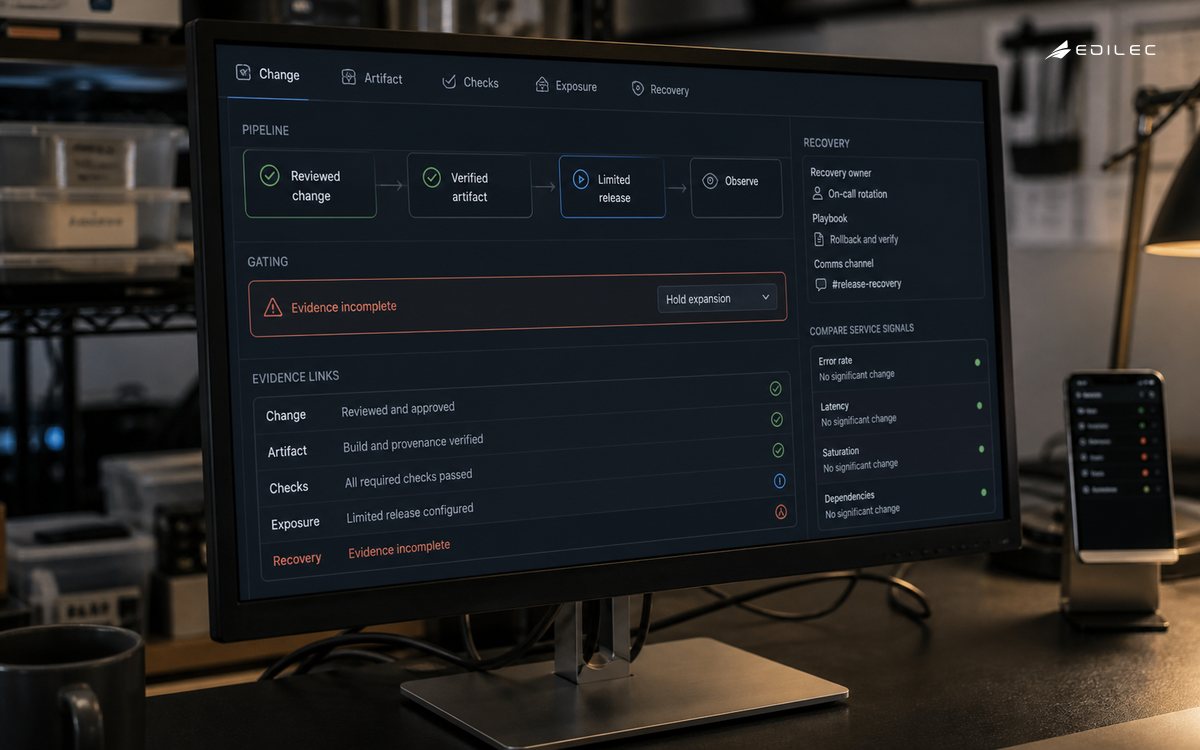
Keep release evidence close to the change. The useful record identifies the commit or approved change request, artifact digest, dependency and configuration revisions, target cohort, checks run, person or workload identity that acted, and recovery decision. It should also state why a gate was bypassed when an exception is legitimate. That small record is operationally valuable because responders can separate the current release from a similarly named earlier release without reconstructing history from several systems.
Design boundaries that matter
Separate pipeline policy from pipeline implementation. A team may use the same CI runner and deployment mechanism for two services while applying different required checks because one service changes a public page and another changes money movement or access control. Write the policy in terms of evidence: required test classes, approvals where justified, artifact provenance, exposure size, observation time, and authority to stop. This makes a later tool migration much less disruptive because the important control is no longer hidden in a vendor-specific workflow file. It also gives reviewers a fair question to ask: does this change carry the evidence appropriate to its consequence, and can the release owner explain why?
Deeper operating considerations
Design for the cases where rollback is not a button. Feature flags may need their own audit trail and expiry; cache invalidations can expose stale or new behavior after code returns; a released event can trigger work in another system. For each such side effect, decide whether the safe response is to stop exposure, issue a compensating action, run a reconciliation query, or continue forward with a corrective release. Put that decision in the release plan before the system is under pressure. A rollback that only restores application code can otherwise create false confidence while durable customer state remains inconsistent.
A useful review cadence
Review one normal release, one stopped rollout, and one manual exception every few weeks. Ask whether the required evidence was available at the decision point, whether alerting distinguished a service issue from a pipeline issue, and whether recovery actually restored customer behavior. Assign a small correction for the weakest finding. This cadence makes controls visible during ordinary work, which is precisely when a team can improve them without the pressure of an active outage.
Frequently asked questions
A pipeline can be continuous delivery even when a person approves a high-consequence release, provided a verified candidate remains ready to deploy and the approval examines real evidence. Rollback is valuable but incomplete for destructive data changes or external side effects. Plan a compensating action and a reconciliation check before release, then keep that evidence next to the deployment record.
Before expanding the practice
Before expanding a release pattern, ask whether the evidence still scales with the number of services and environments. A central dashboard that merely aggregates green checks is not enough; it should let an owner reach the artifact, configuration, exposure, and recovery facts for a particular deployment. Standardize interfaces and records before standardizing every implementation detail. Teams can use different runners or deployment targets if the release contract still identifies what changed, what was verified, who made the decision, and how service behavior was checked. This keeps platform work focused on reducing uncertainty rather than forcing one tool on every team.
A final field test
Field test: ask a responder to identify the running digest, configuration, cohort, and stop authority from one release record. Any answer that depends on memory marks a specific improvement for the next release. Record the result and assign the smallest repair before the following deployment. Keep the evidence available to every responder.
Conclusion
CI/CD pipelines earn trust when they make change identifiable, testable, bounded, and recoverable. Start with one evidence-rich path, exercise recovery, and only then turn the conventions into a shared template.