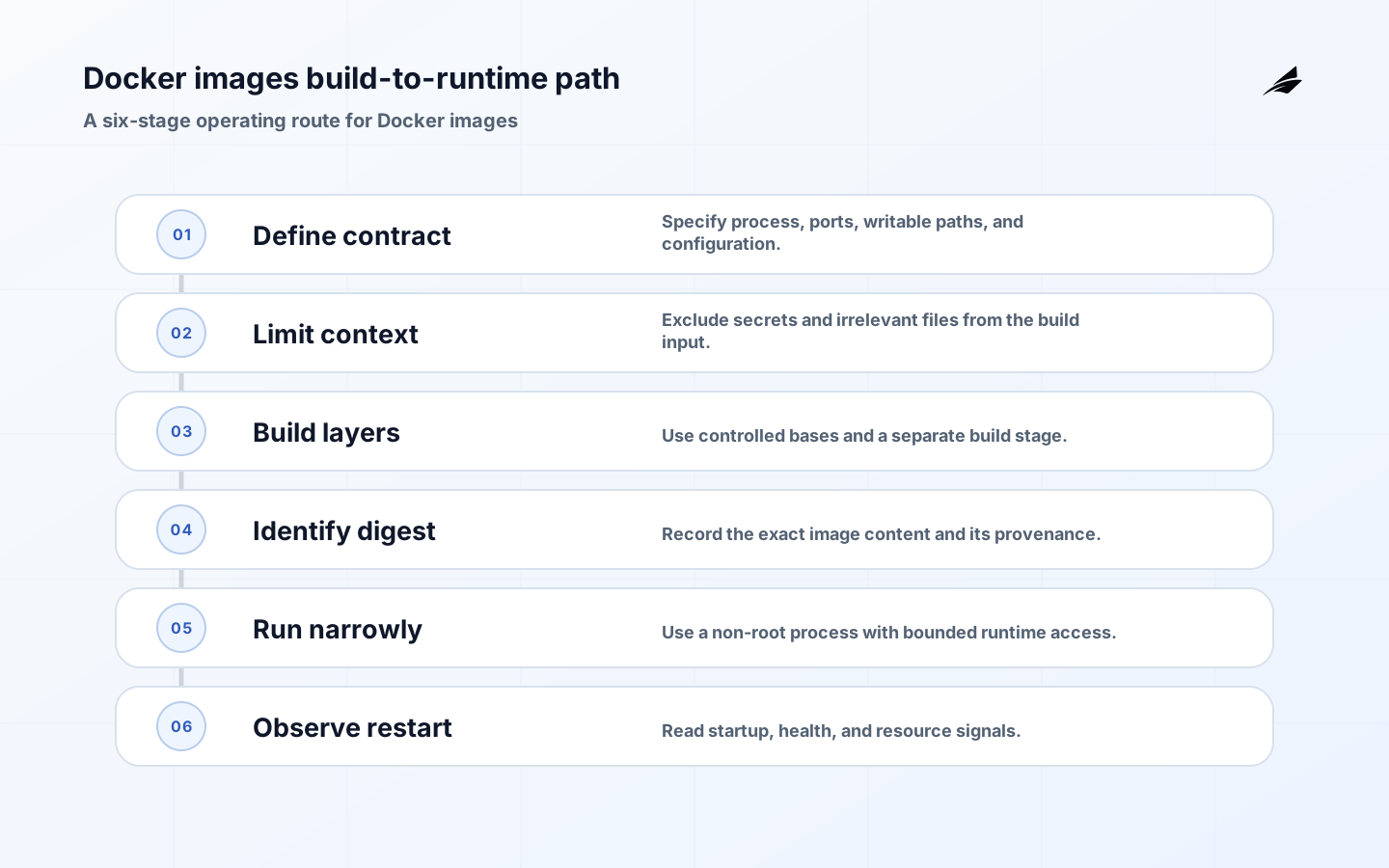
Docker images needs an operating model, not a loose collection of tools. Docker images are packaged filesystem layers and configuration that become runnable containers when a runtime supplies a writable layer and process settings. They are valuable because a known image digest can move through environments, but only when the build context, base image, dependencies, and runtime contract are deliberately controlled. This guide focuses on the choices that make the work inspectable by the people who build, operate, and support it.
Key takeaways
- Define the boundary and accountable owner before standardizing Docker images.
- Keep the records that explain an outcome close to the action that created it.
- Use controls that match the consequence of failure instead of copying generic checklists.
- Test an uncomfortable but realistic failure path while impact is bounded.
- Measure recovery and operating effort alongside speed or throughput.
- Turn repeated exceptions into an owned improvement rather than private knowledge.
What Docker images means in practice
An image tag is a human-friendly pointer, not a permanent identity; tags can be moved. A digest identifies exact content. That distinction matters for incident response and promotion because an operator needs to know what actually ran. Treat the Dockerfile as production build code, with review, tests, and a narrow build context rather than an informal installation recipe. For adjacent operating decisions, compare CI/CD pipelines and container security.
| Decision area | Question to settle | Useful evidence |
|---|---|---|
| Boundary | What part of Docker images is in scope? | Named owner, entry point, and expected outcome. |
| Identity | Which version, record, or state is authoritative? | An inspectable identifier tied to the action. |
| Control | What condition must hold before expansion? | A test, review, or policy result with a decision rule. |
| Recovery | How will the team verify a safe outcome? | A documented action, check, and accountable responder. |
An operating model for Docker images
Use a small, trusted base image, pin it by digest when reproducibility matters, and put stable dependency-install steps before frequently changing application files so layer caching remains useful. Multi-stage builds can keep compilers and package caches out of the final image. Run as a non-root user where the workload allows, declare the expected port and command, and keep mutable state outside the image. The design should make the next decision easier for someone who did not create the original implementation.
A practical implementation path
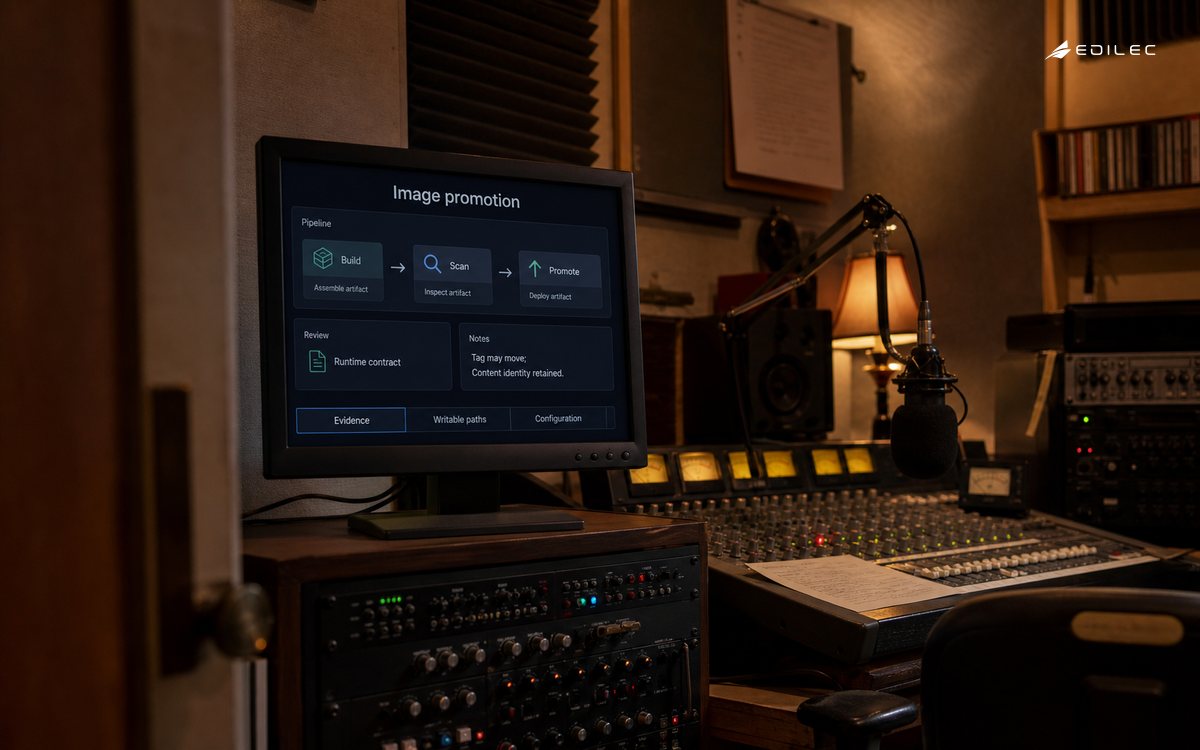
Start by defining a runtime contract: process, port, configuration sources, writable paths, network needs, and health behavior. Add a .dockerignore file so credentials, local caches, and unrelated source files never enter the build context. Build in CI, scan the resulting digest, attach provenance or an SBOM where available, and promote that digest rather than rebuilding for each environment. Prefer a sequence that creates evidence at every stage rather than a broad first release that makes causality difficult to recover.
Risks and controls to make explicit
The common failure is treating the image as self-contained while secrets, privileges, and state leak in through the runtime. Do not bake credentials into layers; deleting a secret in a later layer does not erase it from prior history. A root process, broad Linux capabilities, or an image that writes application data into its own filesystem makes containment and recovery harder than it needs to be. Write the exception route down as well: an emergency action may be necessary, but it should leave an attributable record and return to normal control once the immediate condition is resolved.
| Stage | What to check | Decision rule |
|---|---|---|
| Prepare | Scope, identity, access, and prerequisites. | Do not proceed when ownership or required evidence is unclear. |
| Change | The control that addresses the main failure mode. | Pause when a required test, policy, or review fails. |
| Observe | Technical and user-facing consequences. | Expand only when the agreed signals remain inside bounds. |
| Recover | State, data, and follow-up work. | Close only after the relevant verification is recorded. |
Signals that show whether it is working
Measure image size, build duration, cache effectiveness, vulnerability findings by severity and age, number of unpinned bases, and deployments that cannot be tied to a digest. Pair those technical signals with startup failures, restart loops, and resource requests at runtime. An image that is smaller but cannot emit useful logs or pass a health check has not improved the service. Review the signals with a real example, because a metric becomes useful only when it changes a decision or confirms that an earlier decision was sound.
A Docker images checklist for the next change
Choose one service and compare its current image with a deliberately minimal build. Remove build tools from the runtime stage, deny a write to an unexpected path, and verify the service fails clearly instead of silently recreating state. The exercise reveals whether the container contract is explicit enough for another team to operate. The result should be a short, owned change to the routine, not a retrospective statement that the team should have been more careful.
A worked decision example
A Node service originally copies the whole repository, installs development dependencies, and runs as root. Its revision copies dependency manifests first, uses a build stage for compilation, copies only the runtime output into a pinned base, and runs under an unprivileged user. A CI job records the digest and scans it; deployment uses that digest with configuration supplied by the platform rather than the Dockerfile.
How to phase adoption
Adopt Docker images through one service whose build and runtime contract is already understood. Record the current base image, package sources, build context size, runtime user, writable paths, and startup command before changing anything. Then make one improvement at a time: remove build tools from the runtime stage, add a non-root user, pin the deployment digest, or move a setting out of the image. A measured sequence produces evidence that a security improvement did not silently break the service contract.
Decision records and ownership
The image record should connect source revision, Dockerfile, base-image digest, dependency resolution, scanner result, SBOM or provenance when available, and the deployed digest. This is useful during a vulnerability response because a team can determine whether a finding affects a running artifact instead of searching by an ambiguous tag. It also makes an exemption review concrete: an accepted risk should identify the exact image and expiry rather than applying indefinitely to a repository name.
Design boundaries that matter
Image architecture benefits from a clear distinction between build-time and run-time responsibility. The build stage may need compilers, test tools, and private dependency access; the final stage should contain only what the service needs to execute. Configuration that changes across environments belongs in the runtime platform, not in a family of nearly identical images. This boundary keeps a production image reproducible and reduces the risk that a developer workstation setting, test credential, or unnecessary package becomes an accidental deployment dependency. It also makes a build review concrete: reviewers can inspect the final stage rather than infer its contents from a long installation script.
Deeper operating considerations
Treat a vulnerability finding as a triage question, not a reflex to rebuild everything. Identify the deployed digest, affected package and path, exploitability in the running configuration, available fixed base or dependency, and the owner of the remediation. Then choose a dated action: rebuild and test, mitigate the runtime path, accept a documented temporary exception, or remove an unused component. Keep the scanner result with the image record so an old alert cannot be confused with a newly published artifact. This is how image security supports reliable delivery instead of becoming an unprioritized queue of findings.
A useful review cadence
Review image practice around real failures: a base-image advisory, a startup loop, an unexpected filesystem write, and a build that exposes a secret in its context. Check whether the team can identify the deployed digest, reproduce the build, and explain the runtime privilege. Remove controls that only generate noise, but do not remove the evidence needed to answer those questions. The result should be a smaller, clearer release unit rather than a longer list of security gates.
Frequently asked questions
Docker images are not virtual machines. They package an application and its required filesystem content while sharing the host kernel through the container runtime. A small image is helpful but not automatically secure; provenance, dependency maintenance, runtime permissions, and a clear configuration boundary still matter. Use a digest for deployment identity, while retaining readable tags for navigation.
Before expanding the practice
Before promoting a hardened image pattern, check the developer experience as well as the final scanner result. A build that is difficult to reproduce locally or in CI encourages people to bypass the approved path during an urgent fix. Provide a documented build command, expected inputs, clear failures for missing credentials, and a way to inspect the final image contents. Keep the production image separate from a convenience-rich development environment rather than pretending one artifact can optimize both without trade-offs. That discipline helps teams diagnose a package or base-image change quickly while preserving the narrow runtime contract that makes deployment safer.
A final field test
Field test: rebuild the image from its declared inputs, inspect the final process and filesystem, then deploy the recorded digest to a test target. The difference between expected and actual contents is a build-contract defect.
Conclusion
Docker images become reliable delivery units when their contents are reproducible and their runtime assumptions are visible. Build narrowly, deploy by digest, and test the boundaries that would matter during a restart or incident.